Updated Mar 21, 2026 by Don't Nod
Report
Published by Don't Nod
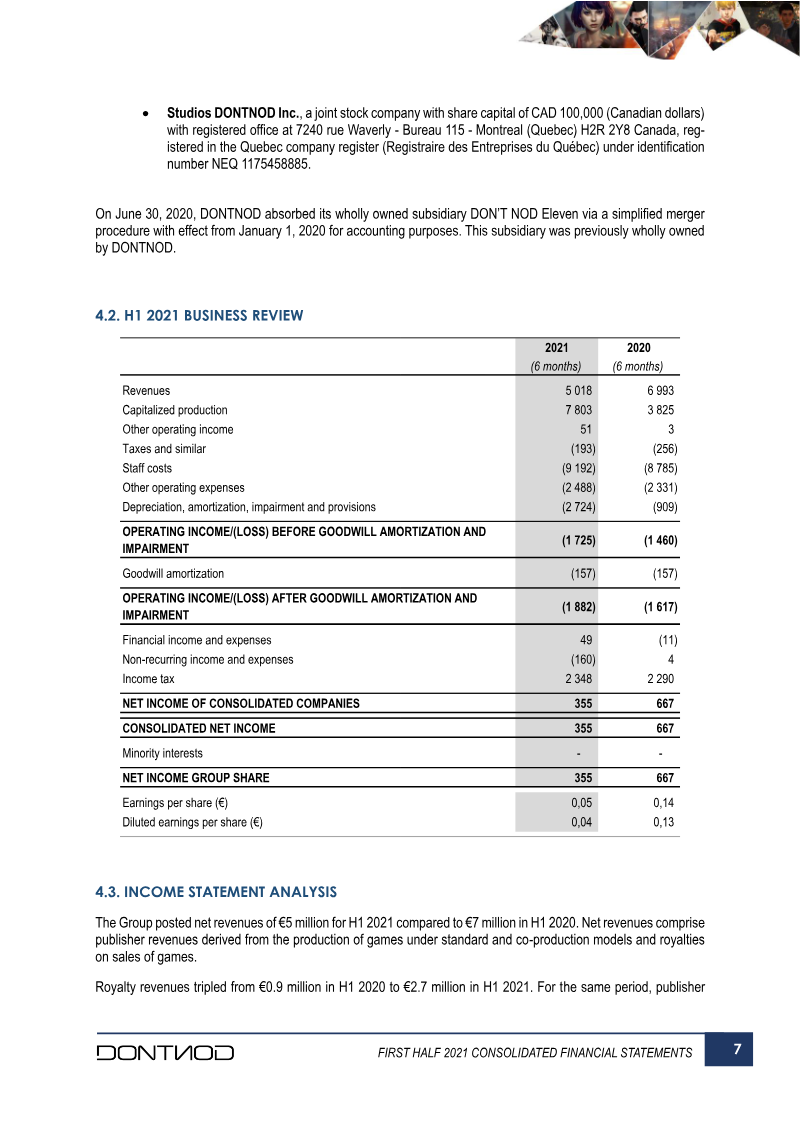
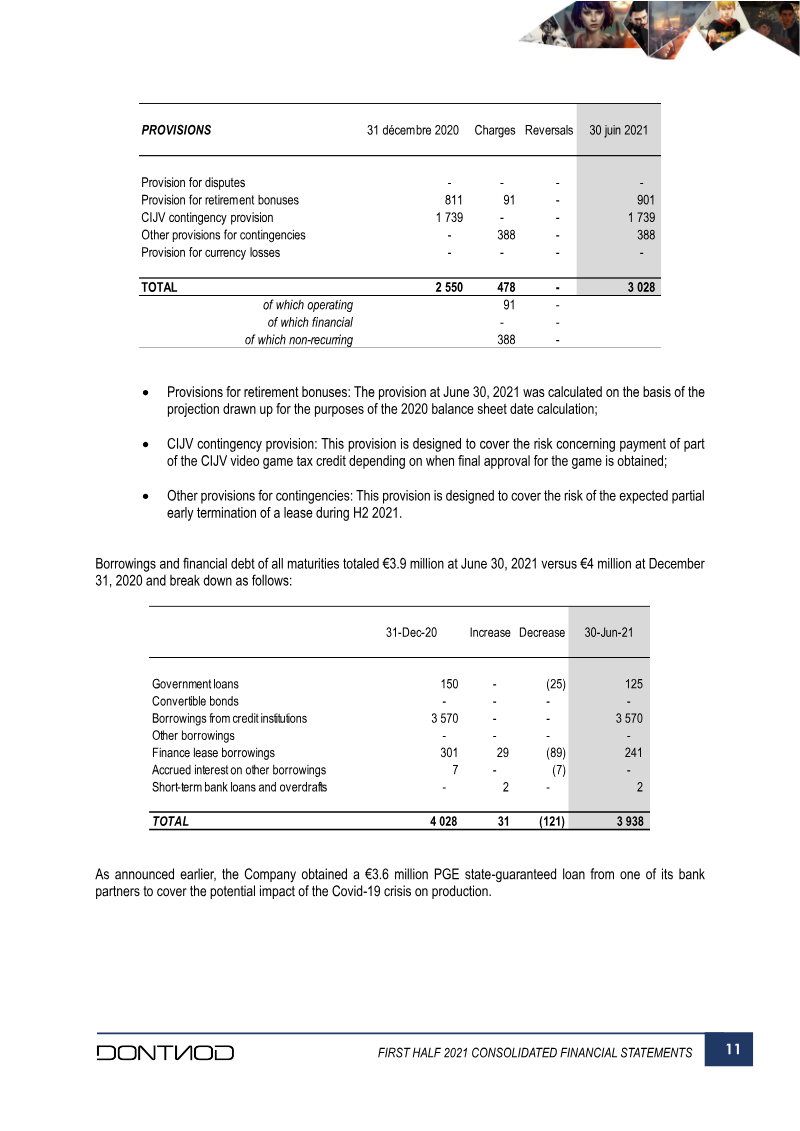
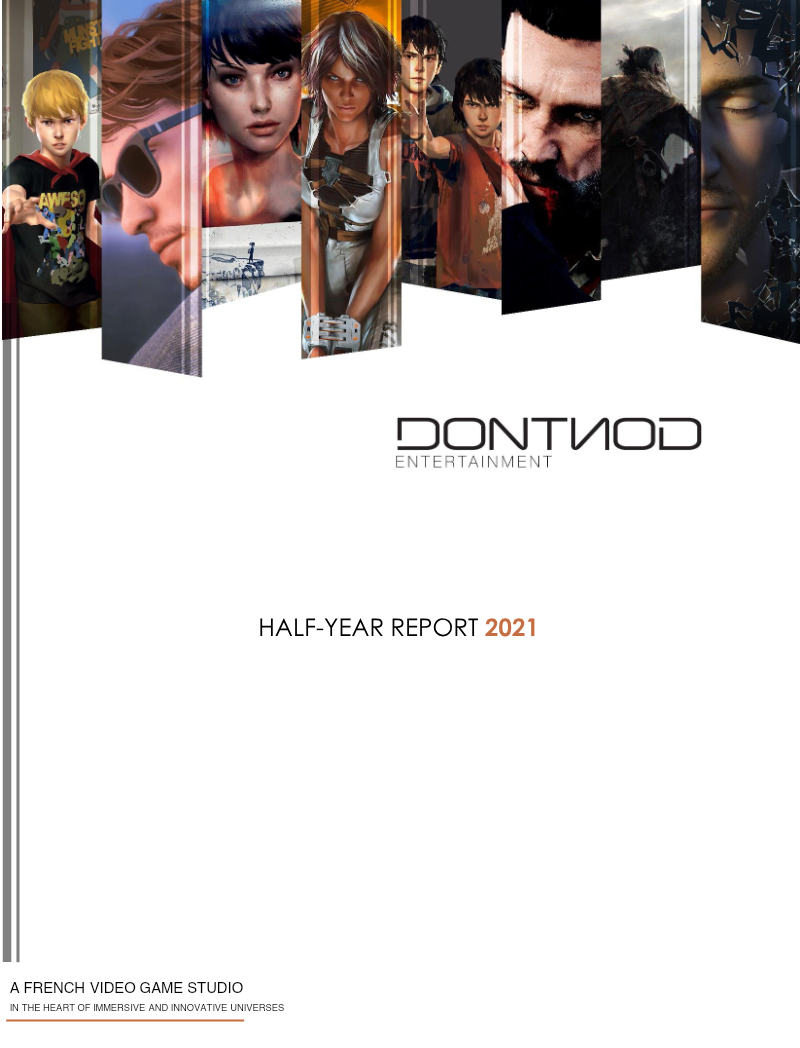
Public limited company (Société Anonyme) with share capital of €168,018.74 Registered office: Parc du Pont de Flandre “Le Beauvaisis” 11 rue de Cambrai, 75019 Paris Paris Trade and Companies Register no. 504 161 902 MANAGEMENT REPORT ON THE CONSOLIDATED FINANCIAL STATEMENTS FOR THE SIX MONTHS ENDED JUNE 30, 2021 1.<sub>FIRST </sub>HALF 2021 HIGHLIGHTS In view of the exceptional circumstances surrounding the coronavirus (Covid-19) health crisis and the ensuing government recommendations, DONTNOD ...
DOTVIOU DON’T NOD ENTERTAINMENT Public limited company (Société Anonyme) with share capital of €168,018.74 Registered office: Parc du Pont de Flandre “Le Beauvaisis” 11 rue de Cambrai, 75019 Paris Paris Trade and Companies Register no. 504 161 902 (the “Company”) MANAGEMENT REPORT ON THE CONSOLIDATED FINANCIAL STATEMENTS FOR THE SIX MONTHS ENDED JUNE 30, 2021
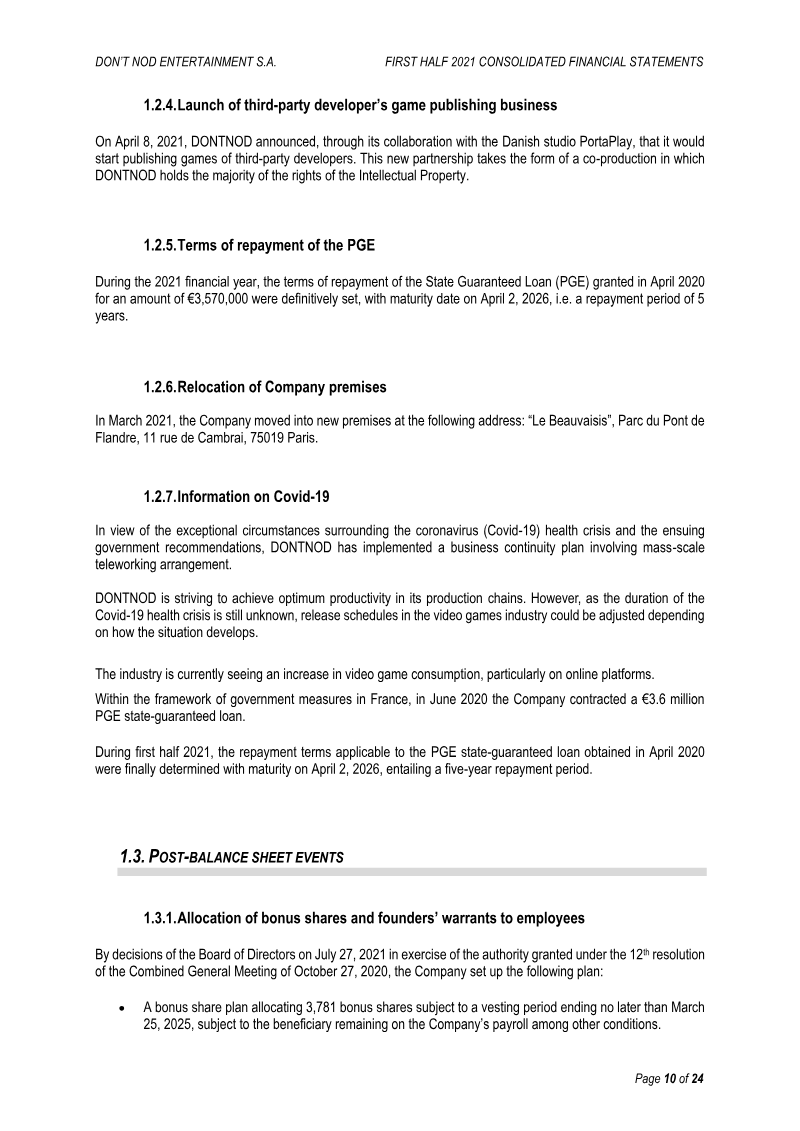
1.<sub>FIRST </sub>HALF 2021 HIGHLIGHTS • Covid-19 update In view of the exceptional circumstances surrounding the coronavirus (Covid-19) health crisis and the ensuing government recommendations, DONTNOD has implemented a business continuity plan involving mass-scale teleworking arrangement. DONTNOD is striving to achieve optimum productivity in its production chains. However, as the duration of the Covid-19 health crisis is still unknown, release schedules in the video games industry could be adjusted depending on how the situation develops. Within the framework of government measures in France, in June 2020 the Company contracted a €3.6 million PGE state-guaranteed loan (“Prêt Garanti par l’Etat”). • Capital increase and business cooperation agreement with TENCENT On January 28, 2021, DONTNOD announced the success of its capital increase without shareholder preferential subscription rights (announced on January 27, 2021) through an accelerated bookbuilding process in favor of certain categories of beneficiaries, for a total of €50 million (the “Private Placement”). The Private Placement was significantly oversubscribed, which allowed the Company to increase the Offering amount from €40 million to €50 million. The subscription price for the new shares was set at €16 per share, representing a discount of 0.9% on the last closing price.
he “Private Placement”). The Private Placement was significantly oversubscribed, which allowed the Company to increase the Offering amount from €40 million to €50 million. The subscription price for the new shares was set at €16 per share, representing a discount of 0.9% on the last closing price. TENCENT Holdings Limited (“TENCENT”), a leading global online service provider and video game publisher, subscribed shares in an amount of €30 million, thereby strengthening DONTNOD’s shareholding structure. This partnership allows DONTNOD to bolster its positioning while stepping up its development plan focused on the selfpublishing model, besides expanding its catalog to include mobile platforms and Asian markets. Principal terms of the Offering: The capital increase was carried out without preferential subscription rights in order to target qualified French and international investors through an accelerated bookbuilding process (the “Private Placement”). A total of 3,125,000 new ordinary shares (the “New Shares”) with a par value of €0.02 each were issued to qualified investors within the meaning of Article 2(e) of EU Regulation 2017/1129 of June 14, 2017 in accordance with the 7<sup>th</sup> resolution adopted by the Company’s Combined General Meeting of October 27, 2020, thereby increasing the share capital to €165,726.86. The New Shares, representing 37.7% of the Company’s share capital before the completion of the Private Placement, were issued following the decisions of the Chairman of the Board of Directors pursuant to and within the limits of the delegation of powers conferred by the Company’s General Meeting and the Board of Directors on January 27, 2021.
any’s share capital before the completion of the Private Placement, were issued following the decisions of the Chairman of the Board of Directors pursuant to and within the limits of the delegation of powers conferred by the Company’s General Meeting and the Board of Directors on January 27, 2021. The issue price of the new shares was set at €16 per share, representing a 0.9% discount on the DONTNOD share closing price on January 27, i.e. €16.15, and a 0.3% premium over the volume weighted average DONTNOD share price on the Euronext Growth Paris market for the last three trading sessions prior to the establishment of the issue FIRST HALF 2021 CONSOLIDATED FINANCIAL STATEMENTS 2
price (i.e. January 25, 26 and 27 inclusive), i.e. €15.95, in accordance with the 7<sup>th</sup> resolution adopted by the Company’s Combined General Meeting of October 27, 2020. Settlement and delivery of the New Shares and their admission to trading on Euronext Growth Paris took place on February 1, 2021. The New Shares are subject to all statutory provisions and are fungible with existing shares upon final completion of the Capital Increase. They bear current dividend rights and are admitted to trading on the Euronext Growth Paris market on the same listing line as existing listed Company shares, under the same code ISIN: FR0013331212 - ALDNE. • Founders’ warrant (BSPCE) and bonus share (AGA) plans By decisions of the Board of Directors on February 4, 2021 in exercise of the authority granted under the 12<sup>th</sup> and 13<sup>th</sup> resolutions of the Combined General Meeting of October 27, 2020, the Company set up four plans: - A founders’ warrant allocation plan (BSPCE2021)<sup>1</sup> exercisable at the price of €18 between March 25, 2023 and March 25, 2025 resulting in the issuance of a maximum 28,055 new shares, subject to the beneficiary remaining on the Company’s payroll among other conditions; - A bonus share plan allocating 47,499 bonus shares<sup>1</sup> (AGA2021-1) subject to a vesting period ending no later than March 25, 2025, subject to the beneficiary remaining on the Company’s payroll among other conditions; - A founders’ warrant allocation plan (B
payroll among other conditions; - A bonus share plan allocating 47,499 bonus shares<sup>1</sup> (AGA2021-1) subject to a vesting period ending no later than March 25, 2025, subject to the beneficiary remaining on the Company’s payroll among other conditions; - A founders’ warrant allocation plan (BSPCE2021)<sup>2</sup> exercisable at the price of €18 as from January 25, 2024 resulting in the issuance of a maximum 208,250 new shares, subject to the beneficiary remaining on the Company’s payroll and the achievement of specific Company share price targets; - A bonus share plan allocating 131,750 bonus shares<sup>2</sup> (AGA2021-2) subject to a vesting period ending on January 15, 2024, subject to the beneficiary remaining on the Company’s payroll and the achievement of specific Company share price targets. In order to be allocated all the shares provided for under the last two plans listed, the target share price is set at €40 (this figure should not be considered as a share price target expressed by the Company). In total, if all new shares allocated under these four plans were issued, 415,554 new ordinary shares with a par value of €0.02 each would be issued representing 5% of the Company’s current share capital. • Capital increase by issuance of new shares under the 2019 bonus share plan By decision of the Board of Directors on March 26, 2021 in exercise of the authority granted under the 26<sup>th</sup> resolution of the Combined General Meeting of March 30, 2018, the Company recorded the issuance of the first tranche of the bonus share plan following the expiry of the vesting period running until March 25, 2021.
The game development industry is currently navigating a period of profound structural instability, characterized by widespread workforce reductions and a pervasive sense of professional anxiety. Despite the rapid integration of artificial intelligence, the primary driver of current career displacement remains studio restructuring rather than technological replacement. While the majority of the workforce remains employed in hybrid or remote roles, a significant portion of professionals are actively reassessing their career trajectories. This climate of cautious realism is reflected in market sentiment, where nearly 40 percent of industry participants anticipate further decline, leading to increased emotional fatigue and a shift in priorities toward time-based benefits, such as the four-day workweek, over traditional office perks. Geographically, the industry maintains a clear hierarchy in compensation, with North America consistently commanding the highest salary tiers across all seniority levels. In contrast, Central and Eastern Europe continue to function as the most cost-effective hubs for talent acquisition. This regional disparity underscores a broader trend of geographic diversification, as studios balance the need for specialized expertise with the economic realities of global operations. Although the workforce remains mobile, the prevalence of remote work has effectively anchored many professionals, creating a distinct divide where on-site employees demonstrate a significantly higher propensity for international relocation compared to their remote counterparts. The current landscape is defined by a maturing workforce dominated by mid-to-senior level professionals, accompanied by a concerning decline in new entrants. This demographic shift, coupled with the ongoing volatility in employment, has necessitated more flexible recruitment strategies. Studios are increasingly moving away from traditional hiring models, favoring diverse solutions that range from subscription-based flat-fee packages to comprehensive recruitment process outsourcing. As the industry continues to evolve, these data-driven benchmarks serve as a critical framework for both studios and professionals attempting to navigate the complexities of global compensation and shifting labor market dynamics.
I’m ready to combine the section summaries into a cohesive overview, but I’ll need the remaining sections to capture the full scope, key data points, and conclusions of the 2024 Catalan video‑game industry analysis. Could you please provide the rest of the section summaries?
The financial results for the first quarter of 2025 detail the operational and fiscal performance of PCF Group S.A., a global video game developer. The data reflects a period of strategic transition, characterized by rising quarterly revenues alongside shifting profitability margins. Total revenue for the first quarter of 2025 reached 63.0 million PLN, an increase from 56.9 million PLN in the same period of the previous year. Despite this growth, the group reported a net loss of 3.9 million PLN for the quarter, compared to a narrow loss of 0.9 million PLN in the first quarter of 2024. Adjusted EBITDA also saw a decline from 11.0 million PLN to 1.7 million PLN year-over-year. The financial performance was influenced by several key operational factors, including the integration of PCF Chicago into PCF US and the inclusion of new projects such as Project Delta and Project Echo. Conversely, profitability was impacted by lower revenues from Project Gemini and the recognition of costs related to Project Bifrost within the cost of goods sold. The group’s workforce remained stable at 675 employees as of March 31, 2025, with a significant concentration of developers in Warsaw and North American studios. In the virtual reality segment, the subsidiary Incuvo continues to manage Green Hell VR, which saw a successful co-op mode launch in late 2024. The group plans to release Project Bison in the fourth quarter of 2025, which is intended to be the final VR title published by PCF Group. Geographically, the group maintains a strong presence across Europe and North America, with its primary development hubs located in Poland and Canada. The methodology relies on consolidated financial data and internal project tracking as of the end of the first quarter of 2025.
The Flemish game industry stands at a critical juncture, requiring a strategic pivot from project-based support toward comprehensive business scaling and economic consolidation. While the sector has seen a rise in the number of studios between 2020 and 2024, growth remains heavily concentrated among a few major players, creating a fragile ecosystem characterized by a lack of mid-sized companies. To ensure long-term viability and competitiveness within the global market—which is currently valued at approximately 187.7 billion dollars—Flemish policy must evolve to address the "missing middle" by facilitating access to private capital and fostering entrepreneurial maturity. Current support mechanisms, including the VAF/Gamefonds and the Tax Shelter, have been instrumental in initial development but are increasingly viewed as insufficient for the demands of international scaling. Global competition, driven by aggressive fiscal incentives in regions like Canada and France, necessitates a more robust and integrated financial instrumentarium. Stakeholders emphasize that while talent development remains a strength, the sector suffers from a lack of commercial focus, high production costs, and difficulties in retaining intellectual property. Consequently, there is a clear mandate to shift policy priorities toward attracting foreign investment, enhancing international promotion, and streamlining governance through a centralized strategic body. Ultimately, the objective for the 2026–2030 period is to transition the Flemish games sector into a more stable, economically diverse industry. This requires a dual approach: optimizing existing public funding to better support commercial growth and implementing new, flexible economic tools that bridge the gap between early-stage prototyping and market-ready maturity. By aligning educational outputs with industry needs, fostering cross-sectoral collaboration, and prioritizing business development over isolated project subsidies, the region can mitigate the risks of brain drain and build a resilient, internationally recognized gaming hub.