Esports

66 documents·34 publishers

Documents

Page 1
Report30 pages

Games, Esports, Live Streaming, Cloud and the Metaverse: 2022 Trends to Watch

The global gaming industry is currently undergoing a structural transformation characterized by the integration of emerging technologies and a pivot toward cross-platform accessibility. Central to this evolution is the expansion of cloud gaming, which serves as a critical bridge to overcome hardware constraints, allowing publishers to reach broader audiences on mobile devices and legacy consoles. Simultaneously, the metaverse is maturing into a robust commercial ecosystem, fueled by significant venture capital investment, the proliferation of virtual real estate, and the integration of digital fashion. These developments signal a broader industry shift toward enhanced creator-viewer interactivity and the adoption of Web3.0 business models.

Monetization strategies are diversifying as companies experiment with blockchain-based player trading and fan engagement tools, despite notable consumer resistance toward non-fungible tokens. This period is also defined by a surge in high-quality cross-media intellectual property adaptations and a crowded release calendar, which intensifies competition for consumer attention. Furthermore, regulatory and consumer pressures are forcing a transition toward more open app store ecosystems, challenging traditional distribution gatekeepers.

Within the esports sector, organizations are actively diversifying revenue streams by prioritizing mobile-first titles and leveraging co-streaming to maximize viewership reach. These trends, observed throughout 2022, reflect a strategic effort to sustain growth across global markets. By synthesizing market intelligence and tracking key performance metrics, the industry continues to navigate the complexities of digital transformation, balancing the pursuit of innovative monetization with the necessity of maintaining user trust in an increasingly interconnected virtual landscape.

  • Cloud gaming is driving industry growth by bypassing hardware limitations, enabling publishers to deliver high-end experiences to mobile devices and legacy consoles.
  • The metaverse is evolving into a commercial ecosystem supported by significant venture capital, virtual real estate markets, and digital fashion integration.
  • Monetization models are shifting toward Web3.0 and blockchain-based player trading, despite ongoing consumer resistance to non-fungible tokens.
  • Regulatory and consumer pressure is forcing a transition away from traditional app store gatekeepers toward more open distribution ecosystems.
  • Esports organizations are prioritizing mobile-first titles and utilizing co-streaming strategies to diversify revenue and expand global viewership.
+5
NewzooJan 2022
Page 1
Report30 pages

Games, Esports, Live Streaming, Cloud and the Metaverse: 2022

The global gaming industry is undergoing a fundamental transformation characterized by the convergence of traditional media, high-fidelity content, and emerging Web3 technologies. The primary thesis posits that the sector is shifting toward an interconnected, cross-platform ecosystem where revenue diversification and creator-driven engagement models are essential for growth. While consumer skepticism persists regarding blockchain-based assets and NFTs, publishers are successfully navigating this transition by prioritizing mobile esports, co-streaming strategies, and efforts to circumvent restrictive app store ecosystems to foster deeper fan loyalty.

Technological infrastructure is evolving to support this expansion, with cloud-based solutions and Platform-as-a-Service models playing a critical role in mitigating hardware limitations. By integrating gaming experiences into smart TVs and leveraging cloud technology, companies are effectively broadening their reach to new demographics. Simultaneously, the metaverse has emerged as a significant focal point for venture capital and brand investment, as corporations increasingly utilize digital fashion and virtual real estate to capture the attention of younger, digitally native audiences.

Geographically, the market remains dominated by the Asia-Pacific region, which generates $88.2 billion in annual revenue, representing over half of the global total. North America follows with $42.6 billion, maintaining a strong position in the industry landscape. However, the long-term trajectory of the market is increasingly influenced by emerging territories in Latin America, the Middle East, and Africa. These regions are currently expanding at rates exceeding the global average, signaling a gradual decentralization of revenue and a more diverse, globalized future for the interactive entertainment sector.

  • The Asia-Pacific region dominates the global gaming market with $88.2 billion in annual revenue, accounting for more than 50% of the total global share.
  • North America remains a primary industry pillar, generating $42.6 billion in annual revenue.
  • Emerging markets in Latin America, the Middle East, and Africa are currently experiencing growth rates that exceed the global average, signaling a shift toward market decentralization.
  • Publishers are prioritizing mobile esports, co-streaming, and direct-to-consumer strategies to bypass restrictive app store ecosystems and increase fan loyalty.
  • Cloud-based infrastructure and Platform-as-a-Service models are being used to overcome hardware limitations and expand reach through smart TV integration.
+5
NewzooJan 2022
Page 1
Report23 pages

Stream Hatchet Video Game Streaming Trends Report 2022 First Quarter Report

The report examines live video‑game streaming activity in Q1 2022, focusing on audience growth, platform market share, and creator performance across Twitch, YouTube Gaming, Facebook Gaming, and emerging competitors such as Trovo, AfreecaTV, and Naver TV. Total hours watched across all platforms rose 140 % from Q1 2019, yet the growth rate slowed to a 6 % decline versus Q1 2021, reflecting creator fatigue and pandemic‑induced saturation. Twitch maintained dominance with 75 % of total hours, adding 286 million hours (5 % growth), while Trovo and AfreecaTV experienced double‑digit gains of 188 % and 15 %, respectively. Esports viewership remained resilient, increasing by 61 % from pre‑pandemic levels and contributing 80 % of esports hours on Twitch.

Creator analytics reveal that xQcOW led all platforms with 62.8 million hours, while Spanish‑speaking channels dominated the top 30 % of viewership. Female creators such as Ironmouse and Valkyrae achieved significant growth, largely driven by VTuber content. Core viewers—those watching 5 hours daily—constitute only 7.8 % of the audience but generate two‑thirds of total hours and are 24 times more likely to engage with repeated advertising. Mobile game streaming remains largely casual, yet core audiences drive 78 % of mobile stream hours.

Methodologically, the study aggregates live and VOD metrics from third‑party APIs across 14 platforms, applying manual labeling and automated filtering to produce hourly, concurrent, and retention statistics. The findings underscore a maturing streaming ecosystem where platform diversification, creator niche specialization, and core audience targeting are pivotal for marketers and publishers.

  • Twitch remains the dominant streaming platform with 75% of total market share, growing by 5% (286 million hours) in Q1 2022 despite a broader industry decline.
  • Total hours watched across all streaming platforms fell by 6% compared to Q1 2021, signaling a market correction following pandemic-era saturation and creator fatigue.
  • Core viewers who watch at least 5 hours daily represent only 7.8% of the total audience but account for two-thirds of all hours watched and are 24 times more likely to engage with ads.
  • Esports viewership remains a high-performing sector, showing a 61% increase over pre-pandemic levels with 80% of all esports hours occurring on Twitch.
  • Emerging platforms are gaining traction, with Trovo and AfreecaTV recording significant viewership growth of 188% and 15% respectively in Q1 2022.
+1
Stream HatchetJan 2022
Page 1
Report2 pages

Global Esports and Live Streaming Market Report

The report outlines the global esports and live‑streaming landscape for 2022, emphasizing key tournaments, viewership metrics, and emerging strategic shifts by major publishers. Counter‑Strike: Global Offensive dominated with the PGL Major Antwerp drawing 10.5 million hours watched and an average concurrent unique viewer (ACU) of 96.7 k, followed by Dota 2 and League of Legends events that collectively attracted over 20 million hours. Valorant’s regional tours and the upcoming Champions Tour in Japan added nearly 3 million hours, while Wild Rift’s global championship moved to Singapore with a $2 million prize pool and 24 teams. PUBG Mobile’s Nations Cup returned to Bangkok with a $500 k prize pool, and the IEM Rio Major was re‑announced after pandemic cancellations, selling out tickets in Brazil’s Jeunesse Arena.

The analysis highlights a shift toward franchising models that reduce entry barriers, notably Riot’s new Valorant structure that foregoes franchise fees in favor of long‑term partnerships and financial stipends, contrasting with the high costs seen in League of Legends. Third‑party organizers are encouraged to host off‑season events, expanding grassroots participation and diversifying content. The report also notes the growing importance of women’s tournaments, such as Riot’s Game Changers initiative, to broaden audience engagement.

Data were sourced from Newzoo’s platform aggregating Twitch, YouTube, and Facebook Gaming streams, covering global viewership across 2022. The scope spans North America, Europe, Asia-Pacific, and Latin America, focusing on major esports titles and live‑streaming platforms. The methodology involved compiling broadcast hours, ACU figures, and prize pool totals to assess market size, growth drivers, and investment trends within the esports ecosystem.

  • Counter-Strike: Global Offensive led 2022 viewership with the PGL Major Antwerp recording 10.5 million hours watched and an average concurrent viewership of 96.7k.
  • Riot Games is shifting its Valorant esports strategy from high-cost franchising to a partnership model that eliminates franchise fees in favor of financial stipends.
  • Major esports titles including Dota 2 and League of Legends events generated over 20 million hours of combined viewership in 2022.
  • Wild Rift’s global championship in Singapore featured a $2 million prize pool across 24 teams, while the PUBG Mobile Nations Cup in Bangkok offered a $500k prize pool.
  • Valorant’s regional tours and the upcoming Champions Tour in Japan contributed nearly 3 million hours of viewership to the global landscape.
+1
NewzooJan 2022
Page 1
Report30 pages

Newzoo’s Games, Esports, Live Streaming, Cloud and the Metaverse

The analysis examines how emerging technologies and shifting consumer behaviors are reshaping the global gaming ecosystem. Blockchain‑based monetisation, particularly non‑fungible tokens (NFTs), has met with mixed reception. While the promise of secure, legitimised trading is evident in titles such as Axie Infinity, major publishers have reacted cautiously. Valve’s ban of crypto games on Steam and Ubisoft’s withdrawal from NFT initiatives after player backlash illustrate a broader industry reluctance, compounded by regulatory constraints in jurisdictions like South Korea and platform‑level anti‑steering rules from Apple and Google. Consequently, publishers are exploring “NFT‑like” features under less controversial branding to satisfy investor appetite while mitigating gamer discontent.

Live‑streaming and cloud gaming are emerging as pivotal drivers of player engagement. Interactive shows such as Facebook’s Rival Peak and PAC‑MAN Community have amassed over 100 million minutes of viewership in three months, opening new monetisation avenues. The semiconductor shortage is accelerating the migration of high‑end titles—Elden Ring, Starfield—to cloud platforms. Services like NVIDIA GeForce NOW and Google Stadia have already recorded user growth, while publishers leverage cloud to deliver AAA content on legacy hardware (e.g., Nintendo Switch) and broaden access through subscription bundles such as Game Pass Ultimate. This trend signals a shift toward broader platform reach and subscription retention.

Geographically, the Asia‑Pacific region dominates global game revenues at $42.6 billion, driven by China’s mobile‑first market and an 8.7% compound annual growth rate (CAGR). North America matches this revenue figure at $42.6 billion, with a 7.9% CAGR. Latin America, the Middle East, and Africa are projected to grow faster than the global average, increasing their share of worldwide revenues. COVID‑19’s impact on Asia‑Pacific was muted, partly due to a strong console gaming emphasis that helped sustain growth. The findings collectively underscore the importance of balancing innovative monetisation models, expanding platform accessibility, and regional market dynamics in shaping the future of gaming.

  • The Asia-Pacific and North American markets are currently tied for the global lead in game revenue at $42.6 billion each, with Asia-Pacific maintaining an 8.7% compound annual growth rate.
  • Cloud gaming is expanding rapidly as publishers use services like NVIDIA GeForce NOW to deliver AAA titles to legacy hardware, driven by semiconductor shortages and the need for broader platform reach.
  • Major publishers are pivoting away from explicit NFT branding due to significant player backlash and platform-level restrictions from companies like Valve, Apple, and Google, opting instead for less controversial 'NFT-like' monetization features.
  • Interactive live-streaming content is proving to be a high-engagement driver, with titles like Rival Peak and PAC-MAN Community generating over 100 million minutes of viewership in a three-month period.
  • Emerging markets in Latin America, the Middle East, and Africa are projected to outpace the global average in revenue growth, signaling a shift in the geographic distribution of the gaming industry.
+4
NewzooJan 2022
Page 1
Report15 pages

Video Game Streaming Trends: 2022 Second Quarter Report

The second quarter of 2022 marked a period of stabilization for the live streaming industry as the rapid growth spurred by pandemic lockdowns began to cool. Total hours watched across major platforms fell 15% year-over-year to 8.1 billion hours. This decline is attributed in part to creator fatigue, evidenced by a 20% drop in unique channels and a 16% decrease in total hours broadcast. Despite this contraction, the industry remains significantly larger than its pre-pandemic state in 2019.

Twitch continues to dominate the market with a 68% share of total hours watched, followed by YouTube at 14%. Facebook Gaming saw a significant 50% decline in watch time compared to the previous year. Conversely, disruptor platforms like Trovo experienced a 127% increase in viewership, largely driven by Russian streamers migrating from Twitch. While the broader market slowed, the esports segment grew by 8%, with major events like the League of Legends Mid-Season Invitational and the PGL Major Antwerp driving significant engagement.

The data highlights a strategic shift among esports organizations, which are increasingly relying on content creators to reach broader audiences. For example, 98% of the hours watched for Luminosity were generated by its affiliated creators rather than competitive matches. Top-tier games like Grand Theft Auto V and League of Legends maintained their dominance, while new releases like The Quarry demonstrated the potential for narrative-driven titles to capture short-term viewership peaks. Non-gaming content also made an impact, as the Johnny Depp vs. Amber Heard trial boosted the Just Chatting category by over 7% during the quarter.

This analysis covers global streaming trends across nearly 20 platforms, including Twitch, YouTube, and Facebook Gaming, for the period of April through June 2022. The findings are based on proprietary data aggregation and business intelligence from Stream Hatchet.

  • Total hours watched across live streaming platforms fell 15% year-over-year to 8.1 billion in Q2 2022, signaling a post-pandemic market stabilization.
  • Twitch maintains a dominant 68% market share of total hours watched, while YouTube holds 14% and Facebook Gaming experienced a 50% decline in viewership.
  • The esports segment grew by 8% during the quarter, bolstered by major events like the League of Legends Mid-Season Invitational and the PGL Major Antwerp.
  • Creator activity contracted significantly, with a 20% drop in unique channels and a 16% decrease in total hours broadcast compared to the previous year.
  • Esports organizations are increasingly reliant on content creators for reach, as evidenced by 98% of Luminosity’s total watch time being generated by affiliated creators rather than competitive matches.
+1
Stream HatchetJan 2022
Page 1
Report30 pages

Newzoo Trends to Watch 2022: Games, Esports, Live Streaming, Cloud and the Metaverse

The analysis projects that 2022 will be defined by a cautious expansion of emerging monetisation models and a deepening investment in immersive technologies. While non‑fungible tokens and crypto‑based revenue streams continue to provoke player backlash, platform bans and regulatory scrutiny, publishers are expected to experiment with “NFT‑like” features under less contentious branding. Concurrently, legal pressure on Apple and Google is likely to ease app‑store steering rules, creating alternative payment pathways that could reshape distribution economics.

Metaverse and virtual‑reality narratives are driving substantial capital inflows, with major hardware releases from Meta, Sony and Apple building on the strong sales of the Quest 2 in 2021. High‑profile titles such as Horizon Forbidden West illustrate the market’s appetite for immersive experiences. A parallel “brand gold rush” in virtual real‑estate is accelerating, exemplified by multi‑million‑dollar acquisitions in Decentraland’s Fashion District and The Sandbox, where corporations are establishing branded malls and interactive spaces.

Globally, the games industry generated $175.9 billion in 2021, anchored by the Asia‑Pacific region’s $88.2 billion contribution and an 8.7 percent compound annual growth rate. North America remains a significant market, while esports and cloud‑based services continue to expand the ecosystem’s reach and monetisation potential. The convergence of these trends suggests a year of strategic experimentation, heightened investment in immersive platforms, and evolving regulatory landscapes shaping the future of interactive entertainment.

  • The global games industry generated $175.9 billion in 2021, with the Asia-Pacific region contributing $88.2 billion and maintaining an 8.7 percent compound annual growth rate.
  • Publishers are shifting away from explicit NFT branding due to player backlash and regulatory scrutiny, opting instead to experiment with 'NFT-like' features under alternative labels.
  • Legal pressure on Apple and Google is expected to force a relaxation of app-store steering rules, potentially creating new payment pathways that will alter distribution economics.
  • Major hardware releases from Meta, Sony, and Apple are building on the momentum of the Quest 2 to drive capital into immersive technologies and virtual reality.
  • A 'brand gold rush' is occurring in virtual real estate, with corporations spending millions to acquire space in platforms like Decentraland and The Sandbox for branded malls and interactive experiences.
+3
NewzooJan 2022
Page 1
Report51 pages

Global Esports & Live Streaming Market Report

The global esports market is projected to reach $1.38 billion in revenue and an audience of 532 million by the end of 2022, signaling a period of robust expansion and structural evolution. China remains the dominant regional player, contributing nearly one-third of total global revenue. While sponsorships continue to serve as the industry’s financial backbone, accounting for approximately 60% of income, organizations are increasingly diversifying into direct-to-fan models. These new revenue streams include lifestyle apparel, blockchain-integrated loyalty programs, and educational platforms, reflecting a strategic shift toward positioning esports as a broader lifestyle brand.

The live-streaming ecosystem is experiencing even more rapid growth, with the audience expected to reach 1.41 billion by 2025 at a compound annual growth rate of 16.3%. This surge is fueled by the rise of non-gaming content and the explosive popularity of mobile esports in emerging markets such as Southeast Asia, Latin America, and the Middle East. Demographically, the esports audience represents a high-value target for advertisers, as nearly three-quarters of enthusiasts are employed full-time and 44% belong to high-income brackets.

Platform dynamics reveal a clear geographic and technological divide. Twitch maintains its dominance in Western markets for PC and console gaming, while YouTube Gaming and Facebook Gaming have successfully captured the mobile-centric audiences of emerging regions. To challenge established leaders, platforms are leveraging massive video-on-demand audiences and exclusivity deals to convert passive viewers into live participants. Despite this growth, the industry faces potential volatility from the fluctuating cryptocurrency sector and the possible migration of audiences toward emerging metaverse events.

  • The global esports market is projected to reach $1.38 billion in revenue with 532 million viewers by the end of 2022, with China accounting for nearly one-third of total global revenue.
  • The live-streaming audience is forecast to grow at a 16.3% compound annual growth rate, reaching 1.41 billion users by 2025.
  • Sponsorships remain the primary financial driver at 60% of total income, though organizations are diversifying into lifestyle apparel, blockchain loyalty programs, and educational platforms.
  • The esports demographic is highly attractive to advertisers, with 75% of enthusiasts employed full-time and 44% falling into high-income brackets.
  • Platform dominance is split geographically, with Twitch leading Western PC and console markets while YouTube Gaming and Facebook Gaming capture mobile-centric audiences in Southeast Asia, Latin America, and the Middle East.
+2
NewzooJan 2022
Page 1
Report18 pages

Key Insights Into UK Gamers

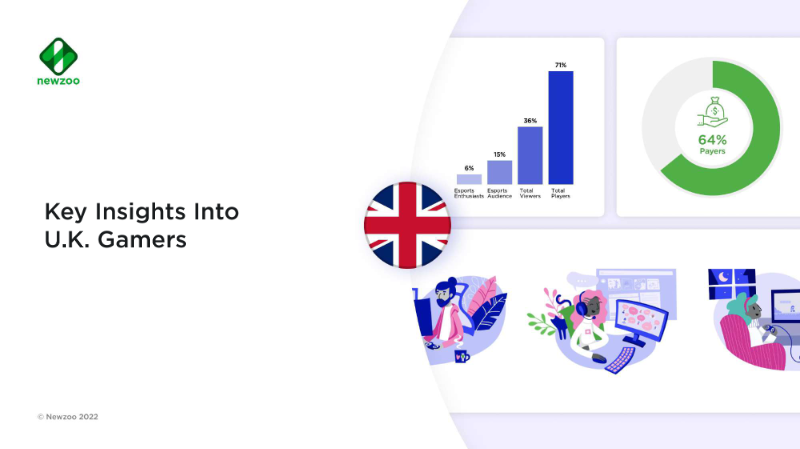
The United Kingdom represents a major global gaming hub, ranking as the sixth-largest market by revenue and tenth by player population as of late 2022. Research conducted among the online population aged 10 to 65 indicates that gaming is a primary entertainment pillar in the region, with 71% of the population identifying as game enthusiasts. This engagement is split between active play and content viewership, with 36% of the population exclusively playing games and another 35% both playing and viewing gaming video content.

The demographic profile of UK gamers is nearly balanced by gender, consisting of 52% male and 47% female players. While gaming spans all age groups, the 21-35 bracket is the most active. Motivation for play is driven primarily by the desire to unwind and relax, followed by the pursuit of achievement and social interaction. When categorized by persona, Time Fillers—those who play casually to pass the time—represent the largest segment, followed by Mainstream Gamers who engage deeply with both play and viewership.

Platform preferences show that mobile gaming has the highest reach at 46%, followed by console at 41% and PC at 29%. However, PC and console players demonstrate higher average weekly time commitments compared to mobile users. Financial engagement is also significant, with 63% of players identified as payers. The primary driver for spending is the availability of sales or special offers, though social motivations, such as spending to play with friends or family, also influence purchasing behavior.

The findings are based on a 2022 survey of 2,010 respondents in the United Kingdom, part of a broader global study covering 36 markets. The methodology utilizes a representative sample of the online population to track dozens of key performance indicators, including audience profiles, platform behavior, and monetization trends.

  • The UK is a major global gaming hub, ranking sixth in revenue and tenth in player population, with 71% of the population aged 10-65 identifying as game enthusiasts.
  • Engagement is evenly split between active players (36%) and those who both play and view gaming video content (35%).
  • Mobile gaming has the highest reach at 46%, followed by console (41%) and PC (29%), though PC and console users dedicate more time to gaming weekly.
  • The gamer demographic is nearly gender-balanced at 52% male and 47% female, with the 21-35 age bracket serving as the most active segment.
  • 63% of UK gamers are payers, with spending primarily driven by sales, special offers, and social motivations like playing with friends or family.
+1
NewzooJan 2022
Page 1
Report18 pages

Consumer Insights: Games & Esports 2022

Gaming has evolved into a multi-dimensional entertainment ecosystem where traditional play is no longer the sole driver of engagement. Findings indicate that 79% of the global online population are game enthusiasts, participating through playing, viewing content, or socializing in virtual worlds. This shift is most pronounced among younger generations; for Gen Alpha, gaming has surpassed social media and streaming video as the primary source of entertainment.

The research highlights a significant trend toward the "metaverse," with 75% of players and 44% of non-players engaging in game worlds for social interaction without playing the core game. This high level of engagement translates into substantial economic impact, with consumer spending in the sector projected to exceed $200 billion in 2023. Approximately half of Gen Alpha, Gen Z, and Millennial gamers are already classified as payers, a figure expected to rise as younger cohorts gain independent purchasing power.

Data suggests that gamers are a highly receptive audience for brands, exhibiting 36% more positive attitudes toward brand messaging compared to non-players. However, the diversity of the audience necessitates a nuanced approach. Using proprietary segmentation, the analysis shows that while older generations often act as "Time Fillers," younger audiences are more likely to be "Ultimate Gamers" or "All-Round Enthusiasts." Even within the same genre, such as Battle Royale, player demographics and motivations vary significantly between titles like Fortnite and Apex Legends, affecting their preferences for products like energy drinks or alcohol.

The findings are based on a 2022 study utilizing Computer Assisted Web Interviewing (CAWI) with a representative sample of 75,930 respondents. The scope covers 36 global markets across North America, Europe, Latin America, and Asia-Pacific, targeting the online population aged 10 to 65. Additional sentiment studies on the metaverse and blockchain gaming supplement the core consumer data.
  • Gaming has become a primary entertainment ecosystem for 79% of the global online population, with Gen Alpha prioritizing gaming over social media and streaming video.
  • Consumer spending in the gaming sector is projected to exceed $200 billion in 2023, driven by a payer base that includes approximately 50% of Gen Alpha, Gen Z, and Millennial gamers.
  • Game worlds are increasingly used for social interaction rather than gameplay, with 75% of players and 44% of non-players utilizing these environments for non-gaming social engagement.
  • Gamers are a highly receptive audience for advertising, demonstrating a 36% more positive attitude toward brand messaging compared to non-players.
  • Audience motivations vary significantly by demographic, with older users often acting as 'Time Fillers' while younger cohorts are more likely to be 'Ultimate Gamers' or 'All-Round Enthusiasts'.
+1
NewzooJan 2022
Page 1
Report19 pages

Video Games – A Force for Good: Europe's Video Game Industry

This analysis provides a comprehensive overview of the European video games industry as of 2021, detailing its economic impact, demographic reach, and social contributions. Jointly produced by ISFE and EGDF, the findings highlight a sector that remained stable following the pandemic-induced surge of 2020, maintaining a market value of €23.3 billion across key European territories. The industry supports a significant workforce, employing over 98,000 people across Europe, with 74,000 located within the EU. Data is primarily sourced from Ipsos, GameTrack, and GSD, covering major markets including France, Germany, Italy, Spain, and the United Kingdom.

The demographic data reveals that video gaming is a mainstream cultural activity, with 52% of the European population aged 6 to 64 participating. The average player age is 31.3 years, and women represent nearly 48% of the total player base. While engagement remains high, average weekly playtime returned to pre-pandemic levels of nine hours. The digital ecosystem dominates the market, accounting for 81% of total revenue, driven largely by app-based gaming and in-game extras.

A significant portion of the analysis focuses on industry responsibility and social impact. It underscores the effectiveness of the PEGI age rating system and the prevalence of parental control tools, noting a sharp decline in unsupervised in-game spending by minors. Furthermore, the industry is positioned as a driver for digital literacy and mental well-being, with specific initiatives targeting STEM education for girls and climate change through the Green Game Jam. The report concludes that the sector is a vital component of Europe’s digital economy, increasingly recognized for its pedagogical value and commitment to diversity and environmental sustainability.

  • The European video game market maintained a stable value of €23.3 billion in 2021, following the initial pandemic-driven surge.
  • The industry employs over 98,000 people across Europe, with 74,000 of those roles based within the EU.
  • Digital revenue dominates the sector, accounting for 81% of total market value through app-based gaming and in-game purchases.
  • Video gaming is a mainstream activity in Europe, engaging 52% of the population aged 6 to 64 with an average player age of 31.3 years.
  • Gender representation in gaming is nearly balanced, with women accounting for 48% of the total player base.
+1
Interactive Software Federation of EuropeJan 2022
Page 1
Report25 pages

A Rising Market: Southeast Asia

Southeast Asia represents a rapidly accelerating segment of the global esports market, characterized by high growth rates in both viewership and revenue. Between 2019 and 2024, the region is projected to see a compound annual growth rate (CAGR) in audience size that significantly outpaces global averages, with year-over-year increases reaching as high as 18.2%. This expansion is driven by a mobile-first gaming culture where 82% of the online population plays mobile games and 39% of players identify mobile as their primary platform. Key markets fueling this trend include Indonesia, Vietnam, the Philippines, Thailand, Malaysia, and Singapore.

The regional ecosystem is heavily influenced by mobile-centric titles, specifically Mobile Legends: Bang Bang, Garena Free Fire, and PUBG Mobile. These three games accounted for roughly half of all global esports hours watched for those titles on Twitch and YouTube Live during the first half of 2021. Revenue streams in the region mirror global trends, with sponsorship serving as the primary contributor, supported by media rights, publisher fees, and digital goods. Government intervention also plays a critical role in market maturation, with initiatives like the Youth Esports Program in the Philippines and the integration of esports into the 30th SEA Games as a medal event.

Data for these findings was sourced from Newzoo’s 2021 Global Esports and Live Streaming Market Report and Consumer Insights. The methodology utilized a Major City Approach for most Southeast Asian nations to represent active internet users aged 10-50, while Singapore data covered the general online population within that age bracket. The findings conclude that improved internet infrastructure and the accessibility of mobile devices are the primary catalysts for long-term engagement and the continued attraction of non-endemic brand sponsorships to the region.

  • Southeast Asia's esports audience is experiencing rapid expansion, with year-over-year growth reaching as high as 18.2% between 2019 and 2024.
  • The market is defined by a mobile-first culture where 82% of the online population plays mobile games and 39% identify mobile as their primary gaming platform.
  • Three mobile titles—Mobile Legends: Bang Bang, Garena Free Fire, and PUBG Mobile—accounted for approximately 50% of all global esports hours watched for those specific games on Twitch and YouTube Live in the first half of 2021.
  • Key growth markets in the region include Indonesia, Vietnam, the Philippines, Thailand, Malaysia, and Singapore.
  • Revenue generation in the region is primarily driven by sponsorships, supplemented by media rights, publisher fees, and digital goods.
+1
NewzooJul 2021

Publishers

Related Topics