Employment

163 documents·66 publishers

Documents

Page 1
Report42 pages

ゲーム開発者の就業とキャリア形成 2024

The 2024 Game Developer Survey for Japan provides a comprehensive snapshot of compensation trends among the nation’s game development workforce, focusing on individuals with formal vocational‑school or university education. By capturing responses from a broad cross‑section of developers, the study aims to assess whether recent industry growth translates into tangible financial benefits for skilled professionals.

Findings reveal that more than 80 % of educated respondents reported a salary increase over the preceding year, a pattern that holds consistently for full‑time employees, with roughly the same proportion experiencing any rise in earnings. This upward trajectory suggests that Japanese studios are increasingly rewarding qualified talent, reflecting both heightened competition for skilled labor and the sector’s expanding revenue streams. The data also underscore the importance of formal education as a predictor of wage growth, indicating that employers value academic credentials when allocating compensation adjustments.

Overall, the survey indicates a robust and positive compensation environment for Japan’s game development sector in 2024, highlighting sustained investment in human capital. The prevalence of salary gains among highly educated, full‑time developers points to a healthy labor market that may enhance talent retention and support continued industry innovation.

  • Over 80% of game developers with formal vocational or university education in Japan received a salary increase in 2024.
  • The trend of rising earnings is consistent among full-time employees, with approximately 80% reporting wage growth over the past year.
  • Formal academic credentials serve as a significant predictor of wage growth, as employers prioritize these qualifications when determining compensation adjustments.
  • The widespread salary growth reflects heightened competition for skilled labor and the overall expansion of revenue streams within the Japanese gaming sector.
  • The 2024 data indicates a robust labor market characterized by sustained investment in human capital and improved talent retention strategies.
+1
CESA – Computer Entertainment Supplier's AssociationJan 2024
Page 1
Report20 pages

The Austrian Game Industry 2024

The Austrian game sector is portrayed as a youthful, fast‑growing cluster of predominantly small and micro enterprises whose economic relevance has expanded dramatically over the past six years. A 2023‑2024 survey commissioned by the Austrian Professional Association of Management Consultancy, Accounting and IT and executed by the Institute of Industrial Research gathered responses from roughly 150 active developers, with detailed data supplied by 78 firms on production output and by 23 firms on serious‑game activities. The study combines firm‑level questionnaires with macro‑economic modelling to assess direct, indirect and induced effects on the national economy.

Revenue generated by domestic developers reached €92.8 million in 2023, a nominal increase of more than 285 % compared with 2017, and still represents a 180 % rise after price‑level adjustment. Employment rose from 474 jobs in 2017 to 1 080 in 2024, a 128 % increase, and the sector’s multiplier effect creates roughly 2 260 jobs across Austria. Projections that assume a slowdown to one‑third of recent growth still forecast revenues of €149 million and a workforce of over 1 500 by 2029. In the preceding three years, the surveyed firms produced 405 games, while serious‑game developers now number 20‑30 companies employing 130‑150 staff, chiefly to raise awareness of social issues such as climate change.

The workforce is highly qualified: almost 80 % hold tertiary degrees, with the 25‑34 age group dominating. Educational provision is concentrated in three regional hubs—Salzburg, Upper Austria and Carinthia—where 25 university programmes supply the bulk of IT talent. Financing remains largely internal, with self‑funding cited by 92 % of firms; public subsidies rank second but are considered insufficient, reflected in the finding that 77 % of developers rate Austria’s location policy as poor or very poor. Nonetheless, only 5 % contemplate relocation, and the majority anticipate continued employment growth over the next three years.

  • The Austrian game industry generated €92.8 million in revenue in 2023, marking a 285% nominal increase since 2017.
  • Direct employment in the sector grew 128% over seven years, rising from 474 jobs in 2017 to 1,080 in 2024, with a total economic multiplier effect supporting 2,260 jobs.
  • Projections for 2029 estimate industry revenue will reach €149 million and the workforce will exceed 1,500 employees, even assuming a significant slowdown in growth.
  • The industry is characterized by small and micro enterprises that rely heavily on internal financing, with 92% of firms self-funding their operations.
  • Despite 77% of developers rating Austria’s location policy as poor or very poor, only 5% of firms are considering relocation.
+1
Austrian Professional Association of Management ConsultancyJan 2024
Page 1
Report4 pages

Czech Gaming Industry Report 2024

The Czech Gaming Developers Association compiled an annual industry overview to map the sector’s economic performance, workforce composition and structural trends for 2023 and early 2024. By aggregating self‑reported financial and employment data from member studios, the analysis aims to illustrate growth trajectories, geographic concentration and the evolving profile of talent within the Czech game development ecosystem.

Overall turnover reached €226 million in 2023, marking a 33 % increase over the previous year, while the number of active studios rose modestly, with newly established entities numbering 166 in 2023 compared with 260 in 2022. Employment expanded to roughly 4,165 staff, a 12.3 % rise, with the majority concentrated in Prague (52 %), followed by Ostrava (13 %) and Brno (20 %). The sector released 29 new titles in 2023, supplemented by 10 early‑access projects and 10 DLCs, for a total of 39 releases.

Ownership structures remain dominated by private limited companies, accounting for the bulk of legal entities, while joint‑stock and foreign‑branch configurations each represent about 5 % of the market. Job creation accelerated, with over 430 new positions announced across the year, a 20‑23 % increase relative to prior periods. The workforce is increasingly international: 34 % of employees are foreign nationals, predominantly from EU member states, while 66 % are Czech. Educational backgrounds are diverse, with roughly half holding higher‑education degrees and a similar share possessing vocational or technical qualifications. The report’s methodology relies on annual surveys administered by the association, covering all registered Czech game development firms and providing a comprehensive snapshot of the industry’s health and direction.

  • The Czech gaming industry reached a total turnover of €226 million in 2023, representing a 33% year-over-year growth.
  • Total employment in the sector grew by 12.3% to 4,165 staff, with over 430 new positions created throughout 2023.
  • The industry released 39 total projects in 2023, consisting of 29 new titles, 10 early-access projects, and 10 DLCs.
  • The workforce is increasingly international, with foreign nationals—primarily from EU member states—comprising 34% of all employees.
  • Geographic concentration remains high, with 52% of the workforce based in Prague, followed by 20% in Brno and 13% in Ostrava.
GDACZ – Czech Game Developers AssociationJan 2024
Page 1
Report41 pages

L'Industrie du Jeu Vidéo au Canada

The 2024 Canadian video‑game sector is presented as a mature, high‑value industry that contributes $5.1 billion to national GDP and sustains 34 010 full‑time‑equivalent positions, with an average compensation of $102 000. The analysis underscores a pronounced geographic concentration, as 83 % of the 821 operating studios are located in Ontario, British Columbia and Québec, reflecting the continued clustering of talent and infrastructure in these provinces.

Compared with 2021, the total number of firms declined by 9 %, a contraction driven largely by the disappearance of micro‑enterprises, while larger studios either remained stable or expanded. Ownership patterns have shifted markedly, with foreign‑owned companies now accounting for 88 % of total employment, indicating deepening international integration and reliance on external capital.

Industry spending reached $4.8 billion in 2024, an 11 % increase over the 2021 level, and labour costs now represent 72 % of total expenditures, up from roughly 66 % three years earlier. This rising labour share highlights the sector’s intensifying dependence on skilled human capital.

The study classifies studios into eight size categories—from solo developers to firms with more than 200 employees—using survey‑derived averages to estimate spending, revenue and wage structures across each segment. By scaling these averages to the number of firms in each tier, the analysis provides a nuanced picture of economic activity across the full spectrum of the industry.

Overall, the findings portray a Canadian video‑game ecosystem that is consolidating around a few large, often foreign‑owned players, expanding its overall financial outlays, and increasingly reliant on a highly paid workforce, all within a geographically limited core that dominates national output.

  • The Canadian video game industry contributes $5.1 billion to the national GDP and employs 34,010 full-time equivalent workers with an average annual compensation of $102,000.
  • Industry spending reached $4.8 billion in 2024, an 11% increase since 2021, with labour costs now accounting for 72% of total expenditures.
  • The sector is increasingly dominated by foreign-owned companies, which now account for 88% of total industry employment.
  • While the total number of studios declined by 9% since 2021 due to the contraction of micro-enterprises, larger studios have remained stable or expanded.
  • The industry is highly concentrated geographically, with 83% of the 821 operating studios located in Ontario, British Columbia, and Québec.
+1
ESAC – Entertainment Software Association of CanadaJan 2024
Page 1
Report13 pages

FY2024 Report: Australian Game Development Survey

The Australian game development industry demonstrated resilience and stability during the 2024 financial year despite significant global economic headwinds. Total income generated by local studios reached $339.1 million, representing a minor 1.9% decrease from the previous year. Employment remained steady with 2,465 full-time equivalent workers, a marginal 0.3% increase. The sector is heavily export-oriented, with 93% of all revenue generated from outside Australia. Furthermore, 85% of studios focus on developing their own original intellectual property rather than work-for-hire projects.

The industry landscape is characterized by a mix of emerging and established entities. While 56% of studios were formed within the last five years, a quarter of the sector consists of mature studios operating for a decade or more. Small businesses dominate the ecosystem, with 47% of studios employing five or fewer staff members. Geographically, Victoria serves as the primary hub, hosting 52% of head offices and 36% of the national workforce, followed by Queensland and New South Wales.

Government support remains a critical pillar for the industry. The Digital Games Tax Offset, which passed in mid-2023, is already being utilized by 25% of respondents to fund new projects or expand existing ones. Despite this support, developers identified securing international and local publishing deals and attracting early-stage development funding as their primary challenges.

The findings are based on a voluntary survey of 137 Australian game development studios conducted by Bond University on behalf of the Interactive Games & Entertainment Association. The data covers the period from July 1, 2023, to June 30, 2024. Looking ahead, the sector maintains a cautiously optimistic outlook, with 81% of studios predicting stable or increased revenue and 61% planning to hire new staff in the coming year.

  • The Australian game development industry generated $339.1 million in revenue during FY2024, reflecting a minor 1.9% year-over-year decline despite global economic headwinds.
  • The sector is highly export-focused, with 93% of total revenue derived from international markets and 85% of studios prioritizing the development of original intellectual property.
  • Employment remains stable at 2,465 full-time equivalent workers, with 61% of studios planning to increase their headcount in the coming year.
  • Victoria is the industry's primary hub, hosting 52% of all studio head offices and 36% of the national workforce.
  • The Digital Games Tax Offset, introduced in mid-2023, is already being utilized by 25% of studios to support project funding and expansion.
+1
Interactive Games & Entertainment AssociationJan 2024
Page 1
Report76 pages

Big Games Industry Employment Survey 2024: Salaries, Compensation Trends and State of the Games Sector in Europe

The European games industry in 2024 is characterized by significant volatility and structural transformation, with 15% of the workforce experiencing layoffs and 10% exiting the sector entirely. This instability disproportionately affects junior professionals, nearly a third of whom have left the industry over the past year. While 44% of those who switched jobs secured career gains, a notable 24% accepted lower pay or seniority to remain employed. Job satisfaction and employee loyalty follow a U-shaped trajectory, typically bottoming out between three and five years of experience before rebounding as professionals prioritize stability and mature corporate processes.

Technological integration and workplace culture are central to current industry shifts. AI adoption has surged by 17% year-over-year, with 54% of professionals now utilizing these tools. Despite this modernization, the sector struggles with persistent systemic issues, including a gender pay gap driven by a lack of female representation in leadership and technical roles. Discrimination remains prevalent, as 32% of respondents reported personal experiences with gender-based bias and 26% cited ageism. Furthermore, a significant gap in professional development exists; 55% of workers received no formal training in the past year, forcing 65% of those seeking advancement to self-fund their education.

Operational pressures continue to impact well-being, with 28% of the workforce reporting stagnant career development and 7% working overtime almost daily. High dissatisfaction is closely linked to professional burnout, poor management, and a lack of work-life balance. However, certain segments show resilience; the outsourcing sector saw a significant rise in employee net promoter scores, and hybrid work models remain a primary driver of retention. While free-to-play studios generally offer higher compensation than premium developers, long-term stability perks and profit-sharing remain the most effective tools for maintaining a committed workforce in an increasingly precarious market.

  • The European games industry faces significant instability, with 15% of the workforce experiencing layoffs and 10% leaving the sector entirely, disproportionately impacting junior professionals.
  • AI adoption has surged by 17% year-over-year, with 54% of industry professionals now integrating these tools into their daily workflows.
  • Systemic workplace issues persist, as 32% of respondents reported gender-based bias and 26% cited ageism, contributing to a gender pay gap rooted in a lack of female leadership and technical representation.
  • Professional development is stagnating, with 55% of workers receiving no formal training in the past year, forcing 65% of those seeking career advancement to self-fund their education.
  • While 44% of job switchers achieved career gains, 24% were forced to accept lower pay or reduced seniority to maintain employment in the current market.
+1
InGameJobJan 2024
Page 1
Report37 pages

State of the Game Industry 2024

The global game industry entered 2024 in a state of profound volatility, defined by a painful market correction following post-pandemic overexpansion. This period of instability is marked by widespread layoffs affecting one-third of the workforce and a surge in studio closures linked to rapid corporate conglomeration. While North America remains the primary hub for development and PC continues to be the dominant platform, the workforce is increasingly preoccupied with job security and the ethical implications of emerging technologies. Generative AI has seen rapid adoption, with nearly half of developers utilizing these tools, yet 84% express deep concern regarding copyright infringement and the potential for further job displacement.

Labor dynamics are shifting as developers react to economic pressures and perceived corporate mismanagement. Support for unionization has climbed to 57%, with particularly high enthusiasm among younger professionals aged 18 to 24 who are grappling with inflation and precarious employment. This desire for collective bargaining coincides with a growing rejection of mandatory return-to-office policies and a decline in confidence regarding corporate diversity and sustainability initiatives. Furthermore, the technical landscape is fracturing; significant dissatisfaction with Unity’s recent policy changes has led one-third of developers to consider switching engines, often favoring open-source alternatives like Godot.

Business models remain centered on digital premium downloads, favored by 51% of the industry, even as marketing strategies face disruption due to overwhelming negative sentiment toward major social media platforms like Twitter/X. Despite the internal turmoil, there is a measurable increase in the implementation of accessibility features, which now appear in nearly half of all projects. However, the industry’s demographic makeup remains largely stagnant, continuing to be predominantly White and male. Ultimately, the current landscape reflects a workforce caught between the necessity of financial stability through consolidation and a growing demand for systemic reform to address ethical, technical, and labor-related grievances.

  • The industry is undergoing a severe market correction characterized by widespread layoffs affecting one-third of the global workforce and a surge in studio closures.
  • Support for unionization has reached 57%, driven largely by younger professionals (ages 18–24) facing economic instability and dissatisfaction with corporate management.
  • While 49% of developers have adopted generative AI, 84% of the workforce reports significant concerns regarding copyright infringement and potential job displacement.
  • Technical infrastructure is shifting, with one-third of developers considering engine migrations—often toward open-source options like Godot—following recent policy changes at Unity.
  • Digital premium downloads remain the primary business model for 51% of the industry, even as marketing strategies struggle with declining sentiment toward major social media platforms.
+3
Game Developers ConferenceJan 2024
Page 1
Report68 pages

The Economic Impacts of Video Game Technology Spillover: UK and Nordic Economies

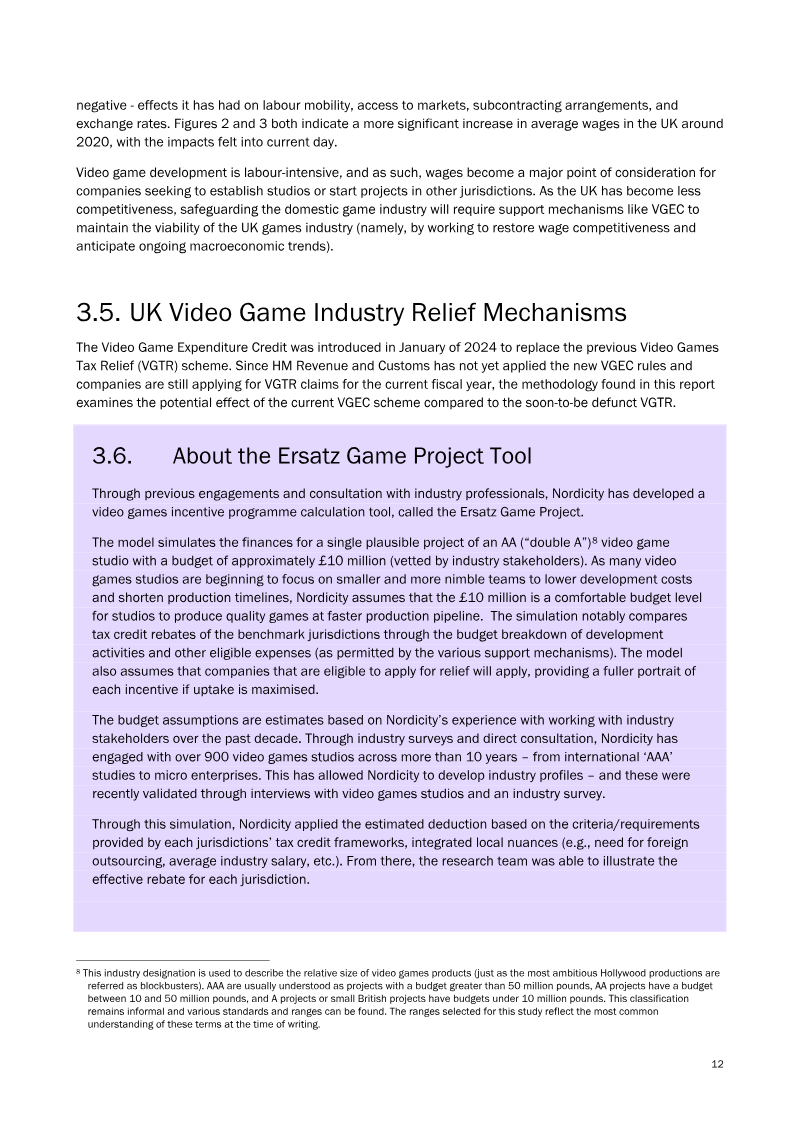
The analysis quantifies how video‑game technology generates measurable economic benefits beyond the entertainment sector, arguing that spill‑over effects constitute a significant engine of growth for advanced‑technology economies. By applying the IMPLAN input‑output model to 2021 data, the study estimates that spill‑overs contributed roughly £1.3 billion of total output and £760 million of GDP to the United Kingdom, delivering £380 million of labour income and £250 million of government revenue while sustaining about 9,900 non‑gaming jobs. These positions are concentrated in information‑technology, business services and energy extraction, with average salaries 25 % above the national mean. In the Nordic region, comparable effects amounted to £190 million of output and £40 million of GDP, underscoring the broader relevance across Western Europe.

The research situates these figures within the wider UK games ecosystem, which comprises approximately 2,600 firms and 71,400 jobs across direct, indirect and induced employment. Spill‑over activity accounts for roughly 13 % of the industry’s gross value added and 19 % of its employment, highlighting the sector’s pivotal role in supporting ancillary markets. Sectoral case studies illustrate how real‑time engines (Unreal, Unity), VR/AR headsets and haptic devices are reshaping healthcare, oil and gas, architecture, horticulture, furniture design and automotive safety, delivering faster, lower‑cost visualisation, enhanced training and new revenue streams.

The findings extend to the United States, where about one‑fifth of software‑job growth in 2016 and $0.5 billion of software output are linked to game‑technology diffusion. Collectively, the evidence demonstrates that video‑game innovations act as a cross‑industry catalyst, generating substantial fiscal, employment and productivity gains across multiple high‑value sectors during the 2021‑2022 period.

  • In 2021, video game technology spill-overs contributed £1.3 billion in total output and £760 million to UK GDP, while sustaining 9,900 non-gaming jobs.
  • Spill-over activity from the UK games industry accounts for 13% of the sector's gross value added and 19% of its total employment.
  • Non-gaming roles supported by game technology—primarily in IT, business services, and energy—command average salaries 25% higher than the UK national mean.
  • Real-time engines like Unreal and Unity, alongside VR/AR and haptic hardware, are driving productivity and cost reductions in sectors including healthcare, architecture, automotive safety, and energy extraction.
  • The economic impact of game technology is significant across Western Europe, with the Nordic region recording £190 million in output and £40 million in GDP from these spill-overs.
+2
UkieNov 2023
Page 1
Report68 pages

Spelutvecklarindex 2023: Swedish Games Industry

The Swedish games industry serves as a powerhouse of global digital entertainment, characterized by rapid revenue expansion and a vast international footprint. In 2022, the sector generated 86.5 billion SEK in global revenue, marking a 47% increase largely fueled by aggressive acquisition strategies. With 392 Swedish-owned studios operating across 59 countries, the industry employs approximately 25,000 people worldwide, including 8,445 domestic staff. This reach is immense, with Swedish-developed titles accumulating nearly 7 billion downloads and engaging roughly one-quarter of the global population.

Despite this commercial success, the industry faces structural bottlenecks that threaten long-term sustainability. A persistent talent shortage remains the primary constraint on production capacity, exacerbated by challenges regarding work permits and a lack of formal financial support structures for early-stage startups compared to European peers. To mitigate these issues, studios are increasingly leveraging productivity-enhancing technologies like generative AI, standardized game engines, and collaborative regional ecosystems that bridge the gap between specialized education and professional development.

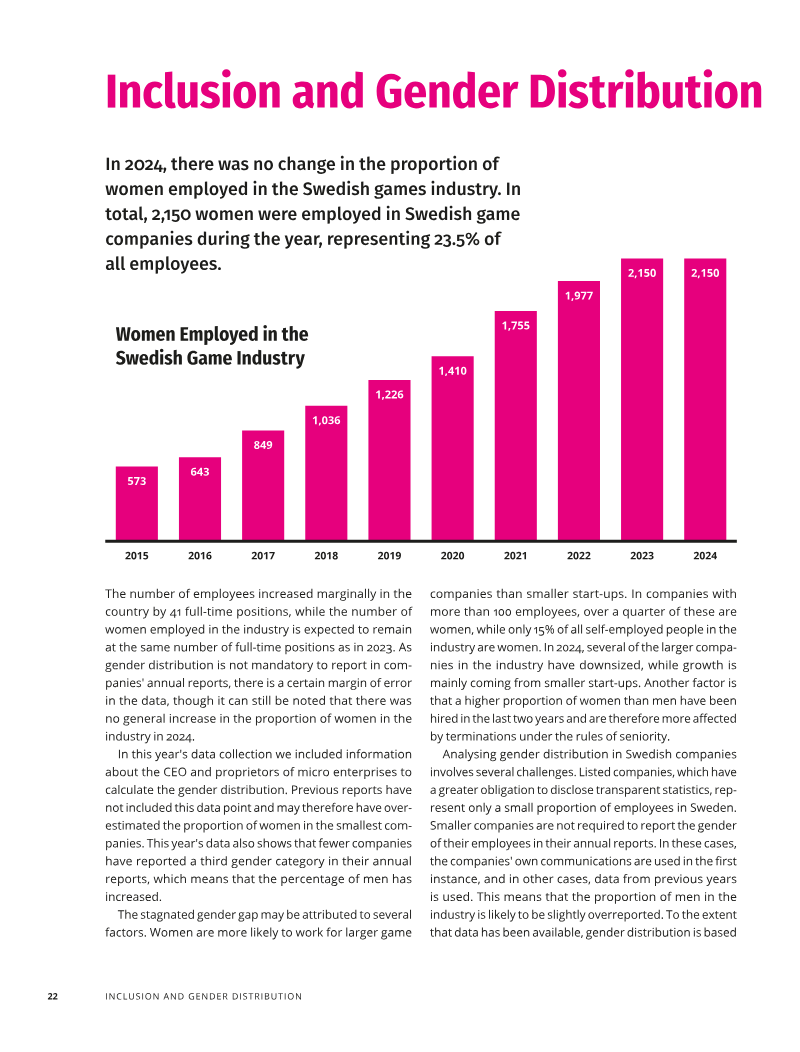
Social and operational evolution remains a core priority for the sector. Efforts to improve gender diversity are yielding tangible results, with women accounting for nearly half of all new hires in 2022, bringing female representation to 23.4% of the workforce. Simultaneously, the industry is pivoting toward broader sustainability goals, focusing on reducing environmental footprints and fostering healthy, inclusive workplace cultures. As the sector navigates the complexities of hybrid work environments and the integration of emerging technologies, it continues to function as a vital catalyst for innovation, driving value that extends well beyond the boundaries of traditional game development.

  • The Swedish games industry generated 86.5 billion SEK in global revenue in 2022, representing a 47% year-over-year increase driven largely by acquisition strategies.
  • Swedish-owned studios now number 392 across 59 countries, employing 25,000 people globally with 8,445 staff based domestically.
  • Swedish-developed titles have reached a massive scale, accumulating nearly 7 billion downloads and engaging approximately 25% of the global population.
  • Gender diversity is improving, with women accounting for nearly 50% of all new hires in 2022, raising total female workforce representation to 23.4%.
  • A persistent talent shortage and difficulties with work permits remain the primary constraints on production capacity, compounded by a lack of early-stage financial support compared to other European markets.
+2
DataspelsbranschenOct 2023
Page 1
Report159 pages

Impacto de la aplicación de sistemas de incentivos fiscales en la industria de videojuegos: España

The analysis evaluates how a targeted fiscal‑incentive regime would reshape Spain’s video‑game industry, arguing that a 20 % corporate‑tax credit for developers could expand sector turnover from €1.435 billion in 2022 to roughly €5.5 billion by 2028—a compound annual growth rate of about 27 %—and raise full‑time employment from just under 10 000 jobs to more than 23 000 by 2030, an 80 % increase. Despite the lower tax rate, overall fiscal receipts would grow, with a direct contribution of €1.9 billion and an additional €1.0 billion generated through reinvestment and consumer spending, indicating a net positive return for the Treasury.

Spain’s ecosystem comprises roughly 760 active studios, of which 445 are incorporated, and 71 publishers, with the top ten accounting for almost 95 % of revenue. Development costs vary markedly by platform—averaging €419 k for consoles, €338 k for PC and €94 k for mobile—while break‑even periods range from 8.6 to 15.5 months, underscoring the financing pressure on predominantly

  • Implementing a 20% corporate tax credit for developers is projected to grow Spain’s video game sector turnover from €1.435 billion in 2022 to €5.5 billion by 2028, representing a 27% compound annual growth rate.
  • The proposed fiscal incentives are expected to increase full-time employment in the industry from under 10,000 jobs to more than 23,000 by 2030.
  • The tax regime is forecast to be net-positive for the Treasury, generating €1.9 billion in direct contributions plus an additional €1.0 billion through reinvestment and consumer spending.
  • The Spanish market is highly concentrated, with the top ten companies accounting for approximately 95% of total industry revenue.
  • Development costs vary significantly by platform, averaging €419k for consoles, €338k for PC, and €94k for mobile.
+2
AEVIJun 2023
Page 1
Report3 pages

NHK Enterprise's 'Kami-Ge Creator Evolution' Succeeds Japan Game Awards 'Amateur' and 'U18' Divisions

NHK Enterprise is launching the “Kami‑Ge Creator Evolution” contest as a dedicated platform for nurturing the next generation of Japanese game developers, and from 2024 it will incorporate the Japan Game Awards’ Amateur and U18 divisions. The initiative, begun in 2022 under the theme “Evolve the Game,” seeks to discover and develop talent through a series of contest events, community support, and media exposure, including a documentary broadcast on NHK General in February 2023 that generated strong public interest.

The competition invites creators from across Japan to submit original games, which are evaluated for innovative expansion of the medium’s boundaries by a diverse panel of established game designers, media artists, and other industry figures. In addition to expert judging, a public popularity vote is conducted, and the contest awards a Grand Prize, Excellence Awards, and Honorable Mentions in the Amateur category, while the U18 category focuses on participants aged 18 or younger, reflecting the Japan Game Awards’ long‑standing commitment to youth development since 2018. The 2024 schedule begins with an entry period from 1 February to the end of April, followed by nomination, second‑round video submissions in July, third‑round game submissions in October, finalist announcements at the end of October, and a final event slated for December.

A closed Discord community supports participants with exclusive benefits, knowledge sharing, and mentorship, reinforcing the project’s role as a learning environment. Special cooperation from the Computer Entertainment Supplier’s Association (CESA) provides additional industry credibility and resources. The contest is open to individuals, teams, corporations, and organizations regardless of age, gender, nationality, or the number of entries, emphasizing inclusivity and broad outreach.

By integrating the Amateur and U18 awards, the “Kami‑Ge Creator Evolution” aims to broaden the creative framework of Japanese games, foster innovative design, and strengthen the pipeline of skilled developers. The organizers are actively seeking sponsors to sustain the project’s growth and align with NHK Enterprise’s broader commitment to sustainable development and cultural enrichment.

  • NHK Enterprise has integrated the Japan Game Awards’ Amateur and U18 divisions into its 'Kami-Ge Creator Evolution' contest, effective from 2024.
  • The 2024 competition timeline spans from February 1 to a final event in December, featuring a multi-stage evaluation process including video submissions in July and game submissions in October.
  • The contest is open to all applicants regardless of age, nationality, or organizational status, with specific categories for general amateur creators and those aged 18 or younger.
  • Participants gain access to a closed Discord community providing mentorship, knowledge sharing, and exclusive resources to support developer growth.
  • The initiative is supported by the Computer Entertainment Supplier’s Association (CESA) to provide industry credibility and resources for the project.
+2
CESA – Computer Entertainment Supplier's AssociationMay 2023
Page 1
Presentation20 pages

People Can Fly: Q1 2023 Financial Results

PCF Group, the parent entity of the People Can Fly studio, reports a period of continued organizational expansion and strategic financial positioning as of the first quarter of 2023. The group has significantly grown its workforce to 642 employees by March 31, 2023, up from 612 at the end of 2022. This growth is concentrated primarily in its European hubs, including Warsaw, Rzeszów, and Newcastle, while maintaining a substantial presence in North America through its Montreal and New York studios. The team composition remains heavily weighted toward development, supported by specialized units like Incuvo and GameOn.

Financial data indicates a stable balance sheet with total assets and liabilities reaching 351.9 million PLN. A notable shift is observed in the group’s cash position, which decreased from 137.1 million PLN at the end of 2021 to 60.9 million PLN by the end of Q1 2023. Simultaneously, investment in development work in progress has surged to 139.7 million PLN, reflecting an intensive production cycle. Equity remains strong at 271.6 million PLN, providing a solid foundation for the group’s long-term objectives.

The strategic focus is transitioning from a work-for-hire model toward self-publishing. While the group continues to leverage partnerships with global publishers to ensure financial stability and experimental freedom, the ultimate goal is to release three AAA projects under a self-publishing framework. This shift is projected to drive a 4.9x revenue increase between 2023 and 2027. Funding for this strategy is secured through a combination of operational cash flow, debt financing, and a strategic investment agreement with Krafton, which contributed 144.5 million PLN via a share subscription. This diversified capital structure is intended to support the full realization of the group’s ambitious development pipeline.

  • People Can Fly is transitioning from a work-for-hire model to self-publishing, with a strategic goal to release three AAA projects by 2027.
  • The group projects a 4.9x revenue increase between 2023 and 2027, supported by a capital structure that includes a 144.5 million PLN share subscription from Krafton.
  • Development intensity has surged, with investment in work-in-progress projects reaching 139.7 million PLN as of Q1 2023.
  • The company's cash position decreased from 137.1 million PLN at the end of 2021 to 60.9 million PLN by the end of Q1 2023, reflecting heavy reinvestment into production.
  • The workforce grew to 642 employees by March 31, 2023, up from 612 at the end of 2022, with expansion focused on European hubs and North American studios.
+1
PCF GroupMay 2023

Publishers

Related Topics