AI reports and market data
Documents

Super Powering Technical Artists Using Deep Learning
Generative machine learning models are fundamentally transforming the role of technical artists by serving as high-speed prototyping engines.
- Deep learning models are currently functioning as high-speed prototyping engines, enabling rapid iteration on visual concepts, facial attributes, and environmental assets through techniques like style transfer and image-to-image translation.
- Reinforcement learning is replacing labor-intensive manual keyframing by allowing animation models to derive realistic movement and environmental reactions directly from motion capture data.
- Core development efficiencies are being realized through ESRGAN for texture remastering and the use of machine learning approximations to replace computationally expensive traditional physics simulations.

Smarter in-game ad integration with Tony Deane from AppLovin
Mobile marketing platforms play a critical role in the gaming industry by enabling developers to scale user acquisition while simultaneously maximizing revenue through efficient ad monetization.
- Machine learning tools like AppLovin’s Axon platform, launched in 2020, have driven significant industry growth, including a reported 400 percent increase in platform performance over the past year.
- Developers are increasingly leveraging first-party data from internal game development to maintain effective, privacy-compliant targeting in response to tightening global data protection regulations.
- The primary objective for mobile game developers remains achieving profitability by optimizing return on ad spend (ROAS) through advanced user behavior prediction and campaign matching.
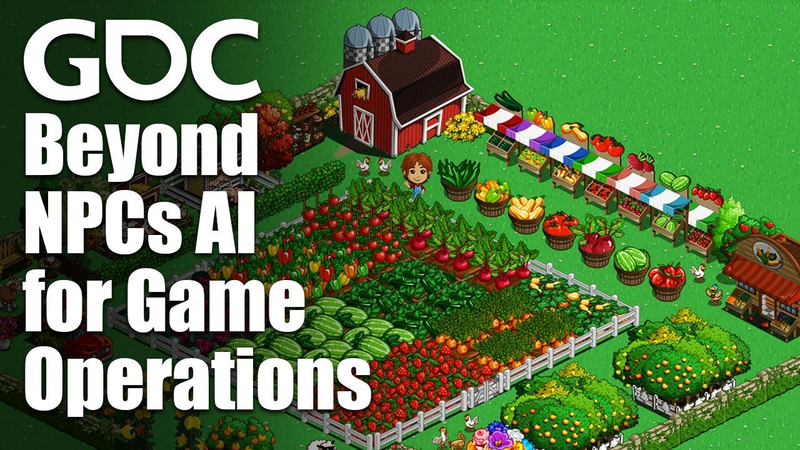
Beyond NPCs: AI for Game Operations
Artificial intelligence serves as a critical driver of operational efficiency within the mobile gaming sector, moving beyond traditional non-player character development to optimize core business functions.
- AI implementation in game operations should focus on tasks that are assistive to humans, superior to human performance, or faster than human execution to drive operational efficiency.
- Zynga manages a portfolio of over 50 live mobile games, utilizing centralized AI and machine learning teams to optimize complex revenue-generating systems like mobile advertising waterfalls.
- Automating mobile ad waterfall management—the process of setting reserve prices across multiple ad networks—is a high-value optimization problem where even a 1% revenue lift translates into millions of dollars.
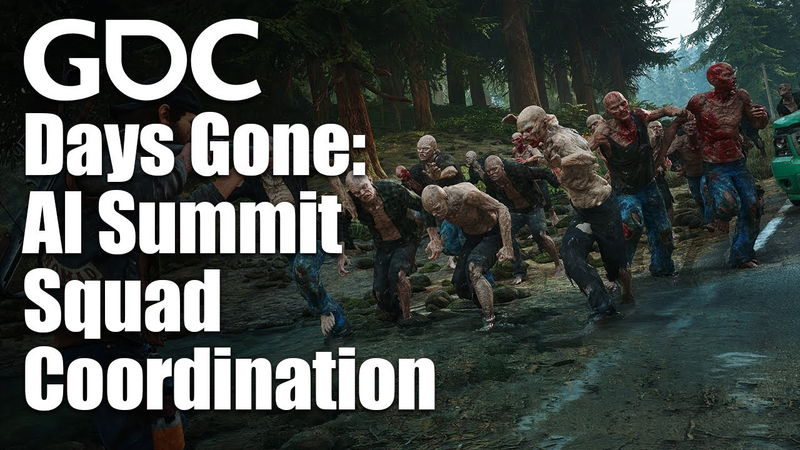
Squad Coordination in 'Days Gone'
Combat believability in Days Gone is achieved through a systemic, squad-based artificial intelligence model that replaces traditional scripted encounters with dynamic, role-based coordination.
- Sony Bend Studio implemented a 'frontline' system in Days Gone that defines the spatial relationship between a squad and its enemies, using a sliding window average to stabilize combat movement and ensure squad members maintain clear lines of fire.
- The AI uses a behavior hierarchy where high-priority reactive tasks, such as avoiding grenades, override assigned combat roles, while low-priority behaviors are suppressed when a valid role is active.
- Squad members are assigned to specific lanes along the frontline to minimize movement, prevent collision, and ensure optimal positioning relative to both the enemy and fellow squad members.
The Convergence of all Entertainment | Best of 2021 Part 2
The entertainment industry is undergoing a fundamental transformation driven by the widespread adoption of real-time technology.
- Real-time technology is dissolving traditional boundaries between gaming, film, and architecture, allowing developers to apply interactive design principles across diverse media formats.
- The industry is shifting toward procedural, all-in-one workflows—utilizing photogrammetry, procedural instancing, and automated character generation—to replace manual, repetitive production tasks.
- Professional roles are bifurcating into two specialized tracks: high-level creative directors and technical experts, requiring a shift away from generalist workflows.

Reinforcement Learning in Action: Creating Arena Battle AI for 'Blade & Soul'
The development of professional-level artificial intelligence for the 1v1 arena battles in the MMORPG Blade & Soul demonstrates the successful application of reinforcement learning (RL) to complex, real-time fighting games.
- NCSOFT replaced traditional hand-written AI rules in 'Blade & Soul' with reinforcement learning (RL) to create pro-level agents capable of strategic, multi-stage combat sequences.
- To ensure robustness and generalization, the team implemented a 'self-play' method where agents were trained against a growing pool of diverse, previously trained sparring partners rather than a single fixed opponent.
- The AI was trained to exhibit specific fighting styles—such as aggressive or defensive—by adjusting reward signal weights, allowing the agents to prioritize either damage output or HP preservation without hard-coded logic.

Making the Believable Horses of 'Red Dead Redemption II'
The development of Red Dead Redemption II prioritized the creation of a grounded, autonomous equine experience by abandoning traditional, rigid animation blend trees in favor of a sophisticated, data-driven locomotion system.
- Rockstar Games replaced manually authored state graphs with an automated locomotion system that extracts root motion and bone movement data to eliminate the need for human-intensive animation blending.
- The team implemented a 'drift' mechanic that uses indirect control, allowing horses to oversteer and skid naturally rather than relying on stiff, discrete turning animations.
- To ensure fluid movement across varying speeds, the developers moved away from fixed-range gait transitions in favor of a continuous control system that synchronizes foot strikes and playback speeds dynamically.
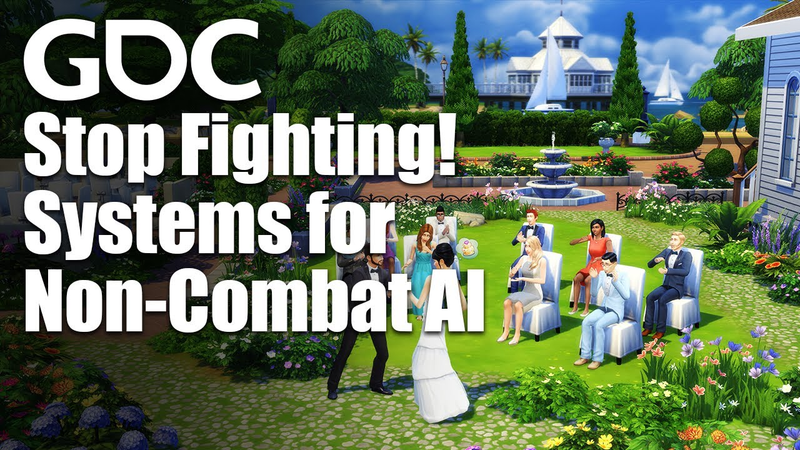
Stop Fighting! Systems for Non-Combat AI
The primary objective of this analysis is to provide a framework for developing immersive, non-combat artificial intelligence in video games.
- Utility theory is the most effective foundation for non-combat AI, using weighted utility curves to drive decisions based on NPC needs, personality traits, and environmental context.
- Controlled randomness must be integrated into utility-based decision-making to generate emergent, organic behaviors that avoid repetitive, deterministic loops.
- Relationship systems, where NPCs maintain distinct feelings toward other characters and objects, are essential for creating social depth and driving non-combat conflict.
Applying Methods from Other Domains to Identify Gamer Behaviors
Addressing disruptive conduct in digital environments requires a sophisticated, dual-modeling approach that synthesizes top-down hypothesis testing with bottom-up data mining.
- Games with low toxicity levels demonstrate over 16% higher player retention compared to high-toxicity games, while medium-toxicity titles see approximately 10% higher retention.
- Analysis of player behavior shows that 35% of players make potentially offensive statements, and in nearly 20% of reported toxicity cases, the offender was provoked by another player.
- Contextual gameplay data reveals that friendly fire rates increase significantly when a team is losing by a large margin, suggesting that environmental triggers like score deficits influence disruptive behavior.
'Death Stranding': An AI Postmortem
The development of Death Stranding necessitated a fundamental reimagining of artificial intelligence navigation to accommodate a vast, traversal-focused environment defined by jagged, fragmented terrain.
- To manage the computational cost of high-density navmeshes in a vast, fragmented environment, the team replaced interval-based pathfinding with an event-driven system that updates only when environmental conditions change.
- The engineering team implemented a hybrid navigation network that integrates standard navmeshes with high-level AI road systems to ensure stable NPC movement across the game's expansive world.
- Dynamic navmesh generation, powered by time-sliced terrain analysis and a delta path cost heuristic, allows NPCs to evaluate the trade-off between distance and traversal difficulty in real-time.
Voice AI For Game Developers: Optimizing the Narrative Process
Voice AI technology is fundamentally transforming the narrative production process in the gaming industry by offering a scalable, cost-effective alternative to traditional voice acting.
- Modern AI voice technology replaces traditional studio recording with scalable, emotionally nuanced dialogue that maintains player immersion.
- Early integration of AI-generated dialogue allows developers to iterate on narrative content faster by removing the financial and time constraints of professional recording studios.
- AI-driven tools now enable real-time synchronization of human cadence, tone, and facial expressions onto digital characters.
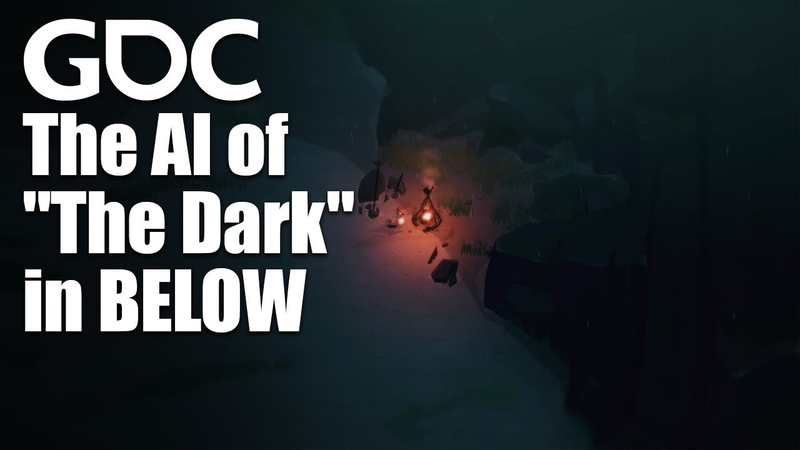
A Dark Mind: The AI of ""The Dark"" in BELOW
The development of the tentacle-based entity known as The Dark in the game BELOW centers on achieving a balance between fluid, animalistic movement and structured, readable combat mechanics.
- Capy Games developed 'The Dark' for the game BELOW using a 30-bone mesh tentacle system that combines bespoke squirmy idle animations with a kinematic chain controlled by an inverse kinematic (IK) tip target.
- To solve issues with poor animation blending caused by complex kinematic states, the team implemented a shape-casting system that rotates around a target to find unobstructed goal positions for the tentacle tips.
- The team transitioned from a rigid, order-of-execution rule system to a flat scoring-based architecture, allowing for configurable weights that make it easier to balance competing behaviors like avoiding the player versus hiding the tentacle base.