AI reports and market data
Documents
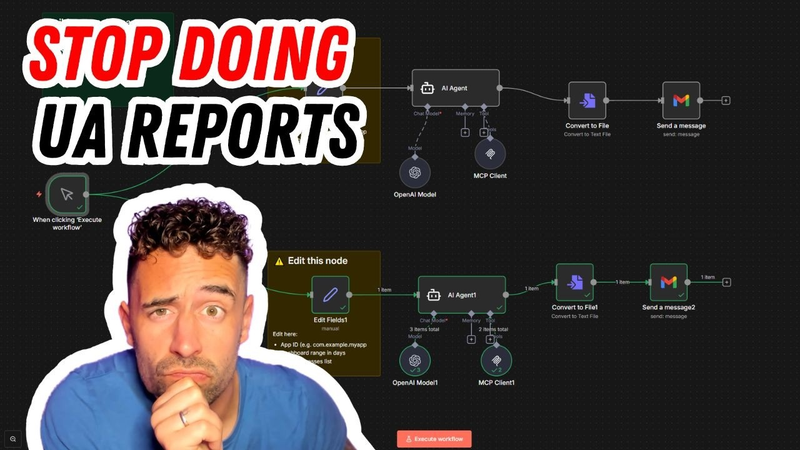
🤖 Building a UA reporting agent live, in 15 minutes by Matej Lancaric
Automating weekly user acquisition (UA) reporting is a highly effective strategy for mobile gaming consultants and growth marketers to reclaim time spent on manual data consolidation.
- Automating weekly UA reporting via the Model Context Protocol (MCP) allows growth marketers to connect AppsFlyer data directly to AI platforms like n8n, Claude, or ChatGPT to eliminate manual data consolidation.
- The technical implementation requires generating an AppsFlyer API token, configuring an MCP-compatible client, and integrating an OpenAI API key within an automation tool.
- UA managers can use open-source AppsFlyer templates to automate executive summaries and spend cap alerts without needing advanced coding skills.

MDM Podcast, Season 7, Episode 11: Understanding Unity's Vector (with Felix The)
Unity’s Vector platform represents a strategic evolution in mobile user acquisition by leveraging the company’s dual role as a game engine provider and an advertising network.
- Unity's 'Vector' advertising product leverages engine-level runtime data to improve user acquisition performance by providing high-fidelity, sequential event signals that are superior to traditional, often fragmented, software development kit (SDK) data.
- Unity is shifting from fragmented machine learning approaches to 'massive unified models' that allow for better autocorrelation, covariance, and causal understanding of user behavior across the advertising ecosystem.
- The company is prioritizing generative AI tools that focus on improving Return on Ad Spend (ROAS) rather than just increasing creative volume, ensuring that advertisers do not simply shift costs from production to marketing without performance gains.
OpenClaw 101: Automated Content Creation with AI
OpenClaw functions as an advanced agentic AI framework designed to achieve full automation of digital workflows, specifically targeting high-volume content creation for platforms like TikTok and Instagram.
- OpenClaw enables the creation of autonomous AI agents that can perform complex, multi-step workflows like managing end-to-end content pipelines for TikTok and Instagram with minimal human intervention.
- AI agents operate using 'skills'—modular, downloadable sets of instructions that allow the agent to execute specific tasks such as video editing, web searching via MCP (Model Context Protocol), or data analysis.
- Persistent memory allows agents to retain context over time, which users can manually review and edit in local files to correct errors or refine the agent's behavior.


2026 Digital Advertising Trends Report
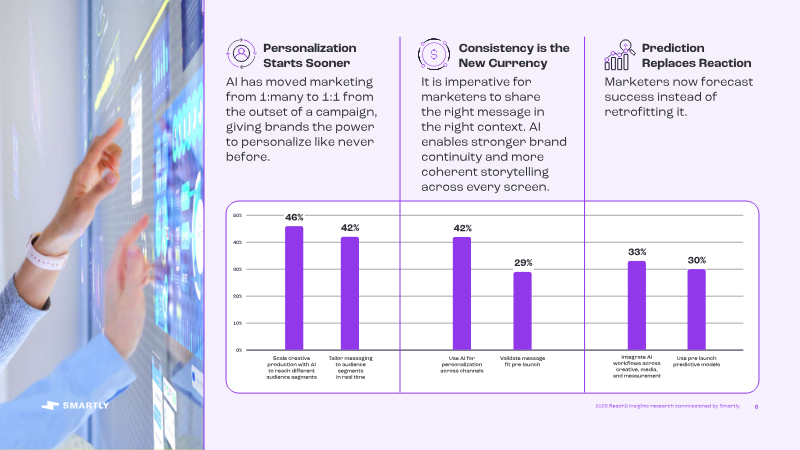
The 2026 Digital Advertising Trends Report identifies a fundamental shift in marketing strategy, where the integration of artificial intelligence, cross-channel orchestration, and predictive intelligence has become essential for maintaining competitive advantage.
- 92% of marketing decision-makers identify AI as the primary driver for redefining the customer journey, signaling a shift from linear funnels to fluid, data-driven ecosystems.
- Marketers categorized as 'precision-first'—those who integrate AI into workflows and utilize six or more platforms—are 27% more effective at minimizing media waste than their peers.
- Generative AI adoption has reached 95% among marketers, who primarily use the technology for the creation and optimization of advertising assets.
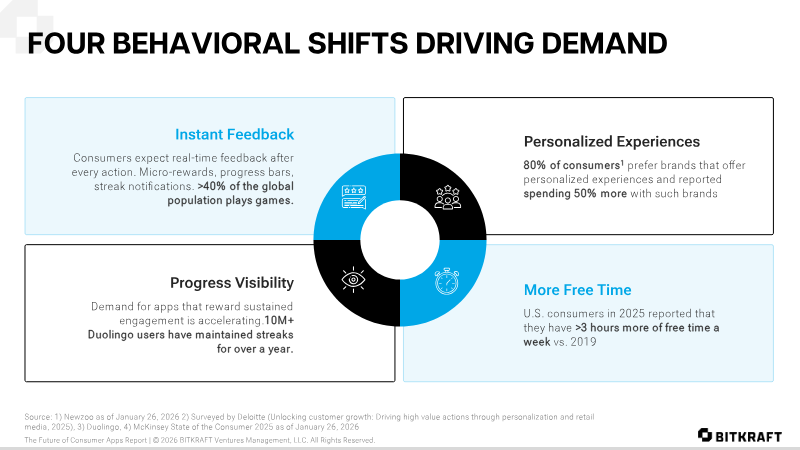
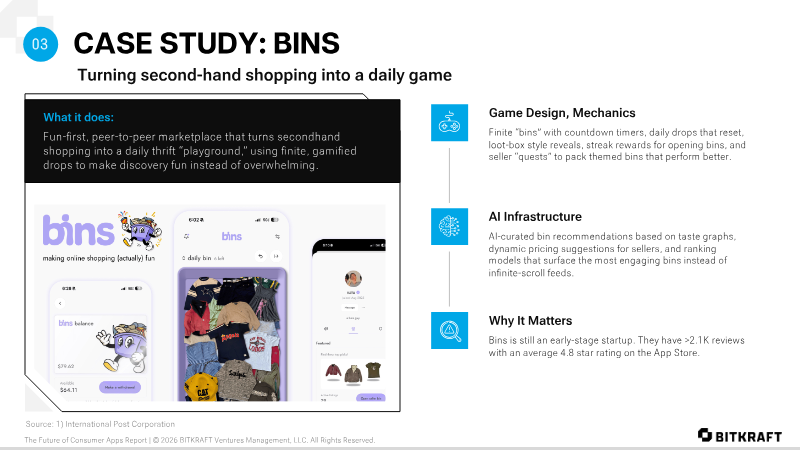
The Future of Consumer Apps: How AI and Game Design Principles Are Reshaping Every Category
The analysis establishes that consumer applications are entering a “Game-Design 2.0” era, driven by AI-native personalization, real-time feedback and progression systems that elevate engagement and monetization across education, fintech, e-commerce, health, social media and emerging verticals.
- Non-gaming mobile app revenue is projected to reach $150 billion by 2030, with spending in this sector already surpassing traditional gaming apps as of 2025.
- AI-driven gamification is the primary catalyst for revenue and engagement, with BITKRAFT forecasting at least five non-gaming consumer companies will exceed $10 billion valuations by 2035.
- High-friction sectors are successfully using game mechanics to drive retention; for example, fintech platforms like StockGro use leaderboards and AI-personalized tutorials to convert financial discipline into instant gratification.

MDM Podcast, Season 7, Episode 7: MDM Mailbag #7 (with Matej Lancaric)
The mobile gaming industry is undergoing a structural shift toward web-based onboarding and direct-to-consumer payment strategies to mitigate the impact of platform-level tracking restrictions and high app store fees.
- Mobile game developers are increasingly using web-based onboarding and shops to bypass the 30% platform fees charged by Apple and Google, though major companies remain hesitant to fully move their monetization stacks due to security concerns and the difficulty of auditing web-based transactions.
- Artificial intelligence and no-code tools have drastically shortened production cycles for high-quality video and playable ads, allowing developers to deploy new creatives in as little as one day using pre-built templates.
- The effectiveness of mobile measurement partners (MMPs) remains debated, with smaller studios often lacking the internal resources to manage complex data attribution, leading to a reliance on internal dashboards built on top of Firebase and Looker.

Model Dev Memo Podcast, Season 7, Episode 5: Ads in ChatGPT (with Rishabh Jain)
The integration of advertising into ChatGPT represents an economically rational evolution designed to scale the platform while enhancing user discovery.
- OpenAI's transition to an advertising model is an economically rational move that allows the company to fund product improvements while providing users with access to more advanced models.
- The initial high-CPM (cost per mille) entry strategy is likely a deliberate tactic to prioritize signal collection and system training over immediate mass-market adoption.
- OpenAI is expected to prioritize large, established brands for early ad placements to minimize user friction and avoid the risks associated with niche or controversial product targeting.

TWiG #375: GDC 2026 Post-Mortem, Epic’s Surrender & Google Play’s Legal Rebirth
The global gaming industry is currently navigating a period of significant structural recalibration, marked by declining event attendance and shifting platform economics.
- GDC 2026 attendance has declined by 30% compared to 2011 levels, signaling a structural shift away from mass-market conventions toward exclusive, executive-focused events.
- Google Play’s recent 5% reduction in service fees is considered insufficient to offset the rising costs of user acquisition, despite improvements in user friction through the removal of installation scare screens.
- Epic Games is pivoting away from protracted legal battles toward internal platform growth, focusing on self-publishing and cross-platform social features rather than alternative mobile app stores.

🚨📢 Breaking News: Apple AI money, rewarded roll-up, mobile funding wave
The mobile gaming industry is currently defined by three major trends: the indirect monetization of generative AI, a resurgence in venture capital funding for game studios, and the consolidation of rewarded user acquisition (UA) platforms.
- Major industry players are prioritizing control over distribution infrastructure, evidenced by NCSoft’s $202 million acquisition of a 70% stake in Just Play and Nazara Technologies’ $100 million investment in Blue Tile and Best Play.
- The mobile gaming industry is undergoing a consolidation of rewarded user acquisition firms, allowing companies to build proprietary ecosystems that bypass traditional ad networks.
- Apple is projected to generate nearly $1 billion in annual revenue from third-party generative AI applications by collecting 15% to 30% commission fees on subscriptions through the App Store.

TWIG #374 GDC 2025: The Honest Debrief
The gaming industry is currently navigating a period of profound structural transition, characterized by a cautious atmosphere and a growing disconnect between traditional development models and emerging consumer preferences.
- Investors are shifting capital away from traditional PC and console development, viewing these sectors as low-growth publishing models and instead prioritizing gaming-adjacent AI tools and emerging markets like Turkey.
- The gaming industry faces a structural crisis defined by rising customer acquisition costs, declining download volumes, and a significant contraction in venture capital investment.
- Gen Alpha is abandoning traditional high-fidelity narrative titles in favor of low-fidelity, social-first experiences on platforms like Roblox, rendering established development playbooks increasingly obsolete.

Podcast: Deploying AI personalization at scale (with Christina Augustine)
AI-enabled personalization has transitioned from static, cohort-based segmentation to a dynamic, real-time model that treats consumers as unique individuals.
- The shift from predictive models to generative AI agents allows brands to move beyond static cohort-based segmentation toward real-time, individualized marketing based on immediate behavioral signals.
- Conversational shopping agents are increasingly used to improve purchase confidence and reduce friction, particularly for complex B2B sales or large-assortment retail where guided selling is required.
- Data quality remains the primary bottleneck for deploying AI personalization at scale, as brands must move from passive click-tracking to active mechanisms that capture explicit customer intent.
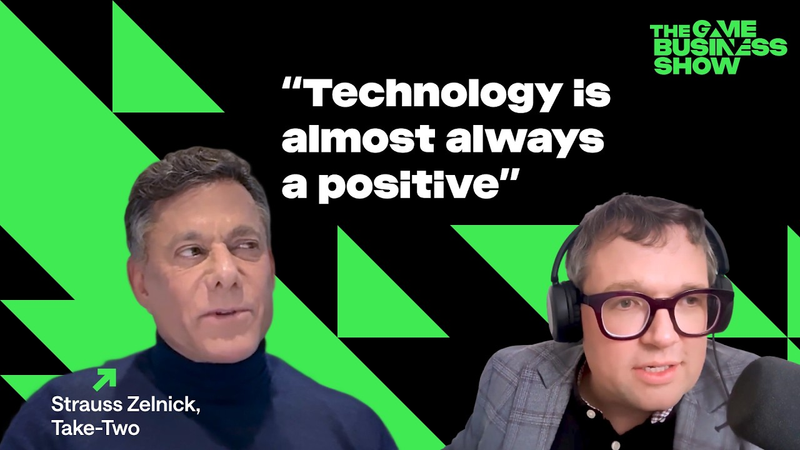
Take-Two CEO Interview: ‘The notion that AI can make GTA is laughable’
Take-Two Interactive CEO Strauss Zelnick asserts that while artificial intelligence offers significant potential for operational efficiency and creative support, it does not pose a threat to the traditional model of high-end interactive entertainment.
- Take-Two Interactive projects a major shift in revenue distribution over the next decade, with the U.S. share expected to drop from approximately 65% to 20–25% as the company expands into India, Africa, the Middle East, and Latin America.
- CEO Strauss Zelnick maintains that AI is a tool for operational efficiency and asset creation rather than a replacement for human creativity, explicitly dismissing the idea that AI can generate blockbuster titles like Grand Theft Auto.
- Take-Two currently utilizes hundreds of AI implementations across its labels to streamline workflows and support the company's core strategy of creativity, innovation, and efficiency.