AI reports and market data
Documents

GDC 2026: AI, UGC, and the New Reality of Game Funding
The gaming industry is currently navigating a pivotal transition characterized by the integration of artificial intelligence and user-generated content as foundational pillars of development and business strategy.
- Investor expectations have shifted from funding based on team pedigree or prototypes to requiring proven traction and established community engagement.
- Gaming companies are adopting AI tools to accelerate development but are keeping these implementations quiet due to negative sentiment from a vocal segment of their player base.
- User-generated content (UGC) platforms like Roblox and Fortnite UEFN are becoming critical for traditional studios to extend game lifespans and maintain player retention as development cycles lengthen.

The Prosperous Society, Part 1: The Primacy of Distribution
The digital economy is undergoing a fundamental structural shift as generative artificial intelligence collapses the marginal cost of software and content production toward zero.
- As generative AI reduces the marginal cost of software production toward zero, the primary economic constraint shifts from production capacity to distribution efficiency.
- Human attention is a finite, non-scalable resource; as AI enables a massive increase in product volume, competition for this attention drives up the cost of customer acquisition.
- Economic savings gained from cheaper AI-driven development are frequently competed away, as firms must reallocate those funds into distribution and marketing to remain visible in a crowded market.

Mobile Dev Memo Podcast, Season 7, Episode 8: Games and AI (with Joost van Dreunen)
The gaming industry currently faces a critical miscalculation regarding the role of generative AI, as public markets erroneously view the technology as a disruptive force destined to replace human labor.
- The video game industry experienced significant workforce reductions, with 15,000 layoffs in 2024 and approximately 9,500 in 2025, a trend accelerated by both economic decline and the promise of AI-driven efficiency.
- AI currently excels at productivity and cost-cutting but fails to generate new consumer demand, a critical gap that industry leaders must address to avoid a surplus of mediocre, derivative content.
- The massive infrastructure investment by AI companies, such as the competition for high-end Nvidia chipsets, is driving up hardware costs and creating a supply-side barrier for consumers and smaller developers.

Mobile Dev Memo Podcast, Season 7, Episode 9: RecSys and internet commerce (with Michael Komasinski)
The evolution of digital commerce is shifting toward an agentic model where artificial intelligence serves as an intermediary between consumers and retailers.
- The future of digital commerce discovery will rely on a hybrid model that integrates semantic language platforms with high-volume recommendation systems (RecSys) to ensure product suggestions are accurate and relevant.
- Criteo rejects the concept of fully autonomous purchasing agents, instead focusing its product roadmap on 'agentic' commerce that acts as an augmented, assisted experience where the human retains final decision-making authority.
- Recommendation systems and ad-targeting algorithms are converging, as both rely on similar dual-encoder architectures and data-driven signal processing to drive conversion outcomes.

🚨📢BREAKING NEWS: 15% Google play fees, EA layoffs, Microsoft saving face 🤯
The gaming industry is currently navigating a period of significant platform adjustments, regulatory scrutiny, and cooling enthusiasm for artificial intelligence.
- Google is reducing Play Store commission fees to a flat 20%, with further potential reductions to 15% for developers who utilize Google Play Games and cloud-based synchronization.
- Electronic Arts is implementing workforce layoffs despite reporting record revenue from its live-service game titles.
- Newzoo projections indicate that PC gaming revenue is expected to overtake console revenue by 2028.
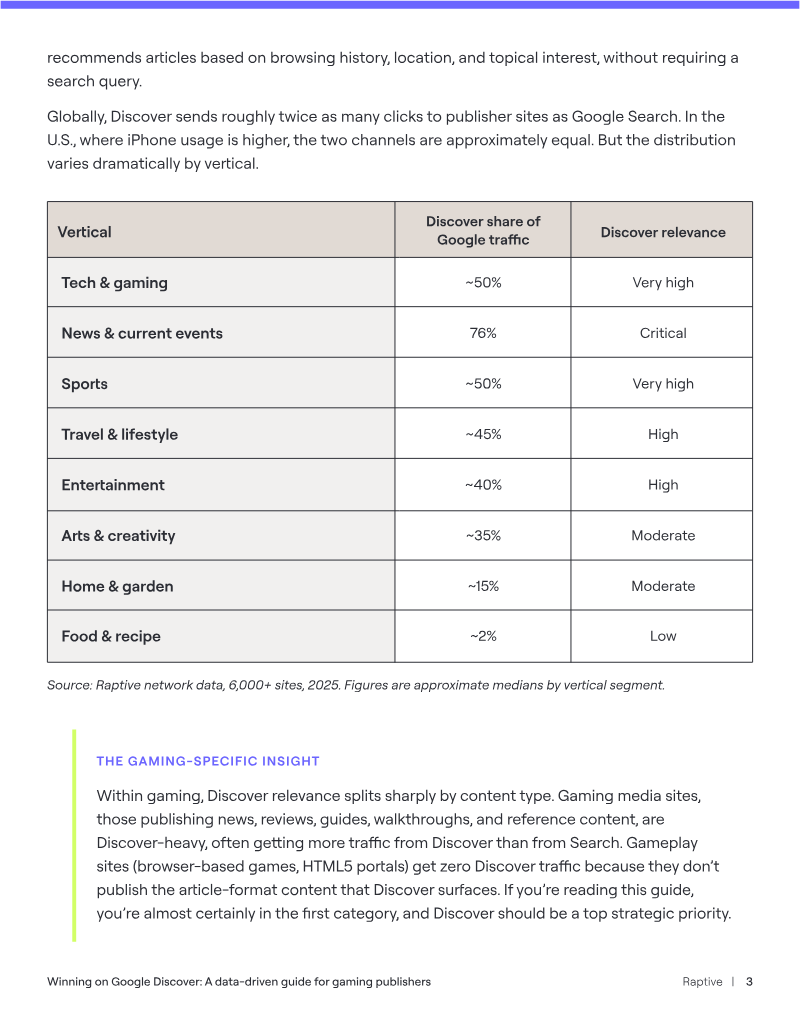
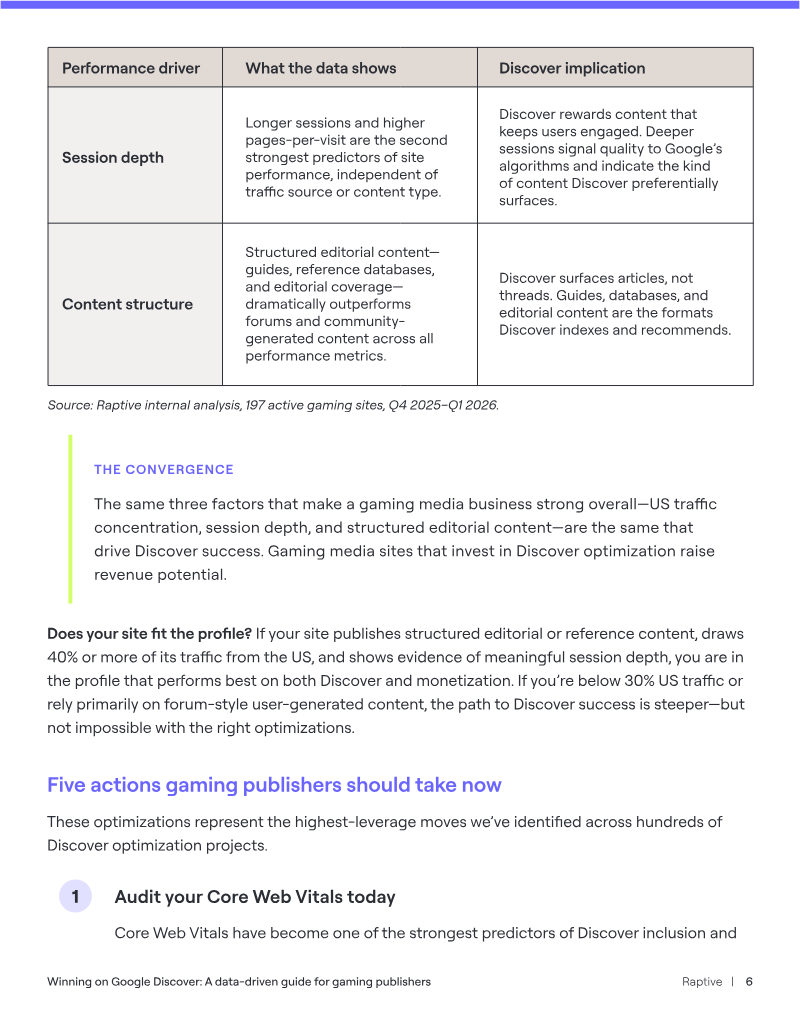
Winning on Google Discover: A Data-Driven Guide for Gaming Media
The brief explains how Google’s February 5, 2026 “Discover core update” expands the personalized content feed and shifts traffic from traditional search to Discover, especially for gaming media.
- Google Discover now accounts for roughly 50% of Google traffic for gaming sites within the Raptive network, following a February 5, 2026 core update that shifted traffic away from traditional search.
- Sites that prioritize high U.S. traffic concentration, deep session depth, and structured editorial content like guides and databases experience superior Discover performance and revenue stability.
- Following the February 2026 update, 20% more gaming sites began receiving Discover feed impressions, with smaller publishers seeing notable traffic growth.

🚨📢 BREAKING NEWS: Fortnite Returns, AI Wars Begin, Netflix Backs Out
The mobile and technology landscape is undergoing significant structural shifts driven by legal settlements, consumer sentiment regarding artificial intelligence, and major corporate consolidation.
- Paramount has acquired Warner Bros. Discovery for $31 per share, casting uncertainty over the future of the latter's gaming division and its high-revenue intellectual properties like the DC Universe and Harry Potter.
- Google is restructuring its platform economy to allow Fortnite's return to the Google Play Store, effectively reducing its standard 30% in-app purchase commission to 20% through 2027.
- Following a partnership between OpenAI and the U.S. Department of Defense, ChatGPT experienced a 295% surge in uninstalls and a decline in new downloads.

Resident Evil Requiem's 5m sales: How Capcom did it
The gaming industry is currently navigating a period of significant structural transition, marked by increased regulatory scrutiny of international investments, the failure of live-service models like Highguard, and evolving platform strategies from major publishers.
- Resident Evil Requiem achieved 5 million unit sales in under one week, marking the fastest launch in the franchise's history.
- The title reached a peak of 344,414 concurrent players on Steam, underscoring the critical role of PC and handheld hardware like the Steam Deck in driving high-volume sales.
- Capcom generated significant pre-launch momentum by securing over one million wishlists through a platform-agnostic marketing strategy that avoided exclusive deals.

Is Roblox Killing the Games Industry?
The gaming industry is currently experiencing a period of stagnation characterized by record-high revenues but steadily declining profits since 2018.
- Roblox is capturing 67% of all non-China gaming market growth, effectively cannibalizing time and wallet share from traditional high-margin console and PC titles.
- While the broader gaming industry has seen only 1.4% growth, it faces a structural crisis of declining profits since 2018 despite record-high revenues.
- Venture capital investment in the gaming sector has plummeted by approximately 85% from its peak, reflecting a broader market shift away from speculative gaming ventures.

Xbox’s Next Chapter: Strategy vs Identity
The recent leadership overhaul at Microsoft’s $23 billion gaming division marks a significant strategic pivot, characterized by the retirement of long-time leader Phil Spencer and the resignation of Xbox President Sarah Bond.
- Microsoft’s gaming division is undergoing a major strategic pivot following the departure of Phil Spencer and Sarah Bond, shifting focus from console competition to AI and cloud-based corporate integration.
- The division faces significant financial headwinds, evidenced by a 10% decline in total gaming revenue and a 32% drop in hardware sales during the most recent quarter.
- Xbox is currently losing the console market share battle, with PlayStation 5 sales outpacing Xbox hardware by more than 43 million units.

Why AI Won't Save AAA Gaming?
The industry discourse surrounding the potential for artificial intelligence to revolutionize AAA gaming is currently dominated by a debate over whether the technology will drive massive efficiency gains or merely exacerbate existing structural problems.
- The industry's growth will not stem from making existing AAA models cheaper, but from developing AI-native platforms that compete for user time against short-form video and social media.
- Historical software development trends show that efficiency gains lead to increased product complexity and scope creep rather than cost reductions, as developers use new tools to build larger experiences.
- The argument that AI will democratize creation ignores that successful franchises rely on non-replicable assets like established intellectual property, athlete licensing, and deep network effects.



The Dual Frontier: A Retailer’s Framework for Agentic Commerce
Retailers frequently adopt LLM-powered chat widgets without addressing the core friction points that shape shopper behavior.
- Retailers must prioritize high-quality, structured catalog data, as insufficient data in an agentic environment causes total exclusion from a shopper's consideration set rather than just lower conversion rates.
- A 32-point readiness diagnostic across four pillars—catalog, infrastructure, organizational capacity, and strategic urgency—determines the viability of agentic commerce, with scores of 26–32 indicating immediate readiness and 0–9 requiring foundational work.
- Retailers should adopt a calibrated data-sharing strategy, categorizing signals into 'share freely,' 'share selectively,' and 'protect' to balance recommendation accuracy with the need to safeguard proprietary competitive advantages.