Updated Apr 13, 2026 by Departement Cultuur
The game development industry is currently navigating a period of profound structural instability, characterized by widespread workforce reductions and a pervasive sense of professional anxiety. Despite the rapid integration of artificial intelligence, the primary driver of current career displacement remains studio restructuring rather than technological replacement. While the majority of the workforce remains employed in hybrid or remote roles, a significant portion of professionals are actively reassessing their career trajectories. This climate of cautious realism is reflected in market sentiment, where nearly 40 percent of industry participants anticipate further decline, leading to increased emotional fatigue and a shift in priorities toward time-based benefits, such as the four-day workweek, over traditional office perks. Geographically, the industry maintains a clear hierarchy in compensation, with North America consistently commanding the highest salary tiers across all seniority levels. In contrast, Central and Eastern Europe continue to function as the most cost-effective hubs for talent acquisition. This regional disparity underscores a broader trend of geographic diversification, as studios balance the need for specialized expertise with the economic realities of global operations. Although the workforce remains mobile, the prevalence of remote work has effectively anchored many professionals, creating a distinct divide where on-site employees demonstrate a significantly higher propensity for international relocation compared to their remote counterparts. The current landscape is defined by a maturing workforce dominated by mid-to-senior level professionals, accompanied by a concerning decline in new entrants. This demographic shift, coupled with the ongoing volatility in employment, has necessitated more flexible recruitment strategies. Studios are increasingly moving away from traditional hiring models, favoring diverse solutions that range from subscription-based flat-fee packages to comprehensive recruitment process outsourcing. As the industry continues to evolve, these data-driven benchmarks serve as a critical framework for both studios and professionals attempting to navigate the complexities of global compensation and shifting labor market dynamics.
I’m ready to combine the section summaries into a cohesive overview, but I’ll need the remaining sections to capture the full scope, key data points, and conclusions of the 2024 Catalan video‑game industry analysis. Could you please provide the rest of the section summaries?
The financial results for the first quarter of 2025 detail the operational and fiscal performance of PCF Group S.A., a global video game developer. The data reflects a period of strategic transition, characterized by rising quarterly revenues alongside shifting profitability margins. Total revenue for the first quarter of 2025 reached 63.0 million PLN, an increase from 56.9 million PLN in the same period of the previous year. Despite this growth, the group reported a net loss of 3.9 million PLN for the quarter, compared to a narrow loss of 0.9 million PLN in the first quarter of 2024. Adjusted EBITDA also saw a decline from 11.0 million PLN to 1.7 million PLN year-over-year. The financial performance was influenced by several key operational factors, including the integration of PCF Chicago into PCF US and the inclusion of new projects such as Project Delta and Project Echo. Conversely, profitability was impacted by lower revenues from Project Gemini and the recognition of costs related to Project Bifrost within the cost of goods sold. The group’s workforce remained stable at 675 employees as of March 31, 2025, with a significant concentration of developers in Warsaw and North American studios. In the virtual reality segment, the subsidiary Incuvo continues to manage Green Hell VR, which saw a successful co-op mode launch in late 2024. The group plans to release Project Bison in the fourth quarter of 2025, which is intended to be the final VR title published by PCF Group. Geographically, the group maintains a strong presence across Europe and North America, with its primary development hubs located in Poland and Canada. The methodology relies on consolidated financial data and internal project tracking as of the end of the first quarter of 2025.
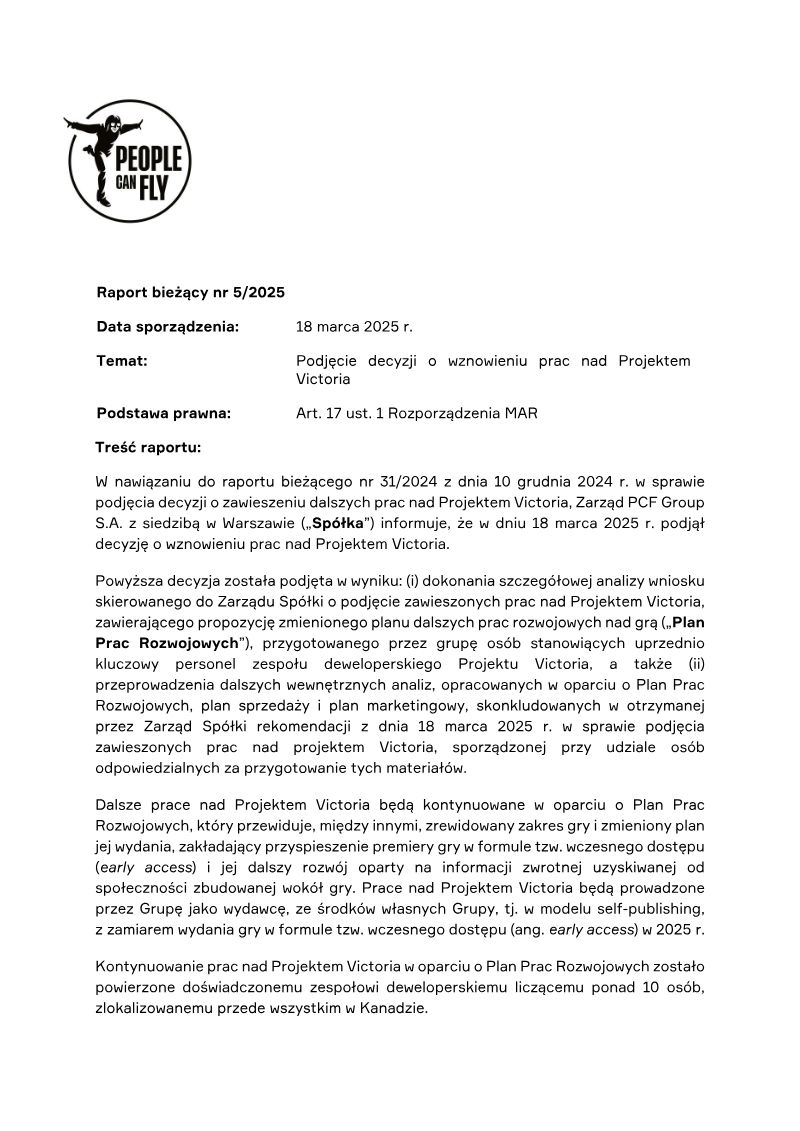
The decision to restart development of Project Victoria reflects a strategic shift by PCF Group S.A., based on a comprehensive review of a revised development plan submitted by the former core team. The new plan narrows the game’s scope, accelerates its launch through an early‑access model, and ties subsequent updates to community feedback. Funding will come exclusively from the Group’s own resources, positioning the title for self‑publishing with an anticipated early‑access release in 2025. Implementation will be overseen by an experienced development unit of more than ten specialists, primarily located in Canada. The revised schedule replaces the previously suspended timeline and introduces a faster market entry, aiming to capture early adopters while mitigating further capital outlays. The Board’s endorsement follows internal analyses of the development, sales, and marketing projections, which were compiled into a recommendation dated 18 March 2025. Concurrently, the Board reaffirms concerns raised in the December 2024 suspension report regarding potential impairment of capitalised expenditures on the project. In line with IAS 36, impairment tests will be performed using financial data as of 31 December 2024, and the results will be disclosed in accordance with statutory requirements. These tests will determine whether the capitalised costs have suffered a loss of value, informing future accounting treatment and stakeholder communication.