Country & Regional Reports·Updated Mar 17, 2026 by Niko Partners
Report · October 1, 2022
Published by Niko Partners
Female gamers represent a primary engine of growth within the Asian interactive entertainment market, accounting for 35% of the region's 1.46 billion total gamers as of 2021. This demographic is expanding at a faster rate than the general gaming population, with a year-over-year growth of 7.6% compared to the total market increase of 5.0%. The scope of this analysis covers China and the Asia-10 markets, which include Chinese Taipei, India, Indonesia, Japan, Korea, Malaysia, Philippines, Singapore, Thailand, and Vietnam. Data was derived from a 2021 survey of over 6,500 randomized respondents who identified as active gamers across mobile, PC, and console platforms. Mobile gaming is the dominant platform for this demographic, utilized by 95% of female gamers, while 60% engage with PC games and 17% use consoles. In terms of genre, female players in Asia show a strong preference for role-playing, racing, and strategy games. Discovery of new titles is primarily driven by social recommendations from friends, followed by the visual quality of graphics and core gameplay mechanics. Monetization trends indicate that female gamers are highly engaged with in-game economies, with 84% of those willing to spend making in-game purchases. They are particularly inclined toward purchasing cosmetic items and participating in gacha mechanics. In 2021, female gamer spending reached $13.07 billion in China and $5.52 billion across the Asia-10 for mobile titles, while PC game spending reached $9.70 billion and $3.93 billion in those respective regions. These findings suggest that gender inclusivity and targeted development for diverse interests are essential for capturing the full economic potential of the Asian games industry.

nikopartners.com | Silicon Valley • Shanghai • London • Bangkok • Jakarta [email protected] | © Niko Partners Female Gamers in Asia Version for Women in Games Asia Panel Gamescom Asia 2022 October 2022
© Niko Partners | Female Gamers in Asia 2 • A majority of the data in this report is proprietary Niko data and was collected via survey by accessing a panel of survey respondents across China, Japan, Korea, Chinese Taipei, Philippines, Vietnam, Thailand, Malaysia, Singapore, Indonesia, and India • For China data, Niko conducted an online survey of 2,400 gamers in tier 1 to tier 5 cities with forced quotas for each city tier. For all market surveys outside of China for this report, Niko surveyed 4149 gamers, approximately 410 respondents from each market, and delivered the survey in the local language • Survey respondents were asked complete approximately 60 questions over 20-25 minutes to ascertain data on demographics, purchase behavior, preferences, sentiment, intentions, and other relevant data. Survey respondents were randomized and survey responses were collected from individuals who identified as "gamers": those who own a mobile device, computer, or video game console and have played games on that device at least once in the past 30 days • Niko conducted further qualitative analysis using open-source, reputable third-party data sources to gather additional data that can be found within this report • In order to maintain like comparisons, all data for this report was drawn from Niko's 2021 pool of data, which is the most recent data available at time of publication for certain markets covered in this report • A further breakdown of our methodology can be made available upon request Methodology Get complete insights and an in-depth breakdown of Asia's female gamer market, including gaming, esports, and streaming, along with market size and potential in the paid version of the report here.
5 2021 est Asia Games Revenue (PC & Mobile) 2021 est Asia Gamers © Niko Partners Includes: China & Asia-10 (Chinese Taipei, India, Indonesia, Japan, Korea, Malaysia, Philippines, Singapore, Thailand, Vietnam)
Niko Partners believe that the diversity within our team, not just in terms of gender but also cultures, ethnicities and nationalities, makes our research more robust Our local expertise enables us to provide a deeper understanding of developments for all demographic criteria, as well as a more holistic view of the market © Niko Partners | Female Gamers in Asia 7 Games should appeal to all genders. There should be no boundary for who feels welcome and inspired to play video games, and games should be developed for different audiences, interests and gaming behavior We observe that female gamers are one of the drivers of growth in the Asian games market. This report provides data and analysis about female gamers in Asia—who they are and how they compare to their male counterparts Gender inclusivity matters
© Niko Partners | Female Gamers in Asia 9 Women comprise 35% of the 1.46 billion gamers in Asia 35% 65% Female Male Share of female gamers in Asia (2021) Percentage of female gamers by region (2021) Asia -10 refers to the markets of Chinese Taipei, India, Indonesia, Japan, Korea, Malaysia, Philippines, Singapore, Thailand, and Vietnam. Asia refers to the Asia-10 markets plus China Source: Niko Partners Source: Niko Partners 7.6% 5.0% FEMALE TOTAL YoY growth of gamers in Asia (2021) Source: Niko Partners
© Niko Partners | Female Gamers in Asia 10 Female gamers in Asia prefer role-playing, racing and strategy games as their top 3 Source: Niko Partners
The female gaming demographic in Asia represents a primary catalyst for regional market growth, expanding at a significantly faster rate than the male audience. In 2019, Asia accounted for 48% of global gaming revenue, totaling $69 billion. Within this landscape, female players grew to comprise 38% of the 1.33 billion total gamers in the region, up from 32% in 2017. This shift is particularly pronounced in China, where 45% of the gaming population is female, followed by South Korea, Japan, and Southeast Asia at 40% each. Mobile technology serves as the dominant platform for this demographic, with 95% of Asia’s female gamers playing on mobile devices compared to much smaller shares for PC and consoles. While female players typically engage in shorter sessions than males—with 60% playing up to seven hours per week—their spending power is substantial. Female gamers contributed 35% of mobile gaming revenue in 2019, a figure projected to reach 39% in 2020. Contrary to casual stereotypes, these players show a strong preference for complex genres including MMORPGs, MOBAs, and shooters, particularly those featuring deep strategy, diverse character options, and immersive storylines. The rise of female-specific esports leagues and professional teams further signals a maturing market with expanding sponsorship opportunities. This upward trajectory was accelerated by the COVID-19 pandemic; data from 2020 indicates that over 96% of female gamers in China increased their playtime during lockdowns, with a majority also increasing their in-game spending. To effectively engage this audience, developers and marketers must prioritize mobile-first strategies and integrate sophisticated gameplay elements that reflect the diverse interests of the modern female gamer.
Asia has established itself as the epicenter of the global gaming industry, driven by a mobile-first population exceeding 1.5 billion players. The region’s market is characterized by the dominance of free-to-play models, which account for nearly 99% of mobile revenue and all top-grossing titles. While China and Japan lead in total revenue, Japan maintains the highest value per user with an average revenue per download of $12.84. Growth is increasingly fueled by the female demographic, which expanded to 500 million players by 2019 and contributes nearly 40% of total mobile gaming revenue. This shift necessitates more inclusive storylines and diverse development teams to capture a demographic that is currently outgrowing its male counterpart. The competitive landscape is defined by the rapid ascent of mobile esports, with Asia generating 68% of the sector's global revenue. Southeast Asia, in particular, has seen a 244% increase in tournament prize pools, signaling a transition from casual play toward complex, competitive genres like MOBAs and Battle Royales. Despite high interest, a significant gap remains between esports viewership and active participation, representing a massive untapped opportunity for developers. Success in these markets requires sophisticated monetization strategies, such as hybrid models combining gacha mechanics, battle passes, and rewarded video ads to accommodate varying income levels across the territory. Navigating the Asian market demands deep localization that extends beyond language to include cultural customs, religious sensitivities, and technical optimization for diverse hardware. While Japan and South Korea remain dominated by local developers and legacy RPG franchises, India and Southeast Asia offer high-growth potential for international titles that provide "lite" versions for accessible play. To achieve long-term engagement, developers must leverage local influencers and community-driven gameplay, ensuring that titles resonate with the specific pop culture trends and infrastructure capabilities of each unique sub-region.
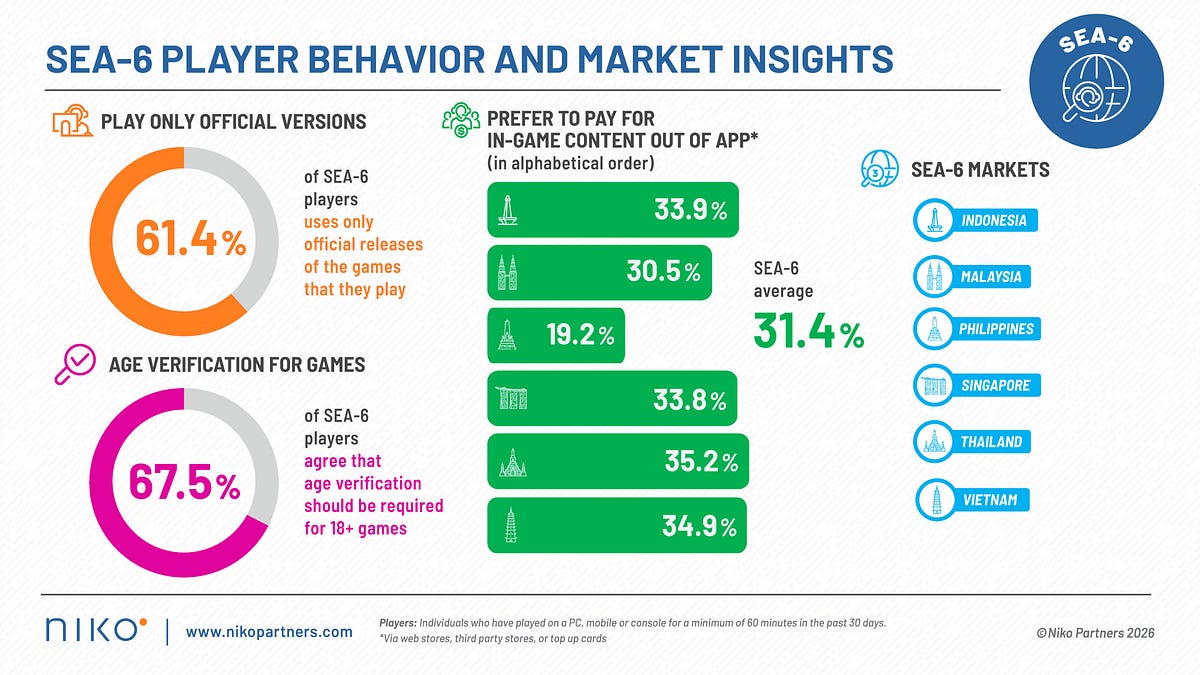
Southeast Asia represents one of the world’s fastest-growing video game markets, characterized by a young population, improving infrastructure, and a rapidly expanding digital economy. Data indicates that the six major countries in the region—Indonesia, Malaysia, the Philippines, Singapore, Thailand, and Vietnam—account for approximately $5 billion in market size and 270 million gamers. While this represents 6% of total Asian games revenue, the region is projected to maintain a compound annual growth rate of 8.6% through 2025. Esports serves as a primary driver for this growth, with over 200 million viewers and gamers in the region. Approximately 60% of Southeast Asian gamers are strongly drawn to esports, and 42% are classified as competitive arena gamers. This interest has led to the integration of esports into major regional athletic events like the SEA Games. Furthermore, the audience is becoming increasingly diverse; female gamers now make up 40% of the total gaming population, with growth rates in this demographic outpacing the general market average. In specific markets like Indonesia and Singapore, women comprise nearly half of the gaming audience. The region has also emerged as a pioneer in blockchain and play-to-earn gaming, exemplified by the success of titles like Axie Infinity, which reached over one million daily active users. However, the market faces unique challenges, including parental skepticism, fluctuating government regulations regarding game approvals and bans, and complex cultural sensitivities. Successful expansion requires navigating diverse religious and social landscapes, as localized content can significantly boost revenue while cultural oversights can lead to public backlash or censorship. Ultimately, Southeast Asia offers significant opportunities for global stakeholders, provided they adopt localized strategies rather than a one-size-fits-all approach.
Asia represents the world’s most significant mobile gaming hub, housing over half of the global player base and generating the majority of the industry's mobile revenue. The primary objective of this analysis is to examine the distinct player preferences, cultural influences, and market regulations across five key regions: China, Japan, South Korea, India, and Southeast Asia. By evaluating top-grossing titles and genre shifts through the first half of 2020, the findings illustrate a broader regional transition from casual play toward complex, competitive, and socially-driven experiences. China remains the largest market, characterized by the successful migration of PC intellectual properties to mobile and a regulatory environment that necessitates domestic partnerships. In contrast, Japan’s market is defined by a deep-rooted console history and the pervasive influence of anime and manga aesthetics, with RPGs accounting for nearly half of its mobile revenue. South Korea leverages its robust 5G infrastructure and "PC bang" culture to sustain a market dominated by high-fidelity MMORPGs. Meanwhile, India and Southeast Asia emerge as high-growth regions where young populations and increasing smartphone accessibility are fueling a massive surge in mobile esports and battle royale titles. The data reveals that localization involves more than translation; it requires integrating local folklore, respecting religious customs, and optimizing for hardware constraints. For instance, "lite" versions of games are essential for market penetration in India, while community-centric features are vital for success in Southeast Asia. Across all regions, the rise of mobile esports is a dominant trend, with competitive titles increasingly displacing traditional genres in the top-grossing charts. The methodology utilizes data from Niko Partners, incorporating market models, five-year forecasts, and qualitative surveys from a panel of millions of consumers across Asia. The analysis covers the period from 2016 through June 2020, drawing on data from retailers, app markets, and interviews with industry executives to provide a comprehensive view of the mobile landscape.