Report14 pages
Prezentacja wyników finansowych: 9 miesięcy 2022
The presentation outlines PCF Group S.A.’s financial performance for the first nine months of 2022, emphasizing revenue growth, profitability metrics, and balance‑sheet strength. Total group revenues reached PLN 131.8 million, up from PLN 130.9 million in the same period of 2021, while EBITDA climbed to PLN 40.3 million from PLN 26.1 million in 2021, reflecting a significant improvement in operating efficiency. Adjusted EBITDA, accounting for non‑recurring items such as warranty provisions and restructuring costs, stood at PLN 41.3 million, underscoring robust underlying earnings.
Net income for the nine‑month period was PLN 42.1 million, a notable increase from PLN 30.8 million in 2021, driven by higher gross margins and disciplined cost management. The group’s balance sheet remained solid, with total assets of PLN 60.3 million and equity of PLN 54.6 million, while working‑capital items such as receivables and payables were well balanced. Cash reserves of PLN 137.1 million provided liquidity for ongoing development and expansion initiatives.
Geographically, PCF Group operates across multiple regions, with a workforce of 614 employees as of September 30, 2022, spread across North America and Europe. The company’s portfolio includes seven titles in development or publishing stages, with several high‑profile IPs such as “Gemini Dagger” and “Bifrost Victoria” slated for release in 2024. The presentation also highlights strategic partnerships, including a collaboration with Take‑Two Interactive Software and ongoing development outsourcing that generated PLN 44.1 million in revenue during the period.
Overall, the data indicate a healthy growth trajectory for PCF Group S.A., driven by expanding IP pipelines, efficient cost structures, and a strong balance sheet that supports continued investment in game development and market expansion.
- PCF Group S.A. reported a net income of PLN 42.1 million for the first nine months of 2022, a significant increase from PLN 30.8 million in the same period of 2021.
- EBITDA grew to PLN 40.3 million from PLN 26.1 million in 2021, reflecting improved operating efficiency and disciplined cost management.
- The company maintains a strong liquidity position with PLN 137.1 million in cash reserves to support ongoing development and expansion initiatives.
- Development outsourcing remains a key revenue driver, contributing PLN 44.1 million to the total group revenue of PLN 131.8 million.
- The company is actively developing seven titles, including high-profile IPs 'Gemini Dagger' and 'Bifrost Victoria' scheduled for release in 2024.
+2
PCF Group
Report2 pages
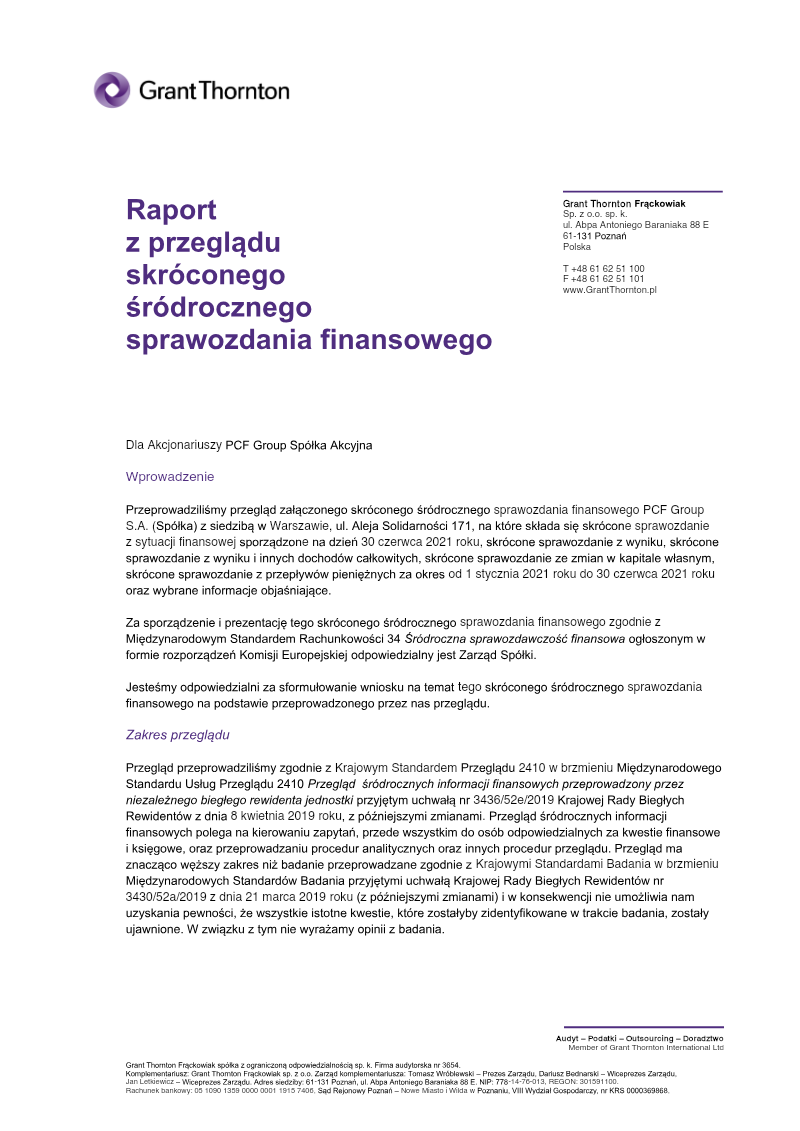
Raport z przeglądu skróconego śródrocznego sprawozdania finansowego: H1 2021
The report presents the conclusion of an independent review conducted by Grant Thornton Frąckowiak on PCF Group S.A.’s condensed half‑year financial statements for the period from 1 January to 30 June 2021. The review covered the condensed statement of financial position, the condensed statements of profit or loss and other comprehensive income, changes in equity, cash‑flow statement, and selected explanatory notes. The statements were prepared in accordance with International Accounting Standard 34 on interim financial reporting, as adopted by European Union regulations.
The engagement was performed under the Polish National Standard for Review of Interim Financial Information (Standard 2410), equivalent to International Standard on Review Engagements. The review involved inquiry procedures directed at the company’s finance and accounting personnel, analytical procedures, and other review activities. The scope is narrower than a full audit; therefore, the reviewers do not express an audit opinion but provide a review conclusion.
The key finding is that nothing was identified that would lead the reviewers to believe the condensed interim financial statements were not prepared in all material respects in accordance with IAS 34. The conclusion is supported by the procedures performed and the information obtained during the review.
The report covers PCF Group S.A., a Warsaw‑based joint‑stock company, and pertains to the first half of 2021. No specific financial figures or ratios are disclosed in the summary, as the focus is on the review methodology and overall compliance with IAS 34.
- Grant Thornton Frąckowiak issued a clean review conclusion for PCF Group S.A.’s condensed half-year financial statements for the period ending 30 June 2021.
- The review confirmed that the financial statements were prepared in all material respects in accordance with International Accounting Standard 34 (IAS 34) for interim financial reporting.
- The engagement was conducted under the Polish National Standard for Review of Interim Financial Information 2410, which is equivalent to the International Standard on Review Engagements.
- The scope of the review was limited to inquiry and analytical procedures, meaning no formal audit opinion was expressed by the reviewers.
- The review covered the full suite of financial documents, including the statement of financial position, profit or loss, comprehensive income, changes in equity, and cash-flow statements for H1 2021.
PCF Group
Report2 pages
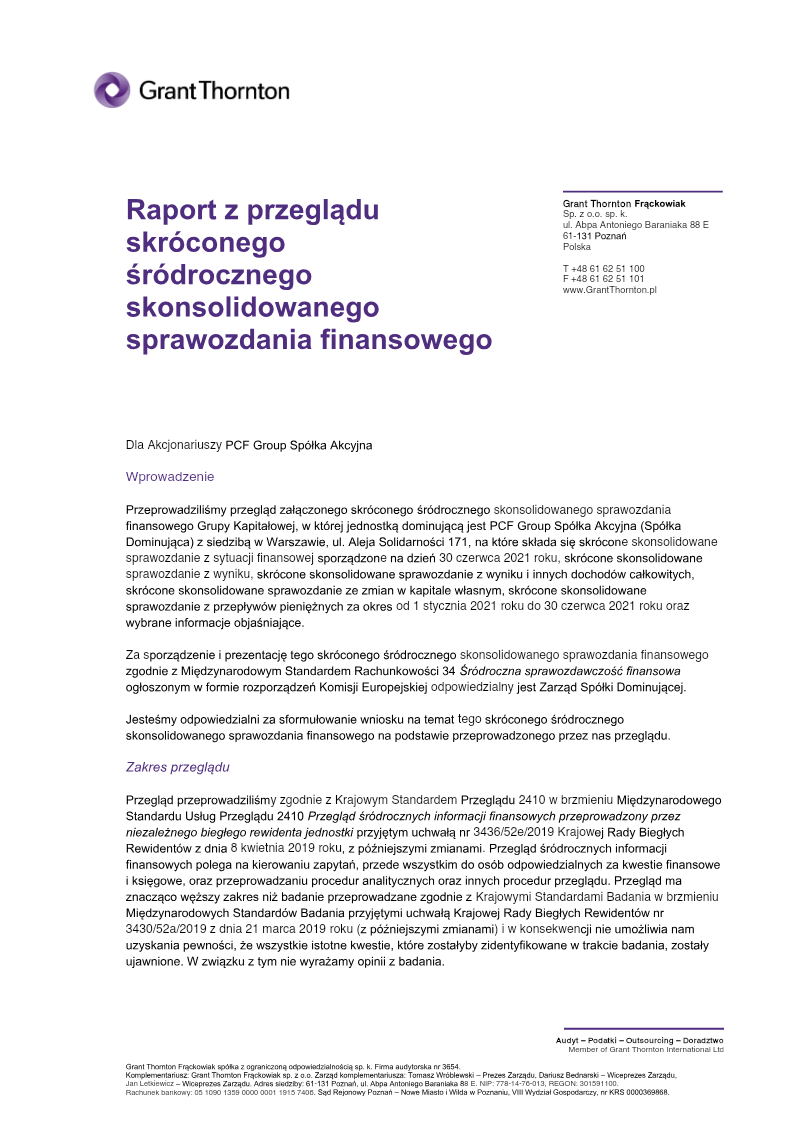
Report on the Review of the Condensed Interim Consolidated Financial Statement: 2021
The report presents the conclusion of a review conducted by Grant Thornton Frąckowiak on the condensed interim consolidated financial statements of PCF Group Spółka Akcyjna for the period ending 30 June 2021. The review covers the group’s condensed consolidated statements of financial position, income, other comprehensive income, changes in equity and cash‑flow information for the first half of 2021. The statements were prepared in accordance with International Financial Reporting Standard 34 on interim financial reporting, as required by European Commission regulations.
The review was performed under Polish National Standard 2410, equivalent to the International Standard on Review Engagements. The engagement involved inquiry procedures directed at financial and accounting personnel, analytical review procedures, and other review activities. The scope is limited compared to a full audit; therefore, the reviewers cannot express an assurance opinion that all material matters have been identified and disclosed.
The conclusion states that nothing was found to indicate that the condensed interim consolidated financial statements were not prepared in all material respects in accordance with IFRS 34. The report is signed by Jan Letkiewicz, a licensed auditor, and dated 29 September 2021.
- Grant Thornton Frąckowiak concluded that PCF Group S.A.’s condensed interim consolidated financial statements for the period ending 30 June 2021 were prepared in accordance with IFRS 34.
- The review covered the group’s financial position, income, comprehensive income, changes in equity, and cash-flow information for the first half of 2021.
- The engagement was conducted under Polish National Standard 2410, which is equivalent to the International Standard on Review Engagements.
- The review process consisted of analytical procedures and inquiries of financial and accounting personnel rather than a full audit.
- Because the review scope was limited, the auditors did not provide an assurance opinion regarding the identification of all material matters.
PCF Group
Report51 pages
Śródroczne skonsolidowane sprawozdanie: Q3 2021
WARSZAWA, 29 LISTOPADA 2021 ROKU Ś RÓDROCZNE SKONSOLIDOWANE SPRAWOZDANIE ZA OKRES 3 I 9 MIESIĘ CY ZAKOŃCZONY 30 WRZEŚ NIA 2021 ROKU 29 LISTOPADA 2021 PCF GRUPA KAPITAŁOWA PCF GROUP SPÓŁKA AKCYJNA 2 0 Śródroczne skonsolidowane sprawozdanie za okres 9 miesięcy zakończony 30.09.2021 r. GROUP (dane w tys.
- PCF Group S.A.'s total assets significantly increased from 95,697 thousand PLN at the end of 2020 to 292,787 thousand PLN by September 30, 2021, driven by a substantial rise in equity from 76,519 thousand PLN to 241,589 thousand PLN.
- The company's net profit for the 9 months ending September 30, 2021, was 46,410 thousand PLN, a significant increase from 21,828 thousand PLN for the same period in 2020. Basic and diluted earnings per share also rose from 0.79 PLN to 1.57 PLN.
- Total revenue from sales grew from 79,319 thousand PLN for the 9 months ending September 30, 2020, to 131,797 thousand PLN for the same period in 2021, with most revenue (130,215 thousand PLN) coming from game production services.
- PCF Group expanded its capital group structure in 2021 by establishing People Can Fly Chicago, LLC (April 6) and acquiring Game On Creative, Inc. (April 27), further strengthening its international presence.
- The company issued new shares (Series B and D) in 2021, raising net proceeds of 100,286,845.80 PLN from Series B shares, contributing to the increase in equity.
+1
PCF Group
Report9 pages
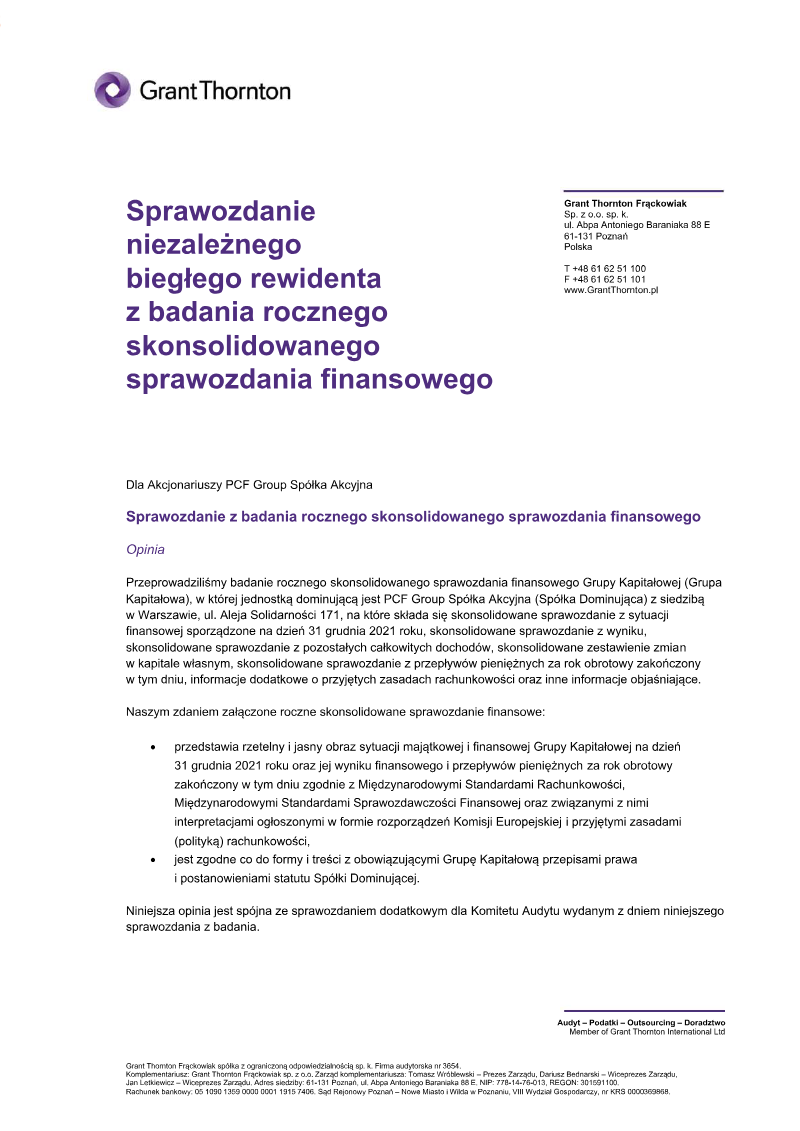
Independent Auditor's Report on the Consolidated Financial Statements: 2021
The audit report confirms that the 2021 consolidated financial statements of PCF Group Spółka Akcyjna and its subsidiaries present a true and fair view of the group’s financial position, results, and cash flows as of 31 December 2021. The statements comply with International Financial Reporting Standards, the European Union ESEF format, and Polish statutory requirements. The auditor’s opinion is unqualified, indicating that the financials are free from material misstatement and comply with applicable accounting principles.
Key findings highlight significant audit focus areas. Revenue recognition from client contracts was scrutinised due to the complexity of multi‑element agreements, variable consideration, and performance obligations. The auditor evaluated management’s estimates for bonuses, warranties, and contract modifications, confirming that disclosures in notes 3 and 9 are adequate. Another critical area involved the acquisition of Game On Creative Inc., Incuvo S.A., and Phosphor Games, LLC. The goodwill recognised at PLN 54,604 thousand required detailed valuation and impairment testing, which the auditor verified as appropriate.
The audit was conducted under Polish law for public‑interest entities and EU Regulation 537/2014, with the audit firm maintaining independence in accordance with IESBA ethics. The engagement covered three consecutive fiscal years (2019‑2021) and was repeated for 2022, ensuring continuity. No non‑audit services that would conflict with the audit were performed.
Overall, the report affirms compliance with regulatory and reporting standards, provides assurance on critical accounting judgments, and confirms that the group’s financial statements accurately reflect its economic reality.
- The 2021 consolidated financial statements for PCF Group Spółka Akcyjna received an unqualified audit opinion, confirming they are free from material misstatement and compliant with IFRS and Polish statutory requirements.
- Auditors verified the valuation and impairment testing of goodwill totaling PLN 54,604 thousand, which arose from the acquisitions of Game On Creative Inc., Incuvo S.A., and Phosphor Games, LLC.
- Revenue recognition processes were subjected to rigorous scrutiny due to the complexity of multi-element client contracts, variable consideration, and specific performance obligations.
- Management’s accounting estimates regarding bonuses, warranties, and contract modifications were reviewed and deemed adequately disclosed in notes 3 and 9 of the financial statements.
- The audit was conducted in accordance with Polish law for public-interest entities and EU Regulation 537/2014, with the audit firm maintaining full independence and providing no conflicting non-audit services.
PCF Group
Report6 pages
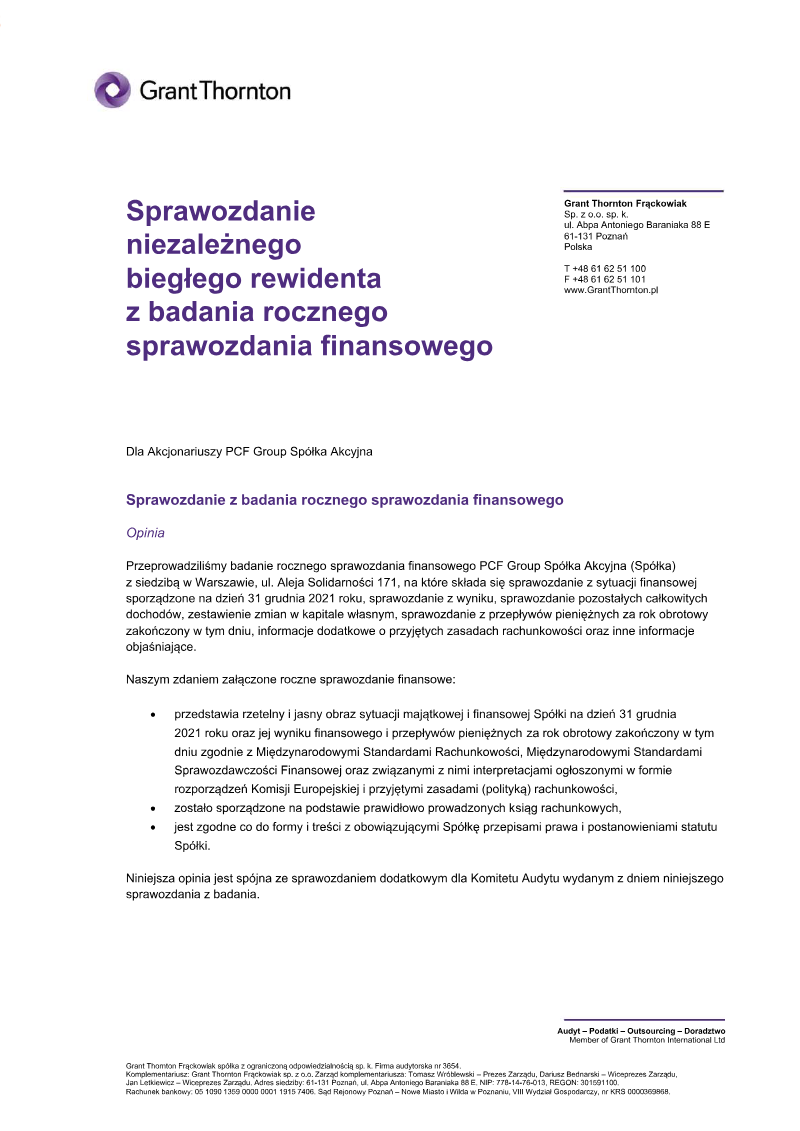
Independent Auditor's Report on the Annual Financial Statements: 2021
The audit opinion confirms that PCF Group Spółka Akcyjna’s 2021 financial statements present a true and fair view of the company’s financial position as of December 31, 2021 and its performance for the year. The statements comply with International Financial Reporting Standards (IFRS), European Commission regulations, and Polish statutory requirements. The auditor’s assessment is based on a comprehensive examination of the company’s accounting records, internal controls, and disclosures, concluding that the financial statements are free from material misstatement.
Key findings include a recorded receivable balance of 22,385 thousand zloty from client contracts and total sales revenue of 107,825 thousand zloty for the year. The audit addressed significant risks such as revenue recognition under IFRS 15 and potential fraud, noting that evidence gathered was sufficient to support the opinion. No separate opinions were issued on these risk areas, and no material misstatements were identified.
The audit was performed in accordance with Polish law on certified public accountants, the National Standards for Auditing (KSB), and EU Regulation 537/2014. The engagement team, led by key auditor Jan Letkiewicz of Grant Thornton Frackowiak Sp. z o.o. sp. k., maintained independence and complied with the International Ethics Standards Board for Accountants (IESBA) code. The firm’s selection by the company’s supervisory board in June 2021 ensured continuity of audit coverage for 2019–2022, with the current engagement covering the 2021 year.
Overall, the audit confirms that the financial statements are reliable and comply with all applicable accounting and regulatory frameworks.
- PCF Group S.A. received an unqualified audit opinion for 2021, confirming its financial statements are free from material misstatement and comply with IFRS, EU regulations, and Polish statutory requirements.
- The company reported total sales revenue of 107,825 thousand zloty for the 2021 fiscal year.
- As of December 31, 2021, the company held a receivable balance of 22,385 thousand zloty stemming from client contracts.
- The audit specifically validated revenue recognition practices under IFRS 15 and assessed potential fraud risks, finding no material issues in these areas.
- Grant Thornton Frackowiak Sp. z o.o. sp. k. conducted the audit, with Jan Letkiewicz serving as the key auditor.
PCF Group
Report53 pages
Skonsolidowany Raport Kwartalny: Q3 2022
Niniejsze sródroczne skrócone skonsolidowane sprawozdanie finansowe zostato zatwierdzone Grupa Kapitałowa PCF Group Spółka Akcyjna WYBRANE DANE W PRZELICZENIU NA EUR Podpisy wszystkich Cztonków Zarzadu Data Imie i nazwisko Funkcja Podpis zgodnie z data podpisu Sebastian Kamil Prezes Zarzadu Signature Not Verified elektronicznego Wojciechowski Dokument podpisay przez Podpisy osoby odpowiedzialnej za sporzadzenie niniejszego sródrocznego skróconego Data I...
- Net profit for the period from January 1 to September 30, 2022, was 38,680.
- Total comprehensive income after tax for the period from January 1 to September 30, 2022, was 9,179.
- Cash flows from investment activities resulted in a net outflow of (36,329).
- Cash flows from financing activities resulted in a net outflow of (11,898).
- The report, titled "Skonsolidowany Raport Kwartalny: Q3 2022" (Consolidated Quarterly Report: Q3 2022), was approved for publication on November 28, 2022.
PCF Group
Report2 pages
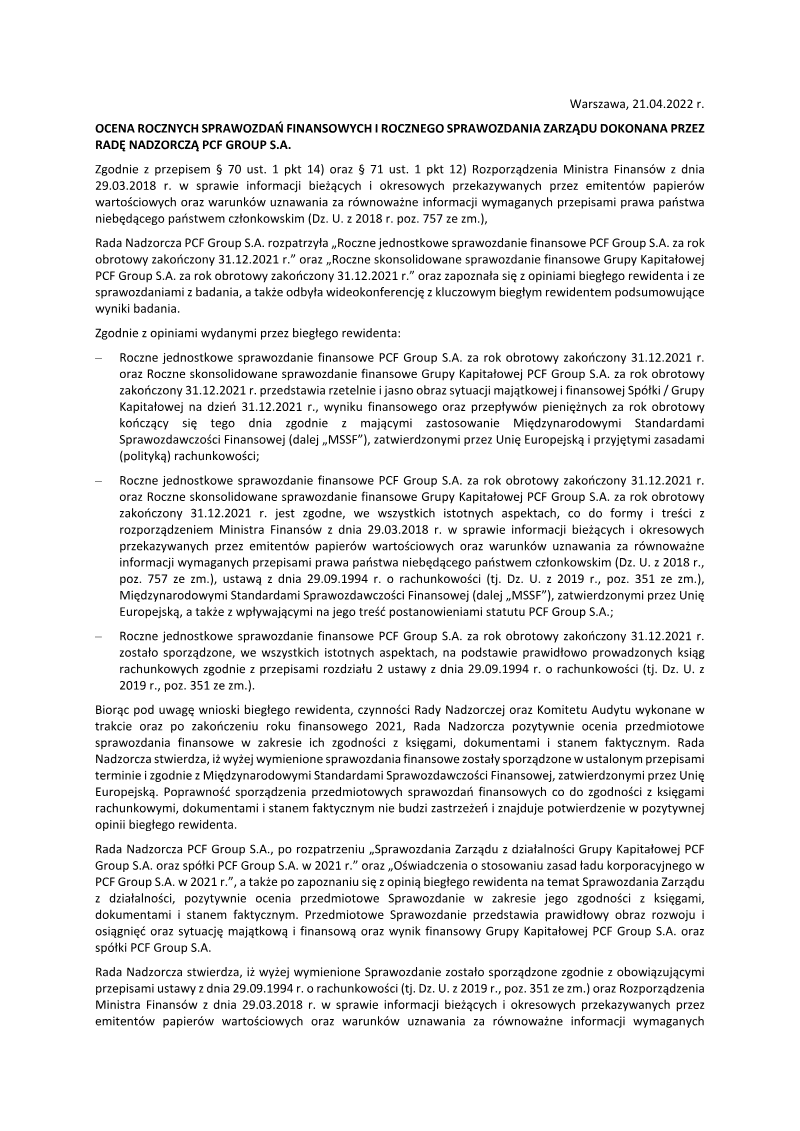
Assessment of Annual Financial Statements and Management Board Report: 2021
The assessment confirms that PCF Group S.A.’s 2021 annual financial statements, both the standalone and consolidated reports, present a reliable picture of the company’s assets, liabilities, equity, income, and cash flows in accordance with International Financial Reporting Standards adopted by the European Union. The audit opinion affirms that the statements are free from material misstatement, comply with applicable accounting legislation and ministerial regulations, and were prepared within the prescribed deadlines. The supervisory board’s review of the management report and corporate governance declaration also concludes that these documents accurately reflect the group’s performance, development, and adherence to governance principles. Methodologically, the evaluation relied on the external auditor’s report, the board’s examination of accounting records and supporting documentation, and a video conference with the auditor to discuss findings. The scope covers PCF Group S.A. and its capital group for the fiscal year ending 31 December 2021, with no geographic or sectoral limitations beyond the company’s operations. The report underscores that all financial disclosures align with statutory requirements, including those concerning non‑EU jurisdictions, and that the company’s governance statements meet regulatory expectations. Overall, the supervisory board endorses the financial and management reports as accurate, complete, and compliant with relevant standards.
- PCF Group S.A.’s 2021 standalone and consolidated financial statements received an unqualified audit opinion, confirming they are free from material misstatement and accurately reflect the company's financial position.
- The financial reporting for the fiscal year ending 31 December 2021 fully complies with International Financial Reporting Standards (IFRS) as adopted by the European Union.
- The supervisory board verified that all financial disclosures, including those pertaining to non-EU jurisdictions, adhere to statutory requirements and ministerial regulations.
- The company’s corporate governance declaration and management report were found to accurately represent the group’s performance, development, and adherence to governance principles.
- The assessment process included a formal review of accounting records, supporting documentation, and direct consultations with the external auditor to ensure procedural integrity.
+1
PCF Group
Report45 pages
Consolidated Quarterly Report: Q1 2023
AL. SOLIDARNOCI 171, Tel +48 22 887 34 30 SKONSOLIDOWANY RAPORT KWARTALNY AL. SOLIDARNOCI 171, Tel +48 22 887 34 30 SKONSOLIDOWANY RAPORT KWARTALNY AL. SOLIDARNOCI 171, Tel +48 22 887 34 30 SKONSOLIDOWANY RAPORT KWARTALNY AL. SOLIDARNOCI 171, Tel +48 22 887 34 30 SKONSOLIDOWANY RAPORT KWARTALNY AL. SOLIDARNOCI 171, Tel +48 22 887 34 30 SKONSOLIDOWANY RAPORT KWARTALNY AL. SOLIDARNOCI 171, Tel +48 22 887 34 30 SKONSOLIDOWANY RAPORT KWARTALNY AL.
- PCF Group's share capital attributable to the parent company's shareholders as of March 31, 2023, was 602,128,144, an increase from 599,121,869 on January 1, 2023.
- The company issued Series E shares, contributing 3,6275 to the share capital during Q1 2023.
- PCF Group reported a net loss of (4,558) for the period from January 1 to March 31, 2023, and total post-tax income of (1,812) for the same period.
- The capital from the sale of shares above their nominal value remained constant at 49,898 from January 1 to March 31, 2023.
- As of March 31, 2023, the company's retained earnings were 90,292, a decrease from 94,850 on January 1, 2023.
PCF Group
Report86 pages
Management Board Report on the Activities of PCF Group: 2021
AL. SOLIDARNOCI 171 TEL +48 22 887 34 30 SPÓLKA 2 0 AKCYJNA 2 1 SPRAWOZDANIE ZARZADU Z DZIALALNOSCI (dane w tys. zł, chyba że zaznaczono inaczej) PEOPLE PCF GAN FLY GROUP Niniejsze Sprawozdanie z działalności Grupy S.A. Kapitałowej PCF Group S.A. i spółki PCF Group S.A. w 2021 r. zostało sporządzone na podstawie § 70 ust. 1 pkt 4, 6, 7 oraz § 71 ust.
- PCF Group's total sales revenue in 2021 reached PLN 180.3 million, marking a 74% increase compared to 2020.
- The 'production of games on commission' segment generated 99% of the Group's total sales revenue in 2021, amounting to PLN 178.4 million.
- The game 'Outriders' premiered on April 1, 2021, and was a key product in the 'production of games on commission' segment.
- PCF Group expanded its operations in 2021 by establishing People Can Fly Chicago, LLC on April 6, acquiring an eighteen-person development team from Phosphor Games, LLC on April 23, and acquiring 100% of Game On Creative Inc. for PLN 29.37 million on April 27.
- PCF Group S.A. provided a USD 5 million loan to its subsidiary People Can Fly U.S., LLC on March 31, 2021, for strategic activities including the establishment of People Can Fly U.S., LLC and the acquisition of the Chicago development team.
+1
PCF Group
Report87 pages
Annual Consolidated Financial Statement: 2021
AL. SOLIDARNOSCI 171 TEL +48 22 887 34 30 Grupa Kapitałowa PCF Group Spółka Akcyjna – wybrane dane w przeliczeniu na EUR PLN EUR od 01.01 do od 01.01 do od 01.01 do od 01.01 do 31.12.2021 r. 31.12.2020 r. 31.12.2021 r. 31.12.2020 r.
- Net cash flow from operating activities significantly increased to 59,254 thousand PLN in 2021, up from 15,762 thousand PLN in 2020.
- The company's profit before tax more than doubled, reaching 64,441 thousand PLN in 2021 compared to 26,658 thousand PLN in 2020.
- Net profit from continuing operations also saw substantial growth, increasing to 61,326 thousand PLN in 2021 from 24,579 thousand PLN in 2020.
- Cash and cash equivalents surged to 137,102 thousand PLN by the end of 2021, a significant rise from 41,302 thousand PLN at the end of 2020.
- Employee benefits expenses increased substantially to 55,884 thousand PLN in 2021, up from 20,311 thousand PLN in 2020.
+2
PCF Group
Report74 pages
Annual Separate Financial Statement 2021: Poland
AL. SOLIDARNOCI 171 TEL +48 22 887 34 30 – wybrane dane w przeliczeniu na EUR PLN EUR od 01.01 do od 01.01 do od 01.01 do od 01.01 do 31.12.2021 r. 31.12.2020 r. 31.12.2021 r. 31.12.2020 r.
- PCF Group's net profit significantly increased from 29,096 thousand PLN in 2020 to 41,752 thousand PLN in 2021.
- The company's total equity grew substantially from 76,501 thousand PLN at the end of 2020 to 235,705 thousand PLN at the end of 2021, driven by a 125,381 thousand PLN increase from the issuance of series B and D shares.
- PCF Group expanded its workforce, increasing the number of employees and collaborators from 236 at the end of 2020 to 284 at the end of 2021.
- Total financial assets increased to 155,068 thousand PLN by December 31, 2021, with cash and cash equivalents making up 90,735 thousand PLN.
- The company's intangible assets, including patents, licenses, and software, saw a net book value increase from 2,586 thousand PLN at the beginning of 2021 to 7,159 thousand PLN by the end of 2021, with the Unreal Engine license valued at 1,139 thousand PLN.
PCF Group
Report40 pages
Śródroczne skonsolidowane sprawozdanie finansowe: Q1 2022
(dane w tys. zł, chyba że zaznaczone inaczej) AL. SOLIDARNOCI 171 TEL +48 22 887 34 30 (dane w tys. zł, chyba że zaznaczone inaczej) Grupa Kapitałowa PCF Group Spółka Akcyjna – wybrane dane w przeliczeniu na EUR PLN EUR od 01.01 do od 01.01 do od 01.01 do od 01.01 do 31.03.2022 r. 31.03.2021 r. 31.03.2022 r. 31.03.2021 r.
- PCF Group's net profit for Q1 2022 was 13,931 thousand PLN, a significant increase from 7,818 thousand PLN in Q1 2021.
- Total revenues for Q1 2022 reached 50,354 thousand PLN, up from 30,871 thousand PLN in Q1 2021, primarily driven by 'Produkcja na zlecenie' (production for hire) segment.
- The company's equity increased to 275,995 thousand PLN as of March 31, 2022, from 259,542 thousand PLN on December 31, 2021.
- Basic and diluted earnings per share (EPS) rose to 0.47 PLN in Q1 2022, compared to 0.27 PLN in Q1 2021.
- PCF Group's core business is video game production, and its operations do not exhibit seasonality or cyclicality in the interim period.
+1
PCF Group
Report9 pages
Prezentacja Wyników Finansowych Q1 2022
The presentation reports the financial performance of PCF Group S.A. for Q1 2022, comparing it with the same period in 2021 and providing a full‑year outlook for 2022. Revenue rose by 63.1 % to PLN 30.9 million, driven primarily by the People Can Fly and Can Fly subsidiaries; EBITDA increased 77.2 % to PLN 9.3 million, while net profit surged 78.8 % to PLN 13.9 million. The group’s enterprise value reached PLN 56.2 million, a 2.9 % rise from the previous year, and shareholders’ equity grew by 6.3 % to PLN 276.0 million. Total assets increased 8.8 % to PLN 344.7 million, with current cash balances slightly down by 1.0 % to PLN 135.8 million.
Operating highlights show that revenue from game production on contract and development outsourcing grew 69.9 % year‑over‑year, while related costs remained stable, improving gross margins. EBITDA trends across the fiscal year demonstrate a steady upward trajectory from FY 2020 through FY 2022, with adjusted EBITDA for Q1 2022 at PLN 16.8 million.
The analysis is based on audited financial statements and internal management data, with figures rounded to the nearest PLN. The presentation covers Poland only, covering Q1 2022 and full‑year 2022 projections. No external survey or market research methodology is disclosed; the data derive from the company’s own reporting systems.
- PCF Group S.A. reported a 78.8% surge in net profit to PLN 13.9 million for Q1 2022 compared to the same period in 2021.
- Total revenue for Q1 2022 reached PLN 30.9 million, representing a 63.1% year-over-year increase driven by the People Can Fly and Can Fly subsidiaries.
- EBITDA grew by 77.2% to PLN 9.3 million, with an adjusted EBITDA of PLN 16.8 million for the quarter.
- Revenue from game production on contract and development outsourcing rose by 69.9% year-over-year while maintaining stable costs, leading to improved gross margins.
- Shareholders' equity increased by 6.3% to PLN 276.0 million, and total assets grew by 8.8% to PLN 344.7 million.
PCF Group
Report2 pages
Review Report of the Interim Condensed Financial Statement: H1 2022
The review confirms that PCF Group Spółka Akcyjna’s condensed interim financial statements for the period ending 30 June 2022 comply with International Financial Reporting Standard 34 and European Commission regulations. The statements include a balance sheet, income statement, statement of comprehensive income, changes in equity, cash‑flow statement for 1 January–30 June 2022, and selected explanatory notes. The audit firm performed a review engagement under Polish National Standard 2410, equivalent to International Review Standard 240, focusing on inquiries of financial and accounting personnel and analytical procedures. The scope is narrower than a full audit, so the review does not provide assurance that all material matters would be identified; consequently no audit opinion is issued. The engagement was conducted by Grant Thornton Frąckowiak Spółka z ograniczoną odpowiedzialnością sp. k., a member of Grant Thornton International Ltd, with the key auditor Jan Letkiewicz delivering the conclusion on 29 September 2022. The report indicates no findings that would lead to a statement that the interim financials were not prepared in accordance with IFRS 34. The review covers only the Polish entity PCF Group, focusing on its Warsaw‑based operations for the first half of 2022.
- Grant Thornton Frąckowiak confirmed that PCF Group S.A.’s interim financial statements for H1 2022 comply with International Financial Reporting Standard 34.
- The review engagement, concluded on 29 September 2022 by key auditor Jan Letkiewicz, identified no material issues regarding the preparation of the financial statements.
- The scope of the engagement was limited to a review under Polish National Standard 2410 and International Review Standard 240, meaning no formal audit opinion was issued.
- The financial documentation reviewed covers the period from 1 January 2022 to 30 June 2022, including the balance sheet, income statement, and cash-flow statement.
- The review was restricted specifically to the Warsaw-based operations of the Polish entity PCF Group S.A.
PCF Group
Report2 pages
Raport z Przeglądu Skróconego Śródrocznego Skonsolidowanego Sprawozdania Finansowego: 2022
The report presents the findings of a review conducted by Grant Thornton Frąckowiak on the condensed interim consolidated financial statements of PCF Group Spółka Akcyjna for the period from 1 January to 30 June 2022. The review was performed in accordance with the Polish Standard for Review of Interim Financial Information 2410, equivalent to International Standard on Review Engagements (ISRE) 2410, and was based on the company’s internal controls and accounting records. The scope of the review involved inquiry procedures directed at finance and accounting personnel, analytical procedures, and other review activities. Because the engagement is a review rather than an audit, it does not provide assurance that all material matters have been identified; therefore, no audit opinion is expressed.
The review concluded that nothing was found to indicate that the condensed interim consolidated financial statements were not prepared in all material respects in accordance with International Financial Reporting Standard 34, as adopted by European Union regulation. The financial statements cover the entire PCF Group, with its dominant entity headquartered in Warsaw, and include balance sheet, income statement, comprehensive income, changes in equity, and cash‑flow statements for the first half of 2022. The report is dated 29 September 2022 and signed by Jan Letkiewicz, a senior auditor of the firm.
- Grant Thornton Frąckowiak performed a review of PCF Group S.A.’s condensed interim consolidated financial statements for the period of 1 January to 30 June 2022.
- The review concluded that the financial statements were prepared in accordance with International Financial Reporting Standard 34 as adopted by the European Union.
- The engagement was conducted under the Polish Standard for Review of Interim Financial Information 2410, which is equivalent to the International Standard on Review Engagements (ISRE) 2410.
- The scope of the review included the balance sheet, income statement, comprehensive income, changes in equity, and cash-flow statements for the PCF Group.
- The review process involved analytical procedures and inquiries of finance and accounting personnel, though it did not constitute a full audit and therefore provides no audit opinion.
PCF Group
Report81 pages
Skonsolidowane sprawozdanie z wyniku i pozostałych całkowitych dochodów: I półrocze 2022
SKONSOLIDOWANE SPRAWOZDANIE Z WYNIKU I POZOSTALYCH CATKOWITYCH DOCHODÓW od 01.01 do od 01.04 do od 01.01 do od 01.04 do 30.06.2022 r. 30.06.2022 r. 30.06.2021 r. 30.06.2021 r.
- Net profit for the first half of 2022 increased to 25,480 (all figures likely in thousands of PLN, based on context) from 21,720 in the first half of 2021, while total comprehensive income rose to 30,996 from 22,072 in the same period.
- Cash flow from operating activities significantly increased to 53,539 in H1 2022, compared to 17,325 in H1 2021, driven by higher profit before tax (27,775 vs 22,912) and changes in liabilities.
- Expenditure on intangible assets grew substantially to 49,448 in H1 2022 from 7,622 in H1 2021, indicating increased investment in development.
- Operating costs (Koszty według rodzaju) rose to 69,404 in H1 2022 from 59,199 in H1 2021, primarily due to increased operational scale, necessitating expansion of development and back-office structures.
- The company's management does not foresee direct threats from the war in Ukraine to the Group's existence or financial performance, as they do not employ a significant number of Ukrainian or Russian foreign nationals and primarily receive revenue in USD or EUR.
PCF Group
Report46 pages
Semi-Annual Report of the Management Board of PCF Group S.A. 2022
AL. SOLIDARNOSCI 171 TEL +48 22 887 34 30 SPÓLKA 2 0 AKCYJNA 2 PÓEROCZNE SPRAWOZDANIE ZARZADU Z DZIAEALNOCI za okres 1.01.2022 – 30.06.2022 r. (dane w tys. zł, chyba że zaznaczono inaczej) Niniejsze półroczne sprawozdanie z działalności Grupy Kapitałowej PCF Group S.A. i spółki PCF Group S.A. za okres 1.01.2022 –30.06.2022 r. zostało sporządzone na podstawie § 68ust. 1 pkt 3 oraz § 69 ust.
- PCF Group's total assets increased by 18% (55.5 million PLN) to 372.2 million PLN as of June 30, 2022, compared to 316.7 million PLN on December 31, 2021.
- The Group ceased generating revenue from Project Dagger production in H1 2022 due to the publisher (Take-Two Interactive Software, Inc.) not entering a new executive agreement; PCF Group is now continuing Project Dagger as a self-published title, classifying its costs as development expenses.
- PCF Group launched the Outriders: Worldslayer DLC on June 28, 2022, under a production-publishing agreement with Square Enix Limited.
- The company increased the share capital of People Can Fly Chicago, LLC by 500,000 USD on June 16, 2022, funded by People Can Fly U.S., LLC, to finance the former's working capital.
- PCF Group is developing a new self-published game, Project Bifrost, using its own intellectual property and funds.
+2
PCF Group
Report49 pages
Skonsolidowany raport kwartalny: Q1 2024
WARSZAWA | 27 MAJA 2024 ROKU (dane w tys. zł, chyba że zaznaczone inaczej) PEOPLE (dane w tys. zł, chyba że zaznaczone inaczej) Grupa Kapitałowa PCF Group Spółka Akcyjna WYBRANE DANE W PRZELICZENIU NA EUR PLN EUR 31.03.2024 r. 31.12.2023 r. 31.03.2024 r. 31.12.2023 r.
- PCF Group S.A. is primarily engaged in the production and publishing of video games, with 100% ownership of its subsidiary, People Can Fly UK Limited.
- The company is actively seeking external publishers for Project Red (currently in pre-production) and collaborating with Microsoft Corporation on Project Maverick.
- PCF Group S.A. resolved the production and publishing agreement for Bulletstorm VR with Incuvo S.A. on January 19, 2024, due to unsatisfactory launch performance, taking over future development and commercialization.
- The management is confident in having sufficient financial resources for at least the next twelve months, based on seeking additional revenue streams like external publishing collaborations (development fees) or capital raises.
- The shareholding structure includes Sebastian Wojciechowski (41.71%), Krafton Inc. (10.00%), Bartosz Kmita (7.18%), Nationale-Nederlanden Otwarty Fundusz Emerytalny (6.59%), Krzysztof Dolaś (5.05%), and Bartosz Biełuszko (5.02%).
+1
PCF Group
Report52 pages
Półroczne sprawozdanie Zarządu z działalności Grupy Kapitałowej: 1.01.2023 - 30.06.2023
AL. SOLIDARNOCI 171, Tel +48 22 887 34 30 PÓEROCZNE SPRAWOZDANIE ZARZADU Z DZIAEALNOSCI GRUPY KAPITALOWEJ PCF GROUP S.A. ORAZ SPÓEKI PCF GROUP S.A. ZA 0KRES 1.01.2023 - 30.06.2023 za okres 1.01.2023 – 30.06.2023 r. (dane w tys. zł, chyba że zaznaczono inaczej) Niniejsze półroczne sprawozdanie z działalności Grupy Kapitałowej PCF Group S.A. i spółki PCF Group S.A. za okres 1.01.2023 –30.06.2023 r. zostało sporządzone na podstawie § 70 ust. 1 pkt 4, 6, 7 oraz § 71 ust.
- PCF Group S.A. generated positive operating cash flow of 48.5 million PLN in the first half of 2023, an 82% increase compared to the same period in 2022.
- The company's cash and cash equivalents increased by 62% to 150.255 million PLN by June 30, 2023, largely due to a 50% increase in equity (135.2 million PLN) from the issuance of Series E and F shares.
- PCF Group S.A. aims to achieve at least 3.0 billion PLN in total revenue between 2023 and 2027.
- A new subsidiary, People Can Fly Ireland Limited, was registered on February 2, 2023, to provide publishing services within the Group.
- PCF Group S.A. settled with OÜ Blite Fund on August 21, 2023, agreeing to pay 2.05 million PLN as an additional payment for the acquisition of Incuvo S.A. shares.
PCF Group