Key insights
7 slides
The metric problem
Peak concurrent users miss long-term commercial viability.
The gaming industry frequently relies on peak concurrent user counts to measure success. This metric often fails to capture the long-term commercial viability of premium titles.
Key number
Thirty sales per review estimates gross revenue conservatively.
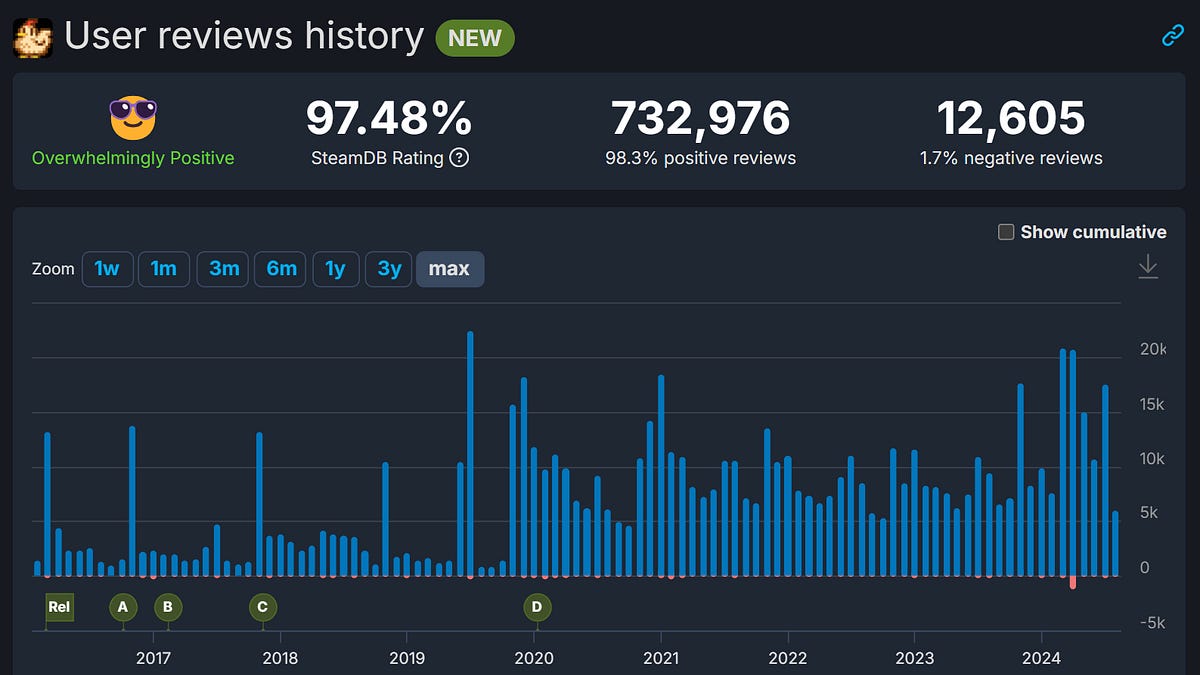
The methodology uses a conservative estimate of 30 sales per review to gauge gross revenue. This multiplier is applied to historical weekly review data to identify perennial sellers.
What changed
Stardew Valley maintained consistent sales velocity for nearly a decade.
Stardew Valley serves as a primary benchmark for the perennial seller model. It has maintained a consistent sales velocity for nearly a decade post-release.
Scale independence
Perennial sales performance is independent of budget scale.
Major titles like the Resident Evil 4 remake and smaller hits like Timberborn and Pseudoregalia show sustained revenue. Perennial sellers are not limited to large-budget productions.
Core traits
Perennial sellers maintain user review scores between 95% and 98%.
Successful long-term titles consistently maintain user review scores between 95% and 98%. They establish a reputation as the definitive best in their specific genre.
Marketing reality
Perennial sellers often succeed without significant ongoing marketing.
These games often succeed without significant ongoing marketing investment. Their quality and community engagement drive continuous discovery and sales.
Marketing need. Games that achieve perennial status often sustain steady sales curves for years without the need for significant ongoing marketing investment.
The takeaway
Weekly review volume reveals distinct long-term market behavior.
Tracking weekly review volume on Steam serves as a reliable proxy for consistent sales performance. The underlying consistency of these review bars reveals a distinct market behavior.
1 / 7
Ask AI about this report