Key insights
4 slides
Key number
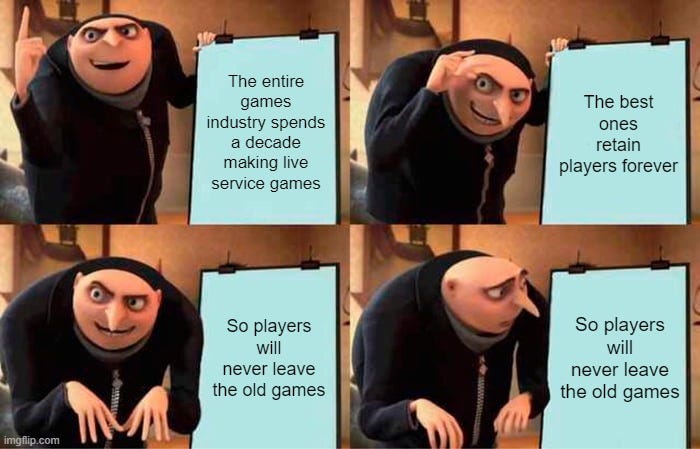
Most gaming hours are consumed by decade-old titles.
A significant portion of the player base remains locked in to a small selection of long-standing titles. The vast majority of total gaming hours are now consumed by games that are often a decade or older.
vast majority
of total gaming hours are consumed by games that are often a decade or older
What changed
New free-to-play titles often spike then decline rapidly.
New free-to-play live service titles often suffer from a 'sugar-rush' launch. This is characterized by a massive initial spike in concurrent users followed by a rapid, terminal decline as players revert to their established habits.
Key drivers
Legacy title retention is driven by time and social equity.
The stickiness of these legacy titles is attributed to several factors. These include the significant time and social equity players have invested, the presence of robust competitive scenes, and the development of community-driven institutions.
Implications
The industry is shifting away from a hits-driven model.
The industry is shifting away from a traditional hits-driven model. It is moving toward one where sustained, long-term engagement with a few dominant titles creates a challenging environment for new market entrants.
Hits-driven shift. The industry is moving away from a traditional hits-driven model toward a market dominated by long-term engagement with a small selection of established games.
1 / 4
Ask AI about this report