Report3 pages
FY25 Trading Update: Strong Results and Increased Momentum
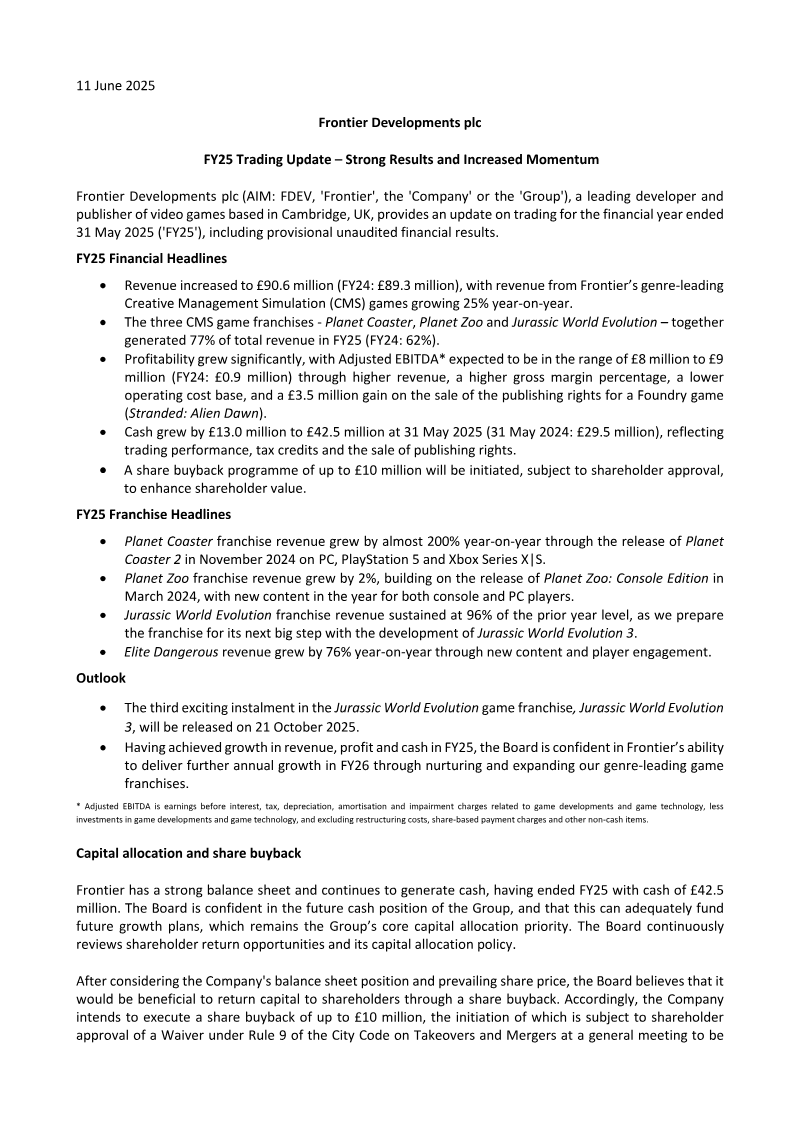
Frontier Developments plc reports a modest revenue rise to £90.6 million for FY25, up from £89.3 million in FY24, driven by a 25 % year‑on‑year increase in its Creative Management Simulation (CMS) titles. The three flagship CMS franchises—Planet Coaster, Planet Zoo and Jurassic World Evolution—accounted for 77 % of total revenue in FY25, a jump from 62 % the previous year. Planet Coaster alone grew almost 200 % following the launch of Planet Coaster 2, while Planet Zoo and Jurassic World Evolution maintained near‑stable sales levels.
Profitability improved sharply; Adjusted EBITDA is projected between £8 million and £9 million, compared with a £0.9 million profit in FY24, thanks to higher gross margins, reduced operating costs and a £3.5 million gain from selling publishing rights to Stranded: Alien Dawn. Adjusted Operating Profit, a new metric effective FY26 that incorporates tax credits and reliefs, is expected to reach £11 million‑£12 million in FY25.
Cash position strengthened, with cash on hand rising to £42.5 million from £29.5 million at the end of FY24, supporting a planned share buyback up to £10 million pending shareholder approval. The board also announced the creation of an Executive Board to streamline decision‑making and highlighted the upcoming release of Jurassic World Evolution 3 on 21 October 2025 as a key growth driver.
- Frontier Developments achieved a significant increase in profitability, with projected Adjusted EBITDA rising to £8–£9 million from £0.9 million in FY24.
- Revenue grew to £90.6 million, driven by a 25% year-on-year increase in Creative Management Simulation (CMS) titles, which now account for 77% of total revenue.
- The launch of Planet Coaster 2 catalyzed a nearly 200% revenue increase for the Planet Coaster franchise.
- The company’s cash position strengthened to £42.5 million, up from £29.5 million, enabling a proposed £10 million share buyback.
- Profitability was bolstered by a £3.5 million gain from the sale of publishing rights to Stranded: Alien Dawn, alongside reduced operating costs.
+4
Frontier Developments
Report17 pages
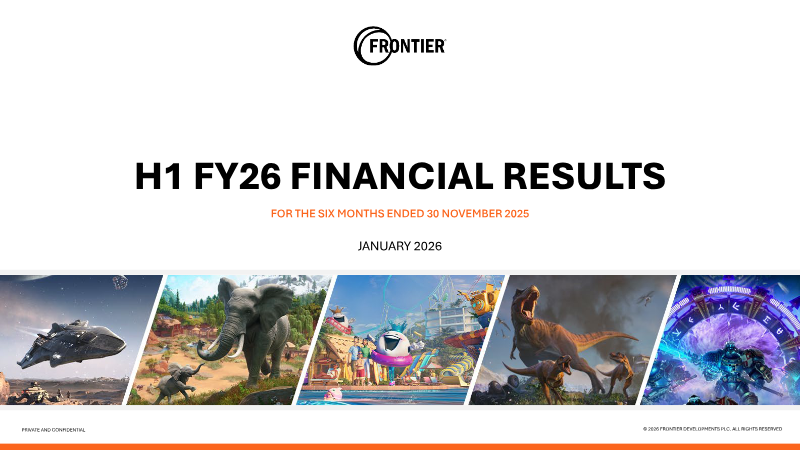
FY26 H1 Results Presentation
The information contained in this confidential the account or benefit of, U.S. Persons (as defined in or advisers take any responsibility for, or will accept any shareholders, directors, officers, agents, employees or document ("Presentation") has been prepared liability whether direct or indirect, express or implied, advisers.
- Frontier Developments plc's H1 FY26 financial results show an Adjusted Operating Profit of approximately £11 million.
- CMS (Content Management System) games grew 52% in H1 FY26, contributing 90% of the total revenue.
- Jurassic World Evolution 3 (JWE3) has been a significant success.
- The company's FY27 CMS title will be a sequel to Planet Zoo, their most successful individual game.
- A new game is being developed by Frontier's Canada team for release in FY27.
+1
Frontier Developments
Report53 pages
Results Presentation: Q3 for the Fiscal Year Ending March 2026
Q3 for the Fiscal Year Ending March 2026 The market forecasts, performance outlooks, plans, strategies, and other forward-looking statements contained in this document are based on information available to the Company and the judgment of its management at the time this material was created. They do not constitute a guarantee of future performance.
- The company recognized impairment losses of approximately 229 million euros (31.3 billion yen) on Rovio's goodwill and other intangible assets, primarily due to reduced sales forecasts for existing and new game titles.
- Q3 FY2026/3 operating income was 19.8 billion yen, a significant decrease from 43.7 billion yen in Q3 FY2025/3. The full-year operating income forecast for FY2026/3 was revised down to 40.0 billion yen from 53.0 billion yen.
- Rovio's performance significantly underperformed initial forecasts, with existing key titles declining more than expected and new titles failing to meet target KPIs or experiencing development delays/cancellations.
- The Entertainment Contents segment's operating income for Q3 FY2026/3 was 23.7 billion yen, down from 34.6 billion yen in Q3 FY2025/3, and its full-year forecast was revised down to 30.5 billion yen from 39.5 billion yen.
- The company plans to improve Rovio's profit margins by actively increasing external payment usage to 30% for Rovio titles within five years, and by optimizing UA costs through marketing strategy updates and AI in development.
+1
Sega Sammy Holdings
Report12 pages
Interim Results: H1 FY26
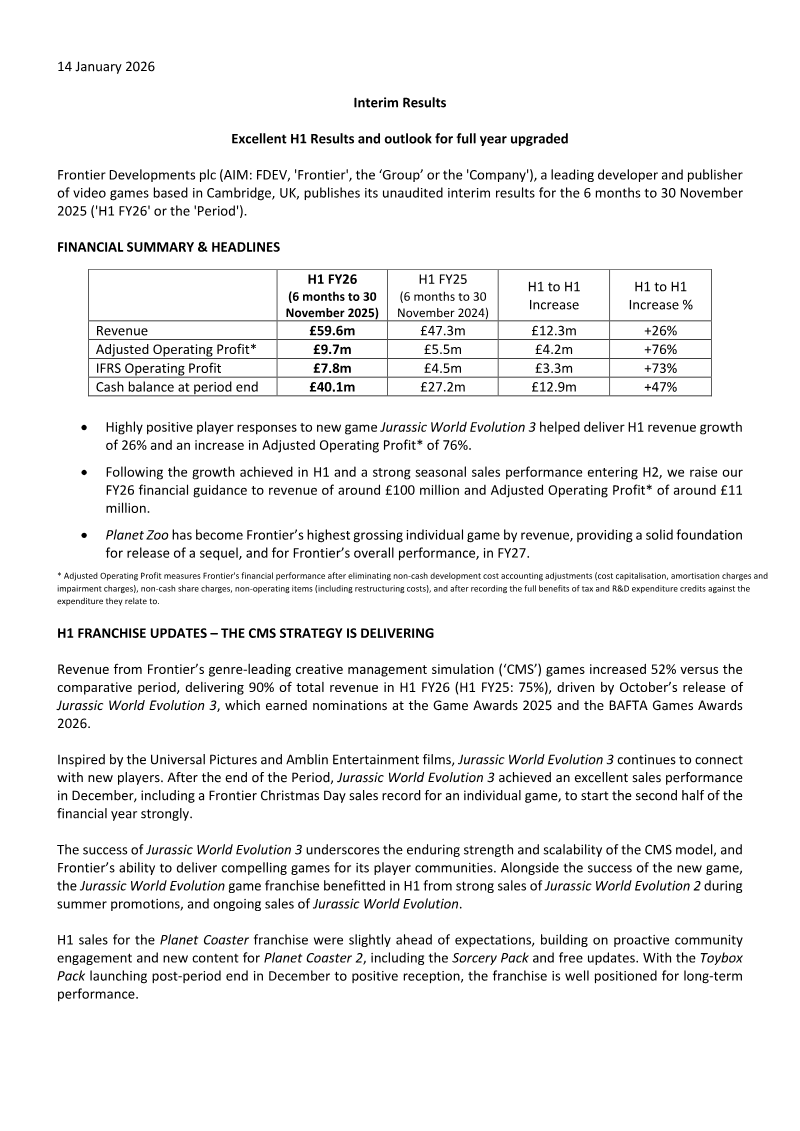
Frontier Developments plc reported unaudited interim results for the six months to 30 November 2025, showing a 26 % increase in revenue to £59.6 million and a 76 % rise in adjusted operating profit to £9.7 million compared with the same period in 2024. The growth was driven primarily by the launch of Jurassic World Evolution 3, which contributed 90 % of total revenue in H1 FY26 and earned nominations at the Game Awards 2025 and BAFTA Games Awards 2026. Other titles such as Planet Zoo, Planet Coaster 2 and Elite Dangerous also performed strongly, with Planet Zoo becoming the Group’s highest‑grossing individual game.
Cash profitability improved markedly; adjusted operating profit, which excludes non‑cash development capitalisation and includes tax and R&D credits, grew to £9.7 million from £5.5 million year‑on‑year. IFRS operating profit rose 73 % to £7.8 million. Gross margin fell to 64 % from 70 %, reflecting higher royalty‑bearing IP revenue. The Group’s cash balance increased to £40.1 million, up 47 % from the prior year, after a £10 million share buy‑back that raised earnings per share to 21.4 p.
The Board upgraded FY26 guidance, now targeting revenue of approximately £100 million and adjusted operating profit of around £11 million, citing strong seasonal sales momentum. CEO Jonny Watts stepped down on 1 January 2026, succeeded by Jo Cooke, with Watts remaining as Executive Director until 31 May 2026 to ensure a smooth transition. The Group remains debt‑free, with no significant liabilities beyond lease obligations, and maintains a robust pipeline of CMS titles slated for release in FY27–FY28.
- Frontier Developments reported a 26% revenue increase to £59.6 million and a 76% rise in adjusted operating profit to £9.7 million for H1 FY26, driven primarily by the launch of Jurassic World Evolution 3.
- Jurassic World Evolution 3 accounted for 90% of total revenue in H1 FY26, while Planet Zoo became the company's highest-grossing individual title.
- The Board upgraded full-year FY26 guidance to approximately £100 million in revenue and £11 million in adjusted operating profit, supported by strong seasonal sales momentum.
- Cash reserves grew 47% year-on-year to £40.1 million, even after executing a £10 million share buy-back that increased earnings per share to 21.4p.
- Gross margin declined from 70% to 64% due to a higher proportion of revenue generated from royalty-bearing intellectual property.
+4
Frontier Developments
Report13 pages
FY2026/3 Q3 Data Appendix
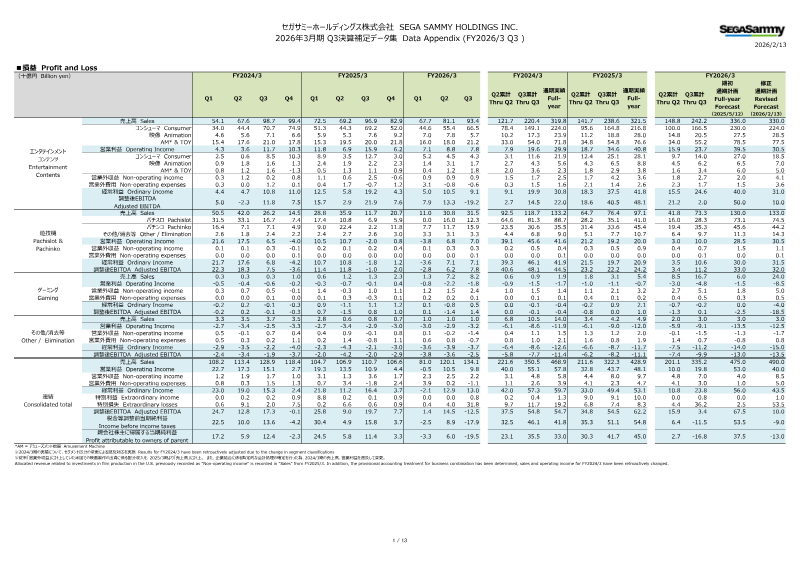
2026年3⽉期 Q3決算補⾜データ集 Data Appendix (FY2026/3 Q3 ) (⼗億円 Billion yen) FY2024/3 FY2025/3 FY2026/3 FY2024/3 FY2025/3 FY2026/3 Q1 Q2 Q3 Q4 Q1 Q2 Q3 Q4 ...
- For FY2026/3 Q3, Sales reached 242.2 billion yen, with a full-year forecast of 330.0 billion yen (revised from 336.0 billion yen). Operating Income for Q3 was 23.7 billion yen, with a full-year forecast of 30.5 billion yen (revised from 39.5 billion yen).
- The Entertainment Contents segment is the largest contributor to sales and operating income, with Q3 sales of 166.5 billion yen and operating income of 14.0 billion yen. Consumer games within this segment generated 66.5 billion yen in Q3 sales.
- R&D and Content Production expenses for Entertainment Contents were 23.1 billion yen through Q3 FY2026/3, with a full-year forecast of 29.7 billion yen. This is a significant increase from 20.3 billion yen in FY2025/3 Q3.
- Unit sales of major IPs for FY2026/3 Q3 include Sonic series at 4,000 thousand units, Total War series at 3,160 thousand units, Persona series at 2,410 thousand units, and Like a Dragon series at 2,500 thousand units.
- The Gaming segment saw a substantial increase in employees, from 104 in FY2025/3 Q4 to 930 in FY2026/3 Q3, reflecting the incorporation of Rovio into the group.
Sega Sammy Holdings
Report64 pages
Annual Report 2005
Printed in Japan This annual report is printed on recycled paper. 2004 2005 2004 2005 2004 2005 2004 2005 2004 2005 2004 2005 Total Games (Offline) Games (Online) Mobile Phone Content Publication Others Financial Highlights ________________________________________ 1 Disclaimer Regarding Forward-Looking Statements To Our Shareholders ____________________________________ 2 Statements in this annual report with respect to the current plans, estimates, stra...
- Square Enix's net income significantly increased to ¥14,520 million in FY2005, up from ¥4,355 million in FY2004, and ¥2,296 million in FY2003.
- Total consolidated net sales for Square Enix reached ¥73,865 million in FY2005, an increase from ¥63,202 million in FY2004 and ¥21,877 million in FY2003.
- The 'Games (Offline)' segment was the largest contributor to net sales in FY2005 at ¥41,944 million, followed by 'Games (Online)' at ¥13,853 million and 'Publication' at ¥10,859 million.
- Notes and accounts receivable decreased by ¥4,375 million to ¥7,670 million in FY2005, primarily because no "million-seller" titles were released during the fiscal year.
- Intangible assets decreased by ¥1,454 million to ¥6,096 million in FY2005, mainly due to ¥1,236 million in goodwill depreciation from the UIEvolution Inc. purchase in the previous fiscal year.
+3
Square Enix
Report70 pages
2004 Annual Report
SQUARE ENIX CO., LTD. www.square-enix.co.jp/ Disclaimer Regarding Forward-Looking Statements Statements in this annual report with respect to the current plans, estimates, strategy, and beliefs of SQUARE ENIX CO., LTD. and consolidated subsidiaries (collectively “SQUARE ENIX”) include both historical facts and forward-looking statements concerning the future performance of SQUARE ENIX.
- Square Enix's strategy focuses on three critical actions: enhancing community management, deploying polymorphic content by leveraging their own IPs across various platforms, and defining new platforms without becoming a hardware manufacturer.
- The Mobilephone Content business experienced significant growth in Fiscal Year 2004, with net sales increasing by ¥1,097 million to ¥2,793 million and operating income rising by ¥404 million to ¥1,159 million, despite overseas operations making insignificant contributions.
- The Publication business also showed strong growth in Fiscal Year 2004, with net sales increasing by ¥3,254 million to ¥9,671 million and operating income rising by ¥1,360 million to ¥3,180 million.
- As of March 31, 2004, Square Enix had a strong financial position with a shareholders' equity ratio of 87.4% and cash and cash equivalents totaling ¥58,676 million, with only ¥18 million in long-term debt due within one year.
- The company's capital surplus at the end of Fiscal Year 2004 was ¥36,393 million, and retained earnings were ¥53,931 million.
+1
Square Enix
Report68 pages
Annual Report 2006
SQUARE ENIX CO., LTD, TH SQUARCCNIX www.square-enix.com/ ANNUAL REPORT 2006 Net Sales Ratio Net Sales (Billions of yen) Games (Offline) 36.9% 2005 Net Sales Ratio Net Sales (Billions of yen) Games (Online) 12.6% 2005 Net Sales Ratio Net Sales (Billions of yen) Mobile Phone Content 4.1% 2005 Net Sales Ratio Net Sales (Billions of yen) Net Sales Ratio Net Sales (Billions of yen) Net Sales Ratio Net Sales (Billions of yen) Contents ...
- Square Enix acquired 93.7% of TAITO CORPORATION in September 2005 via a takeover bid, subsequently merging it with SQEX, Inc. to make Taito a wholly owned subsidiary.
- The company's content production account decreased by ¥8,197 million to ¥7,312 million as of March 31, 2006, primarily due to expensing production costs for major titles like "FINAL FANTASY XII" and "KINGDOM HEARTS II" upon their domestic release.
- Deferred tax assets significantly increased as of March 31, 2006, with current deferred tax assets rising by ¥4,437 million to ¥7,877 million and non-current deferred tax assets increasing by ¥4,754 million to ¥6,523 million, partly due to tax differences from the Taito acquisition.
- Square Enix is expanding its business beyond growing existing communities by developing new ones and actively seeking to approach outside communities, providing value-added services to third parties like EZ Game Street! and On Demand TV, and forming joint ventures such as with Xavel, Inc.
- The company reported net income of ¥14,932 million for the year ended March 31, 2006, a decrease from ¥17,076 million in the previous year, despite an increase in income before income taxes to ¥25,556 million from ¥8,990 million.
+3
Square Enix
Report70 pages
2018 Annual Report
byproviding unforgettable experiences mission thebeliefsfor which we stand. To spread happiness across the globe by providing unforgettable experiences This philosophy represents our company’s mission and the beliefs for which we stand. The Square Enix Group provides n-quality high- content,services, and products to to help those customers create their own Each of our customers has his or her own definition of discover a happiness al happiness.
- The Square Enix Group's corporate philosophy is to spread happiness globally by providing unforgettable experiences through high-quality content, services, and products.
- The company aims to be a leader in entertainment, focusing on creating new and creative gaming experiences and hit titles, particularly revisiting development and operation organizations in the fiscal year ending March 2019.
- In the fiscal year ended March 2018, the Amusement segment saw sales decline to ¥41.7 billion and operating income fall to ¥2.4 billion, despite stable arcade operations and new initiatives like renovating Taito Station Mizonokuchi and opening MEGARAGE.
- The Digital Entertainment segment reported net sales of ¥191,469 million and operating income of ¥38,176 million for the fiscal year ended March 2018, driven by strong performance from titles like "FINAL FANTASY XIV," "DRAGON QUEST X," and "KINGDOM HEARTS Union X."
- The company forecasts net sales of ¥270,000 million and operating income of ¥30,000 million for the fiscal year ending March 31, 2019.
Square Enix
Report70 pages
2013 Annual Report
C o r p o r a t e P h i l o s o p h y This philosophy represents our company's mission and the beliefs for which we stand. To spread happiness across the globe by providing unforgettable experiences This philosophy represents our company’s mission and the beliefs for which we stand. The Square Enix Group provides high-quality content, services, and products to help those customers create their own wonderful, Each of our customers has his or her own definition of happiness.
- The Publication segment achieved net sales of ¥11,086 million and operating income of ¥2,484 million, driven by new title creation, TV animation series deployment, and the growth of web-based platforms like "GANGAN ONLINE" for new IP development.
- The Merchandising segment posted net sales of ¥3,264 million and operating income of ¥667 million, with success attributed to the 25th-anniversary Final Fantasy series collector's box and concerts, and the new ARTNIA official merchandise store.
- Net cash used in investing activities increased by 59.0% to ¥9,189 million, primarily due to ¥10,626 million in property and equipment purchases and ¥1,392 million in intangible asset purchases, offset by ¥2,928 million from guarantee deposit collections.
- Notes and accounts receivable increased by ¥11,795 million to ¥30,226 million as of March 31, 2013, largely due to the March release of "Tomb Raider" in Europe and North America.
- Net cash used in financing activities totaled ¥3,481 million, with the primary application of funds being ¥3,444 million for cash dividends paid.
+1
Square Enix
Report86 pages
2023 Annual Report
Corporate Philosophyby providing unforgettable experiences This represents company's and the beliefs for which we stand. To spread happiness across the globe by providing unforgettable experiences This philosophy represents our company’s mission and the beliefs for which we stand. Each of ourcustomers or her of happiness.
- The "DRAGON QUEST" series has sold over 88 million units worldwide as of the end of June 2023, celebrating its 35th anniversary in 2021.
- Square Enix Group's corporate philosophy is to spread happiness globally by providing unforgettable experiences through high-quality content, services, and products.
- The company faces challenges in game development, including increased difficulty and prolonged timelines due to console advancements, intense competition for talent, and a diminishing number of external partners for large-scale projects.
- Square Enix is focusing on structural transformation of its internal development organization, including strengthening development processes, recruiting talent, and establishing training capabilities.
- The company is investing in new growth domains: AI, cloud technology, and blockchain games, alongside its existing Digital Entertainment, Amusement, Publication, and Merchandising segments.
Square Enix
Report2 pages
Dragon Quest: Reimagined
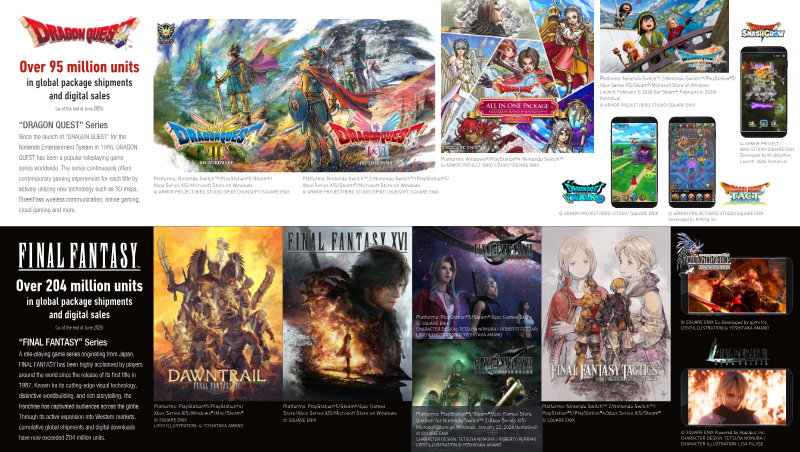
The document presents a comprehensive overview of several flagship role‑playing franchises, focusing on recent releases and cumulative sales achievements. It highlights the launch of “Dragon Quest: Reimagined” on February 5, 2026, available in a bundled package across Nintendo Switch 2, PlayStation 5, Xbox Series X|S, Steam, and Microsoft Store. The title is positioned as a high‑definition 2D remake developed by KLabGames, with a projected global shipment of over 95 million units as of June 2025. The text also references the broader “Dragon Quest” series, noting its continuous evolution since 1986 and its adoption of modern technologies such as 3D mapping, cloud gaming, and cross‑platform connectivity.
The “Final Fantasy” section cites cumulative sales of 204 million units for the series, emphasizing its long‑standing appeal since 1987 and its expansion into Western markets. Platforms listed include PlayStation 5, Steam, Epic Games Store, and Nintendo Switch 2, with a focus on the franchise’s visual innovation and narrative depth. The document underscores the series’ global reach, with sales data aggregated across multiple regions.
Additionally, the “Kingdom Hearts” entry reports 38 million units shipped worldwide by June 2025, noting its collaborative origin with Disney and Square Enix. The overview includes platform details for the original PlayStation 2 release and mentions forthcoming titles slated for various consoles. Overall, the document serves as a market snapshot of key RPG franchises, detailing launch dates, platform coverage, sales milestones, and development partnerships across the industry.
- The Final Fantasy series has reached 204 million units in cumulative global sales since its 1987 debut.
- Dragon Quest: Reimagined, a high-definition 2D remake developed by KLabGames, launched on February 5, 2026, for Nintendo Switch 2, PlayStation 5, Xbox Series X|S, Steam, and Microsoft Store.
- The Dragon Quest franchise reported a projected global shipment of over 95 million units as of June 2025.
- The Kingdom Hearts franchise, a collaboration between Disney and Square Enix, has shipped 38 million units worldwide as of June 2025.
- Major RPG franchises are increasingly utilizing modern technologies including 3D mapping, cloud gaming, and cross-platform connectivity to maintain market relevance.
+2
Square Enix
Report17 pages
Omówienie Wyników Finansowych: Q2 2021
The presentation outlines PCF Group S.A.’s financial performance for the first half of 2021, emphasizing a significant growth trajectory across revenue, EBITDA, and workforce metrics. Total group revenues reached PLN 52.6 million in H1 2021, up 47 % from PLN 35.3 million in the same period of 2020, reflecting a compound annual growth rate of 34.4 % over 2017‑2020. EBITDA rose to PLN 28.8 million, a 36.5 % increase from PLN 21.1 million in H1 2020, and the adjusted EBITDA figure of PLN 27.6 million represents a 55.6 % jump from the prior year’s PLN 17.7 million, after accounting for IPO issuance costs and warrant amortisation.
Personnel expansion is notable: the group’s headcount grew to 252 employees, a 41.7 % rise, with significant additions in North America and Europe, including new studios in Chicago, New York, and Montreal. The People Can Fly division contributed PLN 21.1 million in revenue, while the Can Fly studio reported an EBITDA of PLN 28.8 million, underscoring its profitability.
Strategic initiatives highlighted include a partnership with Square Enix, confirming no royalty obligations for the Outriders title and progressing an investment agreement involving warrants. The group’s portfolio strategy aims to secure a leading position in new IP development, targeting annual releases of self‑published or publisher‑partnered titles by 2024.
Financial statements show a robust asset base of PLN 95.7 million, with equity at PLN 190.1 million and liabilities of PLN 272.8 million, yielding an equity‑to‑asset ratio of 185 %. Cash reserves increased to PLN 150.3 million, supporting ongoing development and expansion plans.
- PCF Group S.A. reported H1 2021 revenue of PLN 52.6 million, a 47% increase compared to the same period in 2020.
- Adjusted EBITDA rose by 55.6% to PLN 27.6 million in H1 2021, while total EBITDA reached PLN 28.8 million.
- The company expanded its global footprint by increasing headcount by 41.7% to 252 employees and establishing new studios in Chicago, New York, and Montreal.
- The group holds PLN 150.3 million in cash reserves to fund ongoing development and strategic expansion plans.
- The portfolio strategy targets a transition to annual releases of self-published or partner-published titles by 2024.
+2
PCF Group

Report39 pages
2025 Annual Report
Purpose C O N T E N T S Creating New Worlds With Boundless Imagination 03 Financial Highlights Creating New Worlds With Boundless Imagination 03 Financial Highlights 04 A Message to Our Stakeholders to Enhance People’s Lives.
- In the fiscal year ended March 2025, Square Enix Holdings recorded net sales of ¥324.5 billion (a decline from the previous fiscal year) but an increase in profit, with operating income at ¥40.5 billion, ordinary income at ¥40.9 billion, and profit attributable to owners of parent at ¥24.4 billion.
- The Game sub-segment saw increased net sales and profit due to the release of "FINAL FANTASY XIV: Dawntrail" and "The Apothecary Diaries" series, despite a decline in the Games for Smart Devices/PC Browsers sub-segment due to weak existing titles and the absence of prior year royalty income.
- The Merchandising segment reported net sales of ¥19.0 billion (up 0.8% from the prior fiscal year) and operating income of ¥6.0 billion (up 7.2%), driven by strong sales of new character merchandise related to popular Group IP.
- Square Enix Holdings is collaborating with the Matsuo Lab at the University of Tokyo’s School of Engineering on a sponsored course focused on simulations and deep learning, and with the Graduate School of Film and New Media at Tokyo University of the Arts on a joint research project.
- The company has an alliance with gumi Inc. for the development and distribution of mobile online and blockchain games, and another alliance to study establishing a dedicated platform for blockchain games.
+1
Square Enix
Report9 pages
Krajowy Rejestr Sądowy: People Can Fly
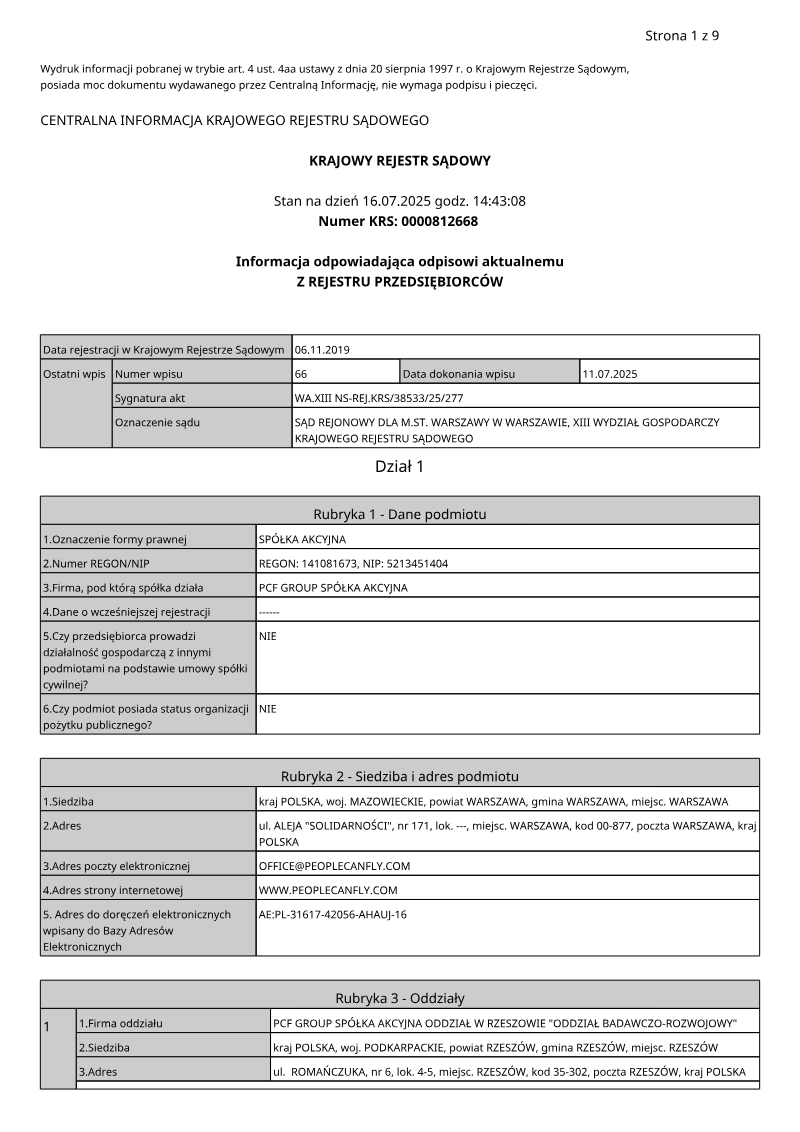
The document presents the official registration details of PCF GROUP SPÓŁKA AKCYJNA, a Polish joint‑stock company incorporated on 6 November 2019 and currently listed in the National Court Register (KRS) under number 0000812668. The company’s legal form is a joint‑stock company, with its registered office in Warsaw, Masovian Voivodeship. The principal business activities are software development (62.01.Z), video game production and retail (47.40.Z, 47.65.Z, 58.21.Z), publishing of computer games (58.29.Z), and related digital services such as hosting and portal operations (63.11.Z, 63.12.Z). The company’s capital structure is detailed: a share capital of PLN 718,805.42 divided into 35,940,271 shares with a nominal value of PLN 0.02 each, and a planned capital increase of PLN 31,118.44 through the conversion of capital bonds into shares. The share issuance is segmented into seven series (A–G) with varying numbers of shares, all non‑preferential.
Key governance information lists the single‑member board headed by President Sebastian Kamil Woiciechowski, and a supervisory board comprising five members. No debt or liquidation proceedings are recorded; the company remains solvent with no outstanding claims or bankruptcy filings.
The document also records a series of statutory amendments to the company’s articles, reflecting changes in capital structure and governance provisions between 2019 and 2025. Annual financial statements and auditor reports for the years 2019–2024 are referenced, indicating regular compliance with reporting obligations. The company’s website (www.peoplecanfly.com) and email contact are provided for further inquiries.
- PCF Group S.A. is a Warsaw-based joint-stock company incorporated on November 6, 2019, and registered under KRS number 0000812668.
- The company maintains a share capital of PLN 718,805.42, divided into 35,940,271 non-preferential shares with a nominal value of PLN 0.02 each.
- A planned capital increase of PLN 31,118.44 is currently in progress through the conversion of capital bonds into shares.
- The company’s equity is structured across seven distinct share series (A through G) to support its capital requirements.
- Governance is managed by a single-member board led by President Sebastian Kamil Woiciechowski, supported by a five-member supervisory board.
PCF Group
Report13 pages
Wyniki Finansowe 2022
The presentation outlines the financial performance of PCF Group S.A. for the year 2022, focusing on revenue streams, profitability metrics, and balance‑sheet highlights. Total operating income reached PLN 180.3 million, with development activities contributing PLN 73.2 million and a partnership with Take‑Two Interactive Software adding PLN 71.5 million. Adjusted EBITDA for the year was PLN 48.2 million, down from PLN 70.5 million in 2021, primarily due to a decline in development earnings and increased outsourcing costs. Net profit fell sharply to PLN 22.0 million from PLN 61.3 million the previous year, reflecting higher operating expenses and a weaker revenue mix.
On the balance‑sheet side, total assets grew to PLN 259.5 million at year‑end 2022, up from PLN 137.1 million in 2021, driven by a significant increase in development‑related assets and cash reserves. Equity rose to PLN 112.7 million, while liabilities remained relatively stable at PLN 68.0 million. The company’s workforce expanded to 612 employees across multiple locations, including Warsaw, Montreal, New York, and Newcastle, indicating ongoing investment in talent.
Quarterly data show fluctuating development revenues, with the highest quarter (Q4 2021) at PLN 44.1 million and a lower Q2 2022 figure of PLN 27.6 million, underscoring volatility in project pipelines. Outsourcing revenue and costs are also reported quarterly, revealing a trend of rising expenses that offset some development income.
Overall, the group experienced revenue growth but faced margin compression and a notable decline in profitability, prompting management to focus on cost control and strategic partnerships for future stability.
- PCF Group S.A. reported a significant decline in net profit to PLN 22.0 million in 2022, down from PLN 61.3 million in 2021, driven by higher operating expenses and a weaker revenue mix.
- Adjusted EBITDA fell to PLN 48.2 million in 2022 compared to PLN 70.5 million in 2021, primarily due to increased outsourcing costs and lower development earnings.
- Total operating income for 2022 reached PLN 180.3 million, supported by PLN 73.2 million from development activities and a PLN 71.5 million contribution from a partnership with Take-Two Interactive Software.
- Total assets nearly doubled to PLN 259.5 million at the end of 2022 from PLN 137.1 million in 2021, fueled by growth in cash reserves and development-related assets.
- The company expanded its workforce to 612 employees across international locations including Warsaw, Montreal, New York, and Newcastle, reflecting continued investment in talent.
PCF Group
Report22 pages
Omówienie Wyników Finansowych 2021
The presentation outlines PCF Group’s financial performance and strategic direction for fiscal year 2021, emphasizing a significant revenue surge of 73.7 % to PLN 103.8 million and EBITDA growth of 129.2 % to PLN 31.9 million, driven by the People Can Fly and Can Fly studios. Net profit rose 149.7 % to PLN 61.4 million, while employee count increased 90.4 %, reflecting accelerated expansion across North America and Europe. Capital structure improved markedly, with equity rising from PLN 259.5 million to PLN 239.2 million and total assets growing 230.9 % to PLN 316.7 million, largely through the acquisition of development assets and IP rights.
Strategically, PCF Group pursued a transformation agenda centered on agility, empowerment, and scalable self‑publishing. The adoption of OKR frameworks and the PCF Framework coupled with Unreal Engine 5 enabled rapid iteration and risk‑managed project delivery. M&A criteria focused on studios with IP, remote work capability, and complementary competencies, aiming to boost EBITDA through synergies. Portfolio expansion targets include new AAA‑compact titles and a planned annual release cadence from 2024 onward, with high‑profile projects such as Outriders: Worldslayer and Green Hell VR already generating strong market traction.
Geographically, the group’s footprint spans Warsaw (HQ), Chicago, Montreal, New York, and regional offices in Kraków and Toronto, supporting a global development network. Methodologically, financial figures are presented on an adjusted basis, with detailed breakdowns of revenue streams (game sales, outsourcing, warranties) and cost components across quarterly periods. The presentation underscores PCF Group’s commitment to sustainable growth, operational efficiency, and market leadership within the independent gaming sector.
- PCF Group achieved significant financial growth in 2021, with revenue increasing 73.7% to PLN 103.8 million and net profit rising 149.7% to PLN 61.4 million.
- EBITDA grew by 129.2% to PLN 31.9 million, supported by the performance of the People Can Fly and Can Fly studios.
- The company expanded its workforce by 90.4% and grew total assets by 230.9% to PLN 316.7 million, primarily through the acquisition of development assets and IP rights.
- Strategic operations are shifting toward a scalable self-publishing model, supported by the implementation of OKR frameworks and Unreal Engine 5 to facilitate rapid iteration.
- The group is targeting an annual release cadence starting in 2024, with a portfolio strategy focused on AAA-compact titles and high-profile projects like Outriders: Worldslayer and Green Hell VR.
+1
PCF Group
Report12 pages
Prezentacja Wyników Finansowych Q2 2022
The presentation reports PCF Group S.A.’s financial performance for the first half of 2022, comparing it to the same period in 2021 and to full‑year 2021 figures. Total revenue rose from PLN 90.6 million in HY 2021 to PLN 77.3 million in HY 2022, a 17.2 % decline, driven by lower game‑development and outsourcing income. EBITDA remained relatively flat, moving from PLN 28.8 million to PLN 29.0 million (+0.7 %), while net profit increased by 17.5 % to PLN 21.7 million from PLN 25.5 million in HY 2021. The company’s equity grew to PLN 259.5 million, up 9.1 % from PLN 283.1 million in FY 2021, and the asset‑to‑liability ratio improved by 17.5 %. Operating cash flow was slightly negative, with PLN 134.6 million in liquid assets versus PLN 137.1 million in assets, a 1.8 % decline.
Strategically, PCF Group is positioning itself as a leading independent studio portfolio. The group plans to launch an annual flagship title from 2024 onward, pursue new genres and VR development, and expand its workforce to over 580 employees by the end of 2022. The portfolio includes pre‑production projects such as “Bulletstorm,” “Gemini,” and “Dagger,” with several titles slated for European release in 2024 and North American launches pending. The group’s geographic footprint spans Warsaw, Chicago, Montreal, Kraków, and Rzeszów, with a growing presence in North America.
Methodologically, the figures derive from internal financial statements and are presented as rounded values; future projections are noted to be subject to change. The presentation emphasizes that it is informational only and not an investment recommendation.
- PCF Group S.A. reported a 17.2% decline in total revenue for the first half of 2022, falling to PLN 77.3 million from PLN 90.6 million in the same period of 2021 due to reduced development and outsourcing income.
- Despite the revenue drop, net profit increased by 17.5% to PLN 25.5 million, and EBITDA remained stable at PLN 29.0 million, representing a 0.7% growth compared to HY 2021.
- The company aims to transition into a flagship-title-per-year model starting in 2024, supported by a development pipeline that includes projects codenamed 'Bulletstorm,' 'Gemini,' and 'Dagger.'
- PCF Group is aggressively scaling its operations, targeting a workforce of over 580 employees by the end of 2022 while maintaining a geographic footprint across five cities in Poland and North America.
- The company's financial position remains solid with equity growing 9.1% to PLN 283.1 million by the end of HY 2022 and an improved asset-to-liability ratio of 17.5%.
PCF Group
Report17 pages
Wyniki Finansowe 1H23: PCF Group S.A.
The presentation reports PCF Group S.A.’s financial performance for the first half of 2023, covering operations across its global studio network and publishing activities. Revenue rose to PLN 90.6 million in 1H 2023, up from PLN 68.7 million in the same period of 2022, driven primarily by a new contract with Take Two Interactive and the launch of the VR title “Green Hell.” Operating income (EBIT) reached PLN 29.0 million, a significant improvement over the prior year’s negative EBIT of PLN 13.1 million, reflecting higher scale and a 16 % increase in the workforce from 29.7 k to 34.5 k employees by June 30, 2023.
The group’s balance sheet shows total assets of PLN 481.9 million at 30 June 2023, up from PLN 350.8 million in December 2022, with equity strengthening to PLN 277.6 million. Cash and cash equivalents increased by PLN 235.3 million, largely due to a secondary public offering (SPO) that raised PLN 235.3 million at an issue price of PLN 40.20 per share. Key shareholders include Krafton Inc., which invested PLN 144.5 million and secured preferential rights for future publishing agreements.
Portfolio highlights include the self‑publishing titles “Maverick,” “Gemini,” and “Dagger,” with projected releases in 2025‑26, and the VR project “Green Bulletstorm” slated for a 14 December 2023 launch. The company projects continued growth in both development and publishing segments, with a focus on expanding its VR footprint and leveraging strategic partnerships for upcoming releases.
- PCF Group S.A. achieved PLN 90.6 million in revenue for 1H 2023, up from PLN 68.7 million in 1H 2022, driven by a new contract with Take Two Interactive and the launch of 'Green Hell' VR.
- Operating income (EBIT) turned positive at PLN 29.0 million in 1H 2023, compared to a loss of PLN 13.1 million in the same period of the previous year.
- A secondary public offering (SPO) raised PLN 235.3 million at PLN 40.20 per share, significantly boosting cash reserves and total assets to PLN 481.9 million as of June 30, 2023.
- Krafton Inc. became a key shareholder with a PLN 144.5 million investment, securing preferential rights for future publishing agreements.
- The company expanded its workforce by 16%, growing from 29.7k to 34.5k employees by the end of June 2023.
PCF Group
Report18 pages
Wyniki Finansowe 2023: PCF Group S.A.
The presentation outlines PCF Group S.A.’s financial performance for 2023, focusing on its core gaming and publishing operations. The group’s revenue reached PLN 180.3 million, with self‑publishing projects contributing PLN 171.5 million and external publishing adding PLN 8.8 million. EBITDA for the year was PLN 49.7 million, a decline from PLN 70.5 million in 2022 due to higher operating costs and lower margins on key titles such as “Bulletstorm VR” and the cancelled “Dagger” project. Net income fell to PLN −75.6 million, largely driven by a one‑off write‑down of the Dagger IP and increased staff expenses.
Balance sheet highlights show total assets rising to PLN 513.5 million, driven by a PLN 68.0 million increase in intangible assets and a PLN 112.7 million rise in development costs. Equity stood at PLN 277.6 million, while cash and equivalents were PLN 159.4 million at year‑end. The company’s workforce grew from 612 to 756 employees, reflecting expansion in development and publishing teams across Warsaw, Montreal, New Castle, Dublin, Katowice, and Rzeszów.
Geographically, PCF operates in Europe and North America, with major studios in Warsaw and Montreal. The group’s strategy for 2024 includes closing underperforming projects, renegotiating VR contracts, and tightening cost controls on travel and event expenses. Funding options will be explored to support the planned portfolio of AAA titles, including “Bison” and “Green Hell VR,” while maintaining a focus on self‑publishing growth.
- PCF Group S.A. reported a net loss of PLN 75.6 million in 2023, primarily due to a one-off write-down of the 'Dagger' project and rising staff expenses.
- Annual revenue reached PLN 180.3 million, with self-publishing projects accounting for the vast majority at PLN 171.5 million.
- EBITDA declined to PLN 49.7 million from PLN 70.5 million in 2022, impacted by higher operating costs and lower margins on titles like 'Bulletstorm VR'.
- The company increased its workforce from 612 to 756 employees across its international studios in Europe and North America.
- Total assets rose to PLN 513.5 million, supported by a PLN 112.7 million increase in development costs and PLN 68.0 million in intangible assets.
PCF Group