Tom Clancy's The Division
13 documents in the library are about Tom Clancy's The Division, from writers such as Ubisoft, Game Developers Conference and GameDiscoverCo, the newest from 2026. Each has a summary and key insights with the page they come from.

Tom Clancy’s The Division is a revolutionary experience that combines robust RPG customization with tactical action combat. There’s never been a better time to jump in and join the fight to save NYC. Join other agents to combat the outbreak in Manhattan across a wide-range of story missions and open-world activities. Enter the Dark Zone to earn high-level gear and face off against other players. Just be sure to watch your back. Customize your agent, get cutting-edge gear, build a unique arsenal to gain an edge on Manhattan’s deadliest inhabitants.
- Released
- Mar 8, 2016
- Developer
- Massive Entertainment
- Publisher
- Ubisoft Entertainment
- Genres
- Shooter, Role-playing (RPG), Strategy, Tactical, Adventure
- Platforms
- PlayStation 4, PC (Microsoft Windows), PlayStation 5, Xbox One
- Links
- Wikipedia
Game data from IGDB.com
Key figures
Monthly active users increased by 33.1% over the nine-month period, driven by the performance of Tom Clancy’s Rainbow Six Siege and Tom Clancy’s The Division.
Ubisoft, 2017 · Ubisoft Reports Third-Quarter 2016-17 Sales, p. 1
Global headcount increased by 9% to 10,667 employees, supporting a capital-intensive production model driven by franchises like Tom Clancy’s The Division and Rainbow Six Siege.
Ubisoft, 2016 · Registration Document and Annual Report 2016, p. 82
The company’s focus on high-engagement multiplayer titles was validated by the performance of Tom Clancy’s The Division, which reached 9.5 million registered users, and Rainbow Six Siege.
Ubisoft, 2016 · Ubisoft Full-Year 2015-16 Sales and Earnings Figures, p. 2
Management projects a 30% increase in sales for the second half of the fiscal year, supported by a pipeline of five major titles including Assassin’s Creed Syndicate and Tom Clancy’s The Division.
Ubisoft, 2015 · Ubisoft H1 FY16 Earnings Presentation, p. 15
Documents about Tom Clancy's The Division

Ubisoft Q3 Fiscal Year 2026 Earnings Results
The Ubisoft third-quarter fiscal year 2026 earnings results, covering the period from October 1 to December 31, 2025, highlight a period of stable revenue performance alongside significant shifts in platform engagement.
- Ubisoft's net bookings for the third quarter of fiscal year 2026 rose 11.9% year-over-year to €337.7 million, exceeding company forecasts.
- The PC platform saw a significant surge in revenue share, growing from 26% to 41% of total net bookings over the past year.
- Revenue share from consoles dropped from 54% to 45%, while mobile revenue share declined from 10% to 7%.


Ubisoft First-Quarter 2025-26 Sales
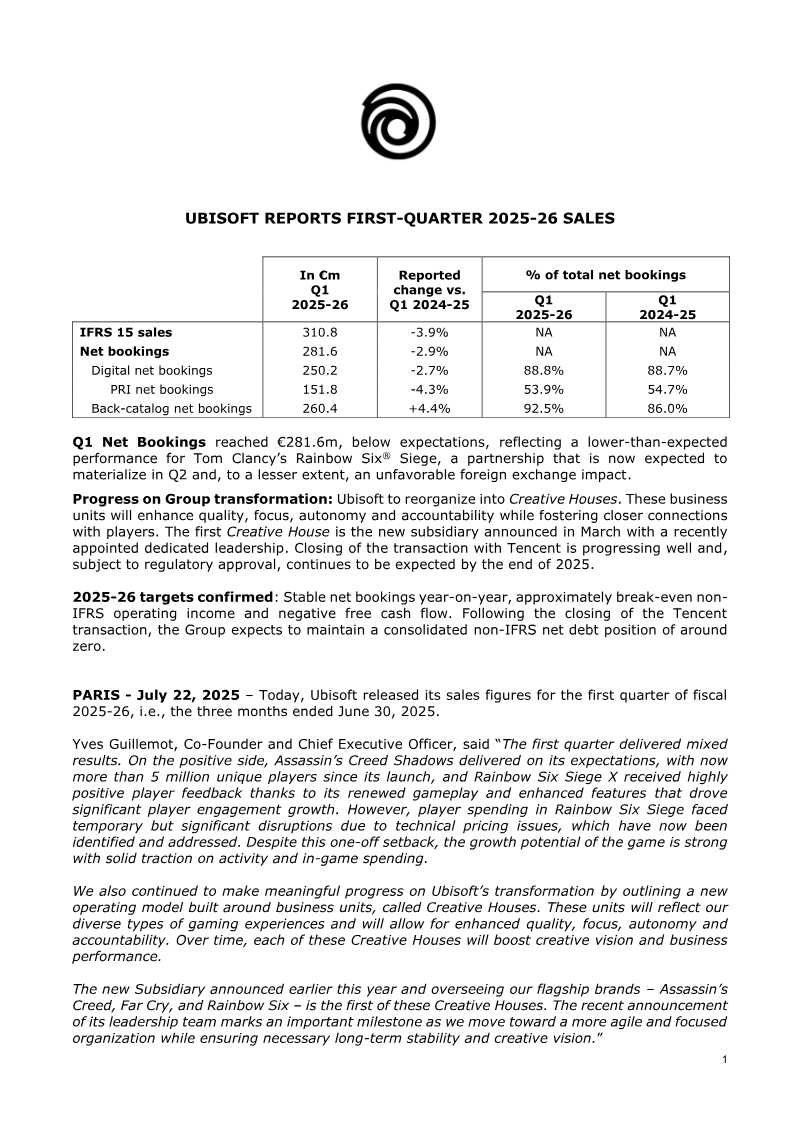
Ubisoft’s first-quarter results for fiscal year 2025-26 reflect a period of mixed performance, with net bookings reaching €281.6 million.
- Ubisoft reported Q1 fiscal year 2025-26 net bookings of €281.6 million, a 2.9% year-over-year decline that missed internal expectations.
- The company reaffirmed its full-year financial targets, aiming for stable year-on-year net bookings and a break-even non-IFRS operating income.
- Operational performance was hindered by technical pricing issues with prepaid currency cards for Rainbow Six Siege, though the title recovered to its third-highest monthly active user count in history by June.
Plus: One Piece Odyssey - A Trad Hit for Namco
One Piece Odyssey has demonstrated a strong market debut, signaling that traditional, high-priced JRPG adaptations of major anime franchises remain highly viable.
- One Piece Odyssey is a commercial success for Bandai Namco, with first-week Steam sales projected between 150,000 and 200,000 units and a top position on U.S. PlayStation digital charts.
- The success of One Piece Odyssey at a $60 price point without live-service mechanics proves that traditional, premium-priced JRPG adaptations of major anime franchises remain highly viable.
- Chinese-developed titles are showing significant market traction on Steam, with Jianghu11 reaching over 10,000 concurrent users and Sailing Era achieving 6,000 concurrent users.

Finding Space For Sound: Environmental Acoustics in Tom Clancy's The Division 2
The development of Tom Clancy’s The Division 2 prioritized a sophisticated approach to environmental acoustics, leveraging the Snowdrop engine to create a dynamic, responsive soundscape.
- The Division 2 utilizes a real-time, raycast-based acoustic system within the Snowdrop engine to replace resource-heavy, material-filtered audio processes.
- This streamlined collision model enabled the procedural generation of impulse responses and ambient room tones across more than 2,500 distinct interior spaces.
- The system employs 'bubble space' metrics, using rotating raycast patterns and a double-buffered broadcast module to adjust weapon audio and reverb based on horizontal and vertical clearance.

Game Server Performance on Tom Clancy's The Division 2
The Division 2 relies on an authoritative server architecture designed to manage massive instances containing up to 1,000 players and 20,000 non-player characters.
- The Division 2 utilizes an authoritative server architecture capable of managing massive instances with up to 1,000 players and 20,000 non-player characters.
- The simulation runs at 20 to 30 frames per second by distributing workloads across 36 dedicated threads on 40-core hardware using a parallelized task framework.
- Engineers mitigated CPU thread starvation and memory contention by replacing global mutexes with a lock-free heap and commit cache to reduce lock contention.

Global Illumination in Tom Clancy's The Division
The Snowdrop engine utilizes a sophisticated, probe-based global illumination system to facilitate dynamic lighting within the expansive, open-world environment of Tom Clancy's The Division.
- Ubisoft Massive utilized a Precomputed Radiance Transfer (PRT) system within the Snowdrop engine to achieve dynamic global illumination, allowing for a full day/night cycle without the need for static light maps or UV unwrapping.
- The system organizes light probes into 2D grid sectors of 64x64 meters, typically containing 300 to 400 probes, with a maximum capacity of 1,000 probes per sector.
- To manage memory and performance, the engine stores sky visibility per probe and uses irradiance bricks to define light influence, resulting in a total lighting data footprint of approximately 1 gigabyte.

Blending Autonomy and Control: Creating NPCs for Tom Clancy's The Division
The development of artificial intelligence for Tom Clancy’s The Division centers on the integration of server-side behavior trees within the proprietary Snowdrop engine to create a dynamic, tactical combat experience.
- The Division features 36 unique combat AI variations categorized into 11 distinct archetypes, designed to create 'combat puzzles' where enemies synergize their skills to force specific player tactics.
- NPC behavior is built on a modular, priority-based system that evaluates critical events (like grenades or status effects) before executing scripted level-design orders or dynamic objectives.
- The AI detection system utilizes five alert levels—ranging from idle to combat investigation—governed by audio and visual stimuli defined by specific archetype vision cones.
Ubisoft Reports Third-Quarter 2016-17 Sales
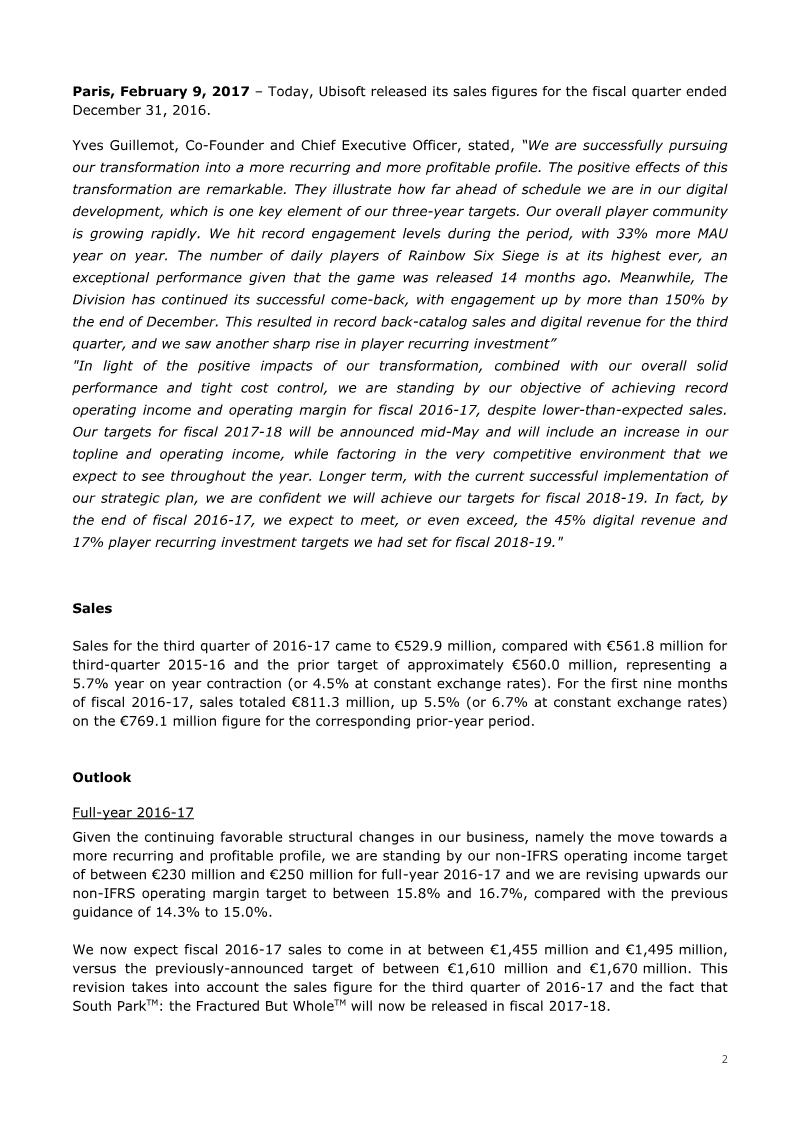
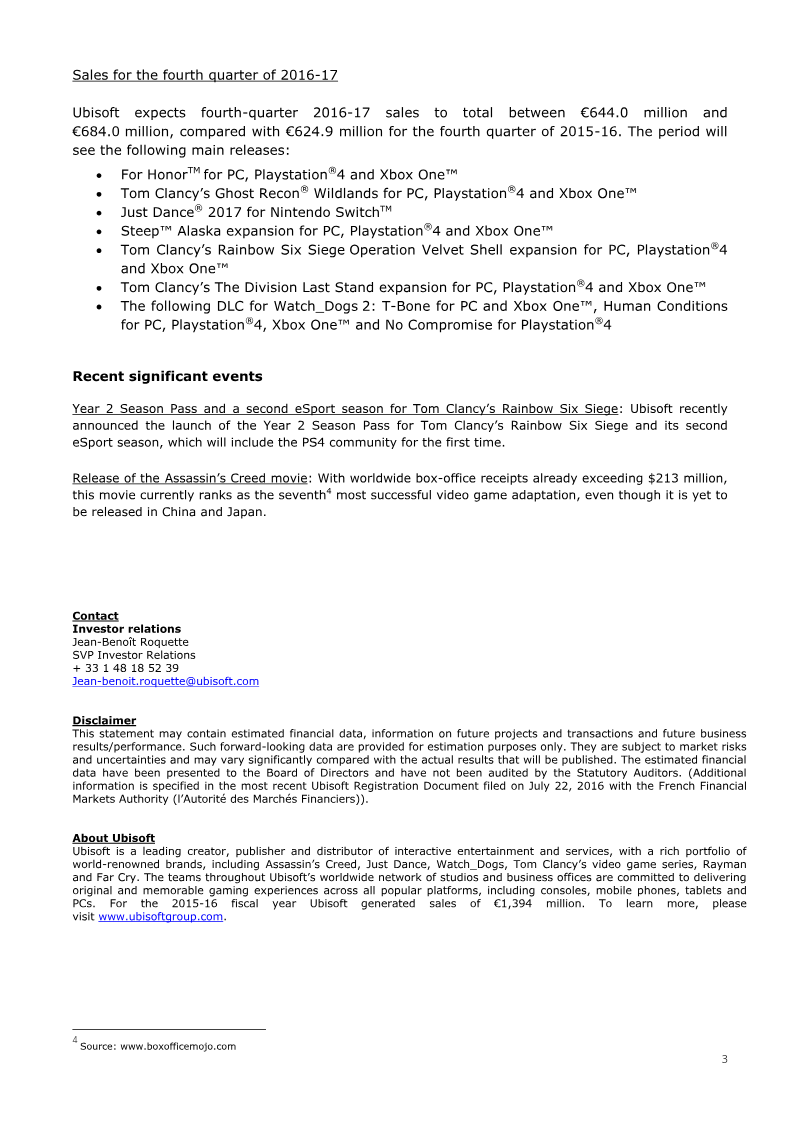
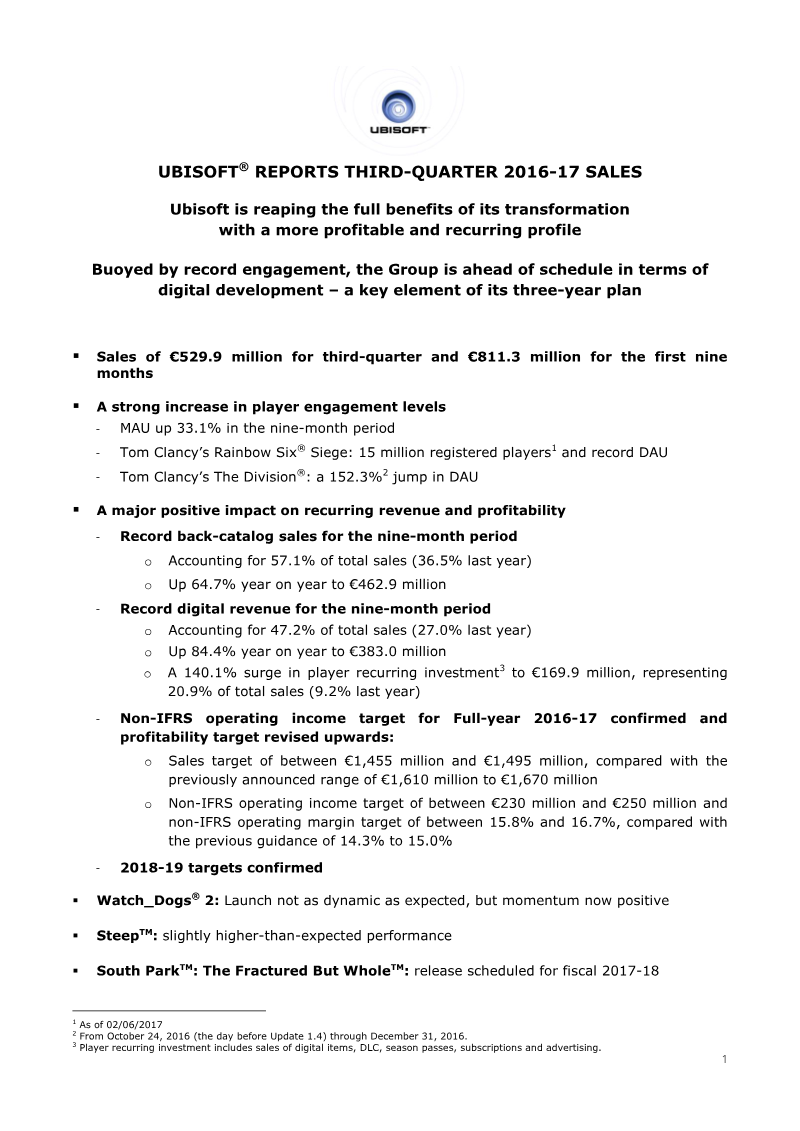
Ubisoft’s third-quarter 2016-17 financial results demonstrate a successful strategic transition toward a more recurring and profitable business model.
- Digital revenue reached €383.0 million for the first nine months of the 2016-17 fiscal year, representing 47.2% of total sales compared to 27.0% in the previous year.
- Player recurring investment—including season passes, subscriptions, and digital items—grew by 140.1% during the nine-month period.
- Monthly active users increased by 33.1% over the nine-month period, driven by the performance of Tom Clancy’s Rainbow Six Siege and Tom Clancy’s The Division.
Registration Document and Annual Report 2016
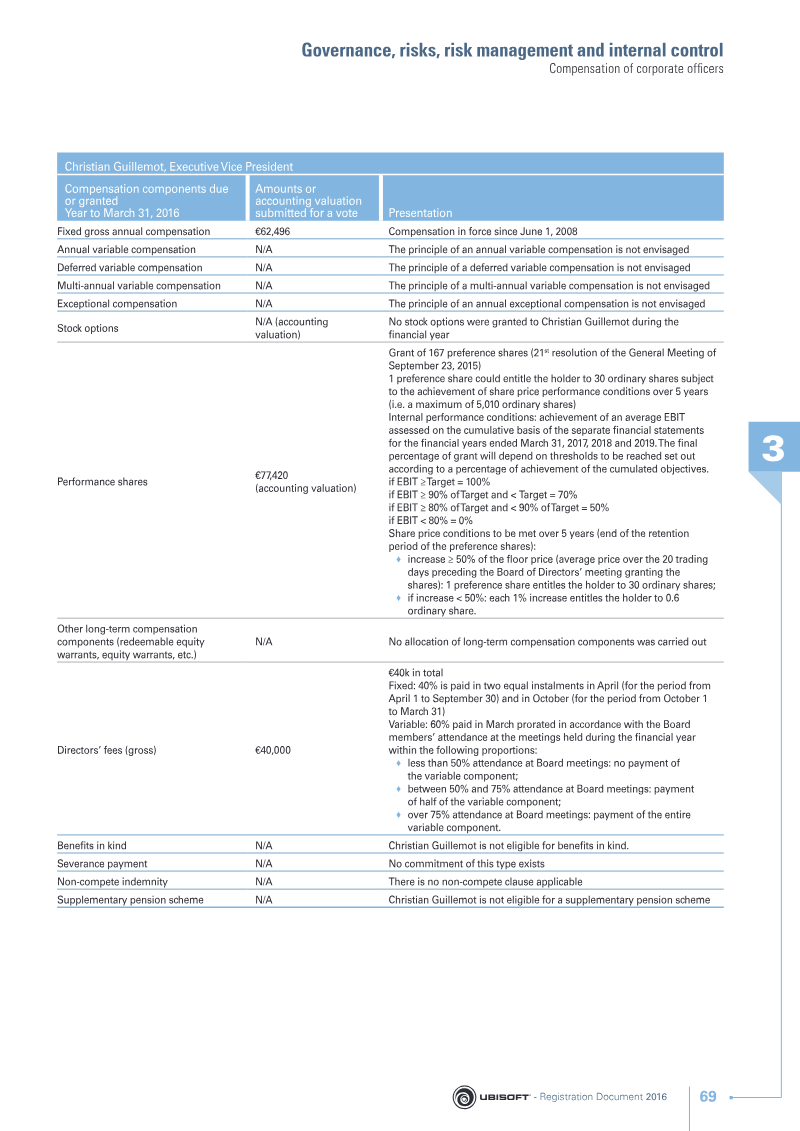
The 2016 Registration Document and Annual Report provides a comprehensive overview of Ubisoft’s financial performance, corporate governance, and operational strategy for the fiscal year ending March 31, 2016.
- Ubisoft set a strategic goal to reach €2.2 billion in sales and a 20% operating margin by the 2018/2019 fiscal year through a digital-first, brand-owned business model.
- Vivendi became the company's largest shareholder by July 2016, triggering a reinforcement of governance protocols and change-of-control protections.
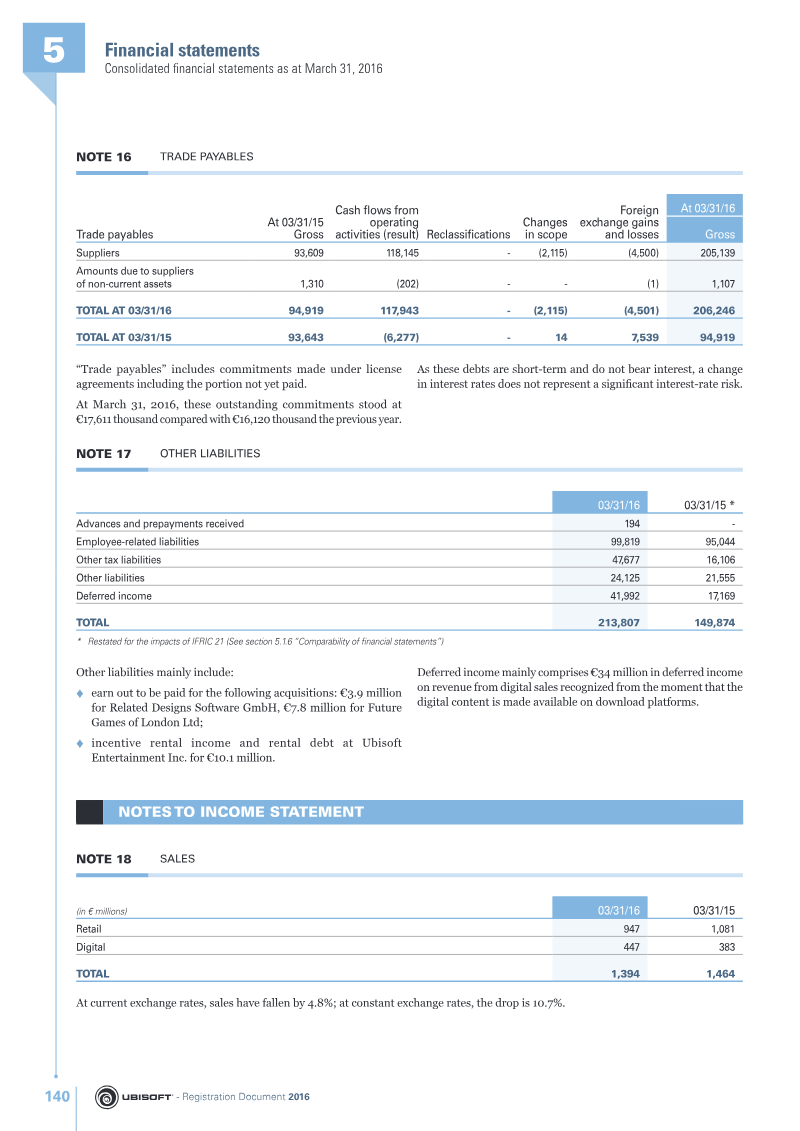
- For the fiscal year ending March 31, 2016, the company reported €1,394 million in annual sales and a net income of €93.4 million.

Ubisoft Full-Year 2015-16 Sales and Earnings Figures
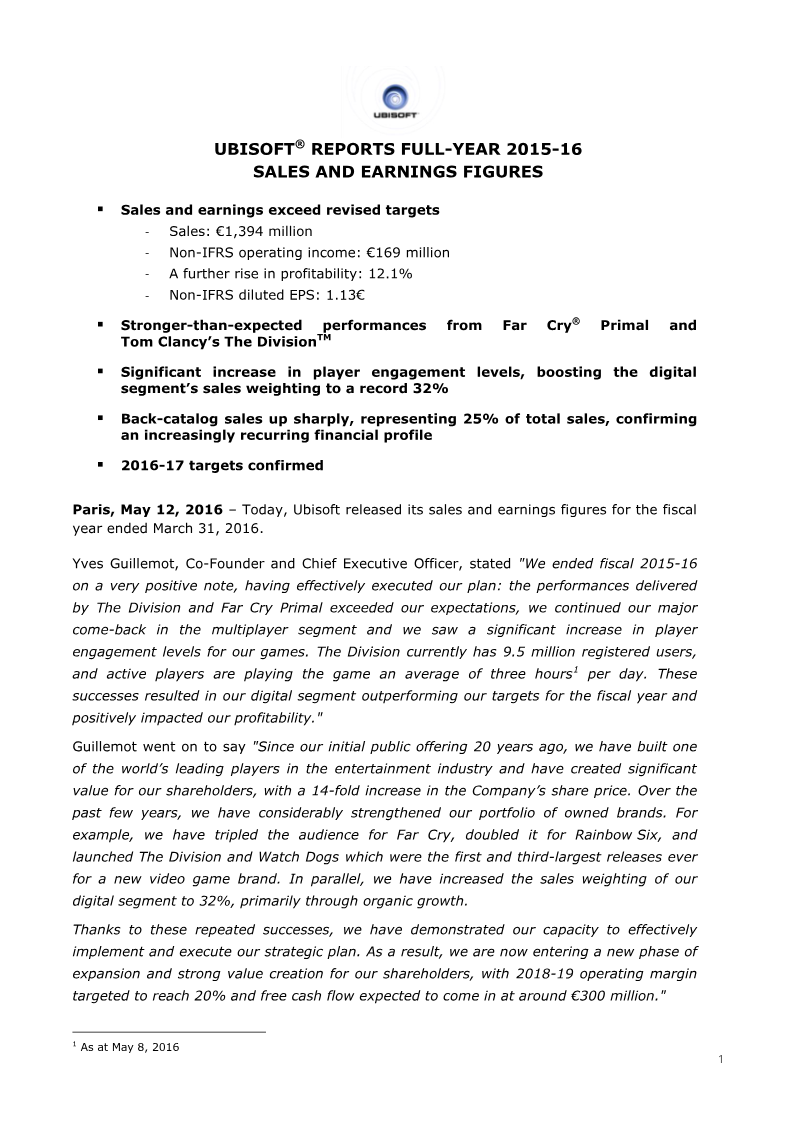
Ubisoft’s fiscal year 2015-16 financial results demonstrate a period of strong operational performance, characterized by the successful execution of a strategy focused on high-engagement multiplayer titles and digital growth.
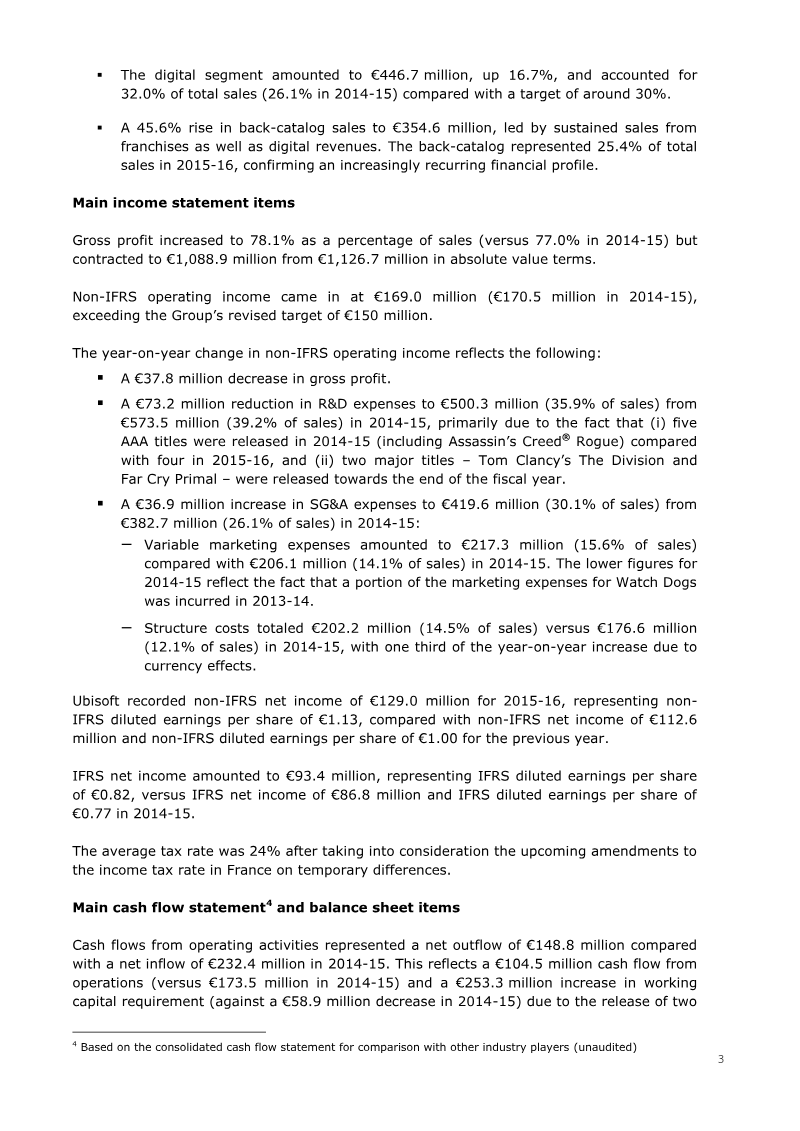
- Ubisoft reported total fiscal year 2015-16 sales of €1,394 million and a non-IFRS operating income of €169 million, representing a 12.1% profitability margin.
- Digital revenue reached a record 32% of total sales, driven by a 45.6% increase in back-catalog sales which now account for 25.4% of total revenue.
- The company’s focus on high-engagement multiplayer titles was validated by the performance of Tom Clancy’s The Division, which reached 9.5 million registered users, and Rainbow Six Siege.

Ubisoft H1 FY16 Earnings Presentation
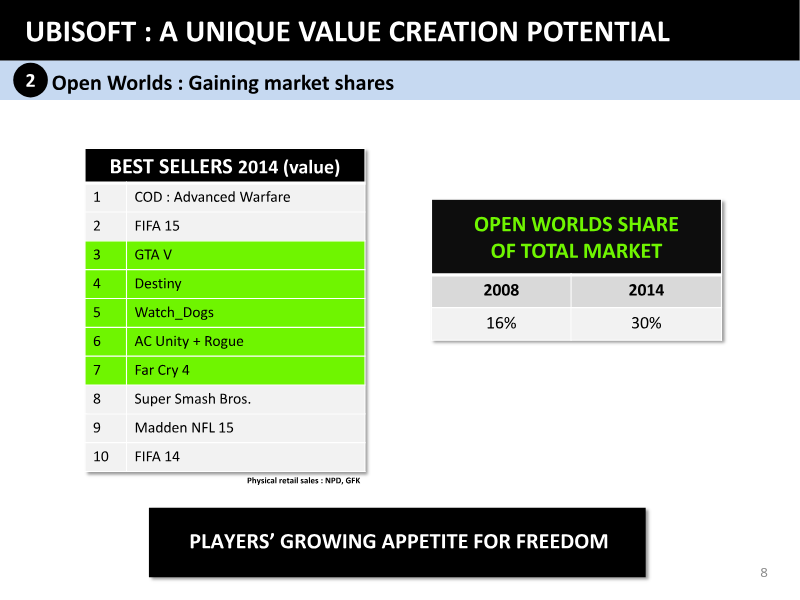
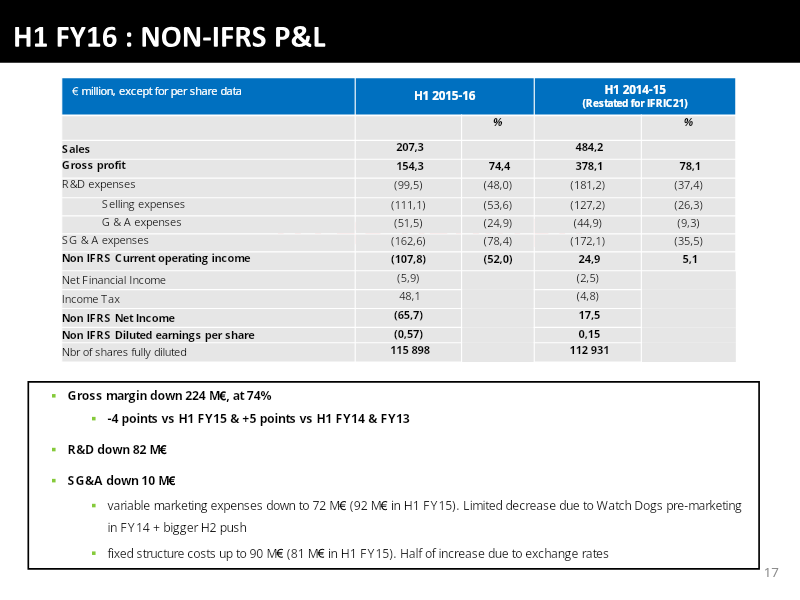
The Ubisoft H1 FY16 earnings presentation outlines the company’s strategic shift toward digital expansion, multiplayer engagement, and the dominance of open-world franchises.
- Ubisoft generated 207 million euros in H1 FY16 sales, with digital revenue accounting for 48% of that total.
- Back-catalog performance grew by 53% to 184 million euros, serving as a key driver during a period that saw a 108 million euro non-IFRS operating loss.
- The company’s market share in the open-world genre nearly doubled, rising from 16% in 2008 to 30% in 2014.
Ubisoft Full-Year 2014-15 Sales and Earnings Figures
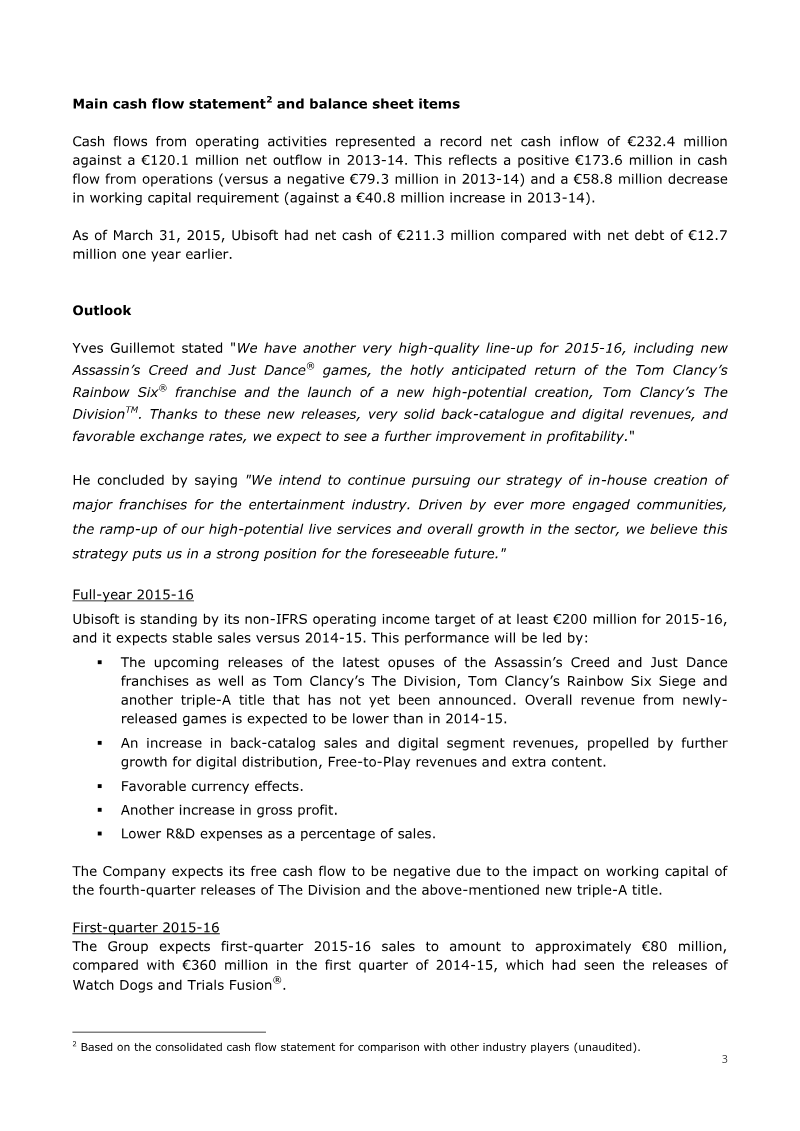
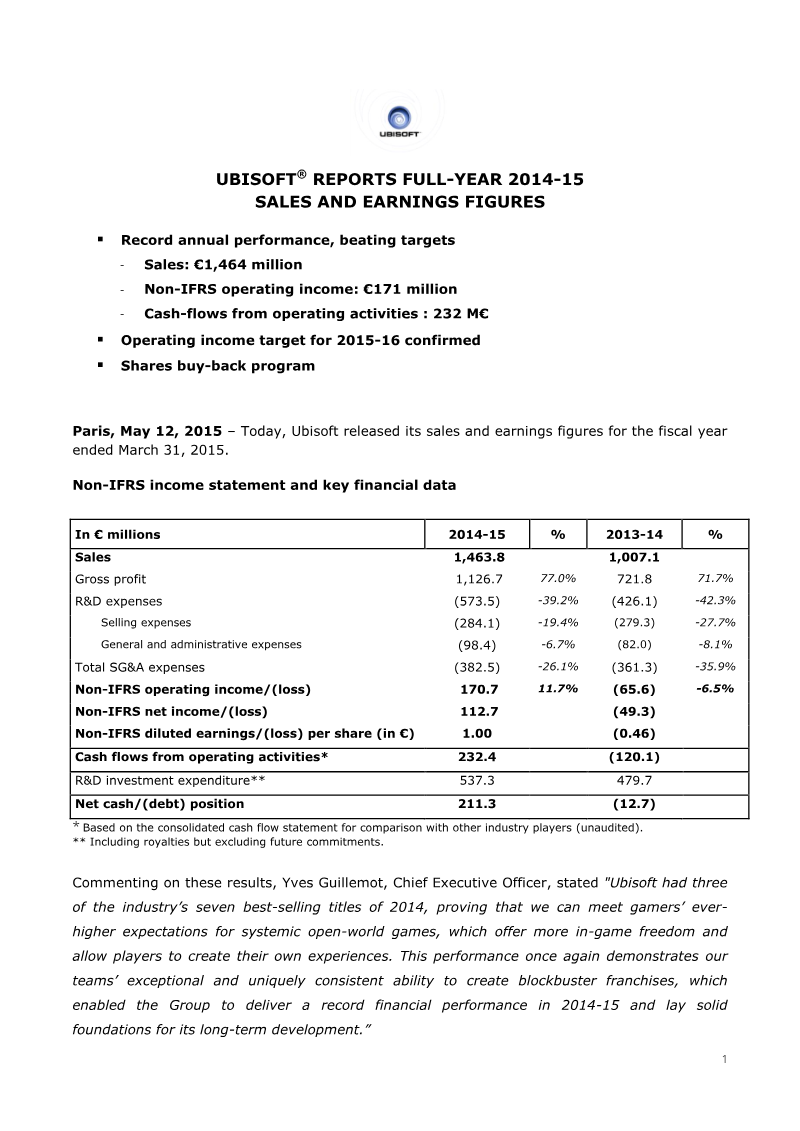
Ubisoft achieved record financial performance for the 2014-15 fiscal year, ending March 31, 2015, with total sales reaching €1,463.8 million. This represents a 45.3% increase compared to the previous fiscal year.
- Ubisoft achieved record financial performance in fiscal year 2014-15 with sales of €1,463.8 million, a 45.3% increase over the previous year.
- The company shifted from a non-IFRS operating loss of €65.6 million in 2013-14 to a record non-IFRS operating income of €170.7 million.
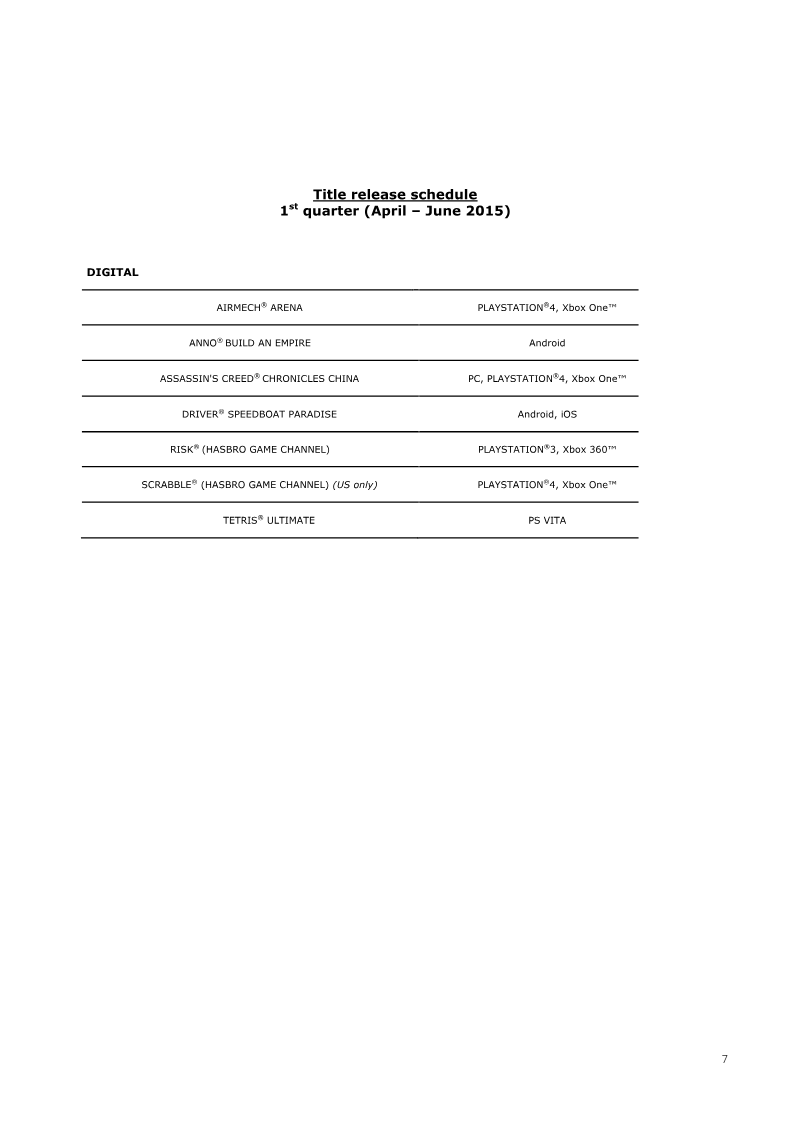
- Digital revenue surged 96.8% to €382.7 million, representing 26.1% of total sales and contributing to a record 77.0% gross profit margin.