The Oregon Trail
Game
9 documents in the library are about The Oregon Trail, from writers such as DiGRA, Game Developers Conference and GameDiscoverCo. Each has a summary and key insights with the page they come from.
Connections
Each row is a game or company named alongside The Oregon Trail, each column a document, oldest first. A mark means that document names it. Select a row to see those documents.
Documents about The Oregon Trail
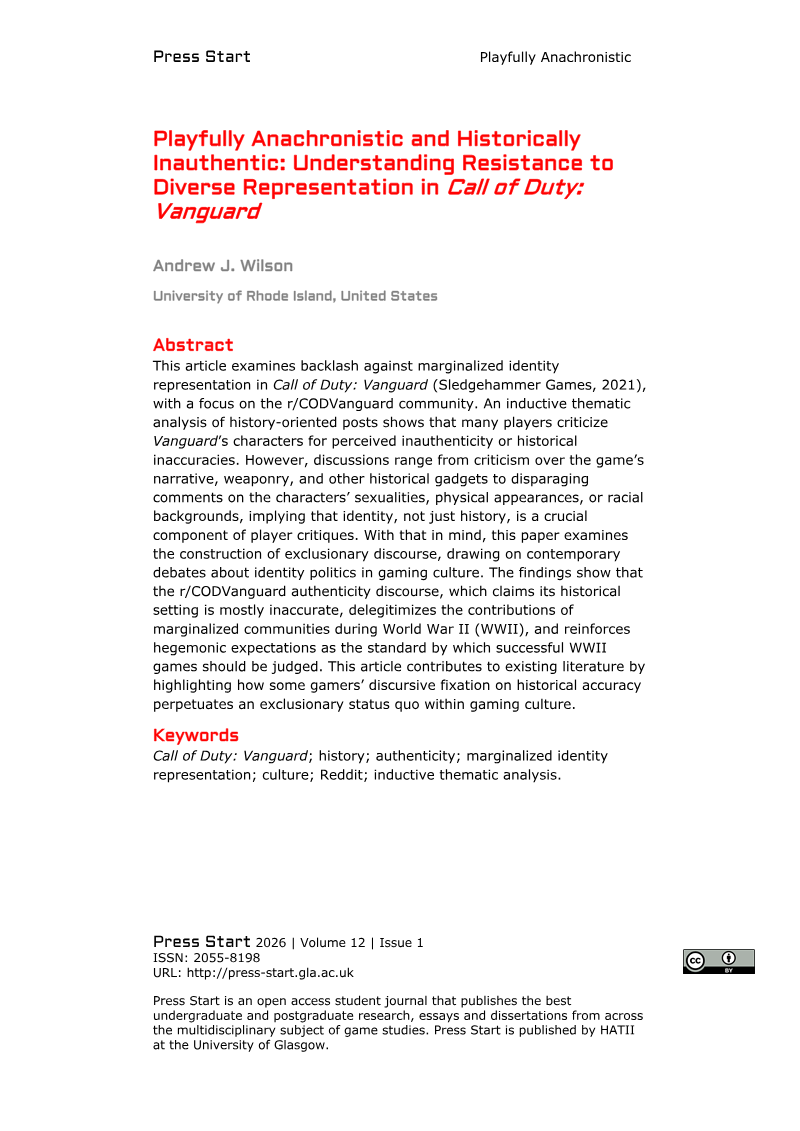
Playfully Anachronistic and Historically Inauthentic: Understanding Resistance to Diverse Representation in Call of Duty: Vanguard
The discourse surrounding Call of Duty: Vanguard reveals a systemic pattern where claims of historical inaccuracy function as a rhetorical shield for exclusionary attitudes toward diverse character representation.
- Analysis of the r/CODVanguard subreddit, which hosts over 105,000 members, reveals that 31.76% of history-oriented discussions focus on historical accuracy and authenticity as primary benchmarks for the game's success.
- Discourse within the community frequently uses 'historical accuracy' as a proxy to criticize the inclusion of marginalized identities, with 17.82% of posts focusing on symbolic representation and 2.04% explicitly debating identity politics.
- Players often frame diverse character representation as 'tokenism' or 'pandering,' reinforcing a status quo that prioritizes white, cisgender, and masculine protagonists as the standard for World War II gaming.
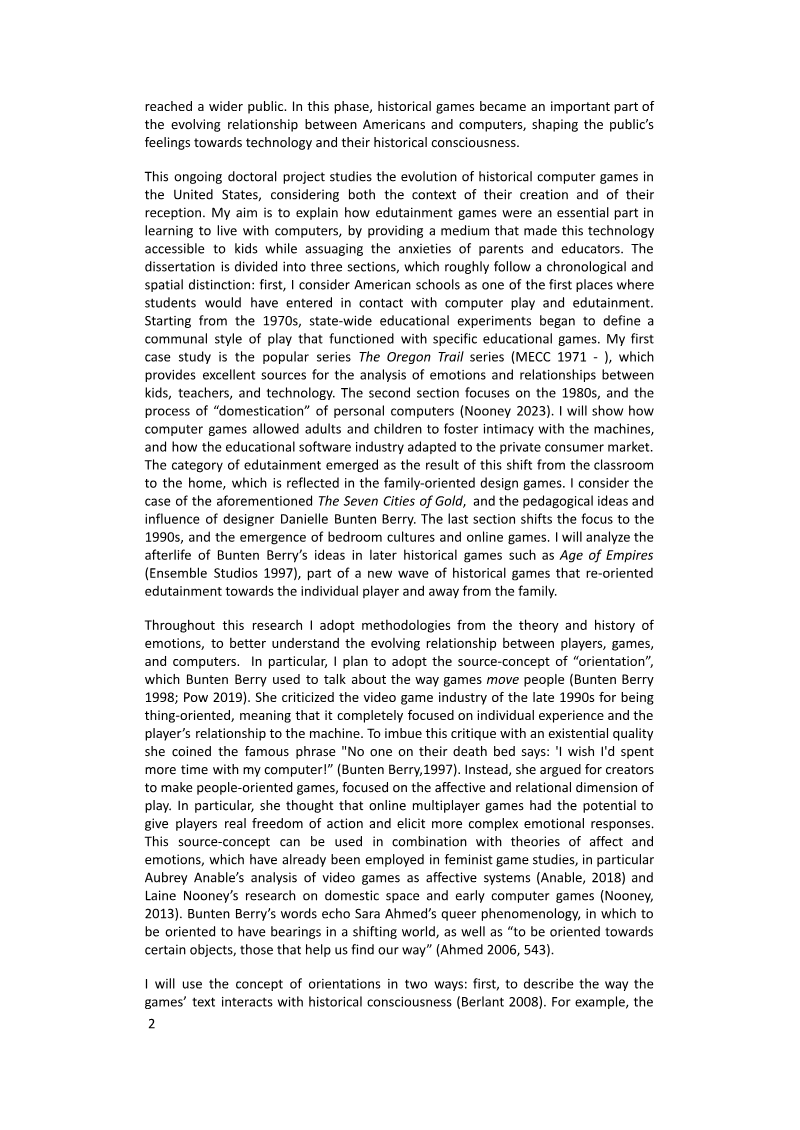
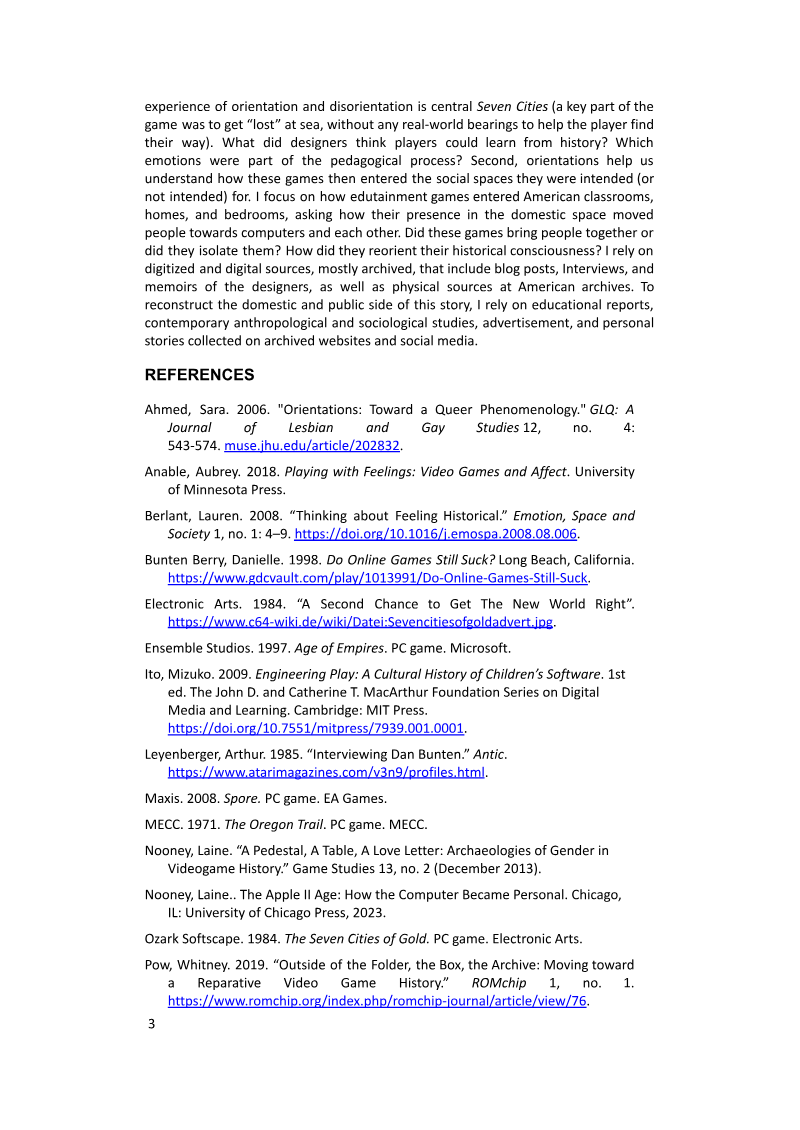
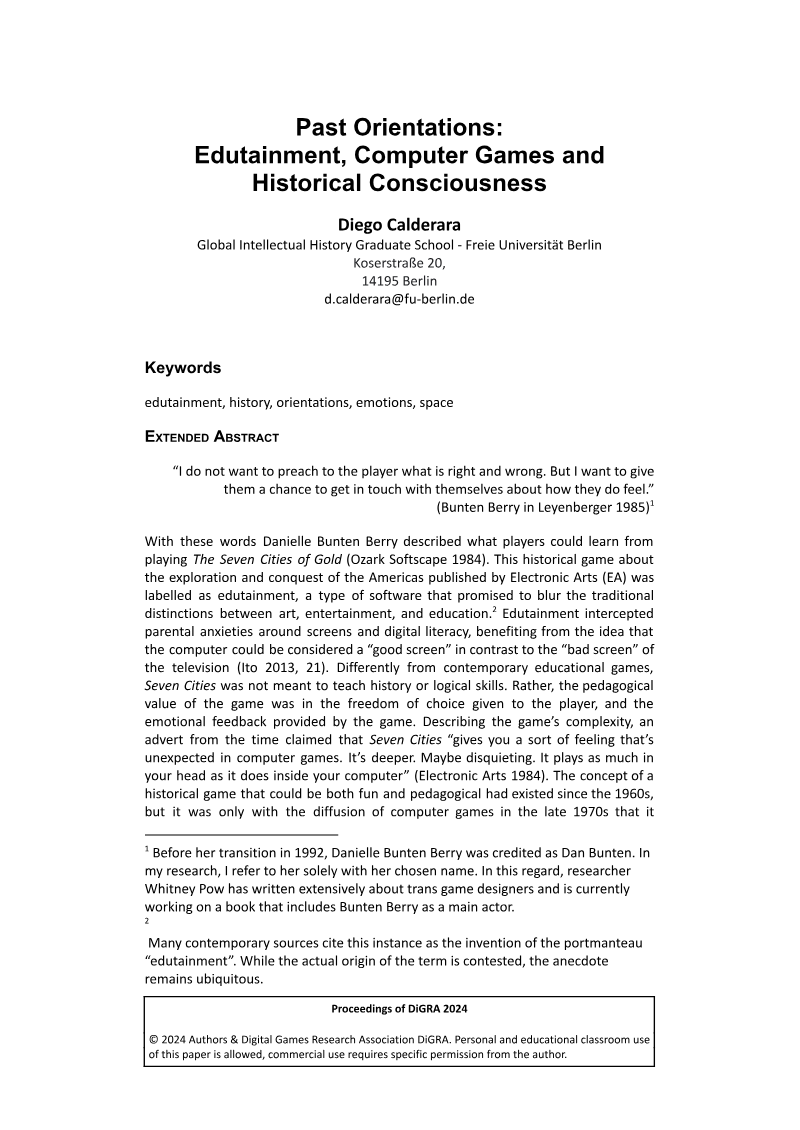
Past Orientations: Edutainment, Computer Games and Historical Consciousness
This doctoral project investigates the evolution of historical computer games, specifically edutainment titles, in the United States from the 1970s to the 1990s.
- The central argument is that edutainment games helped Americans learn to live with personal computers, making the technology accessible to children while easing the anxieties of parents and educators.
- The project uses Danielle Bunten Berry's concept of "orientation" to distinguish thing-oriented games, centered on the individual's relationship to the machine, from people-oriented games centered on affective and relational play.
- The research traces three periods: 1970s classroom computer play (with The Oregon Trail as a primary case), the 1980s domestication of personal computers and rise of edutainment (The Seven Cities of Gold, Bunten Berry's design influence), and the 1990s shift to individual bedroom-based play (Age of Empires).
Plus: Analyzing a Hot Week for Steam Launches
A strong week of Steam launches validated GameDiscoverCo's proprietary "Hype" ranking, which predicts breakout releases from wishlist and attention signals, and this late-July 2021 newsletter reviews the results.
- Steam launches in late July 2021 demonstrated strong commercial viability, led by Tribes of Midgard with 22,000 concurrent users, The Ascent with 10,000, and Starbase with 7,500.
- The Ascent achieved top-tier Steam best-seller status despite being simultaneously available on Xbox Game Pass, indicating that platform overlap does not necessarily cannibalize Steam revenue.
- GameDiscoverCo’s Hype scoring system, which benchmarks 2,000 points as noteworthy and 5,000 as a major contender, accurately forecasted the commercial performance of recent high-wishlist titles.
Cowboys, Outlaws, Ghouls and Spacefarers: The American Frontier within and without the United States
This paper examines how the American Frontier, understood as an ideologically charged trope, shapes the construction of national and non-national identities in video games.
- The paper's central thesis is that games set in the historical American Far West, post-apocalyptic Earth, and outer space share a common logic of space, power, expansion, and personal worth inherited from frontier mythology.
- The author argues this frontier logic is repurposed across time periods and settings, so wastelands, alien worlds, and historical landscapes reproduce similar discourses of conquest and moral agency.
- The study traces how Western tropes such as civilization versus savagery and the valorization of individual agency migrate into video game mechanics and storytelling.
Survival Themed Video Games and Cultural Constructs of Power
The survival video game genre functions as a profound cultural mirror, reflecting the economic and geopolitical anxieties defining the millennial generation.
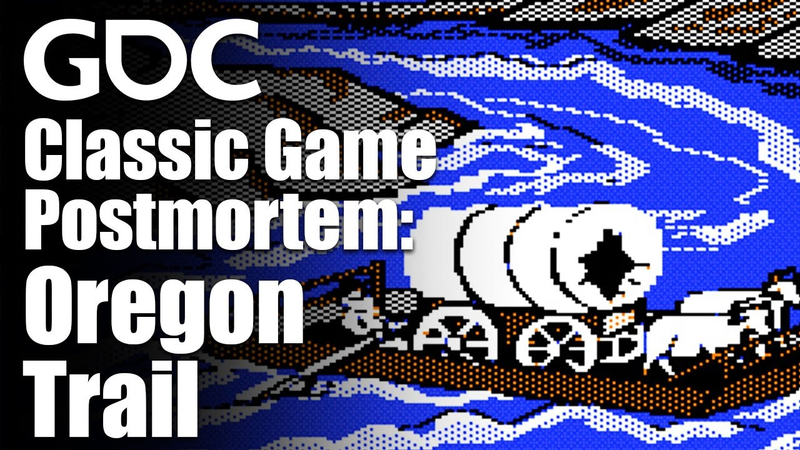
Classic Game Postmortem: Oregon Trail
The Oregon Trail originated in 1971 as a classroom simulation designed to transform history education through interactive technology.
- The Oregon Trail was created in 1971 by student teachers Don Rawitsch, Bill Heinman, and Paul Dillenberger to shift educational computing away from math-centric applications toward interactive history simulations.
- The game achieved significant commercial success after moving to the Minnesota Educational Computing Corporation (MECC), eventually accounting for one-third of the company's annual revenue.
- Developers enhanced the game's historical authenticity by integrating primary source materials from historical diaries, which helped facilitate its widespread adoption in schools.

Adapting Epic Theatre Principles for the Design of Games for Learning
This document introduces a novel framework for designing educational games, specifically those aimed at fostering critical reflection on complex societal systems beyond traditional academic settings.
- The paper argues that educational games fail to transfer learning because they prioritize fun balancing and immersion, so learning itself should be the primary design goal, with critical reflection as the intended outcome.
- Its framework rests on three components: a controlled play context, explicit educational framing, and tightly scaffolded content free of extraneous elements.
- Play context strongly shapes whether reflection occurs: unsupervised students ignored the learning goal in The Oregon Trail, while teacher-structured play increased participation in a Morrowind classroom study, suggesting an educator or cooperative setting is often necessary.
Computer Games as a Tool for Language Education
Ivan Lombardi argues that computer games can serve as a meaningful tool for language education, but only if they are grounded in sound pedagogy and mediated by skilled teachers.
- The work argues computer games should be treated as a genuine approach to foreign language learning rather than a supplementary classroom gimmick, proposing an integrated "ludic methodology" that is playful, learner-centred, multi-sensory, and culturally sensitive.
- Traditional edutainment has declined commercially, with U.S. revenue falling from $495.8 million in 2000 to $152 million in 2004, and the author contends its behaviourist, drill-and-practice methods failed to produce meaningful language acquisition.
- The framework reconceives the teacher as an "edurector", a facilitator and director of learning rather than a transmitter of knowledge, which the work says requires dedicated teacher training.
Theorizing Whiteness as a Proceduralized Ideology in Videogames
Proceduralized whiteness functions as a foundational ideology within video games, manifesting not merely through visual representation but through the core rules, mechanics, and goal structures that govern play.
- Game design often embeds Eurocentric and settler-colonial ideologies into core mechanics, normalizing extractive and expansionist behaviors as the default logic of play.
- Proceduralized whiteness functions as an invisible, foundational ideology in digital spaces by reinforcing dominant social norms through repetitive, automatic gameplay systems.
- Western role-playing games and 4X strategy titles, such as Civilization, Mass Effect, and The Oregon Trail, frequently equate progress with territorial conquest and resource accumulation.
Companies behind it

As the documents state it.