The Oregon Trail
Game
Documents about The Oregon Trail
Past Orientations: Edutainment, Computer Games and Historical Consciousness
This doctoral project investigates the evolution of historical computer games, specifically edutainment titles, in the United States from the 1970s to the 1990s.
- The central argument is that edutainment games helped Americans learn to live with personal computers, making the technology accessible to children while easing the anxieties of parents and educators.
- The project uses Danielle Bunten Berry's concept of "orientation" to distinguish thing-oriented games, centered on the individual's relationship to the machine, from people-oriented games centered on affective and relational play.
- The research traces three periods: 1970s classroom computer play (with The Oregon Trail as a primary case), the 1980s domestication of personal computers and rise of edutainment (The Seven Cities of Gold, Bunten Berry's design influence), and the 1990s shift to individual bedroom-based play (Age of Empires).
Cowboys, Outlaws, Ghouls and Spacefarers: The American Frontier within and without the United States
This paper examines how the American Frontier, understood as an ideologically charged trope, shapes the construction of national and non-national identities in video games.
- The paper's central thesis is that games set in the historical American Far West, post-apocalyptic Earth, and outer space share a common logic of space, power, expansion, and personal worth inherited from frontier mythology.
- The author argues this frontier logic is repurposed across time periods and settings, so wastelands, alien worlds, and historical landscapes reproduce similar discourses of conquest and moral agency.
- The study traces how Western tropes such as civilization versus savagery and the valorization of individual agency migrate into video game mechanics and storytelling.
Survival Themed Video Games and Cultural Constructs of Power
The survival video game genre functions as a profound cultural mirror, reflecting the economic and geopolitical anxieties defining the millennial generation.
- The survival genre has shifted from traditional empowerment-focused gaming to mechanics centered on resource scarcity, vulnerability, and permanent death.
- Survival games function as a cultural mirror for millennial anxieties, replacing the fantasy of absolute domination with the necessity of navigating systemic instability.
- The genre prioritizes an 'uncertainty aesthetic' that emphasizes self-reliance and difficult ethical decision-making over the conventional player-as-hero archetype.
Adapting Epic Theatre Principles for the Design of Games for Learning
This document introduces a novel framework for designing educational games, specifically those aimed at fostering critical reflection on complex societal systems beyond traditional academic settings.
- The paper argues that educational games fail to transfer learning because they prioritize fun balancing and immersion, so learning itself should be the primary design goal, with critical reflection as the intended outcome.
- Its framework rests on three components: a controlled play context, explicit educational framing, and tightly scaffolded content free of extraneous elements.
- Play context strongly shapes whether reflection occurs: unsupervised students ignored the learning goal in The Oregon Trail, while teacher-structured play increased participation in a Morrowind classroom study, suggesting an educator or cooperative setting is often necessary.
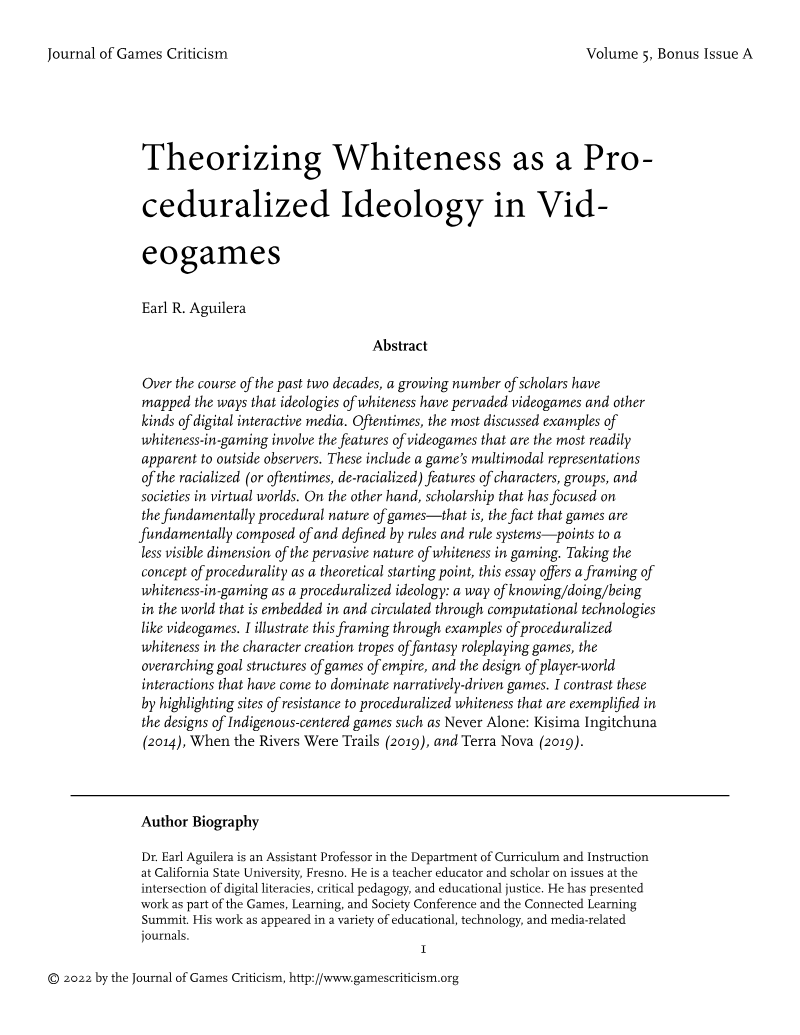
Theorizing Whiteness as a Proceduralized Ideology in Videogames
Proceduralized whiteness functions as a foundational ideology within video games, manifesting not merely through visual representation but through the core rules, mechanics, and goal structures that govern play.
- Game design often embeds Eurocentric and settler-colonial ideologies into core mechanics, normalizing extractive and expansionist behaviors as the default logic of play.
- Proceduralized whiteness functions as an invisible, foundational ideology in digital spaces by reinforcing dominant social norms through repetitive, automatic gameplay systems.
- Western role-playing games and 4X strategy titles, such as Civilization, Mass Effect, and The Oregon Trail, frequently equate progress with territorial conquest and resource accumulation.
Companies behind it

As the documents state it.