That Dragon, Cancer
Game
8 documents in the library are about That Dragon, Cancer, from writers such as DiGRA, Breda University of Applied Sciences and Thomas Brush. Each has a summary and key insights with the page they come from.
Connections
Each row is a game or company named alongside That Dragon, Cancer, each column a document, oldest first. A mark means that document names it. Select a row to see those documents.
Documents about That Dragon, Cancer
Killjoy Play: Illness, Disability, and No-Fun Pleasures in Video Games
This paper examines video games that deliberately refuse conventional notions of fun in order to represent illness, disability, and care.
- The paper argues that the expectation that games be enjoyable shapes which play experiences get valued, and proposes 'no-fun' games about illness, disability, and care as a counter-model of pleasure built on frustration, slowness, non-mastery, and acceptance.
- Drawing on disability studies, crip theory, and Sara Ahmed's feminist killjoy concept, the author frames these games as 'crip killjoy' modes of play that resist cure, progress, and resolution.
- The analysis centers on three titles: you're just imagining it (npckc, 2024), That Dragon, Cancer (Numinous Games, 2016), and Before I Forget (3-Fold Games, 2020), examined through close readings of narrative, mechanics, and audiovisual design.
Making Friends with Death: Posthuman Post-Life Play
The document explores how videogames can facilitate a posthuman reconceptualization of death, dying, and grief, moving beyond traditional humanist, capitalist, and neoliberal perspectives that view death as an interruption or enemy of progress.
- The paper argues that games about death, dying, and grief, such as Spiritfarer, Gris, A Mortician's Tale, and Last Day of June, can reframe mortality away from humanist, capitalist views of death as an interruption of progress toward a view of death as one phase in a generative, interconnected process.
- Drawing on critical posthumanism, feminist, new materialist, and rhizomatic theory (notably Rosi Braidotti), the author reads both Spiritfarer and Gris as enacting postdualistic relations with death, in which the ego and its anxieties dissolve into ongoing processes of becoming.
- Spiritfarer is interpreted as embracing a notion of final destination through its ferrying of spirits to the afterlife, while Gris conveys grief as both overwhelming affect and a process of discovery through its score, restored colour, and backward-moving mechanics.
Unraveling Grief: Design Space Analysis of Death-Themed Games
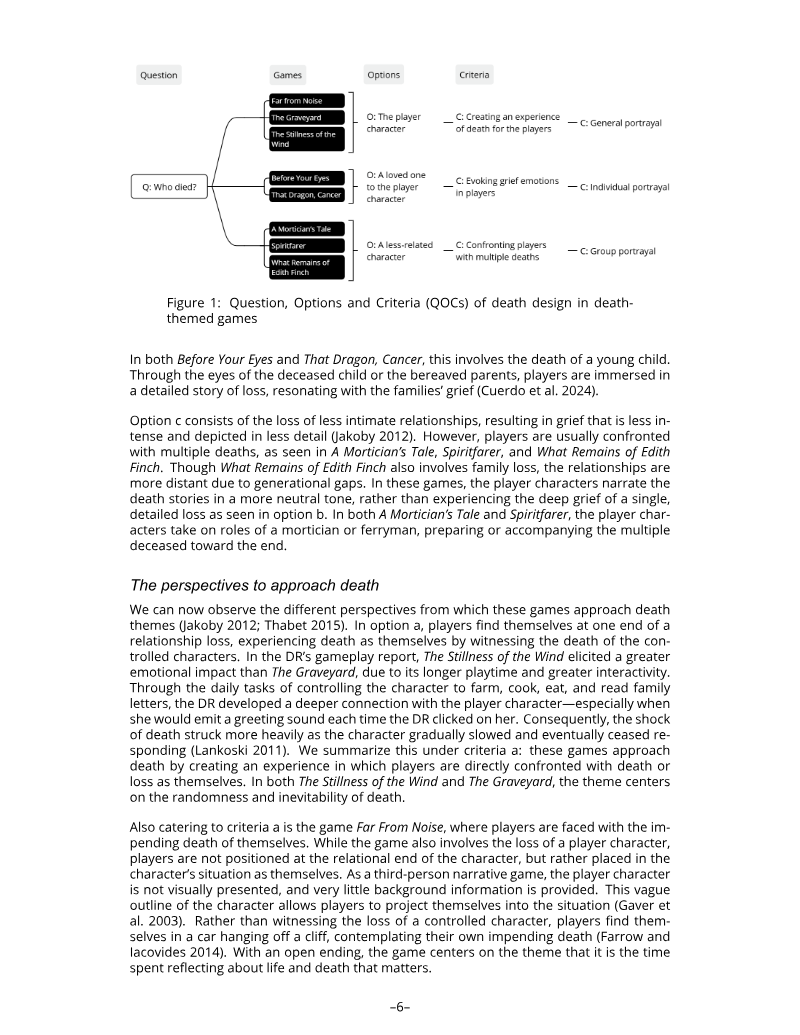
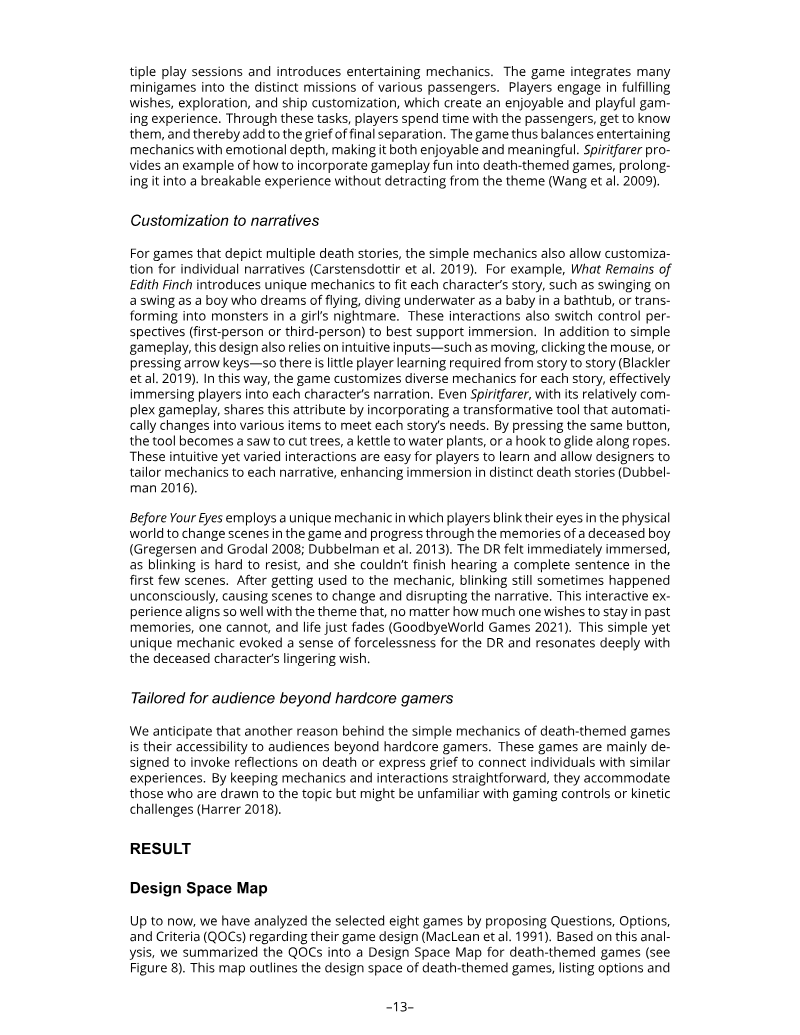
This study, "Unraveling Grief: Design Space Analysis of Death-Themed Games," systematically analyzes eight games to understand how design choices shape digital experiences of grief.
- The study is a Design Space Analysis using the QOC (Questions, Options, Criteria) framework, produced by Aalto University researchers, that organizes death-themed game design into a Design Space Map across four domains: death design, fictional design, visuals, and mechanics.
- Across eight examined games, including That Dragon, Cancer, Spiritfarer, and A Mortician's Tale, individual portrayals of a single intimate loss produced the strongest emotional impact, while group portrayals encouraged broader, more objective reflection on mortality.
- Most games convey death primarily through narrative rather than explicit imagery, and recurring motifs such as spiritual gravestones act as visual shorthand for multiple losses.
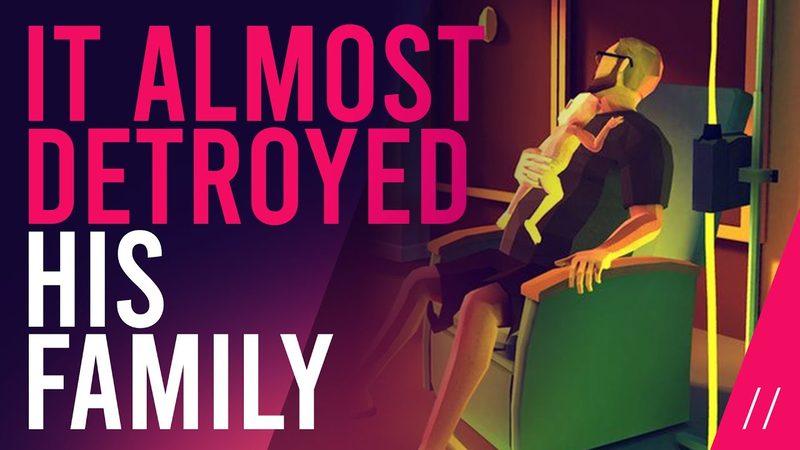
Faith, Family, & The Dark Side of Game Dev | EP 006
The pursuit of a sustainable career in independent game development requires a fundamental decoupling of personal identity from professional achievement.
- Developers must decouple personal identity from professional achievement to avoid burnout and the erosion of family relationships caused by equating self-worth with industry prestige.
- Prioritizing faith and personal presence over the pursuit of industry milestones fosters a resilient mindset that views professional setbacks as growth opportunities rather than catastrophic failures.
- Creating emotionally resonant games, such as 'That Dragon, Cancer,' demonstrates that authentic narratives regarding suffering and doubt build deeper player connections than traditional, didactic storytelling.
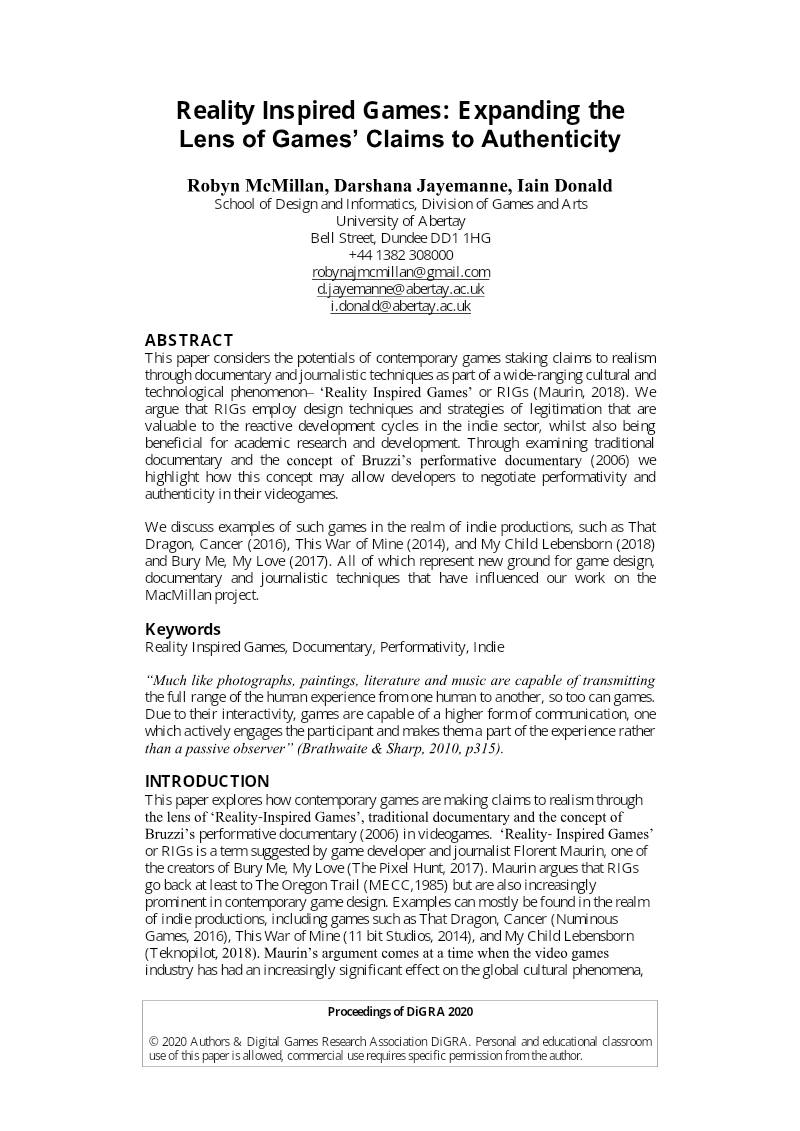
Reality Inspired Games: Expanding the Lens of Games' Claims to Authenticity
The document, "Reality Inspired Games: Expanding the Lens of Games' Claims to Authenticity," posits that a distinct category of video games, termed "Reality Inspired Games" (RIGs), leverages documentary and journalistic techniques to assert claims of realism.
- Reality Inspired Games (RIGs) are indie titles that claim authenticity by borrowing techniques from documentary and journalism, particularly Bruzzi's performative documentary, to connect players to real subjects such as war, refugee experience, and terminal illness.
- Examples cited include That Dragon, Cancer, This War of Mine, Bury Me, My Love, and My Child Lebensborn, which decenter the player and use mechanics and narrative structure to counter the critique of games as shallow or escapist.
- The authors contrast indie RIGs with AAA productions that market realism, arguing that annual release cycles, publisher requirements, and player-centric design limit how deeply AAA studios can explore difficult themes.
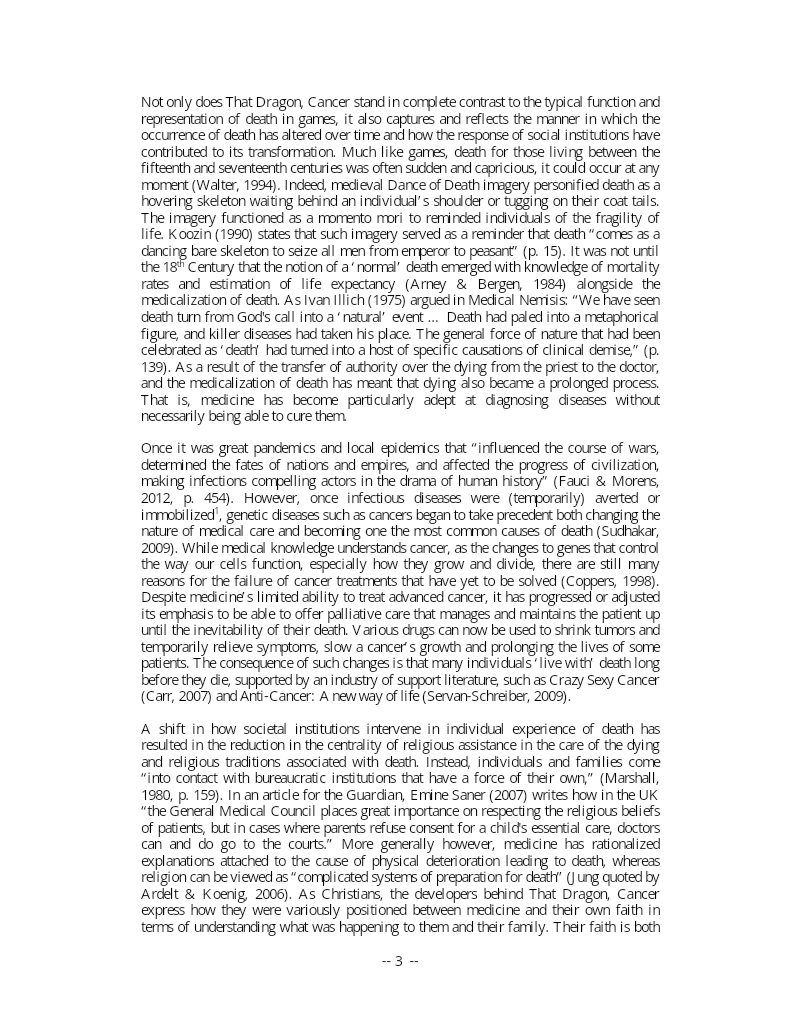
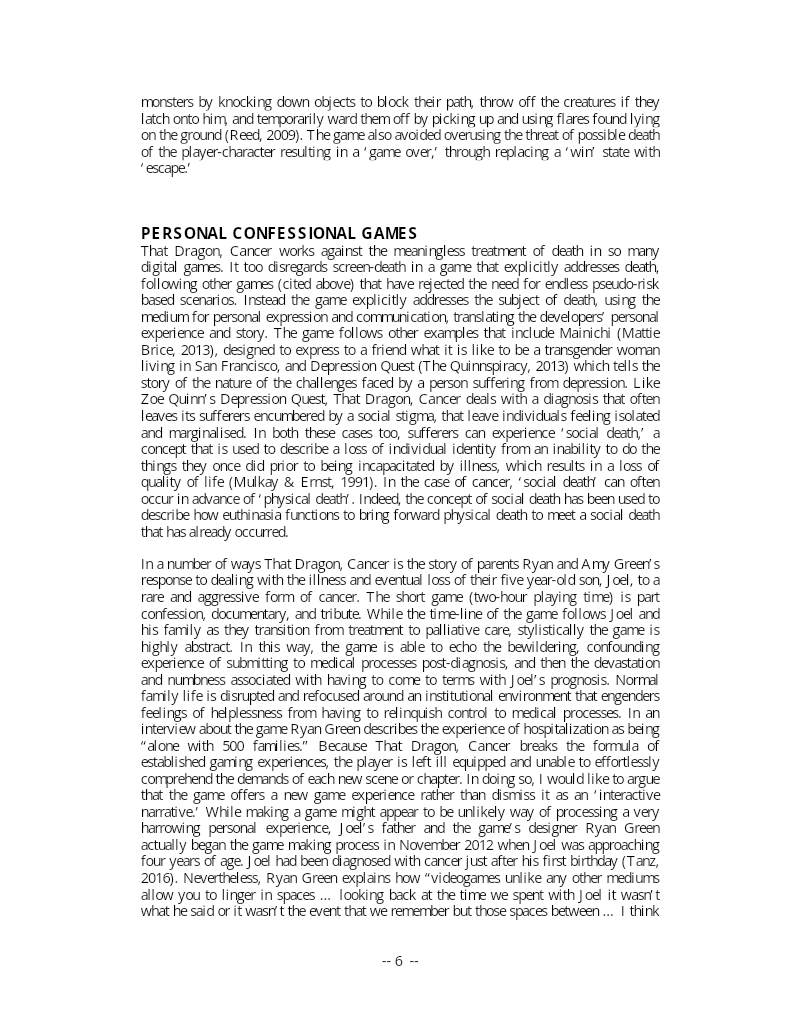
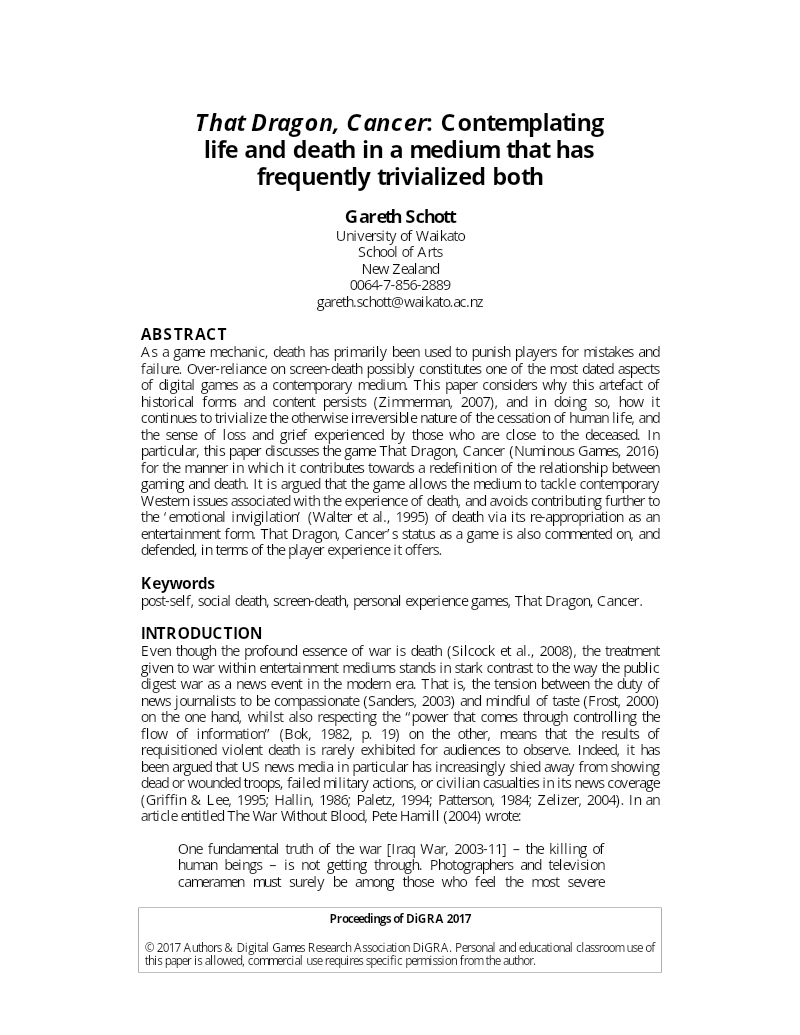
That Dragon, Cancer: Contemplating Life and Death in a Medium That Has Frequently Trivialized Both
The document examines how video games typically portray death as a trivial, punitive mechanic, contrasting this with the profound exploration of mortality in That Dragon, Cancer.
- Games have typically treated death as a punitive mechanic, such as the screen-death 'game over,' which arguably trivializes the irreversibility of mortality and bereavement.
- Schott argues that games can engage death seriously by grounding it in lived experience rather than presenting it as a consequence of player failure.
- That Dragon, Cancer (2016), an autobiographical game of roughly two hours about the Green family's loss of their five-year-old son Joel to cancer, conveys grief and medical helplessness through abstraction, shifting player perspectives, and the absence of a win state.
Creator's Discussion of the Growing Focus on, and Potential of, Storytelling in Video Game Design
Video games are widely perceived as violent, genre-bound entertainment dominated by science fiction, horror, and fantasy, but this reputation overlooks a rapidly growing arthouse-style movement running alongside large commercial releases.
- The video game industry's mainstream reputation for violent, otherworldly content (science-fiction, horror, fantasy) understates a growing arthouse movement of personal, autobiographical and life-inspired narrative games.
- Over the last decade, and especially the last five years, an increasing number of games have focused on vivid, believable characters, personal stories, and emotional experiences enhanced through interaction.
- The article examines key titles in this narrative-driven space and the debates they provoked within video game culture, including discussion of ludonarrative dissonance in BioShock.
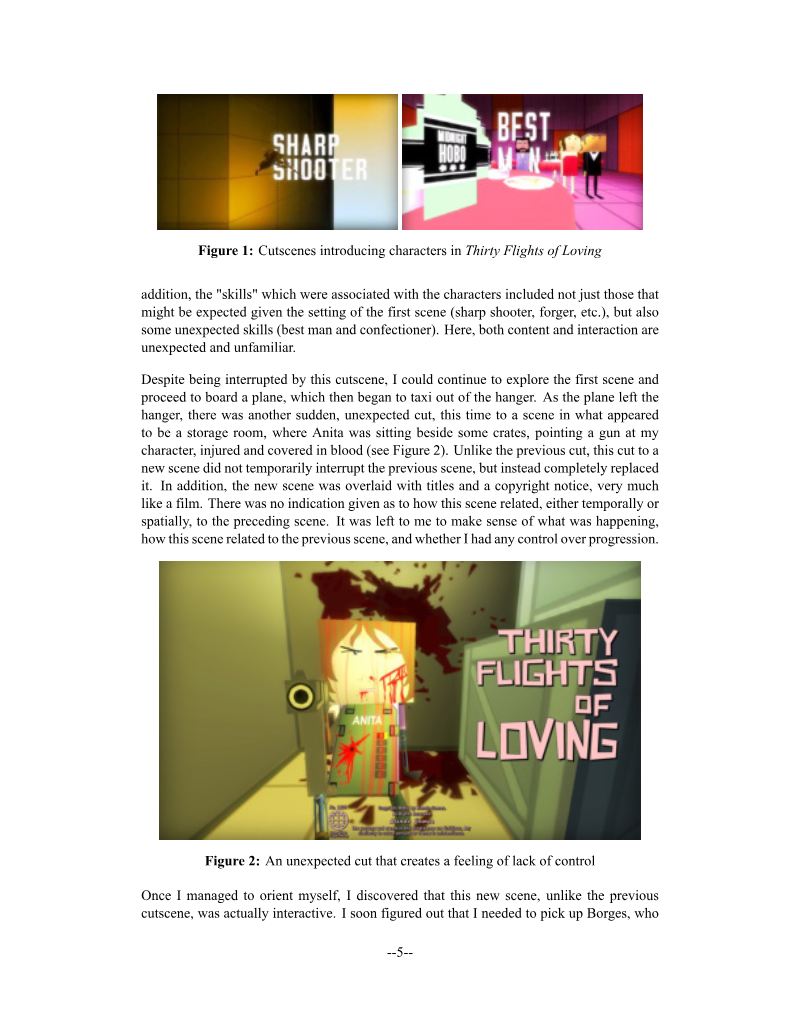
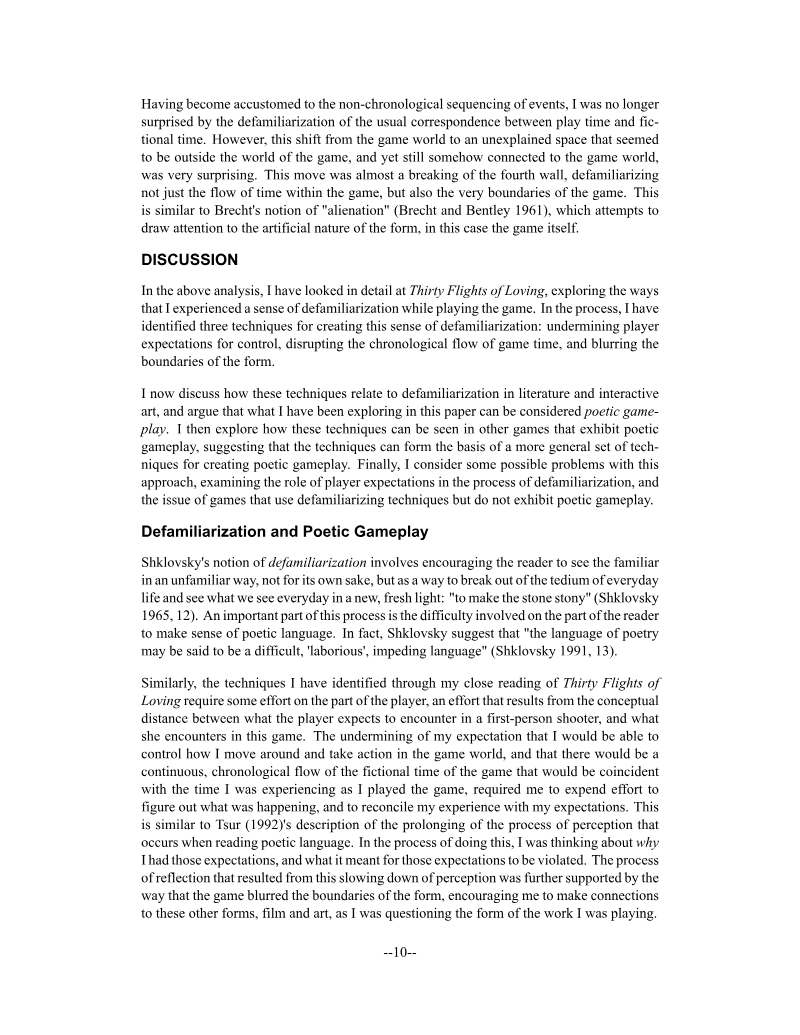
Making the Familiar Unfamiliar: Techniques for Creating Poetic Gameplay
The document explores "poetic gameplay" as a design philosophy that leverages formal structures to create a "defamiliarizing" effect, compelling players to engage with and reflect upon the game's form itself.
- The paper argues games can achieve "poetic gameplay" by applying Shklovsky's concept of defamiliarization: deliberately making familiar game structures strange so players attend to the game's form and reflect on it.
- Three core techniques are identified: undermining player control, disrupting the chronological flow of game time, and blurring the boundaries between game, film, and art.
- The findings rest on a close reading of Thirty Flights of Loving and the author's repeated play and analysis, making them qualitative rather than based on quantitative measurement.
Companies behind it
As the documents state it.