Numinous Games
Company
3 documents in the library are about Numinous Games, from writers such as DiGRA. Each has a summary and key insights with the page they come from.
Connections
Each row is a game or company named alongside Numinous Games, each column a document, oldest first. A mark means that document names it. Select a row to see those documents.
Documents about Numinous Games
Killjoy Play: Illness, Disability, and No-Fun Pleasures in Video Games
This paper examines video games that deliberately refuse conventional notions of fun in order to represent illness, disability, and care.
- The paper argues that the expectation that games be enjoyable shapes which play experiences get valued, and proposes 'no-fun' games about illness, disability, and care as a counter-model of pleasure built on frustration, slowness, non-mastery, and acceptance.
- Drawing on disability studies, crip theory, and Sara Ahmed's feminist killjoy concept, the author frames these games as 'crip killjoy' modes of play that resist cure, progress, and resolution.
- The analysis centers on three titles: you're just imagining it (npckc, 2024), That Dragon, Cancer (Numinous Games, 2016), and Before I Forget (3-Fold Games, 2020), examined through close readings of narrative, mechanics, and audiovisual design.
Making Friends with Death: Posthuman Post-Life Play
The document explores how videogames can facilitate a posthuman reconceptualization of death, dying, and grief, moving beyond traditional humanist, capitalist, and neoliberal perspectives that view death as an interruption or enemy of progress.
- The paper argues that games about death, dying, and grief, such as Spiritfarer, Gris, A Mortician's Tale, and Last Day of June, can reframe mortality away from humanist, capitalist views of death as an interruption of progress toward a view of death as one phase in a generative, interconnected process.
- Drawing on critical posthumanism, feminist, new materialist, and rhizomatic theory (notably Rosi Braidotti), the author reads both Spiritfarer and Gris as enacting postdualistic relations with death, in which the ego and its anxieties dissolve into ongoing processes of becoming.
- Spiritfarer is interpreted as embracing a notion of final destination through its ferrying of spirits to the afterlife, while Gris conveys grief as both overwhelming affect and a process of discovery through its score, restored colour, and backward-moving mechanics.
Unraveling Grief: Design Space Analysis of Death-Themed Games
This study, "Unraveling Grief: Design Space Analysis of Death-Themed Games," systematically analyzes eight games to understand how design choices shape digital experiences of grief.
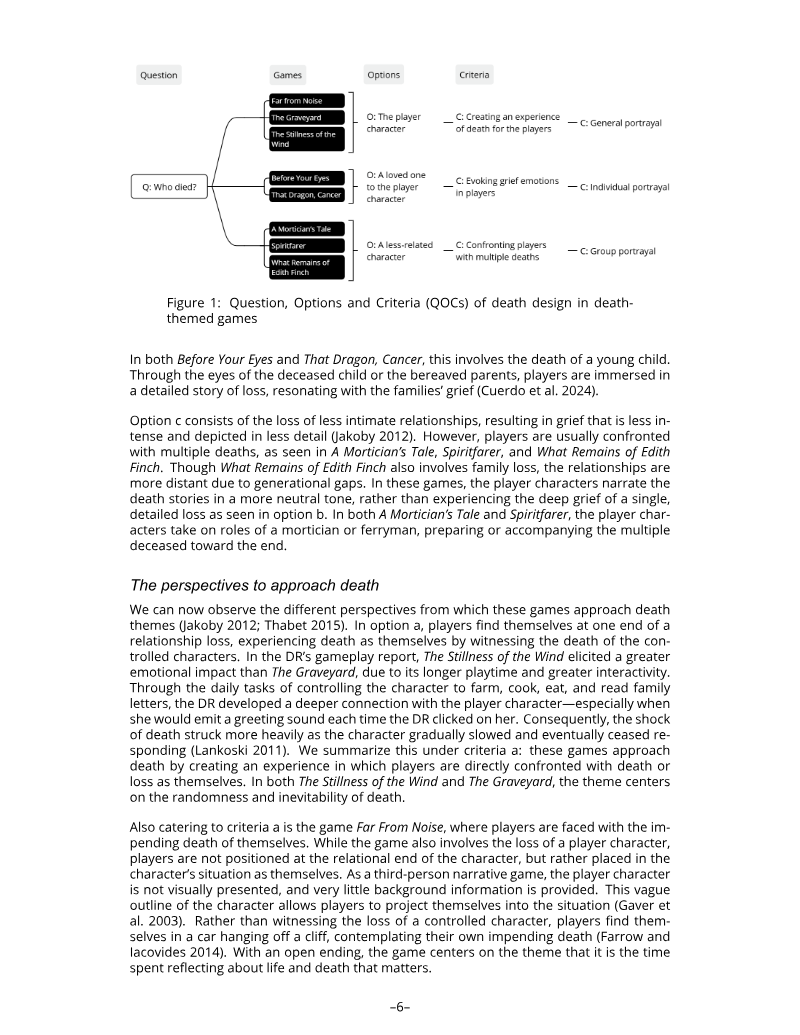
- The study is a Design Space Analysis using the QOC (Questions, Options, Criteria) framework, produced by Aalto University researchers, that organizes death-themed game design into a Design Space Map across four domains: death design, fictional design, visuals, and mechanics.
- Across eight examined games, including That Dragon, Cancer, Spiritfarer, and A Mortician's Tale, individual portrayals of a single intimate loss produced the strongest emotional impact, while group portrayals encouraged broader, more objective reflection on mortality.
- Most games convey death primarily through narrative rather than explicit imagery, and recurring motifs such as spiritual gravestones act as visual shorthand for multiple losses.