
Pentiment
GameBy Obsidian Entertainment · Released Nov 15, 2022
Documents about Pentiment
Evaluating the Classical Greek Reception in Genshin Impact through the Transcultural Study Lens: A Case Study of Enkanomiya Region
This paper examines how classical Greek elements are incorporated into the storytelling of Genshin Impact, with particular attention to the Enkanomiya region, an underground civilisation modelled loosely on Atlantis and set within the game's fantasy world of Teyvat.
- The paper argues that Genshin Impact (2020, produced by a Chinese studio) marks a shift in East Asian game design away from the anachronistic multicultural pastiche long associated with Japanese animation and games, toward a more deliberate, proactive multicultural approach.
- Its central case study is the Enkanomiya region, an underground civilisation loosely modelled on Atlantis that blends Platonic philosophy, Greek mythological figures (Helios, Phaethon, Ouroboros) and Japanese mythological motifs within a single setting.
- The analysis covers the region's architecture, narrative dialogue, cutscenes and player rituals, using Rachael Hutchinson's framework for textual and visual representation in games.
Creating the Foundation for a Virtual Game-Based Learning Lab to Stimulate Distance Education
The paper argues for building a virtual game-based learning lab to support distance education, filling a gap where physical campuses have board game collections but online courses lack digital equivalents aligned to academic subjects.
- The paper proposes a virtual game-based learning lab to fill a gap where physical campuses have board game collections but online courses lack digital equivalents aligned to academic subjects.
- Its central requirement is user-friendly access to both commercial-quality games and educational games tailored to course content, with licensing of commercial games and usability identified as the primary concerns.
- The work is framed as the first phases of a design science project (problem explication and requirements definition) and does not involve empirical testing of the lab itself, with conclusions explicitly described as provisional.
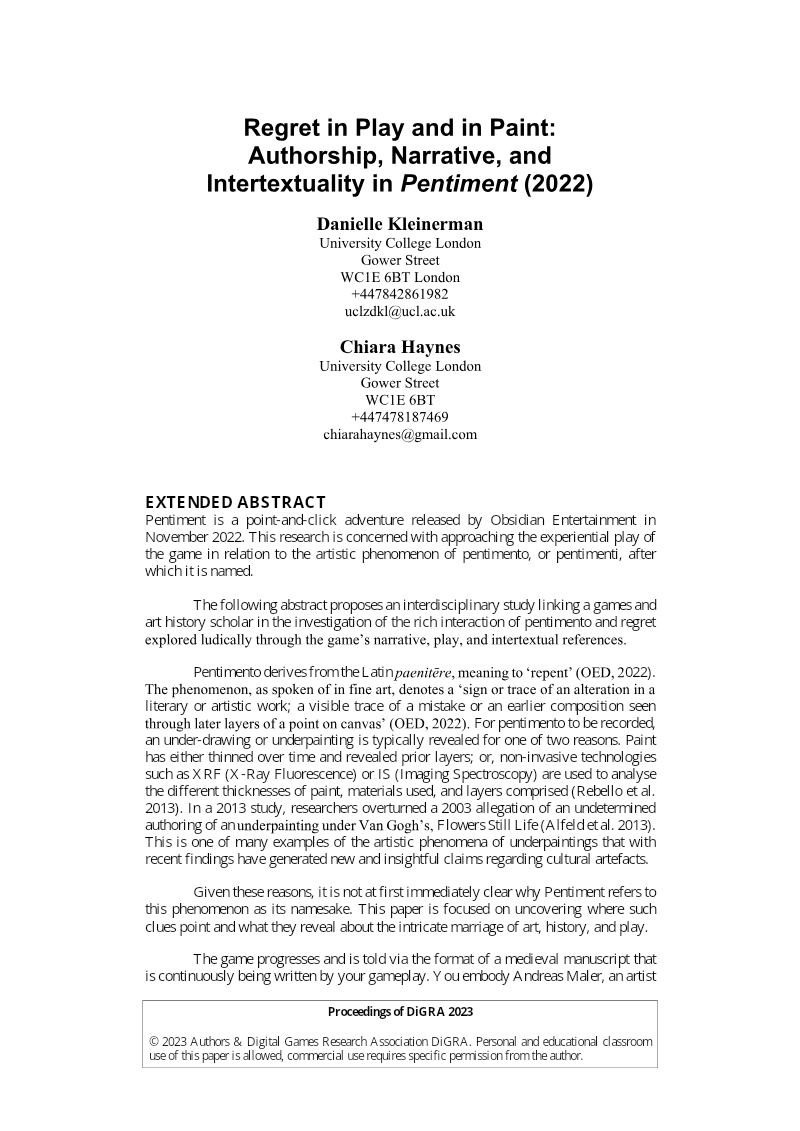
Regret in Play and in Paint: Authorship, Narrative, and Intertextuality in Pentiment
This paper, presented at DiGRA 2023 by Danielle Kleinerman and Chiara Haynes of University College London, examines Obsidian Entertainment's 2022 point-and-click adventure Pentiment through an interdisciplinary lens that joins games studies with art history.
- The paper, presented at DiGRA 2023 by Danielle Kleinerman and Chiara Haynes of University College London, argues that Obsidian Entertainment's 2022 point-and-click adventure Pentiment uses its title, borrowed from the art-historical term for visible traces of earlier painted layers, as a deliberate framing device.
- The authors contend that the game's branching narrative, replayability, and engagement with authorship mirror how an underpainting persists beneath later revisions, so that play becomes an act of writing and rewriting history.
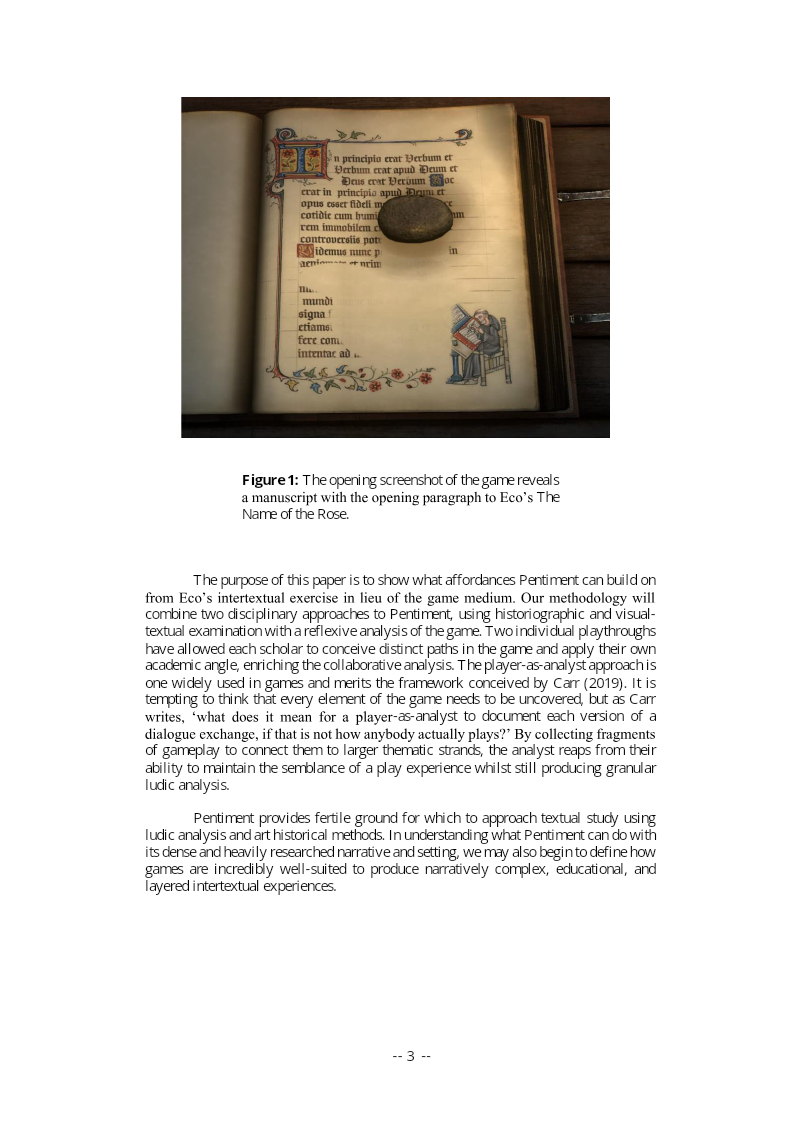
- The game is set in sixteenth-century Bavaria and uses the manuscript as its operating medium, with player choices shaping a continuously written and revised text, linked to early modern shifts in book production and the Reformation's challenge to Catholic authority.
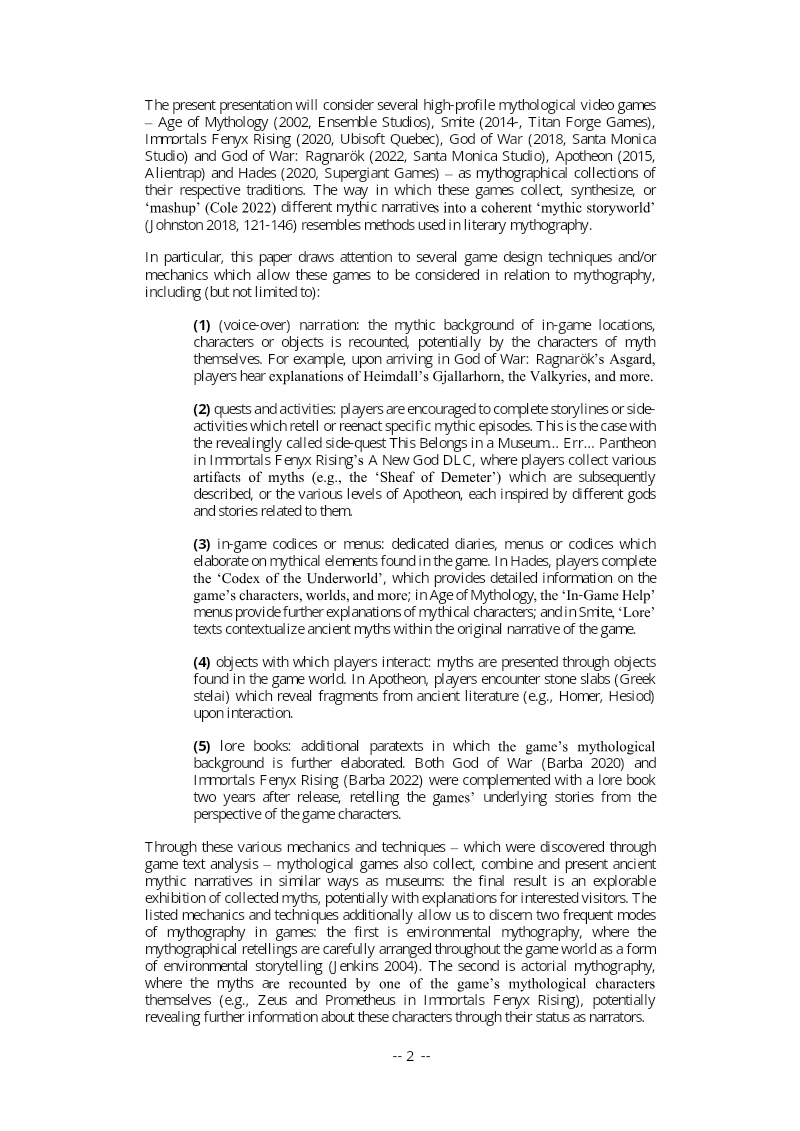
Museums of Myth and Mechanics: Mythography in Mythological Video Games
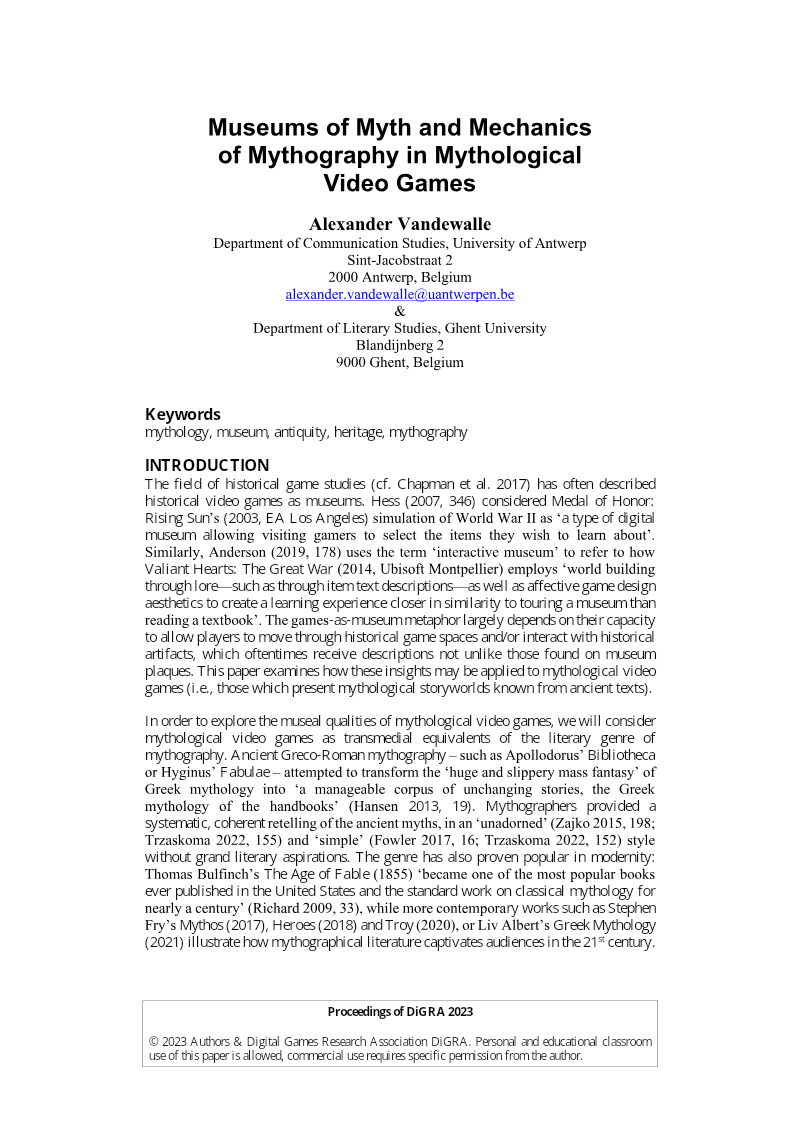
This paper argues that mythological video games can be understood as museums of myth, and more specifically as transmedial equivalents of ancient and modern mythography, the handbook tradition that systematized sprawling Greco-Roman myth into coherent, accessible retellings.
- The paper frames mythological video games as "museums of myth," comparing them to ancient and modern mythography, the handbook tradition that systematized Greco-Roman myth into coherent retellings.
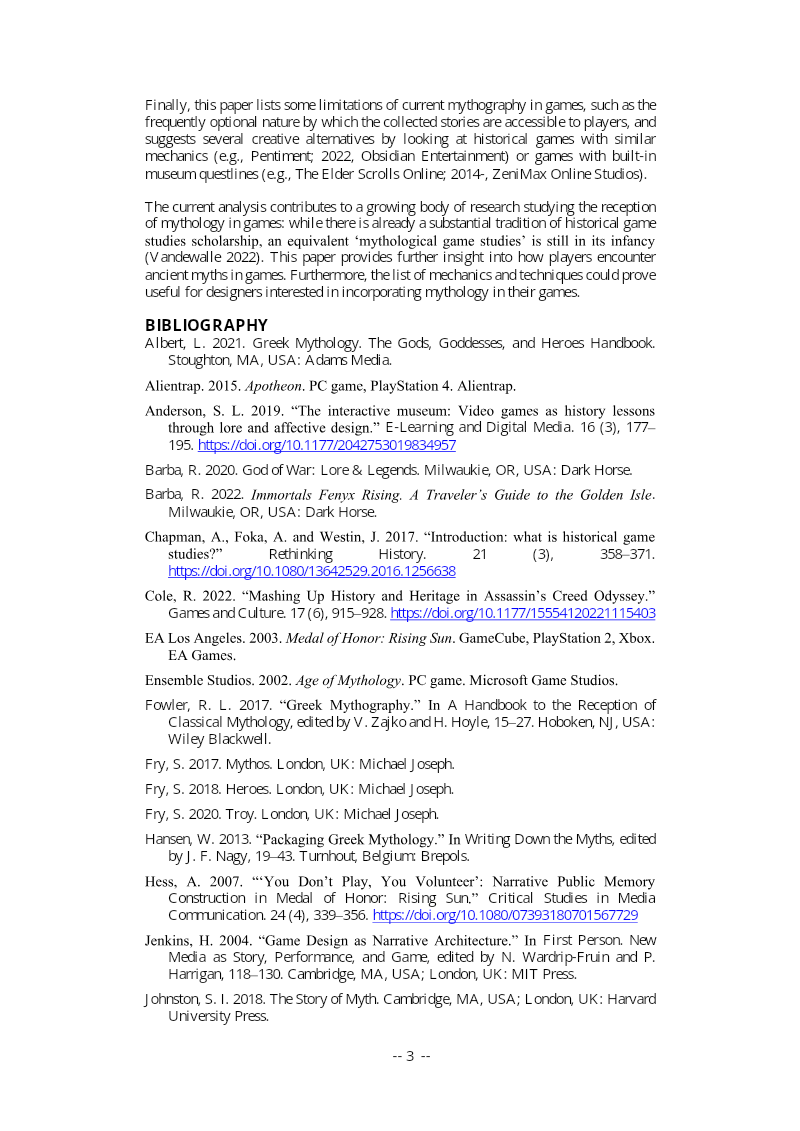
- Analysis of seven high-profile titles (including Age of Mythology, Smite, Immortals Fenyx Rising, God of War, God of War: Ragnarök, Apotheon, and Hades) identifies five recurring mechanics: voice-over mythic backstory, myth-retelling quests, in-game codices and lore texts, interactive objects revealing ancient literature fragments, and supplementary lore books.
- These techniques fall into two modes: environmental mythography, where retellings are embedded in the game world as environmental storytelling, and actorial mythography, where mythological characters narrate their own myths.
Companies behind it


As the documents state it.