Ingress
Game
11 documents in the library are about Ingress, from writers such as DiGRA, Game World Observer and PocketGamer.biz. Each has a summary and key insights with the page they come from.
Connections
Each row is a game or company named alongside Ingress, each column a document, oldest first. A mark means that document names it. Select a row to see those documents.
Documents about Ingress

Pocket Gamer Reacts: Breaking down Scopely's blockbuster $3.5bn deal for Niantic's games business
Scopely’s acquisition of Niantic’s games business for $3.5 billion represents a major consolidation within the mobile gaming sector, signaling a strategic pivot for both organizations.
- Scopely has acquired Niantic’s games business for $3.5 billion, taking over the development and live-service operations for titles including Pokémon GO, Monster Hunter Now, and Pikmin Bloom.
- Pokémon GO remains the primary financial anchor of the deal, having generated over $8.5 billion in lifetime gross revenue.
- Niantic is pivoting to focus on geospatial AI technology, supported by a $250 million funding round that includes a strategic investment from Scopely.
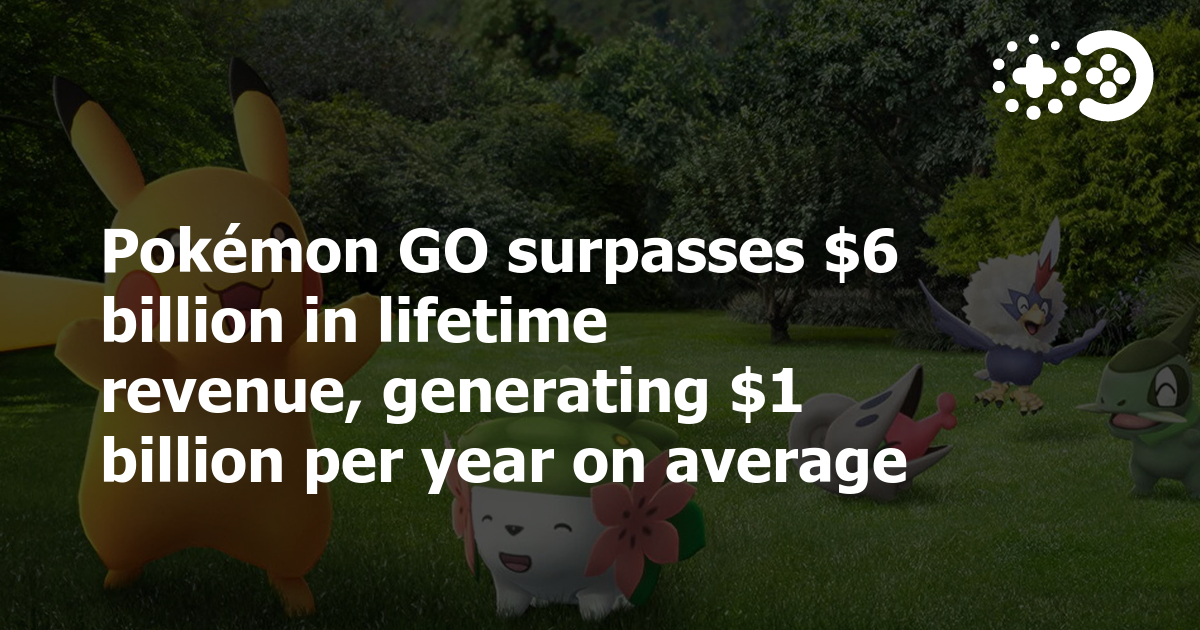
Pokémon GO Surpasses $6 Billion in Lifetime Revenue
The mobile gaming landscape has undergone a significant structural shift with Scopely’s acquisition of Niantic’s game development business for $3.5 billion.
- Scopely has acquired Niantic’s game development business for $3.5 billion, taking ownership of titles including Pokémon GO, Monster Hunter Now, and Pikmin Bloom.
- Pokémon GO has surpassed $8 billion in cumulative gross player spending since its 2016 launch, maintaining an average annual revenue of $1 billion.
- The acquired game portfolio generates over $1 billion in annual revenue and maintains a combined monthly active user base exceeding 30 million.
Practical Considerations for Values-Conscious Pervasive Games
"Practical Considerations for Values-Conscious Pervasive Games" argues that pervasive games, spanning alternate reality games, live action role-playing (larp), treasure hunts, and digital titles such as Ingress, Pokémon GO, and Kind Words, offer a valuable but underexplored means of engaging with player values.
- The report argues that pervasive games (ARGs, larps, treasure hunts, and digital titles like Ingress, Pokémon GO, and Kind Words) are a valuable but underexplored way to engage player values, building on Flanagan and Nissenbaum's values-conscious design framework and Shilton's broad conception of values.
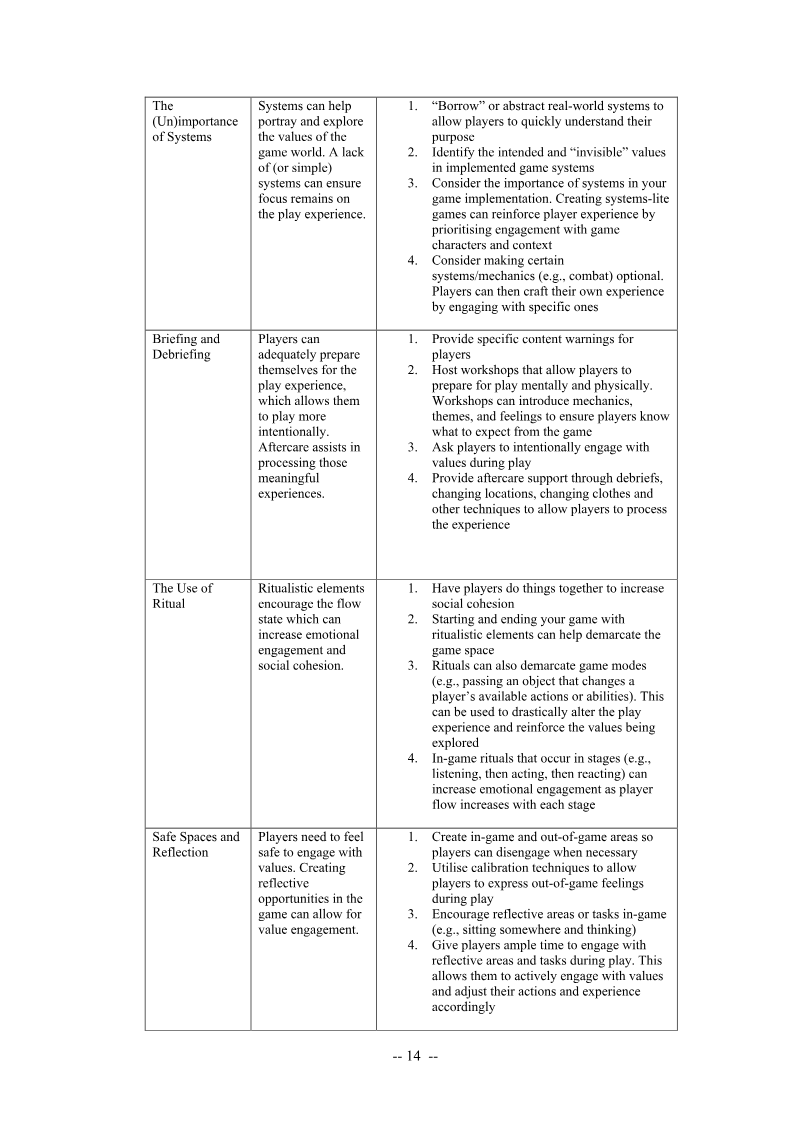
- Its central contribution is ten practical design considerations synthesized across genres, whereas prior research had mostly examined each pervasive-game subgenre in isolation.
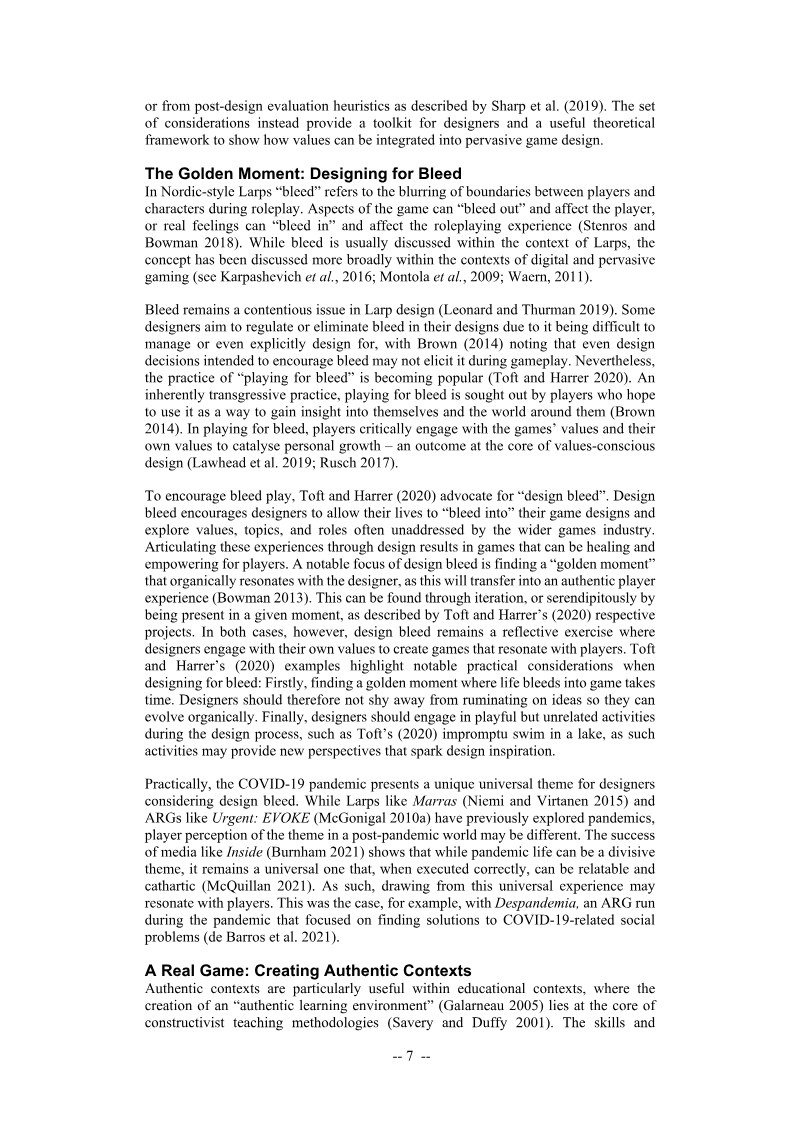
- Designing for "bleed" (the blurring of player and character experience) can support personal growth when designers draw on their own values and lived experience.

Niantic Shutting Down Harry Potter: Wizards Unite
The provided text details a significant strategic shift for Niantic, transitioning from a mobile game developer to a geospatial artificial intelligence firm.
- Scopely has agreed to acquire Niantic’s game development business for $3.5 billion, gaining control of major titles including Pokémon GO, Monster Hunter Now, and Pikmin Bloom.
- Niantic’s game portfolio, which generates over $1 billion in annual revenue and maintains 30 million monthly active users, will continue to be led by Kei Kawai and Ed Wu post-acquisition.
- Following the sale, Niantic will pivot to focus on geospatial AI and AR technology through a new standalone entity, Niantic Spatial, funded by $250 million in capital.
Classification of Gameplay Interaction in Digital Cultural Heritage
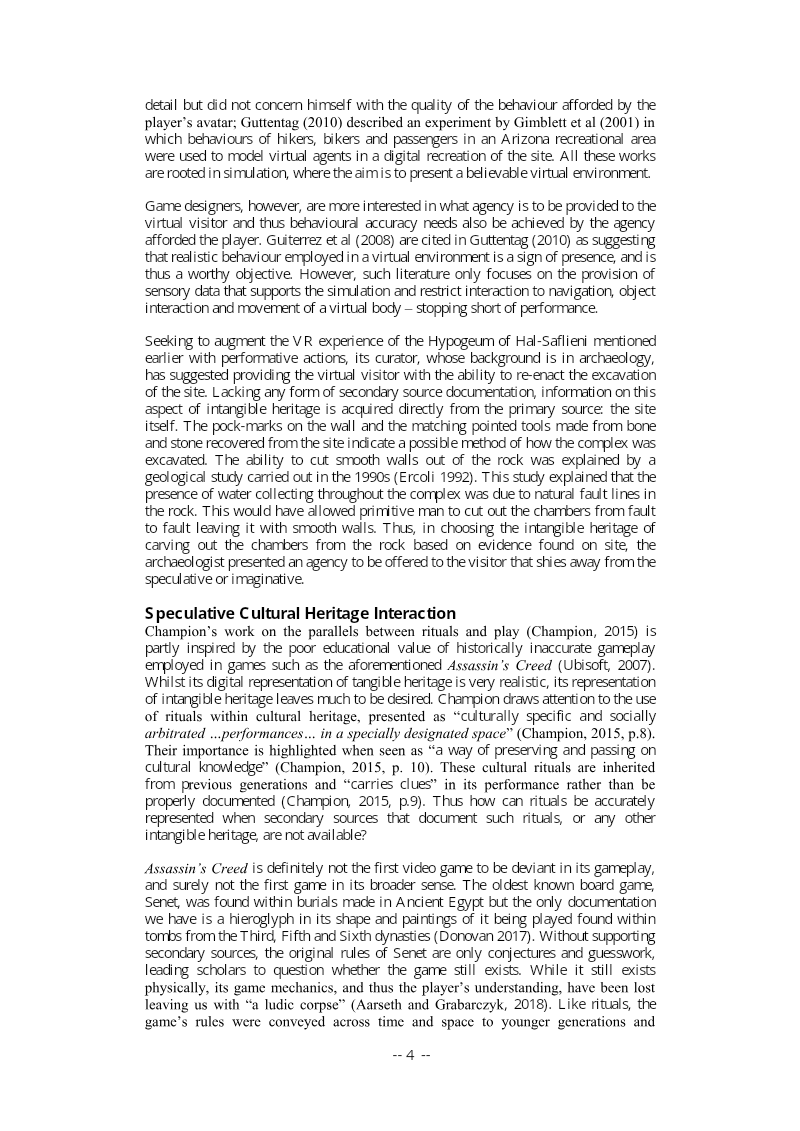
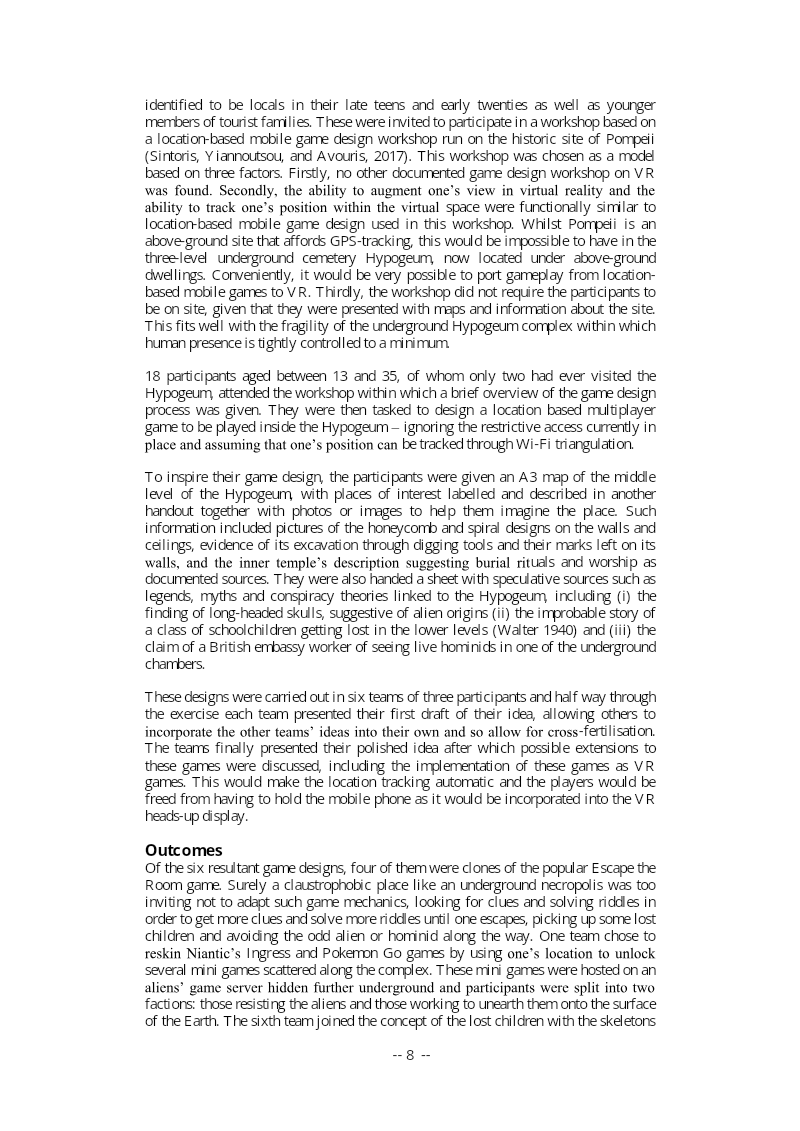
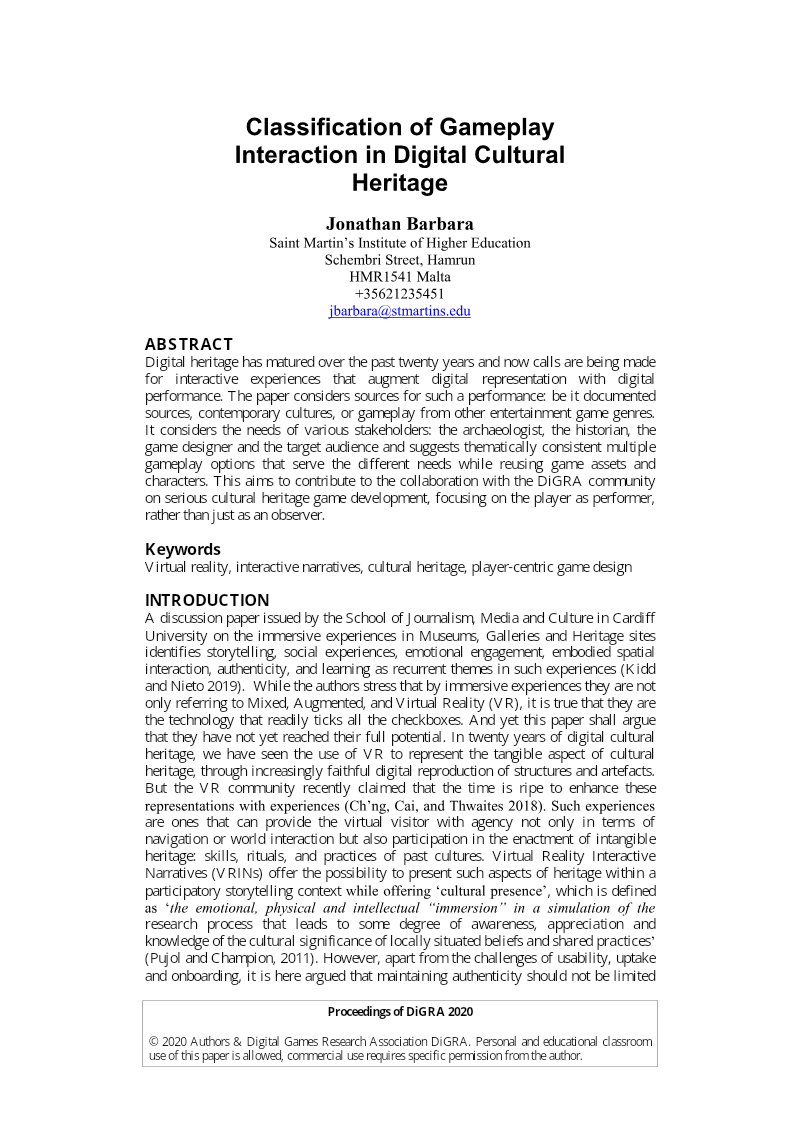
Virtual reality and location-based games offer a promising route for digital cultural heritage, but this document argues that such experiences should move beyond visual reconstruction of sites and instead offer players performative agency in intangible heritage such as rituals and skills.
- The paper argues digital cultural heritage games should offer performative agency in intangible heritage such as rituals and skills, rather than only visual reconstructions of sites.
- Its core contribution is a three-part classification of gameplay interaction with the historical record: documented, speculative, and repurposed, letting designers and curators deliberately weigh authenticity against engagement.
- In a workshop of 18 participants aged 13 to 35 (only two had visited the site), four of six location-based game designs cloned Escape the Room and one reskinned Ingress and Pokémon Go, showing a strong pull toward familiar genre mechanics over historically grounded ones.
Designing Location-Based Augmented Reality Games for Urban Tourism: A Conceptual Framework
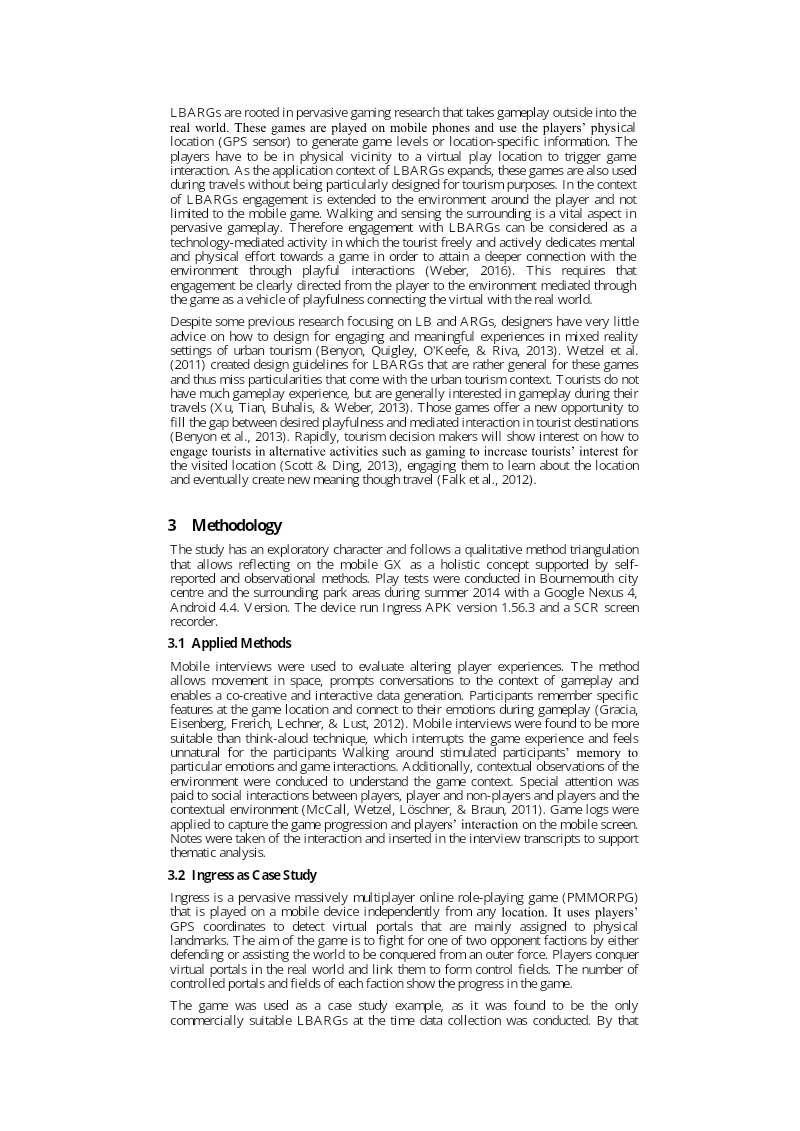
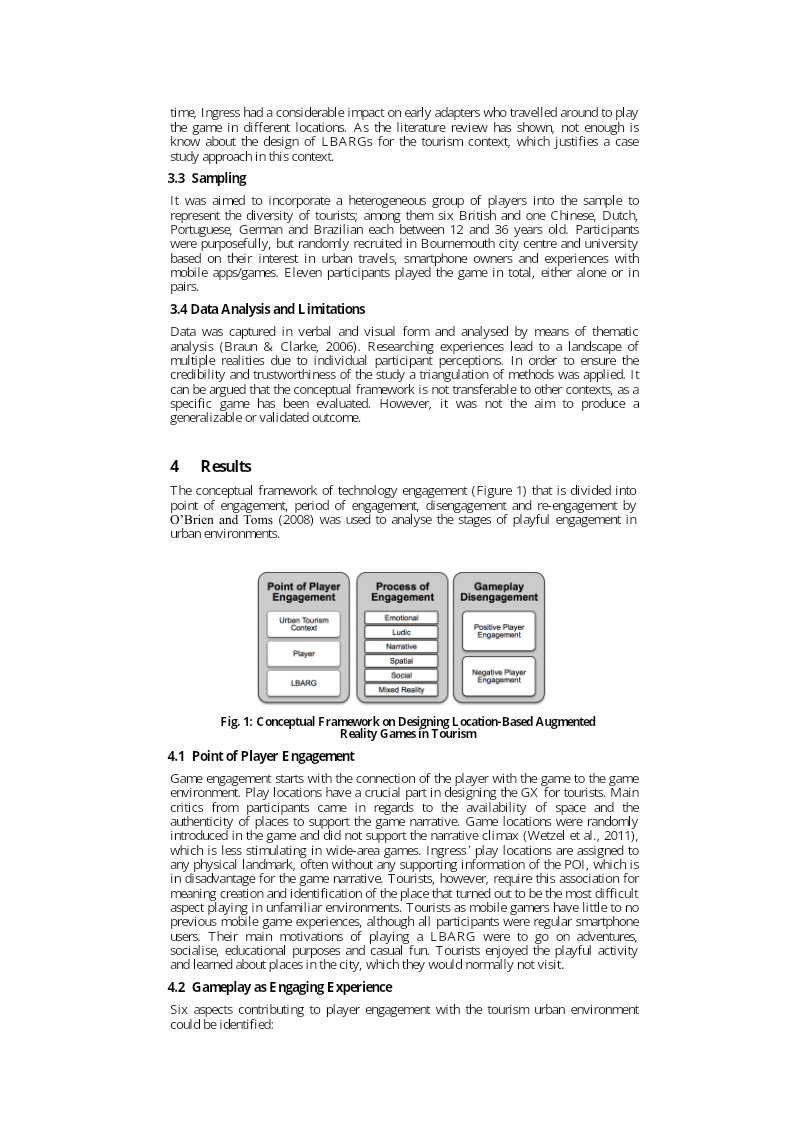
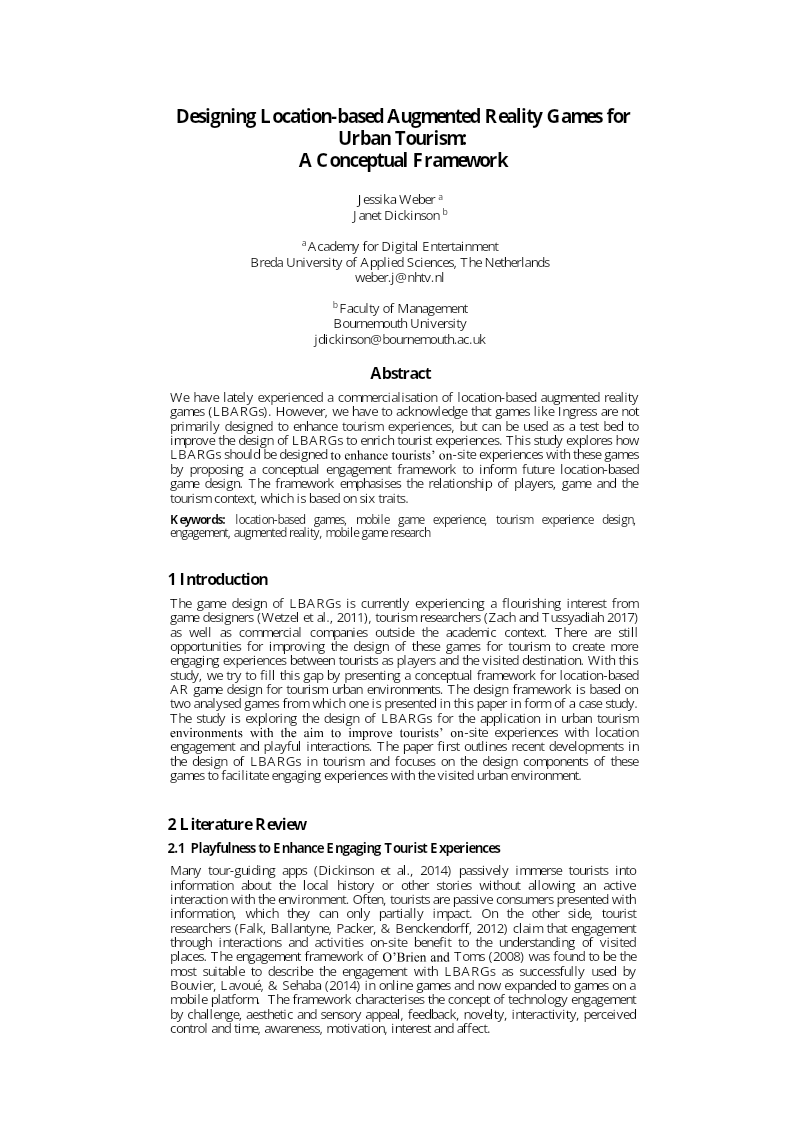
This study proposes a conceptual engagement framework for designing location-based augmented reality games (LBARGs) that enhance on-site tourist experiences in urban settings.
- The study proposes a six-trait engagement framework (emotional, ludic, narrative, spatial, social, and mixed reality) for location-based augmented reality games in urban tourism, built on O'Brien and Toms' (2008) engagement model.
- The framework was developed by testing Ingress, a commercial game not designed for tourism, in a qualitative exploratory study with 11 participants aged 12 to 36 of varied nationalities, playing on Android devices in Bournemouth city centre and surrounding parks in summer 2014.
- Players showed strong excitement during discovery and challenge completion, and spatial exploration heightened their awareness of unfamiliar locations.
Pokemon Go & Designing Interactive Games for the Real World
The development of Pokémon GO represents a strategic effort to transform mobile gaming by integrating GPS and sensor technology to encourage physical movement and real-world exploration.
- Pokémon GO achieved massive scale by leveraging GPS and sensor technology, resulting in over 650 million downloads and billions of kilometers walked by players within its first year.
- The game’s development strategy utilized the foundational location-based mechanics established in Ingress to successfully bridge virtual gameplay with physical-world exploration.
- Technical performance was optimized for diverse mobile hardware by using the Unity engine, a thumb-centric interface, and lightweight, stylized visuals to ensure accessibility across varying connectivity levels.
The Space Between Debord and Pikachu
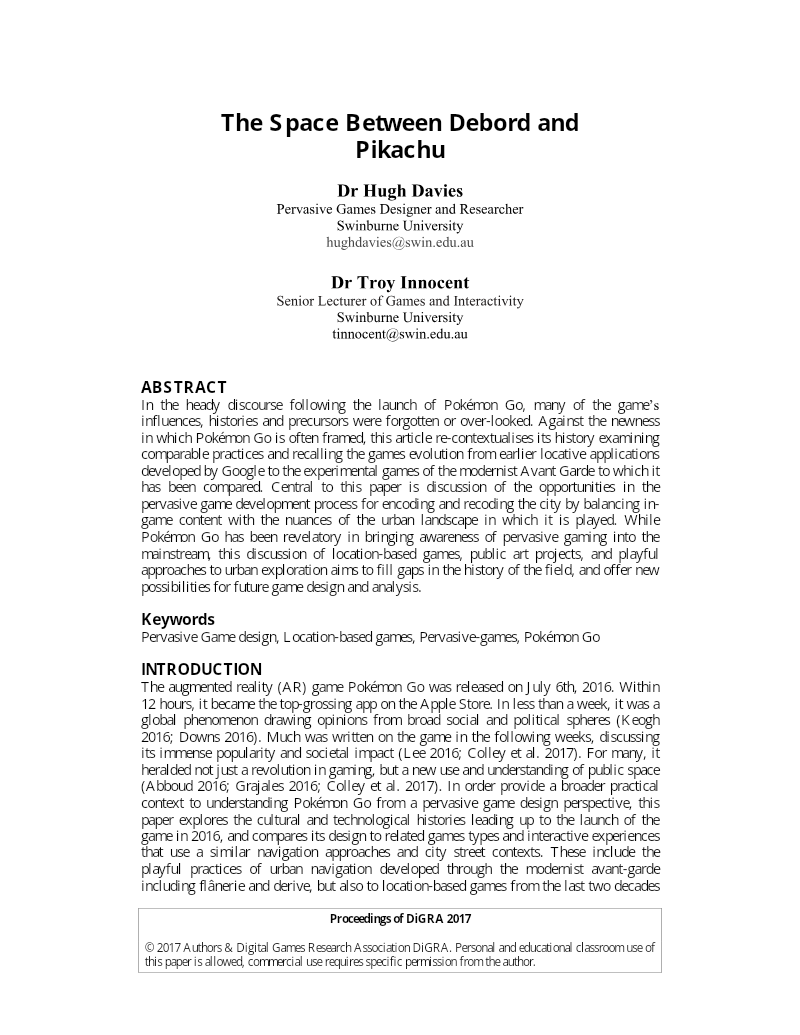
"The Space Between Debord and Pikachu" is a conceptual, qualitative analysis of Pokémon Go that argues the game's cultural significance has been overstated as entirely new.
- The report argues Pokémon Go's cultural significance has been overstated as wholly new, positioning it as building on location-based games (Mogi, Ingress, Shadow Cities) and older urban play traditions such as the Surrealist flâneur, the Situationist dérive, orienteering, letterboxing, and geocaching.
- The analysis is primarily conceptual and historical, drawing on theorists De Certeau and Debord and the authors' design experience rather than quantitative data on player populations or geographic usage.
- It proposes three analytical lenses for such games: play as response to environment, play as exploration of alternate reality, and play as decoding infrastructure.
Localizing Location-Based Gaming: Situating Australian Urban Play
This paper, a conference proceedings contribution by Kyle Moore of the University of Sydney, argues for "situated play" as a conceptual tool for understanding everyday practices of location-based gaming in urban environments, with particular attention to Australian contexts.
- The paper proposes 'situated play' as a conceptual tool for understanding everyday location-based gaming in urban environments, shifting focus from games as spatial or temporal phenomena to the localized cultures in which they are played.
- It argues that urban play sits in a tension between Western conceptions of the city as functional space and as playful space, and frames historical playful urban mobility as resembling play rather than being play in itself.
- Urban play is presented as a potentially subversive reading of cities as sites of capitalist functionality, while also serving a civic and social purpose within the tradition of public play design.
Postdigital Play and the Aesthetics of Recruitment
"Postdigital Play and the Aesthetics of Recruitment" argues that hybrid play is not a novel development but a return to videogames' long-standing hybrid nature, now intensified by distributed computing.
- Hybrid play is framed as a return to videogames' long-standing hybrid nature, now intensified by distributed computing rather than a wholly novel development.
- The authors argue that device-focused models classifying hybrid play by synchrony and dependency cannot account for contexts where devices, spaces, and bodies cannot be specified in advance.
- The proposed analytical framework centres on interface effects and an "aesthetic of recruitment," in which spatial, social, and material domains are enrolled into play.

John Hanke on why location unlocks the next wave of mobile gaming
Location-based mobile gaming represents a significant frontier for digital entertainment, driven by the convergence of advanced mobile hardware, wearable technology, and health-focused applications.
- Location-based gaming is evolving from a niche experiment into a mainstream platform by integrating real-world movement with immersive, narrative-driven gameplay.
- The core value of location-based experiences lies in their ability to foster emergent social behaviors and collaborative community dynamics similar to traditional massively multiplayer online games.
- Global infrastructure is a prerequisite for success, as evidenced by Ingress, which has successfully established a presence across more than 200 countries.
Companies behind it
As the documents state it.