Ingress
Game
Documents about Ingress

Article
Pokémon GO Surpasses $6 Billion in Lifetime Revenue
The mobile gaming landscape has undergone a significant structural shift with Scopely’s acquisition of Niantic’s game development business for $3.5 billion.
- Scopely has acquired Niantic’s game development business for $3.5 billion, taking ownership of titles including Pokémon GO, Monster Hunter Now, and Pikmin Bloom.
- Pokémon GO has surpassed $8 billion in cumulative gross player spending since its 2016 launch, maintaining an average annual revenue of $1 billion.
- The acquired game portfolio generates over $1 billion in annual revenue and maintains a combined monthly active user base exceeding 30 million.
Game World ObserverJun 2022

Article
Niantic Shutting Down Harry Potter: Wizards Unite
The provided text details a significant strategic shift for Niantic, transitioning from a mobile game developer to a geospatial artificial intelligence firm.
- Scopely has agreed to acquire Niantic’s game development business for $3.5 billion, gaining control of major titles including Pokémon GO, Monster Hunter Now, and Pikmin Bloom.
- Niantic’s game portfolio, which generates over $1 billion in annual revenue and maintains 30 million monthly active users, will continue to be led by Kei Kawai and Ed Wu post-acquisition.
- Following the sale, Niantic will pivot to focus on geospatial AI and AR technology through a new standalone entity, Niantic Spatial, funded by $250 million in capital.
Game World ObserverNov 2021
Article
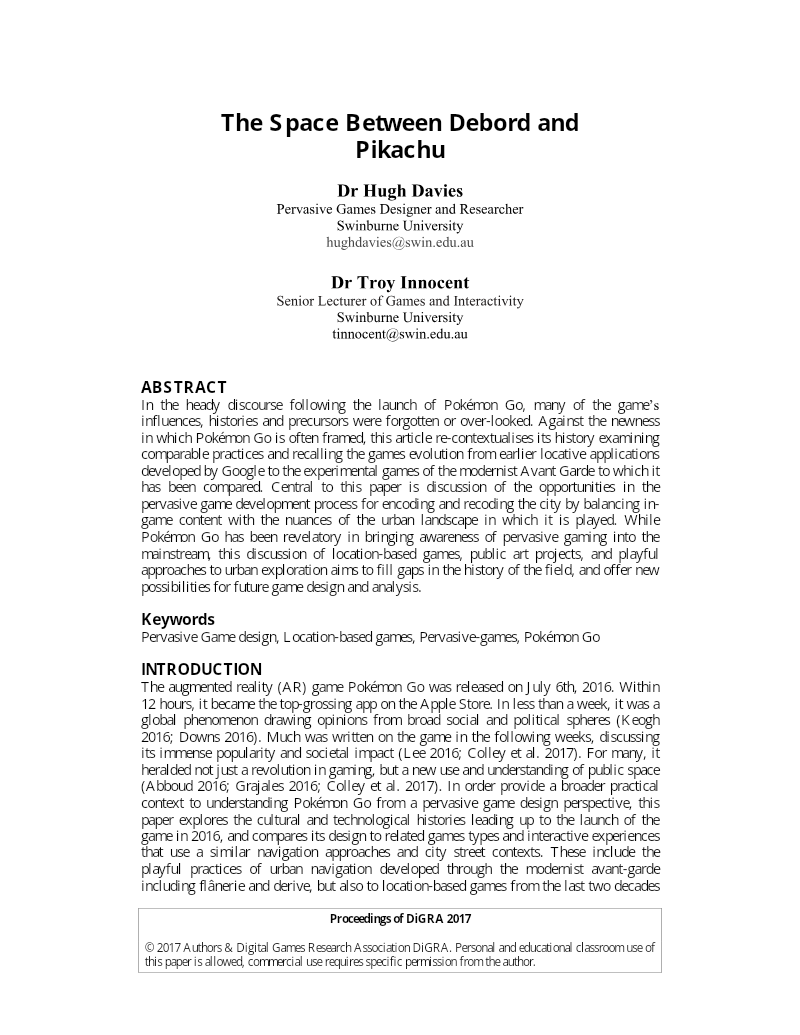
The Space Between Debord and Pikachu
"The Space Between Debord and Pikachu" is a conceptual, qualitative analysis of Pokémon Go that argues the game's cultural significance has been overstated as entirely new.
- The report argues Pokémon Go's cultural significance has been overstated as wholly new, positioning it as building on location-based games (Mogi, Ingress, Shadow Cities) and older urban play traditions such as the Surrealist flâneur, the Situationist dérive, orienteering, letterboxing, and geocaching.
- The analysis is primarily conceptual and historical, drawing on theorists De Certeau and Debord and the authors' design experience rather than quantitative data on player populations or geographic usage.
- It proposes three analytical lenses for such games: play as response to environment, play as exploration of alternate reality, and play as decoding infrastructure.
DiGRAJan 2017
Companies behind it
As the documents state it.