Ingress
Game
Documents about Ingress
Practical Considerations for Values-Conscious Pervasive Games
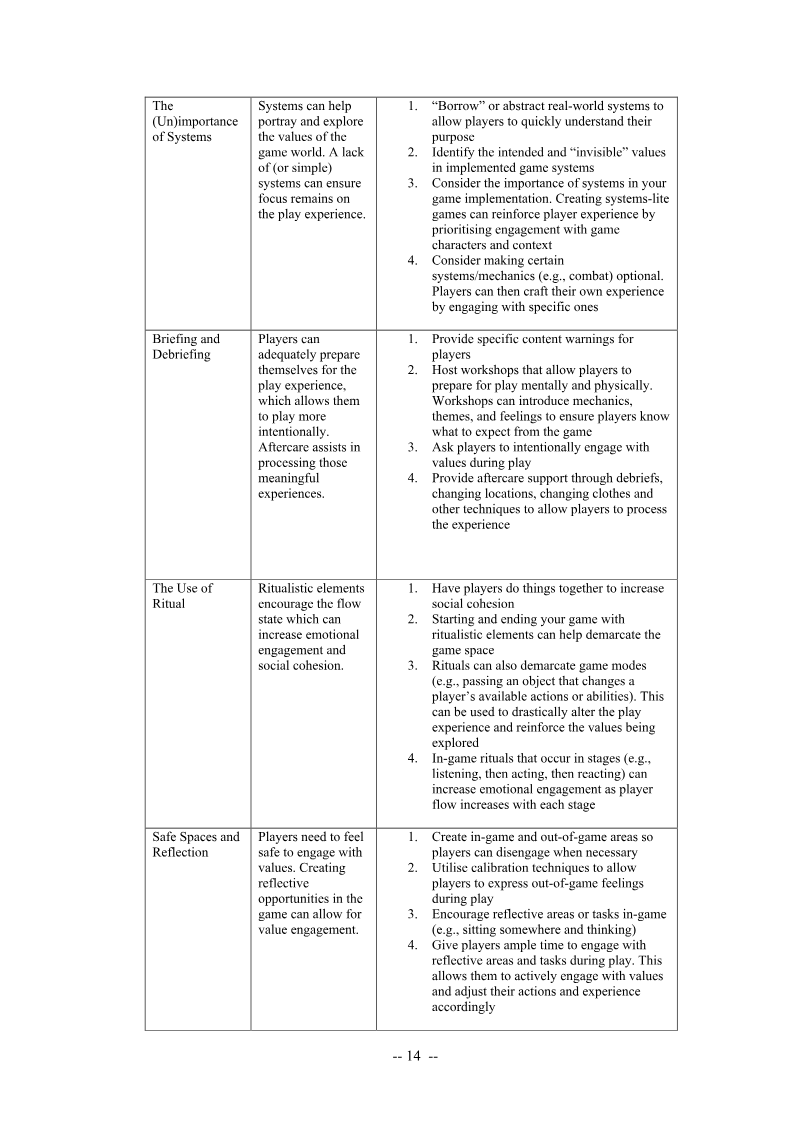
"Practical Considerations for Values-Conscious Pervasive Games" argues that pervasive games, spanning alternate reality games, live action role-playing (larp), treasure hunts, and digital titles such as Ingress, Pokémon GO, and Kind Words, offer a valuable but underexplored means of engaging with player values.
- The report argues that pervasive games (ARGs, larps, treasure hunts, and digital titles like Ingress, Pokémon GO, and Kind Words) are a valuable but underexplored way to engage player values, building on Flanagan and Nissenbaum's values-conscious design framework and Shilton's broad conception of values.
- Its central contribution is ten practical design considerations synthesized across genres, whereas prior research had mostly examined each pervasive-game subgenre in isolation.
- Designing for "bleed" (the blurring of player and character experience) can support personal growth when designers draw on their own values and lived experience.
Classification of Gameplay Interaction in Digital Cultural Heritage
Virtual reality and location-based games offer a promising route for digital cultural heritage, but this document argues that such experiences should move beyond visual reconstruction of sites and instead offer players performative agency in intangible heritage such as rituals and skills.
- The paper argues digital cultural heritage games should offer performative agency in intangible heritage such as rituals and skills, rather than only visual reconstructions of sites.
- Its core contribution is a three-part classification of gameplay interaction with the historical record: documented, speculative, and repurposed, letting designers and curators deliberately weigh authenticity against engagement.
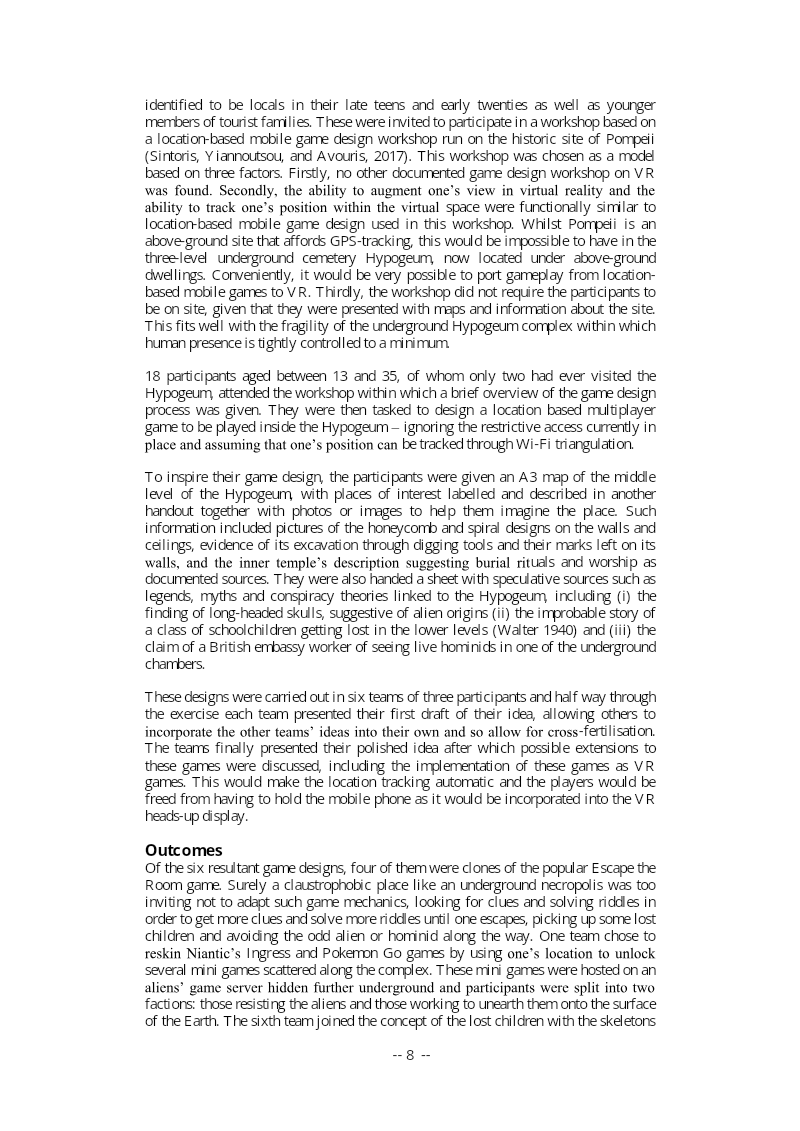
- In a workshop of 18 participants aged 13 to 35 (only two had visited the site), four of six location-based game designs cloned Escape the Room and one reskinned Ingress and Pokémon Go, showing a strong pull toward familiar genre mechanics over historically grounded ones.
Designing Location-Based Augmented Reality Games for Urban Tourism: A Conceptual Framework
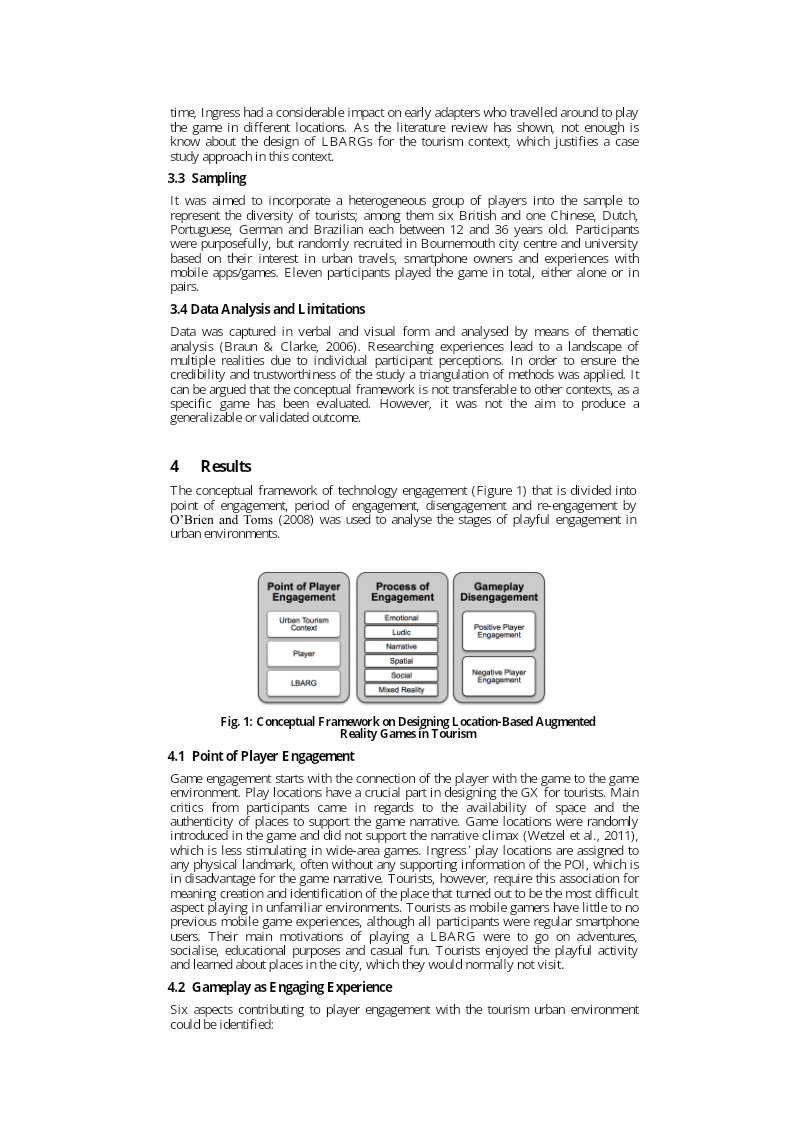
This study proposes a conceptual engagement framework for designing location-based augmented reality games (LBARGs) that enhance on-site tourist experiences in urban settings.
- The study proposes a six-trait engagement framework (emotional, ludic, narrative, spatial, social, and mixed reality) for location-based augmented reality games in urban tourism, built on O'Brien and Toms' (2008) engagement model.
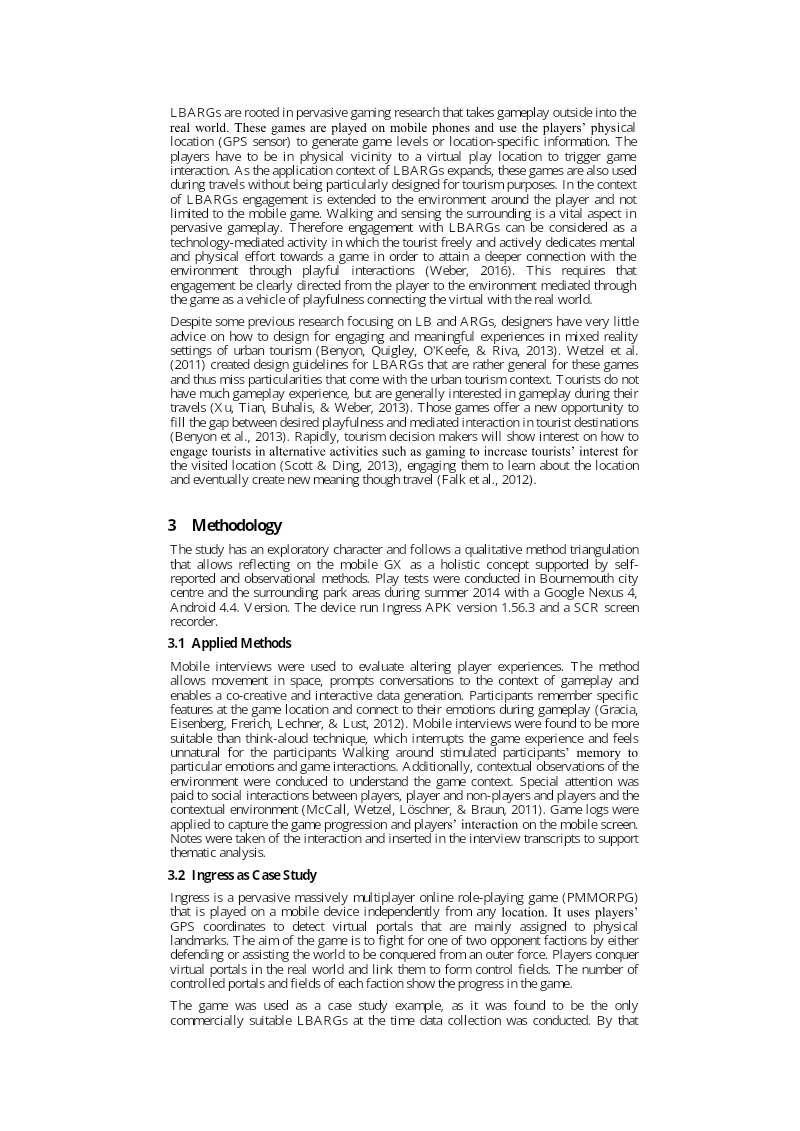
- The framework was developed by testing Ingress, a commercial game not designed for tourism, in a qualitative exploratory study with 11 participants aged 12 to 36 of varied nationalities, playing on Android devices in Bournemouth city centre and surrounding parks in summer 2014.
- Players showed strong excitement during discovery and challenge completion, and spatial exploration heightened their awareness of unfamiliar locations.
Localizing Location-Based Gaming: Situating Australian Urban Play
This paper, a conference proceedings contribution by Kyle Moore of the University of Sydney, argues for "situated play" as a conceptual tool for understanding everyday practices of location-based gaming in urban environments, with particular attention to Australian contexts.
- The paper proposes 'situated play' as a conceptual tool for understanding everyday location-based gaming in urban environments, shifting focus from games as spatial or temporal phenomena to the localized cultures in which they are played.
- It argues that urban play sits in a tension between Western conceptions of the city as functional space and as playful space, and frames historical playful urban mobility as resembling play rather than being play in itself.
- Urban play is presented as a potentially subversive reading of cities as sites of capitalist functionality, while also serving a civic and social purpose within the tradition of public play design.
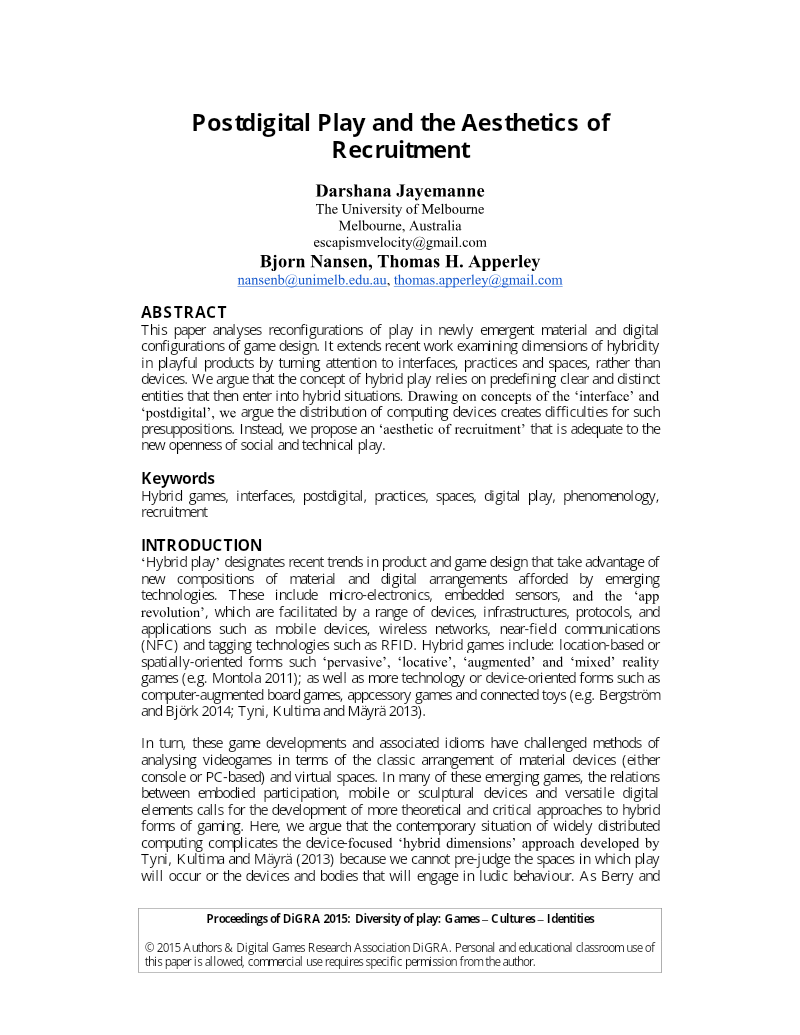
Postdigital Play and the Aesthetics of Recruitment
"Postdigital Play and the Aesthetics of Recruitment" argues that hybrid play is not a novel development but a return to videogames' long-standing hybrid nature, now intensified by distributed computing.
- Hybrid play is framed as a return to videogames' long-standing hybrid nature, now intensified by distributed computing rather than a wholly novel development.
- The authors argue that device-focused models classifying hybrid play by synchrony and dependency cannot account for contexts where devices, spaces, and bodies cannot be specified in advance.
- The proposed analytical framework centres on interface effects and an "aesthetic of recruitment," in which spatial, social, and material domains are enrolled into play.
Companies behind it
As the documents state it.