Gears of War
Documents about Gears of War
Bridging the Gap Between UX Principles and Game Design
This analysis explores the integration of User Experience (UX) principles into game design, arguing that both disciplines share the fundamental goals of clarifying player intent, fostering empathy, and providing meaningful experiences.
- Apply Gestalt laws of proximity and similarity to 3D combat encounters to help players intuitively prioritize threats without relying on intrusive UI elements.
- Use consistent visual language, such as specific shapes to denote safety or danger, to guide player navigation through 3D environments instinctively.
- Implement backend adjustments, such as the 'magic bullets' system used in Gears of War, to ensure core mechanics remain rewarding for both novice and expert players.
Inertialization: High-Performance Animation Transitions in Gears of War
Inertialization serves as a high-performance alternative to traditional crossfade blending within the animation architecture of Gears of War.
- Inertialization replaces traditional crossfade blending with a post-process approach, eliminating the need to simultaneously evaluate both source and target animation states.
- The system utilizes a fifth-order polynomial curve to calculate pose differences and initial velocities, treating transitions as a mathematical smoothing problem rather than a dual-state blend.
- By evaluating only the target animation, the system achieves a fixed frame cost and avoids the performance spikes associated with multi-state evaluation.
Epic Games Primer (Pt V): Fortnite & How It Built the Epic Flywheel
Fortnite serves as the central engine of the Epic Games ecosystem, functioning not merely as a video game but as a foundational social platform and a critical research and development vehicle.
- Fortnite functions as a social network rather than a traditional game, with users spending significant time 'loitering' in virtual spaces to socialize, fish, or dance rather than engaging in competitive gameplay.
- The platform has three primary modes: Battle Royale (competitive), Party Island (non-violent social space), and Creative Mode (a user-generated content engine similar to Roblox).
- Fortnite generates approximately $2 billion in annual revenue through a free-to-play model that relies exclusively on non-competitive cosmetic purchases, proving the viability of this monetization strategy at scale.
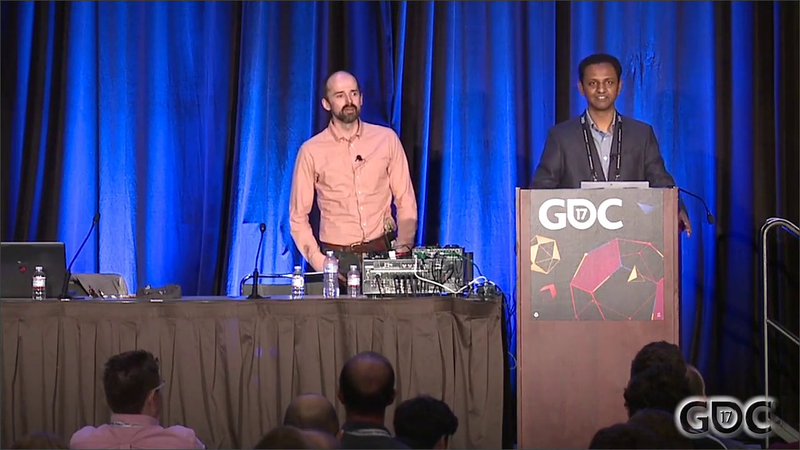
Gears of War 4, Project Triton: Pre-Computed Environmental Wave Acoustics
Project Triton serves as a sophisticated acoustic modeling framework designed to automate the simulation of complex wave phenomena, including diffraction, reflection, and reverberation, within the high-fidelity environment of Gears of War 4.
- Project Triton automates acoustic simulation for complex wave phenomena like diffraction and reflection, replacing labor-intensive manual reverb volume placement with an offline baking process similar to light mapping.
- The system extracts critical perceptual parameters—initial energy, reflected energy, decay rates, and occlusion—and compresses them into a 100 to 110 MB footprint per map to fit within a 500 MB total RAM budget.
- Development teams should prioritize aesthetic interpretation over strict physical accuracy, as evidenced by the shift from a complex 12-reverb matrix to a more manageable and debuggable six-bus system.

What Does Tomorrow Look Like? - How We Envision the Future - Extra Credits
The visual representation of the future has historically served as a mirror for contemporary societal anxieties and aspirations.
- Modern video games frequently rely on derivative mash-ups of 20th-century tropes rather than creating original aesthetic identities that reflect contemporary global concerns.
- The lack of a cohesive, modern vision for the future prevents the gaming industry from effectively engaging with the complexities of current societal issues.
- Historical aesthetic movements, such as 1920s Art Deco, 1960s space-age idealism, and 1980s cyberpunk, provided a shared cultural vocabulary that contemporary media currently lacks.


Financial Results 2025: PCF Group
The 2025 financial results for PCF Group provide an overview of the company’s operational performance, strategic pivot toward work-for-hire (WFH) projects, and financial standing.
- PCF Group reported 2025 revenues of 199.6 million PLN, up from 190.4 million PLN in 2024, but recorded a net loss of 124.3 million PLN due to 103 million PLN in asset write-downs.
- The company is executing a strategic pivot from self-publishing to a work-for-hire (WFH) model, currently managing four active projects with partners including Microsoft, Krafton, and 2K Games.
- The collaboration with Krafton on the XenoPoint mode for PUBG: BATTLEGROUNDS reached approximately 1 million concurrent users at launch.


Consolidated Quarterly Report for Q1 2026: PCF Group
PCF Group faced significant financial headwinds during the first quarter of 2026, characterized by a substantial net loss and declining revenues.
- PCF Group reported a net loss of 23.29 million PLN for Q1 2026, a significant decline from the 3.86 million PLN loss recorded in Q1 2025.
- Revenue dropped to 45.57 million PLN from 62.99 million PLN year-over-year, driven in part by a 24.9 million PLN impairment charge related to the total write-down of the Game On subsidiary.
- To address declining liquidity—with cash and cash equivalents falling to 16.82 million PLN—the company is initiating a capital increase of approximately 13.91 million PLN through a new share issuance.