Forbidden Solitaire
Game
7 documents in the library are about Forbidden Solitaire, from writers such as Thomas Brush, GameDiscoverCo and DiGRA. Each has a summary and key insights with the page they come from.
Connections
Each row is a game or company named alongside Forbidden Solitaire, each column a document, oldest first. A mark means that document names it. Select a row to see those documents.
Documents about Forbidden Solitaire

Should devs change their release plans due to AI clones?
The rapid advancement of AI-assisted decompilation has introduced new security concerns regarding the cloning of unreleased game titles.
- AI-assisted decompilation threats are primarily limited to simple, memetic projects, meaning developers should prioritize market visibility and early prototyping over delaying releases to protect complex, original intellectual property.
- Major studios must balance the pressure of rigorous annual release schedules with the need to maintain cultural relevance through direct consumer communication and the pursuit of industry accolades.
- The Meta Quest ecosystem is experiencing a demographic shift, with younger users increasingly driving demand for free-to-play, sandbox-style gaming experiences.

Steam Games with CCU Staying Power: What Defines Them?
GameDiscoverCo's October 2026 newsletter revisits August 2026 Steam debuts in mid-October to see which titles are still holding concurrent users (CCU) weeks after launch.
- Games with high concurrent user (CCU) retention often succeed by applying roguelike or incremental mechanics to traditionally slower, complex genres, such as 4X or factory automation.
- Successful titles like 'Survival Log' (13k peak CCU) and 'Sandustry' demonstrate that players prioritize strong 'vibes' and satisfying, loop-based gameplay over high-fidelity graphics.
- Steam capsule images may now include text for new updates or events, but Valve strictly prohibits calls-to-action like 'Wishlist now' or 'Available Oct 4th' in those images.

He Made Games For Twenty Years... And Finally Went Viral (w/ Jake Birkett) — Ep 69
Achieving breakout success in the independent game industry requires a transition from solitary development to a data-driven, collaborative strategy.
- To validate a game concept before full production, create a 'smoke and mirrors' trailer combining gameplay and real-life footage to test audience interest and prevent spending years on a 'dead duck'.
- Demos serve as critical marketing and testing tools; using AI to summarize player feedback from demos allows developers to identify sentiment and make necessary adjustments before the 1.0 launch.
- Managing player expectations is vital for high review scores; by clearly defining the game genre and avoiding misleading labels, developers can filter their audience to ensure the game reaches players who actually enjoy that specific type of experience.
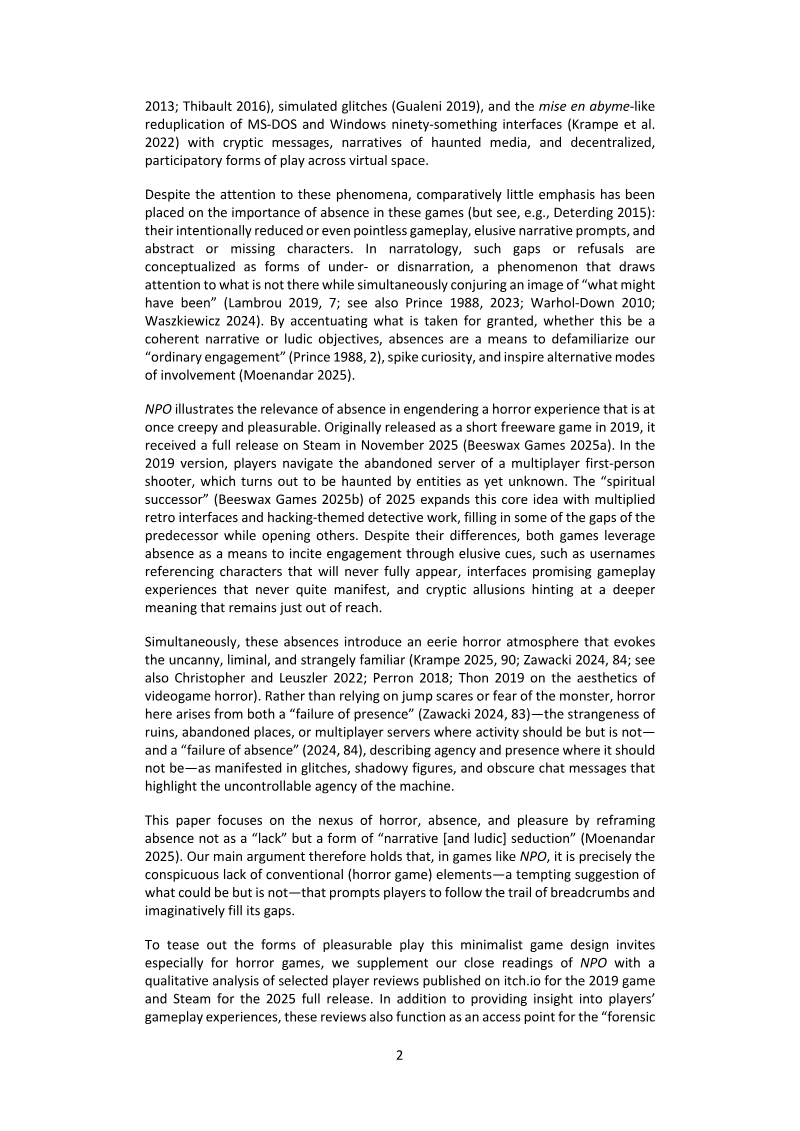
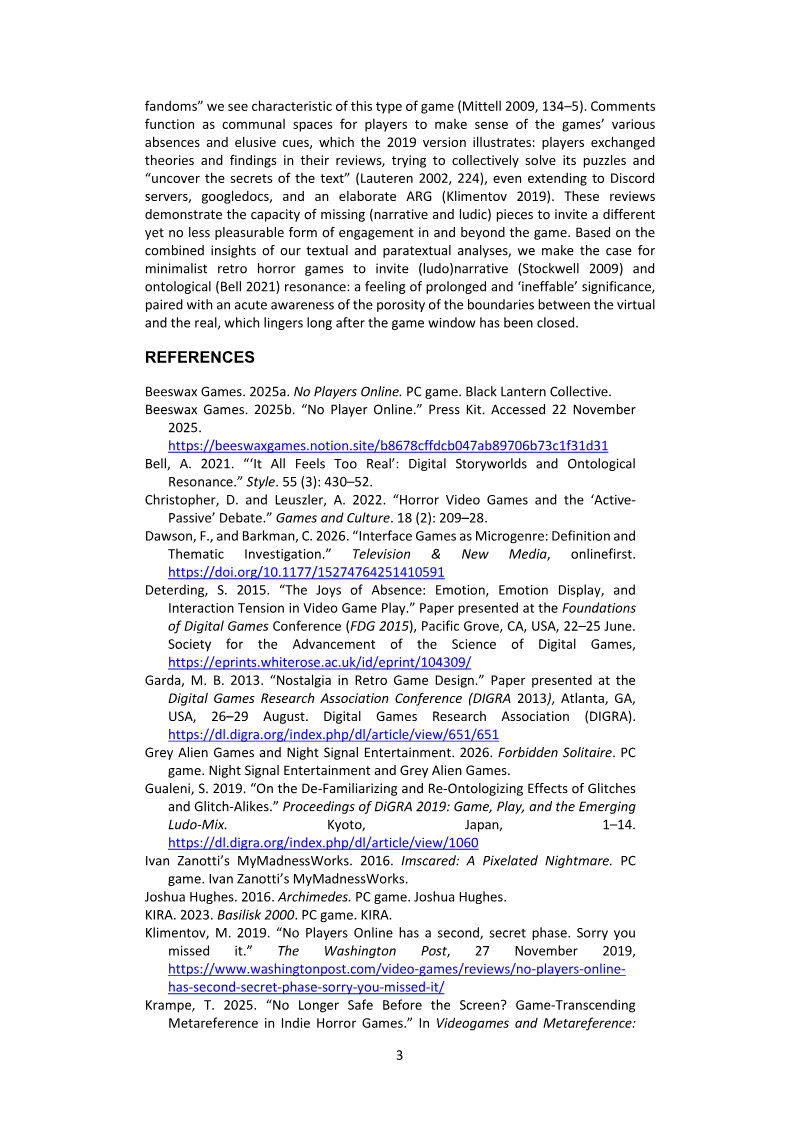
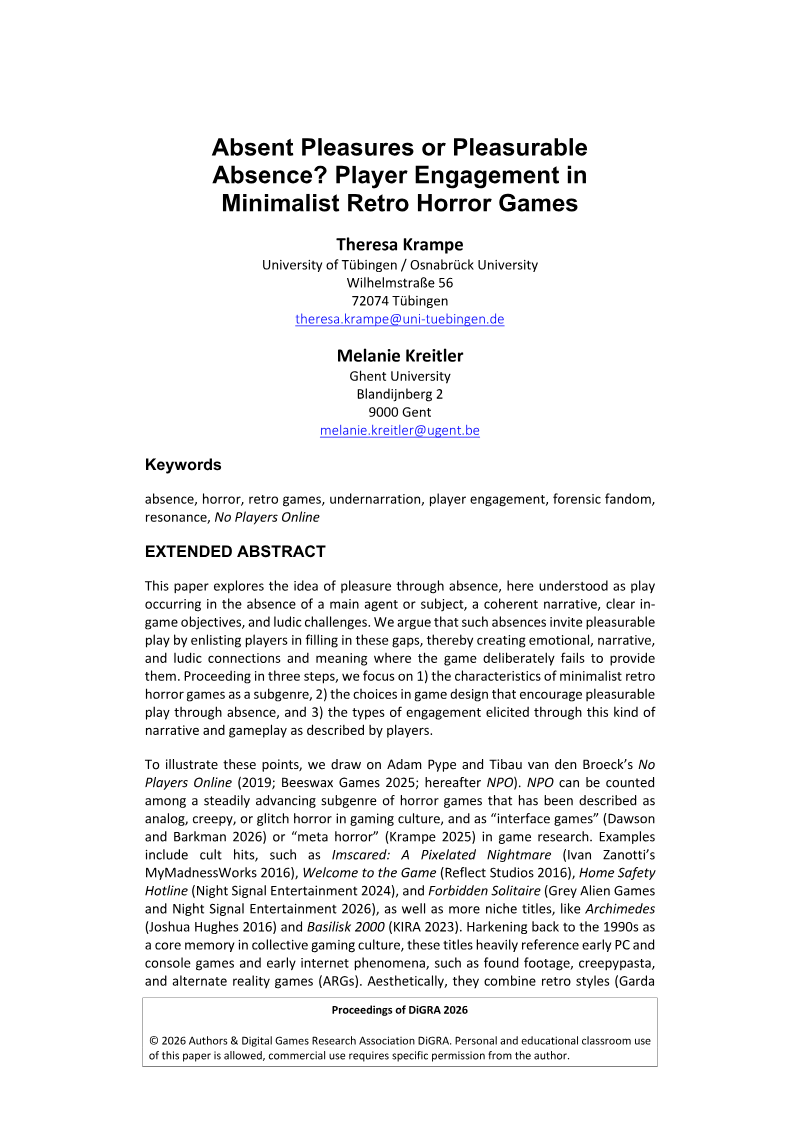
Absent Pleasures or Pleasurable Absence? Player Engagement in Minimalist Retro Horror Games
This paper examines how absence functions as a source of pleasure in minimalist retro horror games, using the 2019 freeware and 2025 full release of No Players Online as its central case.
- The paper uses the 2019 freeware and 2025 full release of No Players Online as its central case to argue that deliberately withholding conventional elements (coherent narrative, clear objectives, a central protagonist) invites players to imaginatively fill gaps, reframing absence as a source of engagement rather than a deficiency.
- Drawing on narratological concepts of undernarration and disnarration, the authors describe absence as a form of narrative and ludic seduction that sustains curiosity.
- The subgenre (labeled analog, creepy, glitch, interface, or meta horror) is linked to 1990s-era references such as early PC and console interfaces, found footage, creepypasta, and alternate reality games.
Tips for Making Your Tweets Go Viral
This analysis examines the strategies behind viral marketing for indie games on X (formerly Twitter), specifically focusing on the promotional impact of influencer IndieGameJoe.
- IndieGameJoe's tweets, which feature re-edited 1-minute game trailers and specific text formats, have generated thousands of wishlists for indie games since March 2026, with a median ratio of 7.15 wishlists per 1000 views.
- The most successful viral tweets often evoke strong feelings, such as nostalgia (e.g., Retro Rewind's 13.7 million views) or fear (horror games like Perceptum and DREADMOOR, which garnered 1.5 million and 1.2 million views respectively).
- A high correlation exists between tweet views and wishlists (Spearman r=0.95), and a strong correlation between likes and wishlists (r=0.86), indicating that public engagement metrics are good indicators of wishlist generation.
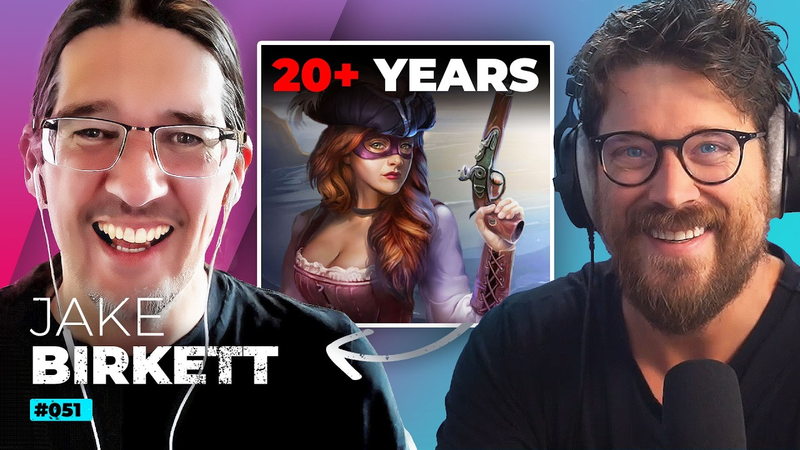
Jake Birkett: How To Make Indie Games Full Time, Unity vs Custom Engine, Indie Survival | Ep. #051
Achieving long-term financial sustainability in the independent game industry requires a shift away from chasing viral trends toward building a diverse catalog of smaller, profitable titles.
- Indie developers should prioritize building a sustainable, long-term business model over chasing viral hits, as 95% of games fail to achieve significant commercial success.
- Consistent income can be generated by building a portfolio of games and leveraging a loyal fan base that purchases bundles and subsequent titles in a series.
- Game feel and player feedback—such as sound, visual effects, and intuitive mechanics—are more critical to long-term success than academic gray-box design or complex meta-systems.

If You're Making Your First Game, LISTEN To This 20 Year Veteran...
The primary objective for independent game developers should be building a sustainable, long-term career rather than chasing viral hits.
- Building a sustainable career as an indie developer does not require a viral hit; instead, focus on releasing a consistent catalog of solid, profitable games that build a loyal fanbase over time.
- Diversify revenue streams beyond a single platform like Steam to mitigate risk; successful developers often combine income from multiple sources such as Patreon, console storefronts, consultancy, and writing.
- Manage financial risk by calculating your 'runway'—the specific date your current funds will run out—based on predictable income and bank balances to avoid the 'feast or famine' cycle.