Fight Club
Game
5 documents in the library are about Fight Club, from writers such as DiGRA, Naavik and PocketGamer.biz. Each has a summary and key insights with the page they come from.
Connections
Each row is a game or company named alongside Fight Club, each column a document, oldest first. A mark means that document names it. Select a row to see those documents.
Documents about Fight Club
Douchebag Games and the "Loser-y" Attitude: White, Male Gamer Imaginaries in the 00's
The document analyzes the dominant gaming culture of the early to mid-2000s, focusing on how it catered to a masculine, heterosexual, and white gamer identity, termed the "loser."
- The paper argues that a 'loser' gamer subject, shaped by 1980s–1990s neoliberalism that turned countercultural disaffection among young men into a marketable demographic, dominated early-to-mid 2000s gaming culture.
- It coins the term 'douchebag games' for titles that validated this subject's masculine anger at being misunderstood, citing examples on the original Xbox such as Grand Theft Auto: San Andreas, Dead or Alive Xtreme Beach Volleyball, Fable, and Conker: Live & Reloaded.
- Drawing on Bernard Suits' 'lusory attitude' and Adam Trammell's 'player' versus 'played' distinction, the authors define a 'loser-y attitude' as privileged actors tacitly accepting patriarchy, white supremacy, and heteronormativity because these logics preserve their power.

Game Radar: Champions Ascension, Delysium, Galaxy Fight Club
This analysis, published in February 2023, evaluates three blockchain games—Champions Ascension, Delysium, and Galaxy Fight Club—across key dimensions including Team & Resources, Game Design & Fun, and Tokenomics & Sustainability.
- Plai Labs is developing Champions Ascension with a $32 million funding war chest and a team experienced in AAA game development and IP management.
- Delysium utilizes a decentralized multiverse operator (DMO) model, allowing operators to run custom game instances and define their own reward structures within a battle royale framework.
- Galaxy Fight Club faces significant regulatory risk from Apple’s policies, which prohibit NFTs from unlocking additional in-game features and complicate the required off-app transaction flows.
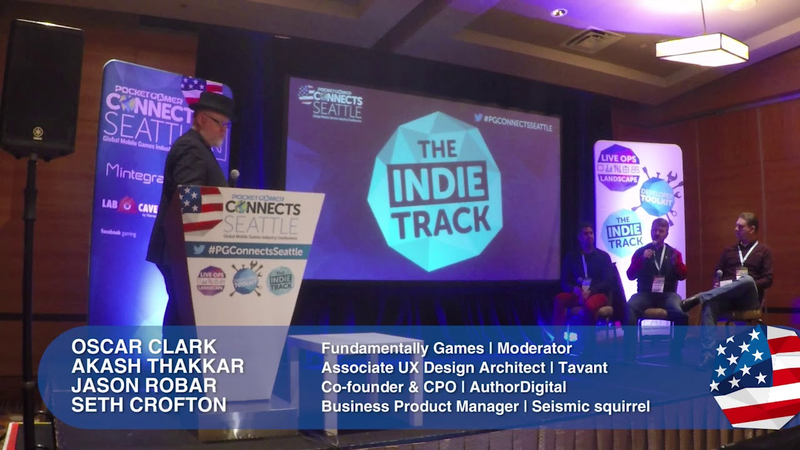
Keep talking and no-one explodes – Tips for smooth teams
Effective team communication is a critical, often overlooked component of game development success.
- Prioritize the human element of collaboration by building trust and empathy to move beyond transactional interactions.
- Implement 'Fight Club' sessions as dedicated, safe spaces for team members to address interpersonal conflicts and misunderstandings immediately.
- Focus on identifying and resolving root causes of disagreements rather than arguing over symptoms, a process referred to as avoiding the 'red table, blue chair' phenomenon.
Markers of Subjective Perception in Larp
Mochocki's paper extends Jan-Noël Thon's framework of subjective representation, originally developed for film, comics, and video games, to live-action role-playing (larp).
- Mochocki argues that spatial point-of-view goes unmarked in larp because players physically inhabit their characters' perspectives, so subjectivity markers in larp signal only other forms of subjectivity, and the paper adds a fourth, "metasymbolic" marker category to cover what Thon's film/comics/video-game framework misses.
- The paper stresses player-character perceptual unity and warns that mishandled subjectivity markers cause metalepses, breaches of diegetic coherence.
- Narratorial markers (generated by gamemasters or players, including metatechniques like the monologue box) and content markers (live acting and tangible elements introduced by the gamemaster) each carry their own metaleptic risks for perceptual unity.
Self and Selfishness in Online Social Play
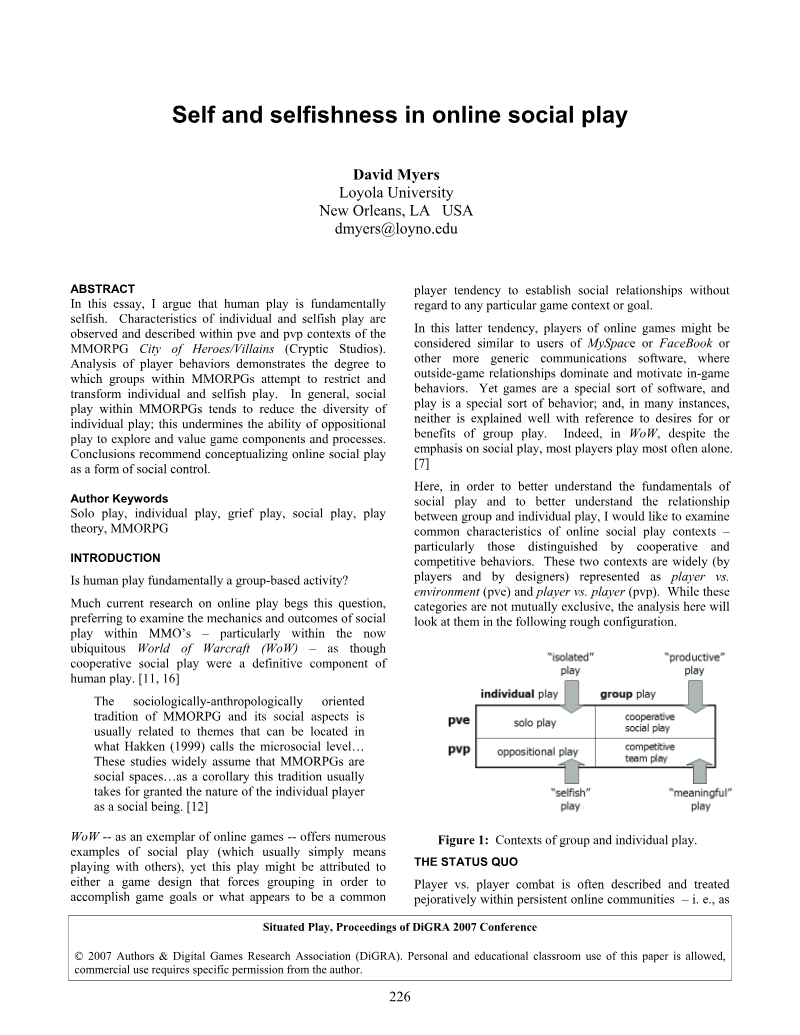
David Myers argues that human play is fundamentally selfish and individual rather than group-based, challenging MMORPG scholarship, often centered on World of Warcraft, that treats cooperative social play as definitive and dismisses competitive behavior such as griefing.
- Myers argues that online social play is fundamentally self-oriented and oppositional rather than a natural expression of cooperation, and should be understood as a form of social control.
- Using City of Heroes/Villains and World of Warcraft as case studies, the report challenges the assumption that social and cooperative play is the default or endpoint of MMORPG engagement.
- One-on-one player-versus-player combat proved a faster and more accurate indicator of relative character value than player-versus-environment play, while larger team matches on the test server were highly variable, distorted by lag, bugs, and imbalances, and often avoided on repeat.