Fight Club
Game
Documents about Fight Club
Article
Douchebag Games and the "Loser-y" Attitude: White, Male Gamer Imaginaries in the 00's
The document analyzes the dominant gaming culture of the early to mid-2000s, focusing on how it catered to a masculine, heterosexual, and white gamer identity, termed the "loser."
- The paper argues that a 'loser' gamer subject, shaped by 1980s–1990s neoliberalism that turned countercultural disaffection among young men into a marketable demographic, dominated early-to-mid 2000s gaming culture.
- It coins the term 'douchebag games' for titles that validated this subject's masculine anger at being misunderstood, citing examples on the original Xbox such as Grand Theft Auto: San Andreas, Dead or Alive Xtreme Beach Volleyball, Fable, and Conker: Live & Reloaded.
- Drawing on Bernard Suits' 'lusory attitude' and Adam Trammell's 'player' versus 'played' distinction, the authors define a 'loser-y attitude' as privileged actors tacitly accepting patriarchy, white supremacy, and heteronormativity because these logics preserve their power.
DiGRAJun 2026

Article
Game Radar: Champions Ascension, Delysium, Galaxy Fight Club
This analysis, published in February 2023, evaluates three blockchain games—Champions Ascension, Delysium, and Galaxy Fight Club—across key dimensions including Team & Resources, Game Design & Fun, and Tokenomics & Sustainability.
- Plai Labs is developing Champions Ascension with a $32 million funding war chest and a team experienced in AAA game development and IP management.
- Delysium utilizes a decentralized multiverse operator (DMO) model, allowing operators to run custom game instances and define their own reward structures within a battle royale framework.
- Galaxy Fight Club faces significant regulatory risk from Apple’s policies, which prohibit NFTs from unlocking additional in-game features and complicate the required off-app transaction flows.
NaavikFeb 2023
Article
Self and Selfishness in Online Social Play
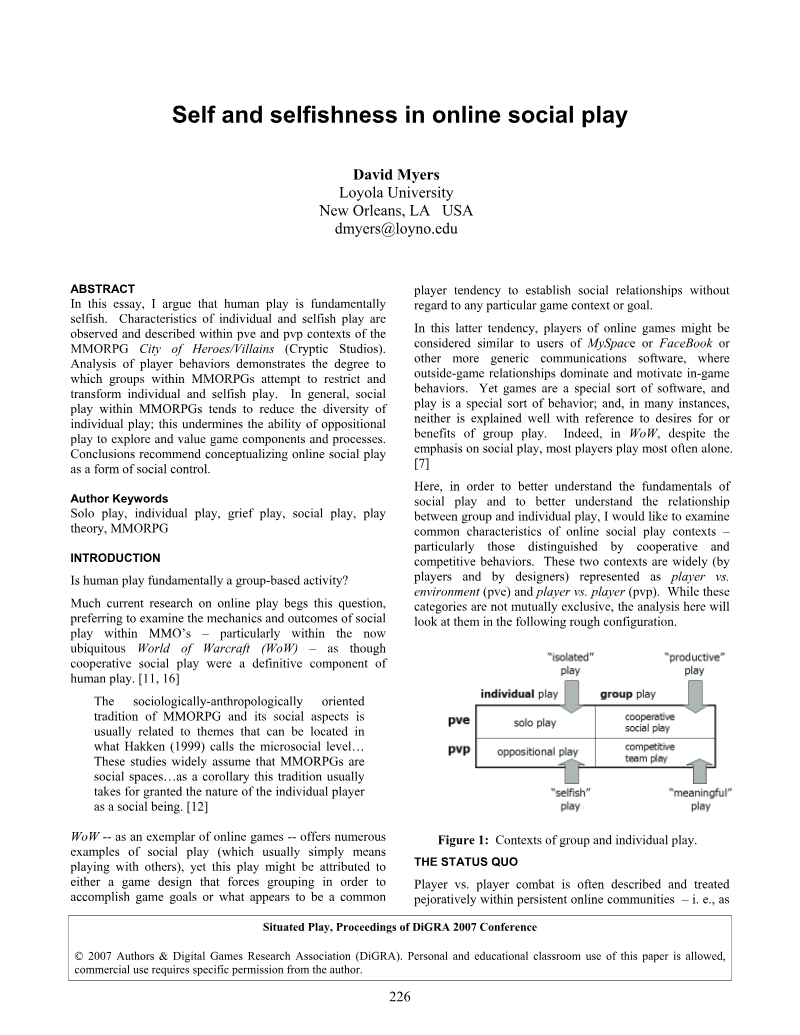
David Myers argues that human play is fundamentally selfish and individual rather than group-based, challenging MMORPG scholarship, often centered on World of Warcraft, that treats cooperative social play as definitive and dismisses competitive behavior such as griefing.
- Myers argues that online social play is fundamentally self-oriented and oppositional rather than a natural expression of cooperation, and should be understood as a form of social control.
- Using City of Heroes/Villains and World of Warcraft as case studies, the report challenges the assumption that social and cooperative play is the default or endpoint of MMORPG engagement.
- One-on-one player-versus-player combat proved a faster and more accurate indicator of relative character value than player-versus-environment play, while larger team matches on the test server were highly variable, distorted by lag, bugs, and imbalances, and often avoided on repeat.
DiGRAJan 2007