Domino Dreams
Game
12 documents in the library are about Domino Dreams, from writers such as Playtika, Mobilegamer.biz and Deconstructor of Fun. Each has a summary and key insights with the page they come from.
Connections
The documents about Domino Dreams on the inner ring, the other games and companies they name on the outer one. Select a cover to see it up close and open it in a new tab; drag to move, pinch or Ctrl + scroll to zoom.
Documents about Domino Dreams
Disney Solitaire's Big Win and Playtika's Earn-Out Trap
Playtika faces a significant financial paradox where the success of its latest title, Disney Solitaire, has exacerbated the company's underlying fiscal instability.
- Playtika faces a critical financial strain due to $2.41 billion in debt, with significant refinancing obligations due in 2028 and 2029 against a market capitalization of under $1 billion.
- The acquisition of studio SuperPlay for $700 million plus an earn-out of up to $1.25 billion has created a 'trap' where the success of their hit game, Disney Solitaire, is causing GAAP losses and rapid cash depletion.
- Disney Solitaire generated $142 million in Q2 2026, yet Playtika’s cash reserves dropped from $820 million to $438 million in six months as the company struggles to balance debt servicing costs of approximately $200 million annually.
Playtika Form 10-Q: Q2 2026
Playtika demonstrates a complex financial trajectory in the second quarter of 2026, characterized by robust top-line growth alongside significant bottom-line volatility.
- Playtika’s cash and cash equivalents decreased from $684.2 million at the end of 2025 to $438.5 million as of June 30, 2026.
- The company successfully refinanced its revolving credit facility on March 11, 2026, establishing a new facility that matures on March 6, 2027.
- Playtika faces multiple ongoing legal challenges, including a putative class action filed against its subsidiary SuperPlay Ltd. on March 6, 2026, alleging that games like 'Dice Dreams' and 'Domino Dreams' constitute unlawful gambling.

Tencent, Playtika and SuperPlay shenanigans, further Google Play changes. Monopoly Go, MTG, more
The mobile games industry is currently navigating significant shifts in corporate ownership, platform accessibility, and market performance.
- Google has dropped its requirement for a 'registered app stores' program, allowing third-party app stores like the Epic Games Store to operate directly within the Google Play Store as of late July 2024.
- Tencent is reportedly in talks to acquire Superplay, the developer of Dice Dreams and Domino Dreams, for up to $1.5 billion following the studio's significant performance growth under Playtika.
- MTG reported Q2 group revenue of $306 million with a 24% profit margin, driven by Raid: Shadow Legends, which earned $111 million, while direct-to-consumer revenue grew to 38% of total group income.
Playtika Negotiating Sale of Studio to Tencent
Playtika is currently exploring the sale of its studio, SuperPlay, to Tencent, with an estimated valuation between $1 billion and $1.5 billion.
- Playtika is in negotiations to sell the studio SuperPlay to Tencent for an estimated $1 billion to $1.5 billion.
- Playtika is seeking to offload SuperPlay because the studio's rapid success triggered high performance-based bonus obligations that have become a financial burden amid Playtika's own debt accumulation.
- The original 2024 acquisition deal for SuperPlay included a $700 million upfront payment and up to $1.25 billion in performance-based bonuses payable over three years.

Session: Winning Portfolio Strategies Of 2026 - Jakub Remiar, two & half gamers.
The current mobile gaming landscape is defined by a shift toward systematic, data-driven portfolio management rather than reliance on individual hit titles.
- Successful mobile game portfolios rely on 'template-ization,' where developers build a reusable engine for a specific genre, allowing them to salvage work from failed projects to accelerate the development of future titles.
- Companies like Gram Games operate like the 'Warren Buffett of puzzle games' by identifying high-traffic, ad-monetized genres and converting them into high-revenue IAP (in-app purchase) models through superior execution and polish.
- Radical innovation, such as the mechanics seen in 'Pixel Flow' or 'Screw Jam,' offers the highest potential for success but requires deep, long-term genre expertise to identify and implement meaningful improvements to existing core loops.

Sega-Rovio woes, Playtika goes casual, Unity's turnaround, pitching investors, data nuggets, more
The mobile games industry is currently defined by a shift toward pragmatism, consolidation, and a strategic pivot away from traditional free-to-play models.
- Sega is pivoting away from free-to-play mobile initiatives following a $200 million write-down related to the underperformance of its Rovio acquisition.
- Unity’s financial turnaround is anchored by its Vector adtech product, which achieved an 80% year-over-year revenue increase.
- Playtika has officially shifted its corporate strategy to prioritize casual gaming titles, such as Disney Solitaire, while treating its legacy social casino business as a non-growth asset.

💡 How to create new mobile games 101, 2026 edition 😎
The current mobile puzzle game market favors a methodical, template-driven approach over the invention of original core mechanics.
- Successful studios like Grand Games and Spyke prioritize a template-driven approach by pairing proven, high-download puzzle mechanics with robust metagame engines rather than inventing original core gameplay.
- The strategy focuses on converting ad-driven audiences into IAP players by applying sophisticated level design, blockers, and live-ops to familiar mechanics.
- Developers should iterate on existing cores by approximately 20% to differentiate their product while maintaining the core appeal that already demonstrates high market demand.
Playtika Holding Corp. Q4 2025 Prepared Remarks
Playtika Holding Corp.’s fourth-quarter 2025 earnings results demonstrate a strategic pivot toward a diversified, casual-game-focused portfolio and the expansion of its Direct-to-Consumer (DTC) channels.
- Playtika reported Q4 2025 revenue of $678.8 million and Adjusted EBITDA of $201.4 million, with full-year 2025 revenue reaching $2.755 billion, an 8.1% increase year-over-year.
- Direct-to-Consumer (DTC) revenue reached $250.1 million in Q4, growing 43.2% year-over-year and accounting for 36.8% of total quarterly revenue.
- SuperPlay, a key growth engine, generated $573 million in revenue for the full year 2025, a 67.5% increase over its $342 million baseline.
Playtika Holding Corp. Q4 2024 Prepared Remarks
Playtika Holding Corp.’s fourth-quarter 2024 earnings remarks outline a strategic pivot toward long-term revenue growth through portfolio diversification, aggressive studio acquisitions, and a transition away from legacy titles.
- Playtika projects 2025 full-year revenue between $2.80 billion and $2.85 billion, with Adjusted EBITDA expected to range from $715 million to $740 million.
- The company completed its largest acquisition to date, SuperPlay, which contributed $48 million in revenue but resulted in $10 million in Adjusted EBITDA losses during the partial quarter.
- Full-year 2024 revenue was $2.549 billion, a 0.7% decline year-over-year, while Credit Adjusted EBITDA fell 9.0% to $757.7 million.
Playtika Holding Corp. Q3 2024 Prepared Remarks
Playtika Holding Corp.’s third quarter 2024 earnings remarks outline a strategic focus on portfolio expansion through mergers and acquisitions, specifically highlighting the pending acquisition of SuperPlay.
- Playtika is acquiring SuperPlay to bolster its portfolio, utilizing a deal structure that includes an upfront payment and performance-based earn-outs to mitigate risk.
- Q3 2024 revenue was $620.8 million, down 1.5% year-over-year, while Credit Adjusted EBITDA reached $197.2 million, a 4.1% year-over-year decline.
- Slotomania performance fell short of expectations with revenue dropping 9.3% year-over-year, prompting a strategic pivot toward product feature updates and IGT-licensed IP like 'Cleopatra II'.

Playtika's $2 Billion Bet: Rolling the Dice on Inorganic Growth
This analysis examines the strategic implications of Playtika’s $2 billion acquisition of SuperPlay, positioned against a backdrop of broader mobile gaming trends and recent corporate performance.
- Playtika is acquiring SuperPlay for $2 billion, consisting of a $700 million upfront payment and up to $1.25 billion in potential earnouts.
- Playtika’s Q2 2024 financial performance shows a 2.5% year-over-year revenue decline to $627 million and a decrease in average daily paying users from 307,000 to 298,000.
- The acquisition strategy faces efficiency challenges, as SuperPlay’s user acquisition spending is estimated to be three times higher than Playtika’s current 18% of revenue.
Playtika Holding Corp. Third Quarter 2024 Results
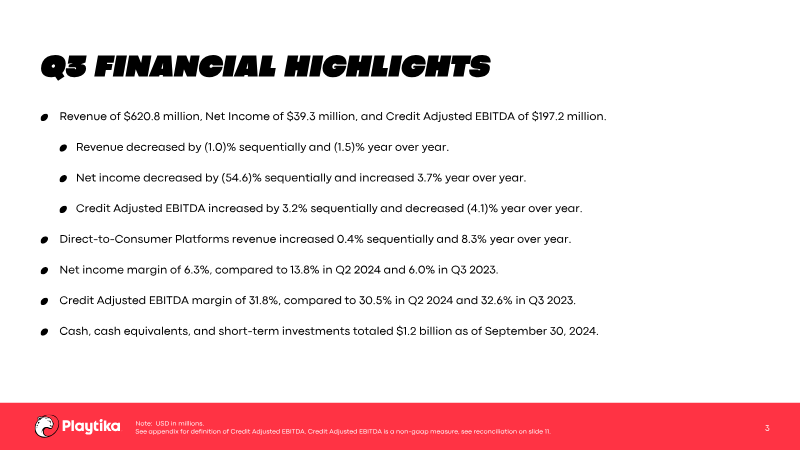
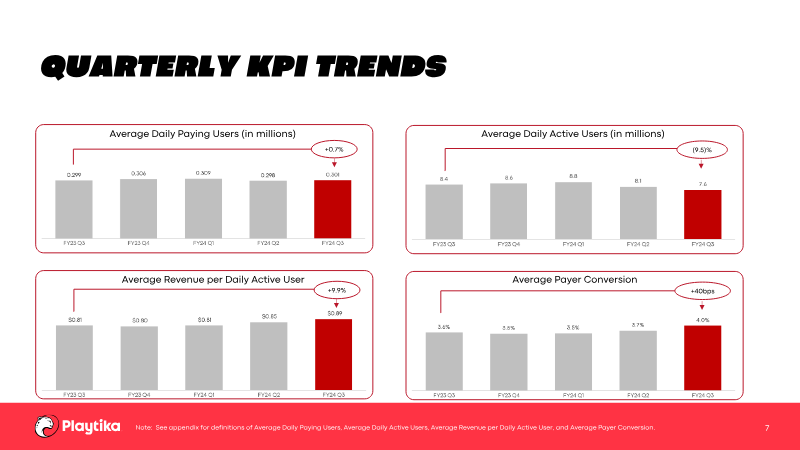
Playtika Holding Corp. reported third-quarter 2024 results for the period ended September 30, 2024, showing a revenue of $620.8 million, down 1.0% sequentially and 1.5% year-over-year.
- Playtika agreed to acquire SuperPlay for an upfront $700 million, with up to $1.25 billion in contingent payments tied to performance targets over the next three years.
- Q3 2024 revenue reached $620.8 million, representing a 1.5% year-over-year decline, while net income fell 54.6% sequentially to $39.3 million.
- Direct-to-consumer platforms grew 8.3% year-over-year to $469.1 million, contrasting with a 4.8% decline in third-party platform revenue.
Companies behind it


As the documents state it.