Social Casino reports and market data
51 game industry reports, presentations and talks about social casino from writers such as PocketGamer.biz, Two & a Half Gamers and Deconstructor of Fun, newest from 2026. Every document has a summary and key insights with the page they come from, and 143 charts and tables are extracted as data.
Key figures
The social casino market is projected to grow from $6.2 billion in 2020 to $7.5 billion by 2026, though high barriers to entry and market saturation make scaling difficult for new entrants.
Liftoff, 2021 · Social Casino Gaming Apps Report, p. 3
Monetization is robust, as 46% of social casino gamers have made in-game expenditures within the last six months.
Newzoo · Casino Gaming Report & Data: US Social Casino Market, p. 2
Documents

TWIG #394: Playtika's Solitaire Meltdown, the AppLovin-AdMob Duopoly and Why Nobody Wants New Games
The mobile gaming industry is currently navigating a period of significant contraction and structural instability, characterized by a shift in consumer preference toward established titles over new releases.
- AppLovin and Google’s AdMob now control 65% of global gaming ad revenue, creating a market duopoly that contributes to rising user acquisition costs and CPI inflation.
- Global mobile game downloads have declined by 12% as consumer preference shifts away from new releases toward established, high-retention titles.
- Playtika’s portfolio is experiencing a 35% year-over-year revenue decline, exacerbated by internal cannibalization from the launch of Disney Solitaire and ongoing legal challenges.
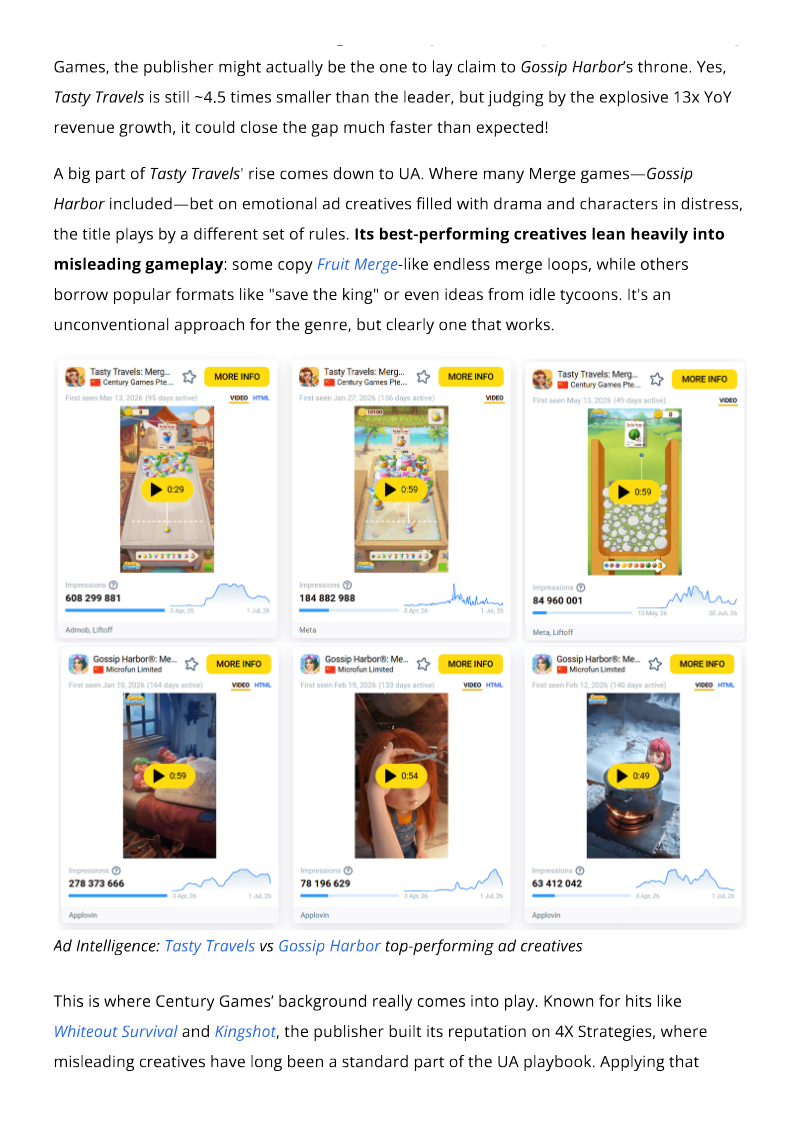
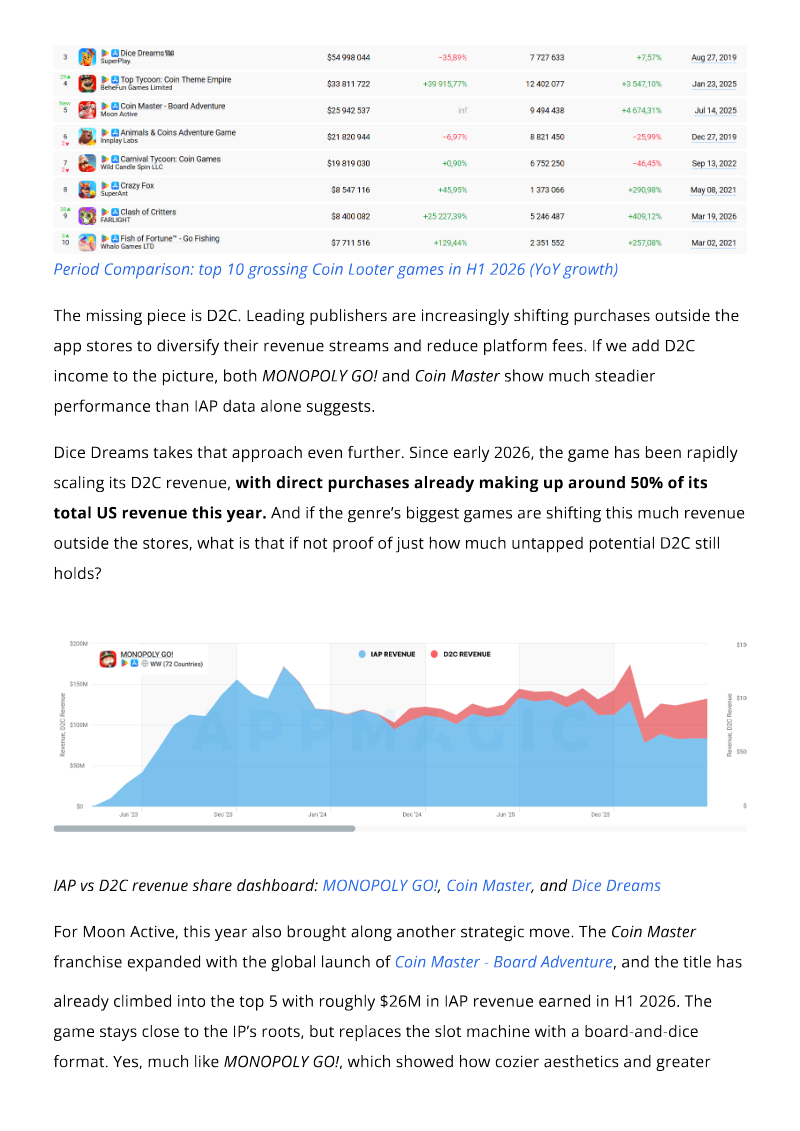
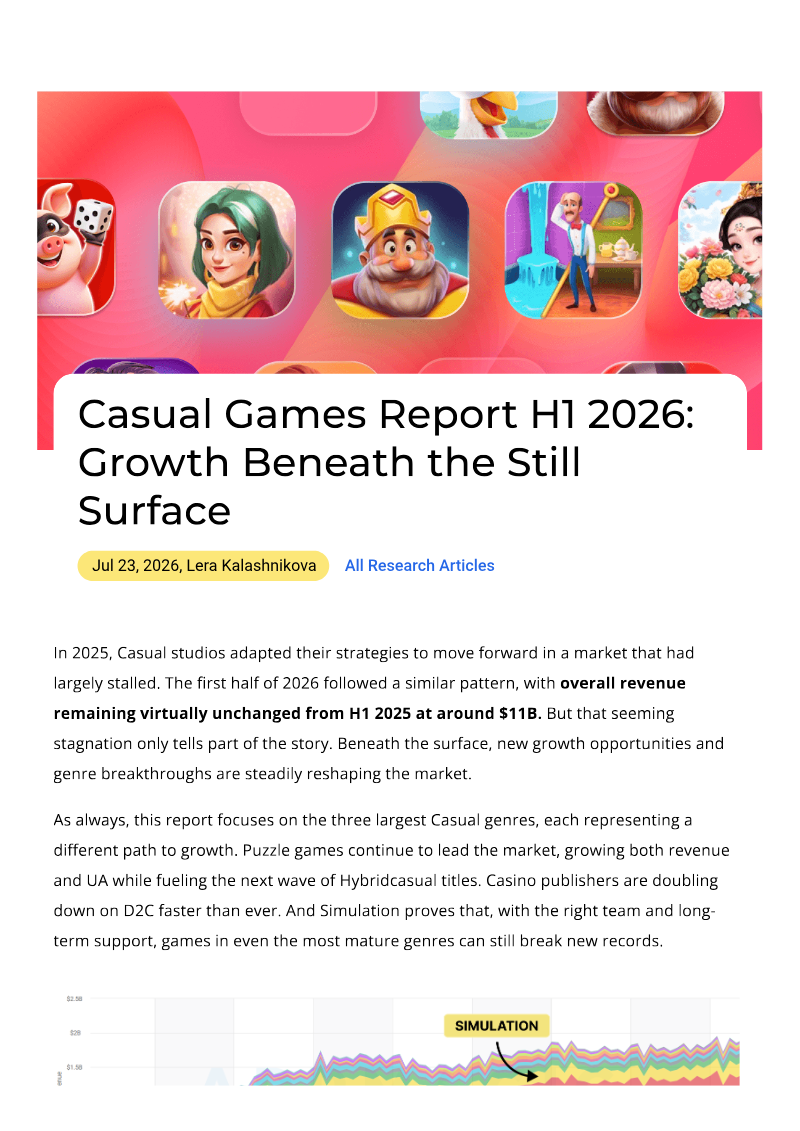
Casual Games Report H1 2026: Growth Beneath the Still Surface
The casual gaming market maintained a stable valuation of $11 billion during the first half of 2026, characterized by a strategic shift from high-volume experimentation toward the refinement of established gameplay loops.
- The casual games market remained stagnant in H1 2026 with $11B in revenue, mirroring H1 2025 performance despite significant shifts in genre-specific growth.
- Merge-2 is the fastest-growing casual genre, nearly doubling its revenue to $1.2B in H1 2026 with a 20% year-over-year increase in downloads.
- Match-3 remains the largest puzzle subgenre at $2.4B, with Dream Games' 'Royal Kingdom' reaching the #3 market spot through a strategy of scaling limited titles and integrating diverse mini-game events.

🎮 Clash of Critters: Pokémon from Wish! Coin Looter + Pachinko + Idle RPG
Clash of Critters represents a strategic attempt to capture market share by blending coin-looter mechanics with idle RPG progression and social-casino raid features.
- Clash of Critters currently generates approximately $200,000 in daily revenue, with its long-term viability dependent on a successful, full-scale launch in Asian markets.
- The game utilizes a hybrid model that integrates pachinko-style coin-looter mechanics with idle RPG progression and social-casino raid features.
- The project’s marketing strategy relied heavily on aggressive use of Pokémon intellectual property and AI-generated creatives to lower initial user acquisition costs, particularly in Japan.
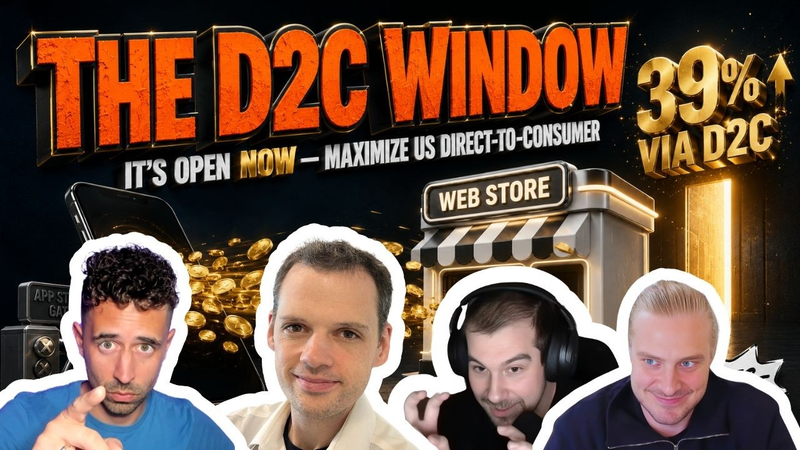
🎯 The DEFINITIVE Guide to D2C in 2026: Real Numbers from 8 Studios
Direct-to-consumer (D2C) strategies have evolved from experimental tactics into a fundamental pillar of financial performance for the global gaming industry.
- Major studios like Playtika, SciPlay, and Ten Square now generate between 27% and 44% of their total revenue through independent D2C channels.
- Transitioning to direct-checkout web stores allows developers to bypass standard platform fees, significantly increasing profit margins by reclaiming revenue shares previously lost to app stores.
- Studios must prioritize habituating players to web store environments immediately to mitigate the impact of evolving platform policies and future regulatory risks.

🚨📢BREAKING NEWS: Block Blast blasted off the Android store, Steam deck price goes to the moon
The gaming industry is currently navigating significant shifts in hardware pricing, mobile market dynamics, and the integration of generative artificial intelligence.
- Monopoly Go continues to dominate the mobile market with $200 million in monthly revenue, providing Hasbro with a $168 million annual licensing run-rate.
- NetEase reported a 7% year-over-year revenue increase to $3.7 billion, fueled by strong growth in China, Turkey, and Vietnam.
- Valve increased the price of the 1TB Steam Deck OLED by 40%, bringing the cost to $949 and raising concerns about its value proposition.

Sega-Rovio woes, Playtika goes casual, Unity's turnaround, pitching investors, data nuggets, more
The mobile games industry is currently defined by a shift toward pragmatism, consolidation, and a strategic pivot away from traditional free-to-play models.
- Sega is pivoting away from free-to-play mobile initiatives following a $200 million write-down related to the underperformance of its Rovio acquisition.
- Unity’s financial turnaround is anchored by its Vector adtech product, which achieved an 80% year-over-year revenue increase.
- Playtika has officially shifted its corporate strategy to prioritize casual gaming titles, such as Disney Solitaire, while treating its legacy social casino business as a non-growth asset.
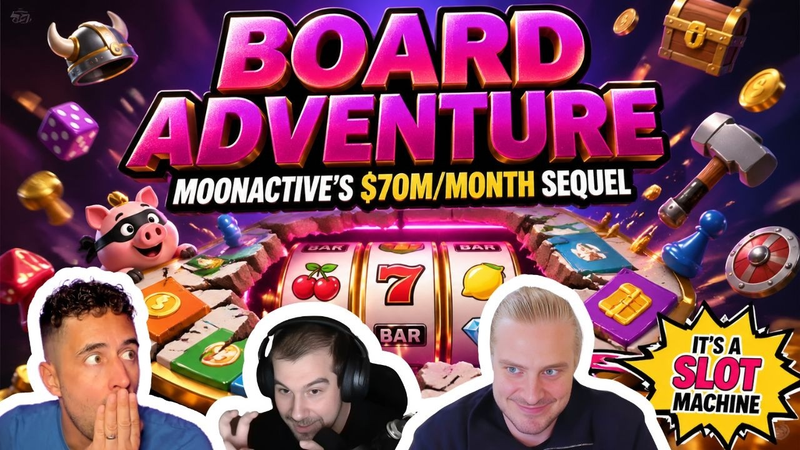
🎲 Will Coin Master Board Adventure eat Monopoly Go? (Our year-end predictions)
The mobile gaming landscape is currently defined by a high-stakes battle between established titans and aggressive new entrants within the social casino and board game genres.
- MoonActive’s Coin Master Board Adventure is directly challenging Monopoly Go, currently recording 2.2 million monthly downloads compared to Monopoly Go’s 1.8 million.
- The mobile gaming sector is shifting toward hybrid experiences that integrate merge and idle systems with traditional social casino mechanics to drive engagement.
- Monopoly Go faces significant market pressure due to rising user acquisition costs and diminishing returns, despite maintaining a massive creative library of over 15,000 assets.

Curated Panel: When is a Game a Gamble? Loot boxes, Virtual Economics and Regulatory Creep.
The classification of loot boxes and virtual items as gambling hinges on the presence of a stake, an element of chance, and a prize with tangible real-world value.
- Loot boxes are legally classified as gambling only when they involve a stake, chance, and a prize with tangible real-world value; most social games avoid this classification by restricting winnings to internal environments.
- Preventing the development of secondary markets—where virtual items are exchanged for real-world currency—is essential to avoid legal reclassification as gambling.
- The European Union is intensifying regulatory pressure through the Digital Fairness Act and Consumer Protection Cooperation principles, which mandate that virtual transactions meet the transparency standards of real-world commerce.

🚨📢 BREAKING NEWS: Unity Fee Drama, Netflix vs WB, Casino Games Everywhere 🤯
The mobile gaming and entertainment landscape is currently defined by significant shifts in corporate monetization strategies and evolving genre dominance.
- Unity has implemented an Enterprise Minimum Commitment Program that mandates annual fees between $250,000 and $2 million for large-scale developers based on gross revenue, sparking significant industry backlash regarding developer trust.
- Warner Bros. Discovery has shifted its corporate strategy by rejecting a $108 billion takeover bid from Paramount in favor of a $72 billion deal with Netflix, highlighting the growing market dominance of streaming platforms over traditional media.
- In the U.S. mobile market, Monopoly Go and Royal Match currently lead in absolute in-app purchase (IAP) revenue, while 4X strategy titles like Last War and Whiteout Survival dominate global performance.

Sunday City Review: GTA or Casino? Sunday City’s INSANE Onboarding
Sunday City represents a sophisticated evolution in the social casino genre, successfully employing a bait-and-switch strategy that masks a traditional gambling core behind the aesthetic of a life-simulation or open-world game.
- Sunday City generates over $60,000 in daily in-app purchase revenue and currently holds a top-10 position within the social casino category.
- The game utilizes a 'bait-and-switch' design, masking a traditional gambling core behind an urban life-simulation aesthetic to lower the barrier to entry for casual players.
- Long-term engagement is driven by a 'third-generation' social casino model that layers meta-game systems, such as collectible albums and seasonal events, over core slot machine mechanics.

Precise UA with Mastercard Data? Edik Mitelman talks Signal Hub & Beyond!
The emergence of data collaboration platforms, such as Signal Hub, marks a significant shift in mobile marketing by enabling privacy-preserving, cross-industry data sharing.
- Data collaboration platforms like Signal Hub allow gaming companies to target users based on real-world financial behavior, such as specific retail or in-app spending patterns, in a privacy-compliant manner (GDPR and CCPA).
- Gaming studios can now act as both buyers and sellers of audience data, creating a new high-margin revenue stream by monetizing their own user insights without compromising trade secrets or privacy.
- Precise targeting based on real-world purchasing data—such as identifying frequent customers of a specific pizza chain to market a pizza-themed mobile game—significantly improves user retention and reduces churn compared to traditional, less targeted advertising.
Did Coin Master Just Copy (back) Monopoly Go?
The mobile gaming industry is currently witnessing a high-stakes competitive cycle characterized by iterative cloning and aggressive user acquisition strategies.
- The 'coin looter' subgenre is currently defined by a competitive cycle of iterative cloning between industry giants Moon Active and Scopely, with Moon Active’s latest title mirroring the mechanics of Scopely’s Monopoly Go.
- Market success in this sector is increasingly driven by 'UA arbitrage,' where firms prioritize outspending competitors on user acquisition over product innovation or unique feature sets.
- The industry has evolved into a 'red ocean' where large, well-capitalized firms prioritize long-term market dominance and aggressive user acquisition over immediate profitability.