
Clash of Clans
GameBy Supercell · Released Aug 2, 2012
Documents about Clash of Clans

Portfolio Dynamics for Mobile Games
The analysis of mobile gaming portfolio strategies evaluates how different organizational approaches to game development impact financial performance.
- A 2014 study of 100 mobile gaming companies by App Annie identified three primary portfolio strategies: franchise-focused (e.g., Rovio), genre-focused (e.g., King), and diversified (e.g., Zynga).
- Empirical data from 2014 indicated that the genre-focused strategy outperformed both franchise-focused and diversified approaches in the mobile gaming market.
- The success of genre-focused leaders like King and Supercell in 2014 was driven by effective cross-promotion tactics, leveraging popular titles to drive traffic to new releases within the same genre.
Was the Clash of Clans Super Bowl Commercial About User Acquisition?
The Super Bowl commercial for Clash of Clans, which aired in early 2015, serves as a case study for the strategic shift of mobile game developers toward traditional, high-cost media.
- Supercell paid approximately $9 million for a 30-second Super Bowl XLIX ad spot, excluding production costs, based on NBC's rates of $4.4 to $4.5 million per spot.
- Assuming 28 million viewers saw the ad, the cost per viewer was $0.32, and a 1% conversion rate would result in a cost-per-install (CPI) of $32.08 for 281,000 new users.
- While the ad drove an increase in App Store rankings from 38th to 28th, the primary goal of such high-profile television advertising for mature games is likely brand legitimacy and re-engagement rather than pure user acquisition.

What Is Supercell’s Strategy with Boom Beach?
Supercell’s release of Boom Beach represents a calculated strategic shift toward user retention rather than portfolio diversification.
- Supercell is prioritizing the retention of its existing high-value user base over portfolio diversification by releasing Boom Beach as an improved, structurally similar alternative to Clash of Clans.
- The strategy aims to mitigate the rising costs of re-acquiring churned players by keeping them within the Supercell ecosystem through familiar but refined gameplay mechanics.
- Boom Beach introduces several mechanical shifts from Clash of Clans to improve long-term retention, including automated resource harvesting, non-consumable troops, and a more complex four-currency economy.
Clash of Clans vs. Candy Crush Saga: Which App Localizes Better?
This analysis evaluates the effectiveness of internationalization strategies for two prominent mobile games, Clash of Clans and Candy Crush Saga, as of October 2013.
- Clash of Clans demonstrates superior internationalization performance compared to Candy Crush Saga, consistently capturing a higher percentage of total downloads across the 10 largest non-US App Store markets.
- Clash of Clans outperforms the overall Games Category in 5 out of 10 international markets, whereas Candy Crush Saga only exceeds the category average in 2 of those 10 markets.
- Both games show their strongest relative localization performance in Italy, where each app achieves its highest margin of success against the broader Games Category.
Why Your Mobile Game Failed: Complexity Kills!
The primary thesis posits that excessive design complexity is a leading cause of failure for mobile games.
- Mobile game success is driven by simplicity, as complex designs frequently fail to resonate with users on mobile platforms compared to console or PC.
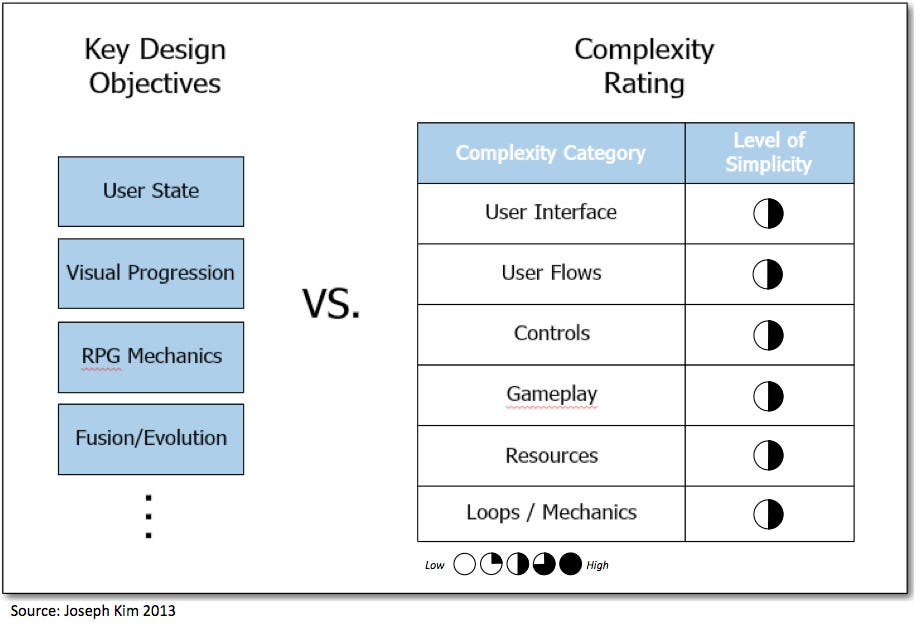
- Designers should evaluate complexity across six core components: user interface, user flows, controls, gameplay, resources, and loops/mechanics.
- Successful mobile titles like Clash of Clans achieved market dominance by actively reducing complexity in UI and HUD elements compared to their predecessors like Backyard Monsters and Edgeworld.

The +1 Mobile Game Design Strategy
The +1 mobile game design strategy posits that the most effective approach to game development involves taking an established set of core mechanics and introducing at least one significant advancement or improvement.
- The '+1' strategy—improving an existing core game mechanic with one significant innovation—is the most effective approach for mobile game success, as it balances the risk of radical innovation with the limitations of simple cloning.
- Horizontal design, which relies on copying existing successful games, has become less viable due to the high cost of user acquisition and the difficulty of competing with established titles that have already built significant user bases.
- Vertical design, which involves creating entirely new mechanics from scratch, carries a high failure rate and often requires a subsequent '+1' iteration to achieve market dominance and commercial viability.
Companies behind it

As the documents state it.