
Assassin's Creed
GameBy Ubisoft Montreal · Released Nov 13, 2007
Documents about Assassin's Creed

Virtual Insanity: Meta AI on Assassin's Creed: Origins
The development of Assassin’s Creed: Origins introduced a sophisticated Meta AI architecture designed to sustain a persistent, living ecosystem within a massive open-world environment.
- Ubisoft implemented a 'Meta AI' system for Assassin's Creed: Origins that manages NPCs and objects globally, allowing them to function autonomously, navigate, and maintain persistent states even when they are far from the player or outside the loaded nav mesh.
- The game utilizes an AI network graph to handle long-range navigation for entities, enabling NPCs to travel across the map and perform scheduled tasks like eating or socializing without requiring the player's presence.
- To optimize performance, the engine uses a component-level Level of Detail (LOD) system with six states based on distance and visibility, allowing the game to disable or reduce the update frequency of specific components like head-tracking or AI logic.

Massive Crowd on Assassin's Creed Unity: AI Recycling
Achieving unprecedented crowd density in Assassin's Creed Unity required the development of a sophisticated AI Level of Detail framework known as the Bulk system.
- The 'Bulk' system manages up to 10,000 NPCs by categorizing them into three proximity-based states: high-fidelity autonomous NPCs, mid-range Puppet NPCs, and long-range Low-Res meshes.
- Engine performance is optimized by reducing polygon counts for distant entities from 20,000 to 2,000, allowing the crowd system to consume only 5% of the total RAM budget.
- The architecture utilizes a deterministic 'Shepherd' container that employs pre-calculated paths and pooled assets to maintain consistent CPU and memory efficiency.

Storytelling with Verbs: Integrating Gameplay and Narrative
Narrative design functions most effectively when treated as a core component of game design, where gameplay mechanics—or "verbs"—serve as the primary building blocks for storytelling.
- Gameplay mechanics, or 'verbs,' should serve as the primary building blocks for storytelling to ensure that the player's physical actions and the narrative arc remain cohesive.
- Integrating narrative design as a core component of game design from the start of pre-production prevents ludonarrative dissonance and streamlines the development process.
- Designers should define characterization and world stakes by analyzing the implications of player actions, such as how 'defend' implies survival while 'attack' implies aggression.
Assassin's Creed Origins: Monitoring and Validation of World Design Data
The development of Assassin’s Creed Origins necessitated a sophisticated approach to quality assurance to manage the complexities of a 120-square-kilometer open world.
- To manage the 120-square-kilometer open world of Assassin’s Creed Origins, the team replaced manual quality assurance with an automated validation framework to address navigation mesh failures and AI pathing errors.
- The development team implemented a daily automated testing suite using C#-based scripts to query over 200,000 individual game objects for objective pass/fail evaluations.
- The integration of a visual interface called Atlas allowed developers to pinpoint specific coordinates of data conflicts, enabling the resolution of issues before they cascaded into systemic failures.
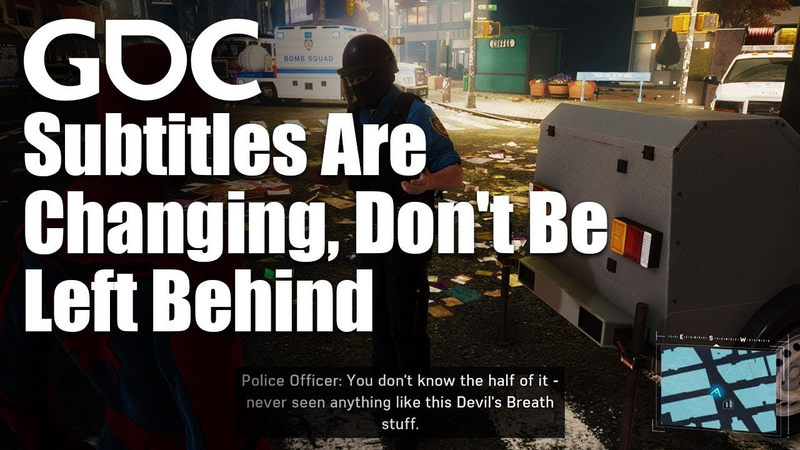
Subtitles Are Changing, Don't Be Left Behind
Subtitles are a critical accessibility feature in modern gaming, serving a diverse user base that extends far beyond the deaf and hard-of-hearing community.
- Over 60% of players utilize subtitles, as evidenced by usage metrics from Assassin’s Creed Origins, indicating that demand extends well beyond the deaf and hard-of-hearing community.
- Effective readability requires a minimum font size of 46 pixels at 1080p, with text limited to two or three lines per screen and a maximum of 38 characters per line.
- Developers must prioritize high contrast by using drop shadows, outlines, or adjustable background boxes to ensure text remains legible against varying game environments.

The Disappointing Final Level - Making Better Endings For Better Games - Extra Credits
The game industry frequently struggles to produce satisfying conclusions, often treating the final level as an afterthought due to development time constraints, resource allocation, and the difficulty of playtesting content that requires a full playthrough to experience.
- Game endings must be treated as a critical, planned component of the development cycle rather than an afterthought to ensure they validate the player's time investment.
- A successful conclusion requires the integration of three distinct layers: the narrative ending for emotional resolution, the mechanical ending for skill mastery, and the ethos ending for thematic reflection.
- Developers should prioritize early planning of the final level to avoid the common pitfalls of rushed development, resource depletion, and the difficulty of playtesting content that requires a full playthrough.

Ubisoft & Square Enix E3 Press Conference | Games ReCAP Episode 004
Ubisoft maintains a robust and stable development model by leveraging established engines and iterative design across major franchises such as Assassin’s Creed, Watch Dogs, Far Cry, and the Tom Clancy series.
- Ubisoft’s strategy of leveraging established engines and iterative design for franchises like Assassin’s Creed and Far Cry provides a stable production model that minimizes the volatility and mass layoffs seen elsewhere in the industry.
- A two-year development cadence is proposed as the optimal standard for major titles, allowing players sufficient time to master complex gameplay systems before the next iteration is released.
- Square Enix’s modernization efforts show inconsistent results, with the Final Fantasy VII Remake succeeding through real-time combat and high fidelity, while projects like the Avengers title and the Final Fantasy VIII remaster suffer from a lack of comprehensive overhauls.
Building a Living World from Ancient Ruins in Assassin's Creed Odyssey
The creation of ancient Greece for Assassin’s Creed Odyssey centers on the synthesis of rigorous historical research and large-scale, modular production techniques.
- The development team managed the massive geographic scope of ancient Greece by coordinating nine global studios under a unified creative vision and a honeycomb design philosophy.
- Production efficiency was achieved through a robust pipeline featuring over 35 architecture kits and 4,000 unique props, supplemented by procedural tools for vegetation and cave systems.
- The project utilized agile two-week development sprints to maintain consistency and alignment across decentralized teams throughout the production cycle.

How does Assassin's Creed Rebellion monetize?
Assassin’s Creed Rebellion is a free-to-play mobile title that blends base-building mechanics with turn-based squad RPG elements.
- Assassin’s Creed Rebellion utilizes a Gacha-style loot box mechanic as its primary progression system, requiring players to collect character shards to unlock and upgrade heroes.
- The game employs a non-aggressive monetization strategy that avoids heavy content gating, allowing players to progress through standard gameplay without mandatory spending.
- Revenue is generated through a multi-layered economy featuring a hard currency shop for DNA cubes, energy refills, and crafting materials, alongside a monthly subscription service for accelerated progression.

Waltzing with Blades: The Music of Assassin's Creed Syndicate
The musical direction for Assassin’s Creed Syndicate represents a deliberate departure from the franchise’s traditional, brooding orchestral scores in favor of a nimble, character-driven aesthetic.
- The score utilized a modular, character-driven design featuring solo violin for Jacob and cello for Evie to provide real-time, reactive feedback based on player choices.
- Production shifted from a traditional orchestral style to a Neo-Mendelssohn, chamber music framework to better reflect the sarcastic and intimate tone of Victorian London.
- Technical implementation prioritized grid-based transitions to eliminate cross-fades, ensuring seamless audio continuity across gameplay, loading screens, and cinematics.

10 Years of Evolution of the Assassin's Creed Brand
The Assassin’s Creed franchise has undergone a decade-long transformation, evolving from a singular technical showcase into a sprawling, multi-platform global brand.
- The franchise transitioned from a standalone technical showcase to a multi-platform global brand by implementing a multi-studio production pipeline that leverages specialized international teams.
- Development shifted from scripted combat to modern, systemic open-world design, utilizing hitbox-based mechanics and emergent AI to modernize gameplay while retaining core parkour and historical elements.
- The brand maintains a cohesive universe through a strict transmedia strategy that enforces unified narrative guidelines across literature, film, and games, allowing each entry to function as a standalone product.

The Digital Museum - Assassin’s Creed Origins Discovery Tour - Extra Credits
The Discovery Tour mode in Assassin’s Creed Origins represents a significant milestone in the integration of interactive entertainment and formal education.
- The Discovery Tour mode in Assassin’s Creed Origins establishes a proof-of-concept for AAA studios to repurpose commercial game engines into formal educational tools for historical study.
- By removing combat and incorporating expert historical consultation, the mode successfully transforms a high-fidelity game environment into a digital museum experience.
- The current implementation relies on a restrictive, linear 'on-rails' design that mirrors traditional audio tours, which limits the medium's potential for self-directed learning.