1 free read left. Create a free account for unlimited reading + AI research.
Create free account
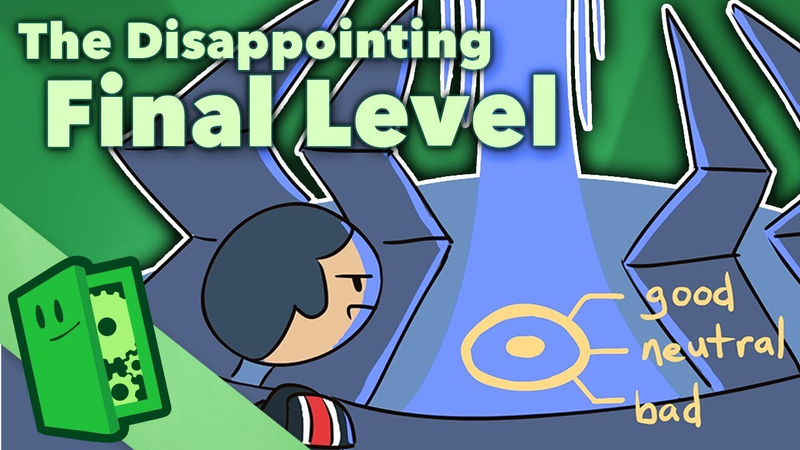
The Disappointing Final Level - Making Better Endings For Better Games - Extra Credits
Key insights
6 takeaways- 01Developers should prioritize early planning of the final level to avoid the common pitfalls of rushed development, resource depletion, and the difficulty of playtesting content that requires a full playthrough.
- 02Narrative and thematic consistency are essential for a satisfying conclusion, as evidenced by the success of Portal and Silent Hill 2 compared to the tonal failures found in Assassin’s Creed and Fallout 3.
- 03Mechanical endings must serve as a culmination of the skills mastered throughout the game, contrasting successful examples like Super Mario Odyssey with poorly integrated experiences like Psychonauts.
- 04The final level must align with the game's established difficulty curve and tone to ensure the conclusion feels like a cohesive extension of the player's journey.
- 05A successful conclusion requires the integration of three distinct layers: the narrative ending for emotional resolution, the mechanical ending for skill mastery, and the ethos ending for thematic reflection.
- 06Game endings must be treated as a critical, planned component of the development cycle rather than an afterthought to ensure they validate the player's time investment.
Ask AI about this video
Transcript
The game industry is getting pretty good at figuring out how to make the openings of games more engaging. However, games still often run into problems making a satisfying conclusion. A lot of final bosses end up as lame shooting galleries, or the denouement turns out to be the most rushed contrived thing you've ever seen. So, why does this happen so often? Before we dive in, please say hello to Bryce, who's doing guest art for this episode. Thanks, Bryce. You know, there's a common developer joke about realizing mere months before shipping that the game has no ending. But honestly, there's some truth to this. We often leave the ending, you guessed it, until the end. So, not only does the finale not have as much thought put into it as the rest of the game, but it's most certainly had much less playtesting. Because to properly experience the emotional impact of the ending, you have to play through the rest of the story. And that's not even considering that in order to get a sense of what skill level the players will be
at to make an appropriate end challenge, you'd need to have the rest of the game already locked. And sadly, in-house testers are often no good for this, because by the time it comes to the ending, everyone's already played the game until their eyes bled. It's no longer an emotional experience or a challenge to them. It's just a bug hunt. And a less obvious problem comes from developers simply not putting in as much time on the ending, because they don't think that many players will see it. The rationale being that it's not worth spending resources to nail an ending that only a fraction of players will ever see, especially in games that don't have narrative as one of their core forms of engagement. So, how can we make endings better? First, we have to discuss the fact that most games often have more than one kind of ending. They have a narrative ending and a mechanical ending. But since most games focus more on delivering either narrative or mechanics, one of these endings tends to excel at the expense of the other. The narrative ending is concerned with concluding the game's story, and this should follow the ideal interest curve,
showing the game's highest climax and culmination. Unfortunately, because endings tend to get so little thought during development, we often see games lessen their impact by rushing to a conclusion, or we get twists and weak cliffhangers that seem to come out of nowhere. To avoid problems like this, ask yourself a few questions while writing your ending. One, does it tie up the major plot points and provide resolution for the main characters? Portal, for example, spent the entire game building up towards the eventual confrontation between GLaDOS and Chell, and the ending left us with a simple but satisfying resolution for both of them. The first Assassin's Creed, on the other hand, raised more questions than it answered with its ending, and really just felt like they were trying to sell us a sequel. Two, is the emotional payoff worthy of the build-up to this point? Batman: Arkham City is a positive example here, with the demise of the Joker being a bittersweet send-off for the character. Contrast this with No Man's Sky, which hyped up the mystery found at the center of the galaxy, only to show that there was literally nothing
there. When you raise the stakes, you really do have to make sure that the payoff is worth it in the end. And three, does the tone fit with the gameplay? The first Assassin's Creed falters here again, because once the action ends, the game becomes an exposition dump in a sterile boardroom, and that doesn't fit with the acrobatic action or even the inherent mystery of the rest of the game. Silent Hill 2, by contrast, uses its numerous endings to explore different implications of its protagonist's psyche, which is what the whole game was designed around. The mechanical ending, meanwhile, is when the player's experience culminates in a test of their accumulated skill. This should fit right at the top of the game's difficulty curve. This is also where the aforementioned lack of playtesting is problematic. A lot of final levels end up being either extremely difficult compared to the rest of the game because the designers are the only ones playing it, or end up too easy, as the designers don't know what skills their players may have mastered along the way. Not to mention, the problem of difficulty is also often
compounded when designers exhaust all of their best ideas before the finale. So, the only way to ramp things up is by either cranking up the difficulty or throwing in new mechanics that don't really fit with the game. Psychonauts is actually a great example of both, with its legendarily painful final level. It begins with the game's only escort mission, which is timed, and it only gets harder from there. Worse still is that most of the gauntlet is pure platforming challenges, so it never lets the player actually play with many of the psychic abilities they've been mastering the whole game. Now, contrast that with Super Mario Odyssey, which in my opinion has one of the most creative endings Mario has ever seen. A literal hat trick, which lets the player explore some of the game's most interesting mechanics from a brand new perspective. The narrative and mechanical endings are the climax of the game's pathos and logos, the emotive and cerebral endings, respectively. But, there can also be an ethos ending, the summation of the game's spirit. This is when a game uses its ending to reinforce everything the player went through, and gets them to
think about their experience from a higher plane, rather than just admiring their score or kill count. Spec Ops: The Line pulled this off masterfully by confronting the player about their actions and leaving them thinking about what they went through. On the opposite end, we have Fallout 3's original ending, in which a game that is supposedly all about choice and freedom forces you to sacrifice yourself in an irradiated room, while your radiation-immune companion stands by and watches your heroism, I guess. So, what actions can we as designers take to improve game endings? Well, having some idea of where the story is going, what the mechanics mean to the overall narrative, and not waiting until the tail end of development to figure out those things is a solid starting point. The ending should be where the players get to see the extent of what can be done with the game's mechanics, And the narrative should be informed by what the mechanics are saying. And if this is done well, any game can leave a player in deep introspective thought, an adrenaline-fueled high, or feeling any emotion that the designers wanted them to feel, long after the players turn it
off. Game endings should never be treated as an afterthought that only the most dedicated players will see. And we need to spend the time to find endings that transcend a game's mechanics and narrative. Because if we nail that, players will sit back while the credits roll and reflect on how those final moments in game made spending all those days of their lives playing through it all worthwhile. Not to mention how much more of that experience they'd like to see.
Summary
The game industry frequently struggles to produce satisfying conclusions, often treating the final level as an afterthought due to development time constraints, resource allocation, and the difficulty of playtesting content that requires a full playthrough to experience. This analysis argues that a successful game ending requires a cohesive integration of narrative, mechanical, and thematic elements, rather than being a rushed or disconnected final challenge.
The primary thesis posits that developers must treat the ending as a critical component of the player experience, ensuring it aligns with the game’s established tone and difficulty curve. A well-executed ending functions on three levels: the narrative ending, which provides emotional payoff and resolution; the mechanical ending, which serves as a culmination of the player’s mastered skills; and the ethos ending, which reinforces the game’s core spirit and encourages player reflection.
Key examples illustrate these principles. Games like Portal and Silent Hill 2 are highlighted for successfully aligning their narrative resolutions with their established themes. Conversely, Assassin’s Creed and Fallout 3 are cited for failing to maintain tonal consistency or logical narrative progression. Mechanically, the analysis contrasts the frustrating, poorly integrated final level of Psychonauts with the creative, skill-reinforcing conclusion of Super Mario Odyssey.
To improve outcomes, the analysis concludes that developers must plan the conclusion early in the development cycle, ensuring that mechanics and narrative are mutually reinforcing. By prioritizing the ending as a vital part of the player’s journey rather than a secondary task, designers can ensure that the final moments provide a meaningful, lasting impact that validates the time invested by the player.
















Comments