VideoThe Game Business
Life beyond Elden Ring: A rare interview with Bandai Namco Entertainment CEO Nao Udagawa
18 Nov 202518 min video
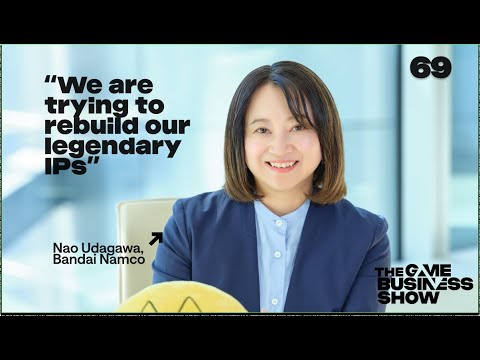
We are focused on both third party IPs as well as our own brands IPs. Going forward, we would like to really expand on our internal capabilities on developing games internally for our own IPs. Hello and welcome to the game business show with me, Christopher Ding. I am in Nice in France to attend EVO, the fighting game tournament. There's going to be some tech and there's going to be some Dragon Ball and I'm going to enjoy that. What you're going to enjoy is an interview with the president and CEO of Bandai Namco Entertainment, No Urugawa. It's a very rare interview. She doesn't normally do it, so it was a really privilege to be able to speak to her. Check it out.
Helloan, welcome to the show. Thank you for coming. I wanted to begin by hearing a little bit about your your career and about the roles that you've had. Could you tell us about that?
Thank you very much. It's very nice to meet you and thank you for the opportunity to have this interview. So, I joined Bandai back in 1994. I have always wanted to work for a
manufacturing company um because I wanted to work closely with the items that are embedded in customers lives. Bandai at the time was venturing into new fields very many of them and since the third year that I have joined the company I have started to work on their network contents operations. At the time my focus was to work on the internet and also PC communications services. I was at the time working on the contents within the carrier communications services and that company became part of Bandai Namco Entertainment and that's when I started to work on the network games as part of the carrier communication services and that company became part of Bandai Namco games and I became the president and CEO of Bandai Namco Entertainment two and a half years ago but before that I was the president and CEO of Bandai Spirits which focused on toy and hobby items. In Bandai spirits, I have dealt with models as well as collectible items. So
tangible items were my focus. And now as part of Bandai Namico Entertainment, I focus on games as well. So it has been a great pleasure to be both involved in practical as well as games content both on the short-term and long-term items as well with life cycles.
Fantastic. So what have been your what do you think have been your greatest achievements your best achievements so far? I think when I became the business development manager of network entertainment contents, we have started to work on mobile apps and mobile game apps very early in the industry and it was my aim to at least double the sales figures. So, we really worked hard on it. I consider it to be one of my greatest achievements to be able to expand on the
mobile game apps because
Well, fantastic. Congratulations on that.
Well, let's talk about Band Dynamco Entertainment. You do so many things across so many different vehicles. What have been your most important recent successes do you think?
So, definitely.
Well, yes. I believe uh one of the notable ones is Elden Ring which we have developed in collaboration with From Software. In terms of sales figures, we have recorded the best ever in Bandamico brand and that itself is an achievement. But not only that, with the Elden Ring brands, we have released various different games and that shows that that world has been celebrated amongst the fans and the clients and we have managed to really capture them in the world that we created.
Well, I'll talk about that cuz from software could work with anyone. They could work well they they do they work with Nintendo, they work with Sony, they work with Activision, but they always seem to come back to you. What's the
secret between that long lasting relationship between Bandynamco and From Software?
I believe the length of our successful collaborations is really the key. What both companies have mutually is that we are aiming to exceed fans expectations always. So from software works extremely hard on development and we do our best in terms of global marketing. I think both sides really hard work and dedications um have managed to capture and bring out the best that seems to work very well for the fans as well.
Well, let's talk about we've talked about the sort about some successes but what about what are the challenges that you're facing at the moment where perhaps are you struggling?
Well, I believe there is still capacity for our business to expand even further. I believe there are so much that we could still do to deliver amazing entertainment to their customers. So I think we have set the bars high and we
believe that there are so much more that we could deliver ongoing.
Well, Capcom recently spoke about concerns around consoles, PlayStation and Xbox in particular, PlayStation because of the higher prices of these machines. Um, is this is this a challenge you've identified?
I think it depends on the titles obviously. However, I do think it's not wrong when the concerns has been expressed that yes, these console games tend to require a long time to develop and that cost tends to be higher. But I think one of our strength lies in the breadth of the portfolios that we have. So yes, we do have AAA titles, but there are many more games that the fans look for and are waiting for as well of various scales. So I think it is our focus to not only limit ourselves to one side of the business but really work everything concurrently.
You're talking about the cost of games there and the cost of AAA games have been rising but we've seen a lot of companies lately talk about doing more
double A smaller titles and they've been performing strongly in the market. How are you approaching what games and franchises that you invest in?
One thing that I can stress is the diversity in our titles and the lineup that we hold. Their primary focus is we do try and deliver what the customers really are looking for. Um something that they would be pleased to see them released and then we consider the costs of development as well as the scheduling as well. Then we try and assess their varieties within the new releases.
Is there a change in what you're signing or what you're commissioning as a result of the challenges in the market? I think change is inevitable in any industry but particularly in games as well and in terms of markets and it's natural for everything to change. So I don't see the change as a challenge so much but I think we just need to adapt to the changes and what's happening in the market and the industry but the primary focus does not change. We tend to consider the fans and what they are
looking for and what they would be pleased to see. And so I really think it's one of the most interesting things to ride through these challenges um and the changes that might be happening today.
Well, let's let's talk about something that has been successful in the market. The Nintendo Switch 2 has launched. It's got off to a very strong start. How are you feeling about that?
Yes, Nintendo Switch 2 is doing extremely well and we have games released on that platform. Um so yeah we are extremely pleased with what's happening and there are many new playful functions for example chat functions as well as game share functions and they could use the console as if it's a mouth as well and that's extremely new novel and interesting one of the titles that we have released on Tamagotchi is set in a sushi restaurant and so the players could really mime as if they are making sushi as part of the game. And that kind of
immersive experiences are new and I believe is extremely interesting. Um, that's something that customers could really enjoy.
Some of your games are are third party partnerships, their other people's IP. How much emphasis are you putting on those partnerships, other people's IP versus pushing your own brands? We are focused on both third party IPS as well as our own brands IPs. Going forward, we would like to really expand on our internal capabilities on developing games internally for our own IPs.
Well, that's quite exciting. You you've had some success in the smartphone space, I think, with Gundam and and things like that. What is your current strategy towards sort of mobile? It's great to see how well mobile games have been doing from our company and my career as I have explained has started in the mobile games businesses as well. So I do feel it's very close to my
heart. So it's exciting. It's an exciting time, exciting field. I would like us to keep delivering to the customers what they find exciting. So we have diverse range that is ready to come out.
Mobile's so hard to succeed in. You know, it's such a competitive space. the big games, always the big games. So, it must be quite reassuring to see some of your games get into that top 10 and get into those rankings. Is it the strength of the IP? Is it your experience with with making games in that space? Do you think that's helped you achieve that?
I think first and foremost, we develop mobile games based on the strength of its own IPs. Another thing to mention is our strength in analysis, marketing analysis. We do determine at which pathways the customers find our games and also the monetization process has been analyzed as well. So we do get to know our customers and the games itself extremely well. So that analysis steps really help and do as
well as that our capabilities in global marketing seem to work hand in hand. And what's your philosophy about expanding your IP and your games into other mediums like movies and and films as Bandai Namco Group to really have the IP contents as our focus is really the core of our principles. I think all our employees focus is how to really capture the world created through its own IPs and let them develop into different products or different mediums. That's really something that we do think about a lot. So not only limited to one medium such as adaptations, we do think about everything as an integrated process. So as well as films for example turning our IPs into products something that can be
embedded into customers lives. So it's a total integrated approach. I think that is the key to our approach.
Do you have any examples of that of something that you've done that's a bit like that or you're doing that's like that?
Yes, we are surrounded by some of them. Pac-Man has celebrated the 45th anniversary. So we have celebrated his 45th birthday together as a whole. He is a well-known character already, but I believe he actually has even more potential. So, I think especially in regarding the licensing business, that's something that we'd like to expand on. Well, let's talk about it doesn't have to be Pac-Man, but you do have this huge back catalog of games and IP that go back 45 years in some cases. What are your current thoughts on the the retro game space and what Bandai Namco's role might be in that? Yes, sure. We call them legendary IPS within Bandai Namco and most of them are extremely unique in its
characteristics and they are gems of IPS. So we do get approached by partner companies with the view of collaborations. So, we are trying to rebuild onto those legendary IPs and exploring new pathways to collaborate with potential partners.
Is that through merchandise or are we talking remasters, ports, remakes? What sort of things are you potentially looking at?
Many different ways. [laughter]
Okay. Um, I'll move on. Um, well, let's let's ask a general question then. What do you see as the growth opportunities in video games today? What do you see as the Yeah. What do you see as the opportunities?
I think it's best that we play on our strength. Each company plays it own strength and I personally view really valuing the fans and what they are looking for. One of our group's purposes is fun for
all into the future. That captures our motto and the way that we work on everything. We really want to make the fans smile, really be happy with what we produce. So, I want our future to be created with our fans.
We recently had someone on on our show who said that um uh he believes in strengthening your strengths and not strengthening your weaknesses, which I thought was a I don't know. I picked up the same sort of sentiment from what you were just saying there.
Thought this was it.
I really do think so. Well, our group have many outlets and they are touch points to our customers. So, I think it makes sense and it's extremely valuable for us to never forget those touch points and always maintain a great relationship with our fans.
I'm going to ask about Japan because Japan's video game industry is enjoying a feels like a huge resurgence globally.
What's the what's what do you think is behind that? It's wonderful to hear if that's true. So, some of the strength that I can really attest to is the attention to details in Japanese games development and as well as the representations on the character skills and strength really and if those expressed through anime as well as games and if that has been communicated to the fans that's really our most pleasure really
not just Japan you see it with Korean drama um Korean in music and and just you're seeing games films music developed in other countries doing so well in in western countries and all over the place and it's it's really wonderful to see in in many respects but also the quality of the development as you say probably because of the attention to detail has been so impressive and it's just great to see the games winning all these awards there
felt like a period of time where Japanese games were in the wilderness and to sort of see them become leading the industry again is is well there's not a question here But it's very it's very I'm very pleased to see it.
Thank you for that. At the Tokyo game show that happened very recently, it was wonderful to see so many global participants coming outside of Japan. About half of the participants were already not from Japan and that was wonderful to see but it really showcased the growth and the size of the global games business itself. So I really hope that more games would really travel from Japan, created in Japan, but also travel to the international market that we would really strengthen our development capabilities as well. That's something that I really look forward to seeing.
Yeah, me too. And Elder Ring is a great example of that. I'll ask one final question. Where would you like to see Bandai Namco Entertainment in 5 years? What I'm aiming for is to keep creating what the customers are looking for and
something that could make them happy and we would like to produce diverse range of those titles and really keep making them pleased with what they see.
It's a very very succinct. Um well thank you so much for your time. Um it's been an absolute pleasure to have you on and I it's been a privilege to speak with you. So can thank you.
It was wonderful. Thank you very much. That's it for today's episode of the game business show. It was a real privilege to be able to speak to Udagawasan about all things Bandai Namco. We will be back in the days and weeks to come to discuss all things video games industry. Some analysis, some interviews, some news, the usual stuff. Until next time, thank you for tuning in. What's the first thing you do when you get into work in the morning?
The first thing I check um it's not an interesting answer. I just check my schedule.
What's your favorite Bandai Namco IP? There's a quick answer. Quick answer. What is your favorite movie of all time?
Back to the future. [laughter]
What a great answer. Back to the future.
Will Nintendo Switch 2 out sell Nintendo Switch One?
I will just say that I'd love it to exceed.
What company in the video game industry do you admire the most outside of Van Line?
Well, all of them have unique characteristics and I respect them all.
That's that's definitely that's definitely a dodge. Um,
and uh, what's your favorite? [laughter] Oh, no. Pac-Man. Will game streaming ever become a mainstream proposition?
If it develops its own standing as a platform, I don't think it's a bad thing for our industry. So,
who's your favorite band or musician?
I don't have one. [laughter]
Okay. [music]
Auto-generated captions from YouTube — names and numbers may be misheard.
Bandai Namco Entertainment CEO Nao Udagawa outlines a strategic vision centered on balancing third-party partnerships with an increased focus on internal development capabilities. The company’s primary objective is to leverage its diverse portfolio to deliver high-quality entertainment that meets evolving fan expectations. By maintaining a broad range of titles—from AAA blockbusters to smaller-scale projects—the firm aims to navigate the rising costs of development and the shifting landscape of the global gaming industry.
A cornerstone of this strategy is the cultivation of long-term collaborations, most notably with FromSoftware. The success of Elden Ring serves as a benchmark for this partnership model, which combines rigorous development standards with robust global marketing. Beyond traditional gaming, the company employs an integrated approach to intellectual property, extending its brands into merchandise, film, and mobile applications. This strategy is designed to embed Bandai Namco’s legendary IPs, such as Pac-Man, into the daily lives of consumers across multiple mediums.
The company’s approach to the mobile sector relies on a combination of strong IP utilization and sophisticated data analytics. By analyzing player behavior and monetization pathways, the firm successfully maintains a competitive presence in the mobile market. Furthermore, the company is actively exploring ways to revitalize its back catalog of classic titles through remakes, ports, and new collaborative opportunities.
Looking ahead, the company remains committed to the Japanese industry’s tradition of attention to detail while expanding its reach in international markets. The leadership emphasizes that success is rooted in maintaining strong touchpoints with fans and prioritizing the creation of experiences that resonate emotionally with global audiences. By focusing on these core strengths, the company intends to foster sustainable growth and continue delivering diverse, high-quality content over the next five years.

The Game Business · 2026

The Game Business · 2026

The Game Business · 2026

The Game Business · 2026

The Game Business · 2026

The Game Business · 2026

The Game Business · 2026

The Game Business · 2026

The Game Business · 2026

The Game Business · 2026

The Game Business · 2026

The Game Business · 2026
Marvelous
Marvelous

GungHo Online Entertainment
The Game Business · 2026

Deconstructor of Fun · 2026

The Game Business · 2026

The Game Business · 2026
The Game Business · 2026
The Game Business · 2026
Square Enix · 2025

The Game Business · 2025

The Game Business · 2025
Comments