VideoThe Game Business
How come Fuse Games gets to make a Star Wars racing game?
24 Feb 202628 min video
Transcript
You can't build a great game without a great team. Well, you certainly can't do it sustainably. A shared love of Star Wars and a shared love of racing and then a a look at this and go, "Hold on a minute. Why hasn't there been a Star Wars racing game for [music] a couple of decades?" For us, it was like, you know, let's just go 4K 60 Star Wars spectacle and have at it. [music] Hello and welcome to the Game Business Show with me, Christopher Ding. Last week we were speaking to 22 cans which is a studio in Guilford in the UK. This week we're speaking to another studio from Guilford in the UK called Fuse Games. This is the new development team behind the upcoming Star Wars Galactic Racer which is out later this year. Now Fuse formed three years ago from former leaders of EA's Criterion Studio which is of course the studio famous for Burnout and Need for Speed. Now Fuse showed its upcoming game at the Game Awards last month and it looks excellent. They just debuted a new trailer just last week and it still looks excellent. And as someone who
loved Star Wars Episode 1, Pod Racer on the N64 back in 1999. I am really excited for this one. So without further ado, I'm delighted to welcome one of the top studio leaders working video games today, the founder and CEO of Fuse Games, Matt Webster. Hello Matt. Welcome to the show.
Hey Chris, how are you?
I'm good. It's lovely to It's lovely to speak to you um in a professional capacity rather than a gossipy one with a drink in our hands. Uh, [laughter] okay. Okay.
Before we get to Star Wars and this game, let's start with Fuse because I've known you for a long time and I think you join I still can't believe it. You join in air in 1990, was it?
I was. I ended up being there longer than I wasn't. [laughter]
Well, you were the producer on the first FIFA game. That's how we first sort of worked together on um telling the story of that first FIFA. You've done loads of
Yeah, that's right. Yeah. Well, actually the original design I I I pieced together in uh early 90 late ' 92, I think. And then um yeah, and then we ended up uh we ended up making it in uh
with uh newly formed EAC that EA Canada that was formed out of the acquisition of DSI. Yeah. Yeah. A long time ago, actually. Interesting. Some funny story. Someone someone shared a uh uh a picture of um from 19 cuz I think the thing on Instagram or something was like in 1993 in in FIFA you could run away from the ref to avoid a car getting a getting a yellow card and it was it had Matt Webster as the character running away because we didn't have we didn't have real real player names. So I ended up naming [clears throat] every player in the game. Had to put myself in the England team. [laughter]
Wow. I think it was 32 years of EA at the end or longer than that maybe.
Yeah. And then you decided to somehow go from being an EA lifer to doing your own thing. I need to know I need to go back to this point. What led to that?
It was a milestone birthday which you know you sort of get to well I got to that point and and and you know and I was very happy with Electronic Arts. you know, I learned everything I know there and you know,
I've got a romantic attachment to to to electronic arts and I grew up there. So, you know, I was I was I was very happy there. And but I think you get to an age and you think, well, okay, well, there's a fork in the road and I can continue down one route or perhaps I'm I'm at the point to to try something to try something new and um had an opportunity to do so and uh and and and so took it.
Wow.
And that's really that's that's the starting point. And you I remember I think we were maybe I don't know five or 6 weeks in and and someone said to me, "Oh, you're brave starting an independent studio." And I was, "Oh, really? Should I?" Cuz you know, you're in a bubble in Electronic Arts. You know, you're in something of a bubble. And it's been quite the journey since then. We celebrated our third birthday um in just in the middle of January.
GGC23, I think, was when we we we sort of announced the world what we were doing and we we spoke to you and I thought we were going really quickly and now it's three years. It's quite it's quite amazing.
You did spin up during a tricky time in the industry at least sort of early I
guess earlyish in that tricky time.
Yeah.
How was that experience then set you getting that investment and getting publisher interest and building partnerships at a time when everyone seemed to be starting to batten down the hatches?
Well, I mean we were very fortunate to have some you super support right at the very start.
Mhm. uh and so we were uh somewhat insulated from the turbulence initially but it's been a you know it's been a long journey and you know everybody I think has been affected by by the changes I think what served us well is clearly a track record but I think it's a track record of building teams a lot of the time that we've spent talking about is was around the best places to work you know I think when you were doing that your old gig and um that sort of stuff was really important for us you know
you can't build a great game without a great team. Well, you certainly can't do it sustainably. Um, and so when it comes to doing our own thing, the focus would be on, okay, let's use everything that we've learned to start from those best
practices of build a great team, have a clear idea of what it was that we want to do. And and along the way, we felt that the the quality would show through and it has done. And we've been fortunate enough to um to have weathered some of those challenging times. Not that we've been unaffected, by the way. Um, we've, you know, we've had some challenges along the way, some significant ones.
Oh, really?
But now we sort of Well, yeah. Now we're welcoming. It was great to get I saw you in in Los Angeles when we announced at the Game Awards and um it was just really a really lovely moment to be able to talk to people about what we're doing.
Yeah.
And now to show people.
Interesting you brought that up. I was going to mention the fact that yeah, you were one of my chief advisers and helpers on what to do with the best place to work awards and and giving me all sorts of guidance. It's clearly something that you're passionate about and and and have been driven and you know what you did at Criteria and there were multiple award winners. I think probably one every year that you were there. Before I get on to Star Wars, talk about that you know game awards reveal and the game. How are you set up
then? How many how many are there at Fuse? I don't think I know what what the scale of your studio is.
We're about 75. Oh,
okay. I I say about because it's always plus or minus one.
It's always been whenever we're tying up team numbers. Okay. Yeah. Let's see. Yeah, we're we're 75 75 core. Mhm.
I would imagine there's double that um in addition to that that are working that are working on the game
and we looked at that through we want to build a a great team and we want to build a team sustainably and we're very fortunate in this country
to have a mature what we would call this distributed development industry. You know, it used to be that folks kind of helped you out on your game because they kind of had to because they were keeping the lights on, but but that's really matured over the last decade in particular. And now you have fantastic partner studios that have people that are motivated to work on multiple things, right? That's what gets them going. That's what that's what's important to them that and that's important to us as well. So you have, you know, we look at distributed
development on a a number of different threads. There's well known one outsourced which is a little bit more transactional and then we have distributed development where or external development sorry where we have you know some teams that are working on a specific thing that's very self-contained and then we have codev which is the majority of the support that we have here with some fantastic partners from UK based studios that are essentially extensions to the team. No.
And what that does is that allows us to scale in capacity and capability when we need it. And we know that those relationships have a have a finite time frame. And it means that we're not scaling and contracting based upon the particular needs that we have at particular points in time in in in our development.
How nice.
Yeah, that's a that's a sort of construct of the studio, our core team. Um, but they're very important partners that we work with to bring this game to life.
It's really great. I mean, it's a good year for the UK dev scene in terms of big releases and obviously not just Star Wars, but Lego Batman, obviously Grand Theft Auto and James Bond's been part made over here as well. And yeah, I I
I'm a global media brand, so I have to be impartial on these things. Obviously, as a Brit, it's it's nice to see uh Playground Games obviously um on top of that.
Yeah, for sure.
That brings me on to my question because you've known this. You've been in racing games uh for for years and years and years now. It's an inconsistent and tricky genre to operate even for the big brands. There's this notion that perhaps players don't want or need that many racing games. Maybe um there's always contradictory data to that. Now, Fuse formed around the same time as like Maverick formed as well and Lighthouse Games formed and I think they're all looking into doing things in this genre and obviously there's established players like Playground like co-masters and this is just the UK scene.
Yeah.
Did any of that give you pause? Was there any anxiety around the genre that you were sort of specialist in?
Um, no. I think we see opportunity.
Mhm.
Every time we've made a game, we've tried to innovate inside it. And I think if you look at it more broadly, if you sort of zoom out a little bit, I think it's a genre that's crying out for some fresh new ideas to steal from some other
genres as well and to try new things. And we've always tried to do that in in every game that that that we've made, you know, particularly through the years of of of burnout. But then, you know, into into Need for Speed and most recently when when we made Unbound, you know, to try to do things to freshen things up. That was a particular visual refresh. But also, we did some real systemic changes inside that thing to try and condition players to not always think that they were going to win every race. That you know, a hard four fifth place finish felt should feel as exciting and as valuable for you as a victory when you know that a midpack finish is probably what the vehicle is that you've got ready to race with. So, so there's there's things that we can do to freshen up the experience and then there's things that we can do which will lead us into the Star Wars opportunity where because you're decoupled from tires on tarmac, you can do some fun things. So, we look at it as as a really fresh opportunity and a genre that's ripe for some disruption and some innovation and we look to take that on a shared love of Star Wars and a shared
love of racing and then a a look at this and go hold on a minute why hasn't there been a Star Wars racing game for a couple of decades? It's a genre that we love and you know and we've got a lot of capability and talent in there. So, so it looks like a great opportunity for us.
Well, I mean it does give me confidence cuz you are working in the Star Wars license. It also gives me confidence because I was a huge fan of Star Wars Episode One Pod Racer from 1999. I I played it all that summer on the N64. So, I'm really excited for this. But how did this did this relationship with Lucas the opportunity with Star Wars that come from the fact that Criterion worked on Star Wars Battlefront for a bit? How did that relationship come to be?
There's some personal relationships that we built up through those those experience that we did starting on Battlefront one. Actually, we we did some work with DICE on on that. We did the uh
was it I think it was pitched to me as the impossible mission uh which was you know to deliver on that Star Wars fantasy of racing a speeder bike at super high speed through a forest. And that's actually when that's the first thing we okay well our you know the
convention the things that we that we take really seriously like how something feels and game feel delivering a particular fantasy for players we could take from a vehicle and apply it to a a levitating motorbike for for one of a you know a different description and uh and actually we did a we did a really great job with that and that then led us into I think the game we worked on I think it's got the longest title that I've ever seen which I think ended up Star Wars uh Rogue one X-Wing VR mission which we ended up doing.
Yeah, I remember that.
And loved doing actually and that was a that was a real eye opener for us in the studio there at the time because it was the game that that delivered some significantly emotional reactions out of players cuz you immersed in Star Wars and for many people it was delivering that X-wing pilot fantasy. Um, and then we did then we ended up, you know, doing Starf Fighter Assault, which I think is a, you know, one of the best combat space combat games that was a mode in in another game in Star Wars Battlefront 2, which was huge.
Yeah. And so in doing that, we we we
build up um a lot of great relationships with the with the folks at Lucasfilm Games and and a lot of trust and and so when we look at okay, all the things that we could do as a new studio, we've got we've got a new team, we've got new tools, new technology, we've got new creative, whenever there's a new there's there's risk and so we can look to mitigate those risks in in some different areas. We can mitigate tech risk obviously by using by using something like Unreal. we can mitigate some of our talent risk by by uh working with folks that that we've got existing relationships with and we can mitigate some creative risk by playing in someone else's IP and that felt like a strategically as a studio a good place to go. that happened to be an opportunity for us because we have great relationships with the folks at Lucasfilm. And so we had a bunch of different ideas but for what could be our first game and this one really really resonated as an opportunity for us, a shared one both both at Lucasfilm um and with a a desire for something that we felt like we could breathe some fresh uh contemporary life into an experience that folks haven't had for a
number of years.
It looks really AAA and I know that you're a big team really. I mean, maybe not the biggest in the world, but you certainly it's it's not a small team and obviously you've got so much pedigree and experience and so I shouldn't be surprised by that, but it looks fantastic.
Thank you.
Was there ever a challenge for you in in going down this route, going down the sort of I don't know, am I might be using the term wrong, but down this sort of AAA avenue?
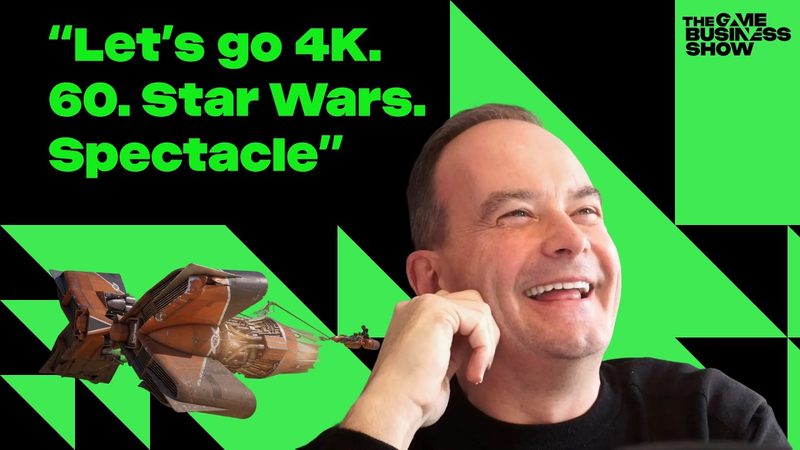
Yeah. Well, well, it's what we know. So you you come from a position of experience and that's great but but we also knew that there's I think there's an expectation you even though you know visually Star Wars um has got many different expressions actually um in in different media for us it was like you know let's just go 4K 60 Star Wars spectacle and have at it that's what we're putting up on screen and and I think for this type of experience getting up and close with the detail in
Star Wars Yeah.
And particularly from, you know, when you look at that pod racing sequence
that everyone knows and loves. And by the way, the nostalgia when we showed the nostalgia moment was really quite profound from the feedback that we got from from the reveal at the game awards.
Yeah.
But that's, you know, that was the guiding light, you know, let's deliver this fantasy. But everyone's got a a view of what that looks like. Uh, and we felt that um, you to do that um, in a way that evoked those memories from from episode one, but to do it in real time, you know, 20 odd years, 25 years later, to be able to do something in real time to that sort of fidelity, it was a real challenge as well, but one that we felt sort of from a from a visual direction perspective was necessary.
Because the type of journalist I am, my instant thought went, "Ah, you must have had some tough publishing and funding conversations as the industry went on." That's where my brain goes to. I looked at that as how boring I've become. I look at an amazing Star Wars [clears throat] game and I go, "Oh, I bet they must have found it really difficult to find money."
Yeah, it's it's expensive.
Yeah.
You know, it is expensive, you know, and
we didn't make it easy for ourselves because,
you know, whilst we are showing pod racing, you'll see from the reveal, we wanted to to be different.
Yeah. Um, [snorts] and to, you know, tell that tell that story of the the Galactic League and and the the vehicles you're racing go beyond pod racing.
Mhm.
Why do you think there hasn't been a Star Wars racing game for so long?
I don't know. Someone asked me that. Why? Actually, when you know, when we spoke to the Lucasfilm games folks, it's like there aren't many sort of white whales left, but this is one of them. And the question was, well, what why? [laughter] Uh, and and I don't know. I think you know your point earlier know each of those teams that you mentioned about doing work in in racing games it's not you know to make a great racing game is not easy
you know um or and I'm sure all of those folks that you mentioned each of them have got decades of experience there there's a load of hard one lessons that you that that you collect along the way from making racing games and um and so
that means and so that means something so when you I think when you look at it as an opportunity and also if you think you got to think differently and maybe timing is right.
Yeah,
maybe it's just the right just the right time. Um
there is certainly nostalgia oddly for those I say oddly, I don't mean too critical, but I mean for for those sort of um prequel trilogy films and and the pod racing scene.
Yeah, it's it's wild that isn't. I think we learned that when we when we were making um Battlefront 2 actually is that you know certainly from my first touch point with Star Wars is obviously the first film
but there's many people now particularly a younger generation who their first touch points might have been it might have been episode one might have been the Clone Wars um you know lots of love for the broader Star Wars uh stories that are told uh you can't just lean on the the the one area that you know uh very well there's there's lots of stories to tell in lots of different eras and and I think that's the other thing for for us when we're looking at a racing game particularly one as I said
that we feel is right for a bunch of innovation where do we want to innovate you know there's clearly a it's a Star Wars racing game so Star Wars fans crave they crave immersion in that galaxy they crave a story to be told and characters to fall in love with and
beautiful locations that we know and love and and and so that actually is is a really fertile ground for us when think about the second to second experience but then more broadly in the sphere of Star Wars storytelling you so that's why we call it a racing adventure because yeah clearly the action and the activity is in in racing but importantly you play as a character you are a you are shade you are a can you cannon uh canonical Star Wars character um the player can you customize um aspects of of that character in terms of voice and um and how they show up and what they wear, but in terms of the core character and his backstory that's there for you to inhabit and and along the way,
you you race your way through through the Galactic Racing League in order to become, you know, deliver on that, you know, racing pilot fantasy, but we're telling a story at the same time and that story manifests with different characters and uh and the paddock area, you know. So we it's one thing that we we think is incredibly valuable. You know, you you're walking down the ramp into the into the racing paddock. Um and that does a bunch of different things. One one clearly is telling you this is a this is a sport. This is racing as a sport. It's you as a character. This is a great location um for us to get up and close with the things that that are that we love in in Star Wars. The vehicles and the critters and the
the views and those things. That's what immerses players in the world. And it's a wonderful counterpoint to super high intensity racing. We've got that lower intensity moments where players are experiencing Star Wars and immersing themselves in Star Wars. And that's I think you know a really significant differentiator for for this game where
you we're moving we think we're moving the the racing genre forward as a whole in terms of its creative expression as well as innovating in the the exciting the second to second moment to moment bits which which we know and love and and are experts at.
Wow. I know you've just you know just shown the new trailer and that's why but the very first trailer this is where we talked you mentioned a minute ago at the game awards. You obviously shared the moment oddly with another Star Wars game was sort of announced at the same time.
Yes. Yes.
But still you seem to have picked up plenty of traction. You talked about the nostalgia um appeal that happened from that trailer. It came out as one of the top performing games of the show. When I saw you at the game awards had a drink in your hand. I imagine you was jetlagged. You were as jetlagged as I was. So it was a um you seemed happy though.
Yeah. And and it's you know it's you know we have we are so privileged in what we do. um just making games, you know, to to be able to do a job that you love. Um you know, one of our values as a fuse is is
a lot is love games, right? But that's a that's a that's a reflection of the passion for the art and the passion for the craft. So what how we make something is as important to us as what we make. And sometimes when when you're when you're making games, you can you get so focused on the the the minutia and the decision making and the dayto-day and you're constantly looking at things that could be better, you know, and uh you're you're optimizing and problem solving along the way trying to remind people that and it's very difficult to do, but to take a step back and try and you know look with fresh eyes about around the the thing that you've made and the the this wonderful industry that we get to work in where you're you know delivering entertainment to hopefully millions and millions of people. Um and and actually more sometimes more profound than that work that you've done might inspire somebody to get involved in making games as a career. It's an incredible thing to be a part of.
But it's those moments that when you get to do a reveal like that in front of an audience there there seeing what you've seen for the very first time and to feel that energy is was a real was a really profound moment and super exciting for for Pete and I um um from the team that were there and and and for the and for our partners and uh and uh the folks that have supported us and the secret mode folks along the way. You know, it's an incredibly exciting moment and it's one one with, you know, when when you stand up in front of a decent bit of software and people are responding to it brilliantly. It's um it's a it's a wonderful moment.
Yeah. Well, that and Bradley the Badger were my two favorite reveals of the show.
Yeah. Wow. There's there was some there was some super stuff showed.
Yeah.
The one thing you mentioned it there. One of the things did surprise me is actually Secret Mode because there were great people. I know James Shaw who runs really well and I rate them and I rate him. I think this is this is though is on a different scale to the sort of things that they've as a as Secret mode
individually they've done big games but Secret Mode um has done in the past. So I have to imagine you had other suitors banging on your door wanting to work with you. What drew you to Secret Mode? What what drew you two together?
Yeah, we did. And you know actually a little bit like um what we were talking about earlier on about you know it's a question of timing and um and that touch and values. You know our values are really important. We're a valuesled studio and values are they're not they're not just something you slap on a website and you never see them again. You know, we operate our team, we hire our people, we measure our people, we we take those sorts of things really seriously. They're there, you know, they're you on your vest day and we strive to live them. Uh and we look for them in our partners. Um and and so when we you know when we've been around the world showing people the game and there were lots of people interested um we look at the sorts of folks that share our vision and our interests with secret mode are wholly aligned and uh you know I think that the success of this game um
is is as important um and as v you as vital for their for their you know vision for where they want to go as as it is for us. and and that is a a compelling um situation to be in.
Uh you plus they're in the UK and you know and they're ambitious and they're hungry and you know we share some similarities in terms of uh freshness and whilst you know a bunch of experience that you know we're doing our we're doing our own thing you know for the first time. So there's lots of similarities there and and you know just huge amounts of support and encouragement, enthusiasm, expertise and insight that we get from collaborating with those folks and and of course you know the incredible support and partnership that we've had with Lucasfilm Games pretty much since you know week three I think of of us working at working at Fuse. So those three things coming together is what's brought us to this place. What's it like working for Lucasfilm? Are they uh saying to no that's not how you do Sabula's hair? is that is that
well there are moments like that but you know this is the thing that it's well like I said again it's it's a super it's a real privilege you know we get to we get to play in one of the you know one of the biggest IPs on the planet but they're game makers there right there that's a that's a game you know there are this is not like a licensing department that's you know rubber stamping or not a particular submission that you've given to them and and and I've been in those situations before over you know in my time many many years ago um this is a yeah this is a creative partnership. Um, and we see the potential and, you know, and the the game that we the game that we initially pitched was was adjusted and and modified and steered in particular directions to reflect the opportunity that that they saw. Um, and you know, and along the way, you know, we've had a huge amount of support in a in a me in a manner in which um, you know, they've they've not they've not worked in that way before. M you know that's a reflection of the I think the confidence and the support um that they showed us and and the trust that we've built up
over the years. We understand how how they work, what's important uh for them, you know, in the other direction is true as well. So it's a real privilege. It's a real privilege to get to do new things in that universe. There's a there's a lot of things that um in this game that we you know we reached into the into the Star Wars archives and and got to play with and but there's an al awful lot of new there and and that and the new stuff requires collaboration and iteration and and that's that's those sorts of things are the you know the foundational values of of the studio. So again you know in a similar way with with Secret Mode our interests are super aligned. The same is true with uh with Lucas games. I'll ask one more question because I've taken up too much of your time, but what what would what does success look like to you
for this game to come out and to to deliver on on the fantasies that the players have for it to be, you know, clearly a commercial hit is important for us as an independent studio, you know, to give us the um the foundation
to continue to to continue as a as a as a as a new independent AAA studio to show that we can operate at the levels of quality that that I think that we're delivering. Um, we've got big ideas uh for the for this game and beyond. We like to look at this, you know, like it's got a life beyond just one experience. Um, so I think I think success looks like looks like that as opening the that new door to be the new the next uh sorry the next foundation step that we take as a team that to realize our dreams. But more importantly, it's delivering on the fantasy that many players have. Whether that's racing a land, you know, a land speeder or a speeder bike for the first time, which we've never done that together. We're introducing a brand new vehicle uh that we've developed and designed in partnership with Lucasfilm that's never been seen before in Star Wars, uh called the Skin Speeder.
Uh and of course, we've got Pod Racing. So yeah, just to deliver on those play fantasies, to be recognized for bringing something fresh and new into racing
beyond the fact that it's a Star Wars racing game and to, you know, to establish ourselves um as a as a sustainable, growing, independent UK based development team.
I'm really excited, Matt. It's a game right up my street. I can't wait to play it. I'm glad it's out relatively soon.
We need to arrange a time for you to come and see us.
Yeah, I would definitely I would definitely be up for that. But thank you so much for your time. Thanks Chris. I appreciate the time and you know and again you know congratulations on your new gig and looks like you're going gang busters. So well done to you.
Thank you. Ah thank you. Well that's it for today's episode of the game business show. I hope you enjoyed that. I'm really looking forward to it and what a strong year it's shaping up to be for the UK development scene. Now of course we'll be back with more news analysis interviews and insight in the days and weeks ahead. But until then thank you for tuning in.
Auto-generated captions from YouTube — names and numbers may be misheard.

















Comments