1 free read left. Create a free account for unlimited reading + AI research.
Create free accountWhitepaper DiGRA
1 free read left. Create a free account for unlimited reading + AI research.
Create free accountWhitepaperDiGRA
The paper argues that Asia-Pacific and Southeast Asia remain underexplored in game live streaming research. It motivates localized studies of gaming and digital cultures in the region.
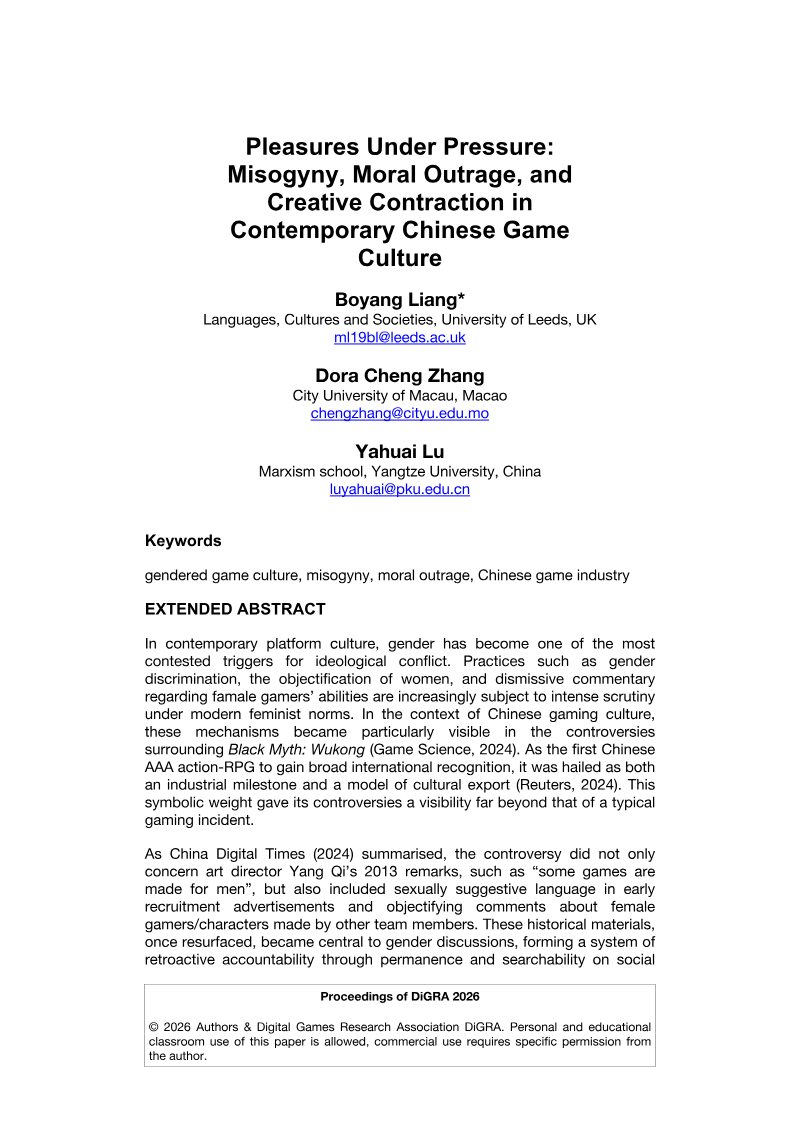
This work-in-progress paper examines how Vietnamese game streamers perform affective labor and whether their presentations of masculinity align with or challenge Western-centered norms documented in existing game streaming research. Its central argument is that research on game live streaming remains heavily concentrated in Western contexts, leaving the Asia-Pacific region and Southeast Asia underexplored, and that localized studies are needed to understand how gaming and digital cultures take shape in these settings. The paper frames affective labor as the emotional engagement, audience interaction, and community-building through which streamers turn passion into livelihood, and it positions masculinity in streaming as a comparatively under-researched area.
The paper reports figures suggesting the scale of the field: the global game streaming market is projected to grow by 10.2 percent over five years, and game streaming accounts for roughly 45 percent of online content consumption in Vietnam, a trend linked to the country's young population. Regional platforms such as NimoTV are described as growing in importance alongside YouTube and Facebook, and the games commonly streamed include Arena of Valor, PUBG: Battlegrounds, Free Fire, and Genshin Impact.
The methodology is preliminary digital ethnographic observation rather than a large-scale survey, so the findings are exploratory. The authors observe that Vietnamese streamers often broadcast at night in loose clothing and interact with audiences in an unscripted, informal manner, contrasting with more professionalized Western streamers. Their popularity is attributed to perceived authenticity, casual speech including swearing and joking, and a resulting sense of intimacy that encourages longer viewing and donations. The paper concludes that these practices may challenge conventional masculine norms, though this claim is presented as a preliminary contribution pending further study.
DiGRA · 2026
DiGRA · 2026