1 free read left. Create a free account for unlimited reading + AI research.
Create free accountWhitepaper DiGRA
1 free read left. Create a free account for unlimited reading + AI research.
Create free accountWhitepaperDiGRA
Existing work concentrates on ethical and economic problems such as variable reward schedules and dark design patterns. The experiential quality of the opening act has received comparatively little attention.
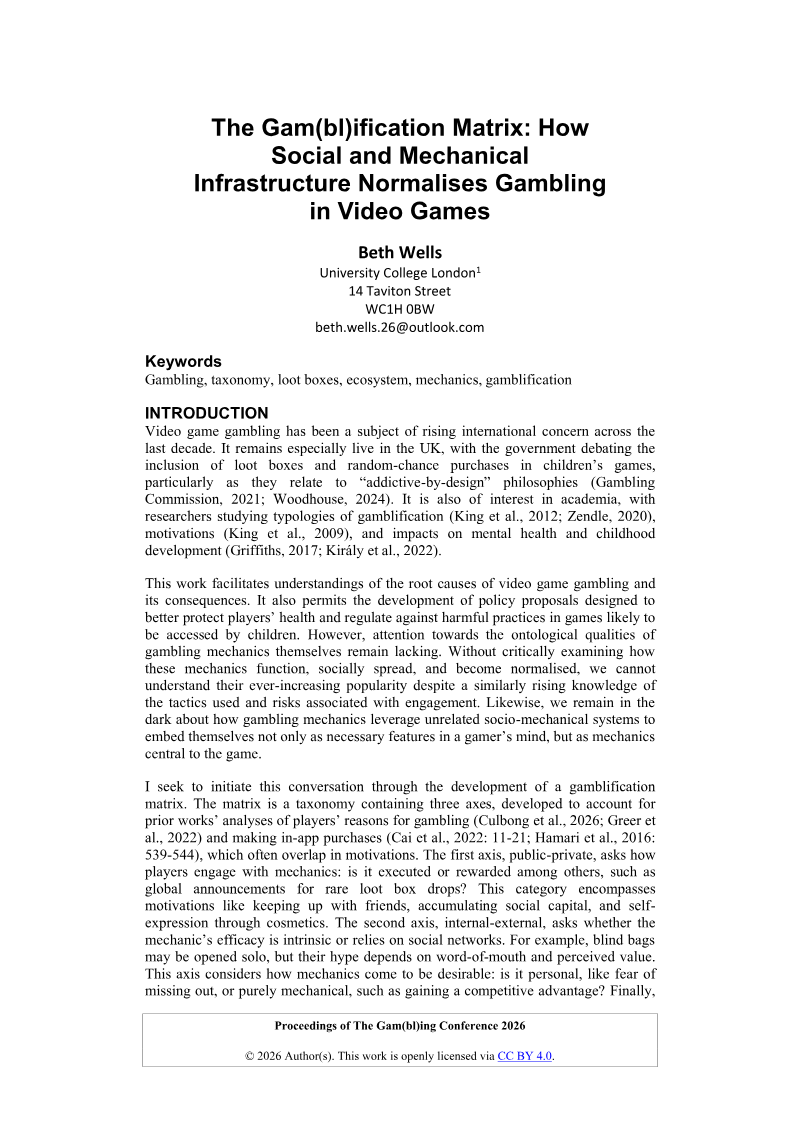
This study examines whether interaction design borrowed from physical blind box opening rituals can improve user satisfaction in digital loot box-style reward systems, and whether added friction in the opening process might also mitigate potential harms. The authors introduce the "digital blind box," a randomized virtual reward mechanism in which players open a box through a deliberate, drag-based gesture rather than a single button click. The work responds to a literature that has concentrated heavily on the ethical and economic problems of loot boxes, such as variable reward schedules and dark design patterns, while giving comparatively little attention to the experiential qualities of the opening act itself.
The primary evidence comes from a controlled within-subjects experiment with 14 participants, who compared a drag-based opening mode against a conventional button-based mode using a custom instrument, the Digital Blind Box Interaction Questionnaire (DBBIQ). The drag-based version scored significantly higher on enjoyment, personal gratification, perceived agency, anticipation, overall satisfaction, and interaction preference, and it produced lower frustration. Differences in visual aesthetics and usability/playability were not statistically significant, which the authors interpret as indicating that the satisfaction gains stem from the interaction itself rather than from visual or usability differences. The authors frame these results as support for "perceived hapticity," the idea that visual and motor engagement can simulate tactile sensation in digital environments.
The study's scope is limited to a single prototype built in the Unity engine and a small, short-term sample, so its findings are preliminary. The authors explicitly note that the harm-reduction hypothesis, namely that friction would slow purchasing and opening, was not tested and remains a question for future research. The paper is a conference contribution from the Gam(bl)ing Conference 2026 and reports no external funding.
Each row is a game or company this document names, each column a document, oldest first. A mark means that document names it. Select a row to see those documents.

DiGRA · 2026

DiGRA · 2026



DiGRA · 2026



DiGRA · 2026



DiGRA · 2026



DiGRA · 2026



DiGRA · 2026



DiGRA · 2026

DiGRA · 2026



DiGRA · 2026

DiGRA · 2026
DiGRA · 2026
DiGRA · 2026