1 free read left. Create a free account for unlimited reading + AI research.
Create free accountWhitepaper DiGRA
1 free read left. Create a free account for unlimited reading + AI research.
Create free accountWhitepaperDiGRA
Pleasure arises from the interplay of body, space, identity, and culture.
This study argues that pleasure in video games is an intersectional experience rather than a universal sensation, arising from the interplay of body, space, identity, and culture. Drawing on embodied cognition theory and an intersectionality framework, its authors draw on mixed methods, including sustained observation of 340 players on WeChat, ten in-depth interviews, a 50-day offline fieldwork period, and descriptive statistics from 165 survey responses. The work spans five game genres and examines titles such as Breath of the Wild, JX3, Ghost of Tsushima, Sekiro, Minecraft, and The Sims 4, with a particular focus on Chinese and Japanese-themed games.
Several recurring findings emerge. Players appear to take pleasure in embodied control over virtual space, favoring climbing, flying, and rule-breaking over designed routes, which the authors term the "pleasure of mastery." Identity formation through sustained role-play with virtual bodies is also central, and cultural pleasure depends on whether a player's identity aligns with the culturally coded roles their avatar performs, with alignment producing resonance and mismatch producing alienation. The authors further identify standard-body assumptions that exclude disabled and neurodiverse players, along with the commodification of experience through convenience-driven design.
The evidence base is modest, and the strength of its conclusions varies accordingly. Much of the support rests on individual interview quotes and researcher observation, and some quantitative claims, such as an 89 percent figure on walking enjoyment in open-world design, rest on small samples. Neurological and causal assertions about neural correlates and neurochemical reinforcement are not substantiated by the material presented and should be read as hypotheses for future work. The authors accordingly call for research on the neural mechanisms of intersectional pleasure, on accessible design for diverse players, and on how virtual pleasure carries into practices such as cosplay and fan fiction. They conclude that intersectionality should guide both game analysis and design so that the enjoyment games offer is available to all players rather than a privilege for a few.
 The Legend of Zelda: Breath of the WildGame · Nintendo EPD Production Group No. 3 · 2017 · 40 documents
 Ghost of TsushimaGame · Sucker Punch Productions · 2020 · 42 documents
 Sekiro: Shadows Die TwiceGame · FromSoftware · 2019 · 8 documents
 The Sims 4Game · The Sims Studio · 2014 · 37 documents
 The SimsGame · Maxis · 2000 · 122 documents
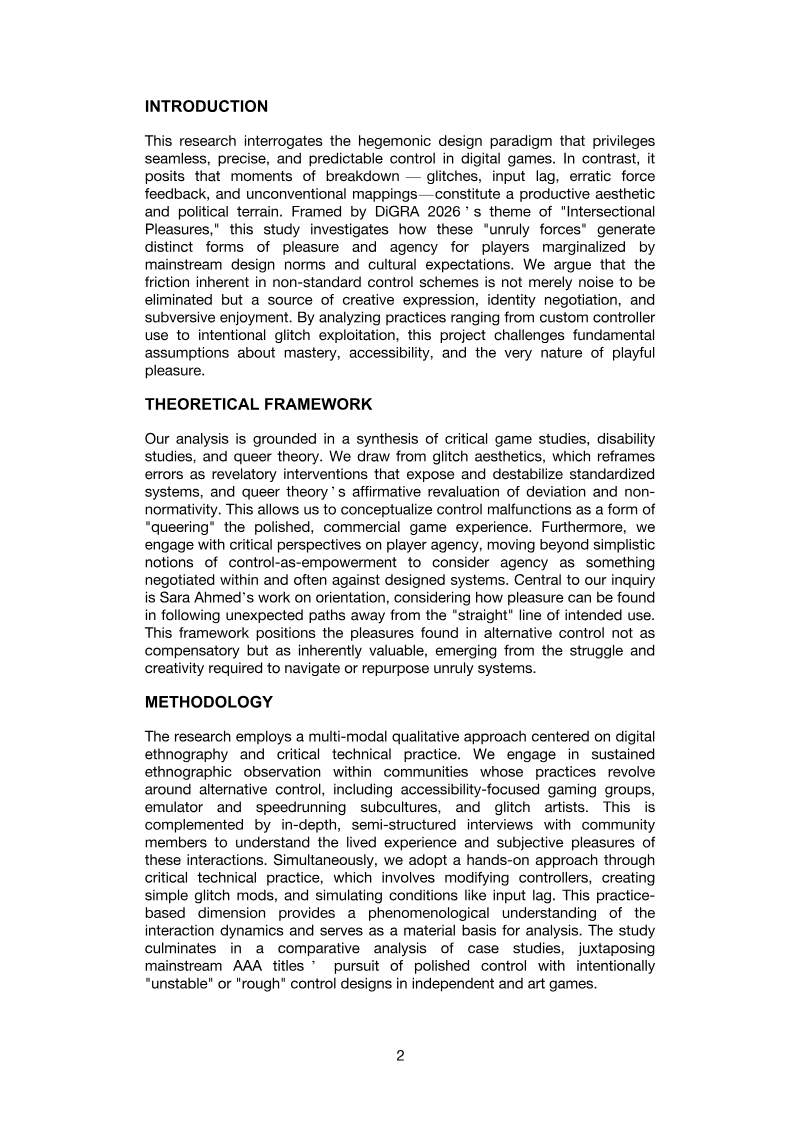
Each row is a game or company this document names, each column a document, oldest first. A mark means that document names it. Select a row to see those documents.
DiGRA · 2026
DiGRA · 2026
DiGRA · 2026
DiGRA · 2018