Enix
Company
Documents about Enix

Ubisoft & Square Enix E3 Press Conference | Games ReCAP Episode 004
Ubisoft maintains a robust and stable development model by leveraging established engines and iterative design across major franchises such as Assassin’s Creed, Watch Dogs, Far Cry, and the Tom Clancy series.
- Ubisoft’s strategy of leveraging established engines and iterative design for franchises like Assassin’s Creed and Far Cry provides a stable production model that minimizes the volatility and mass layoffs seen elsewhere in the industry.
- A two-year development cadence is proposed as the optimal standard for major titles, allowing players sufficient time to master complex gameplay systems before the next iteration is released.
- Square Enix’s modernization efforts show inconsistent results, with the Final Fantasy VII Remake succeeding through real-time combat and high fidelity, while projects like the Avengers title and the Final Fantasy VIII remaster suffer from a lack of comprehensive overhauls.
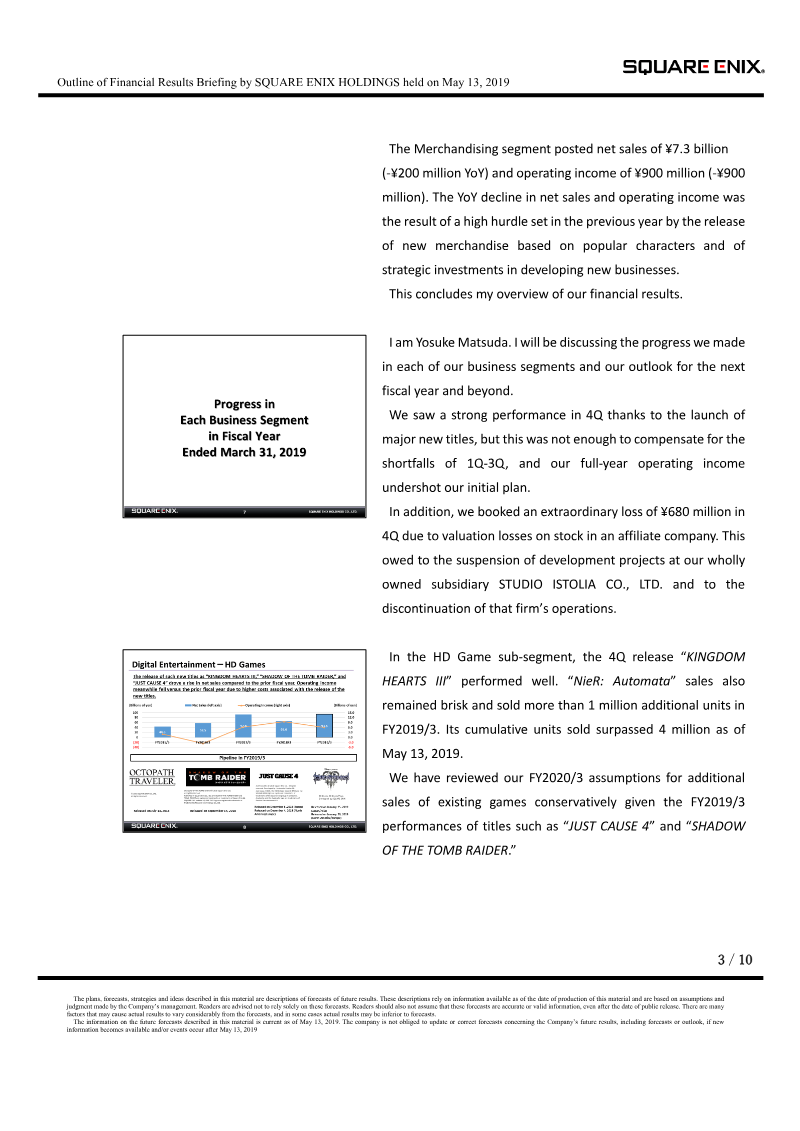
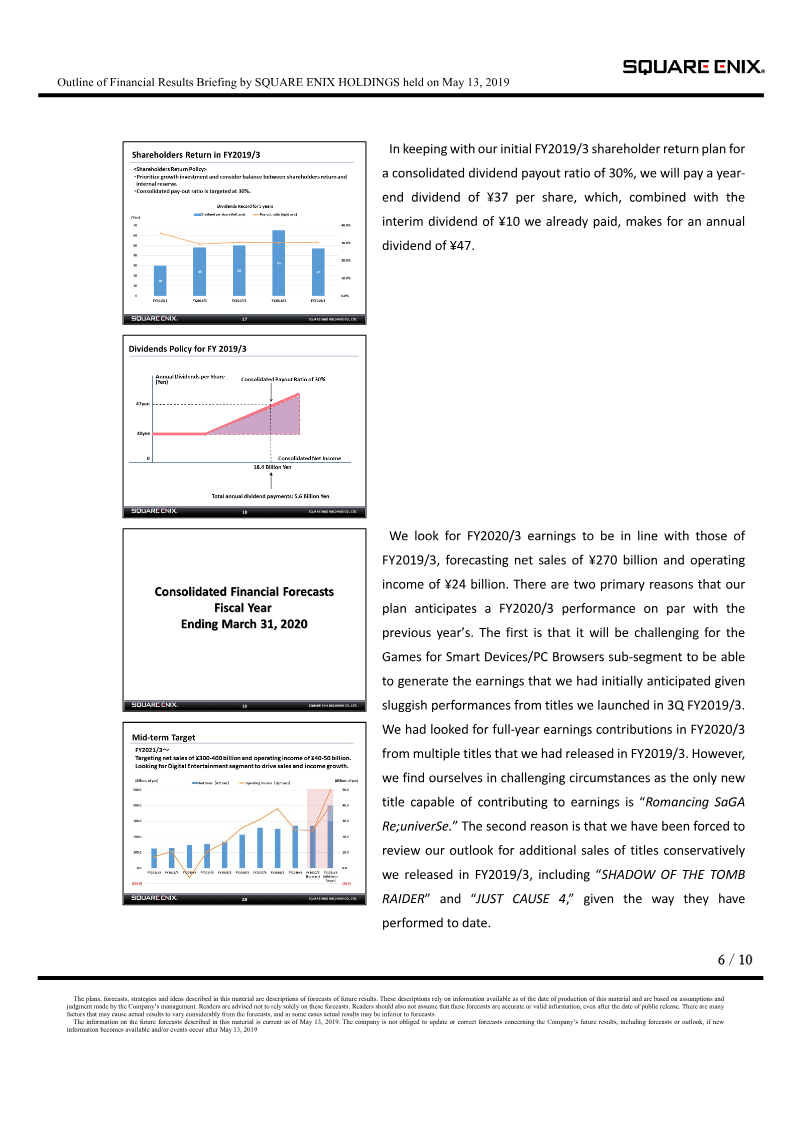
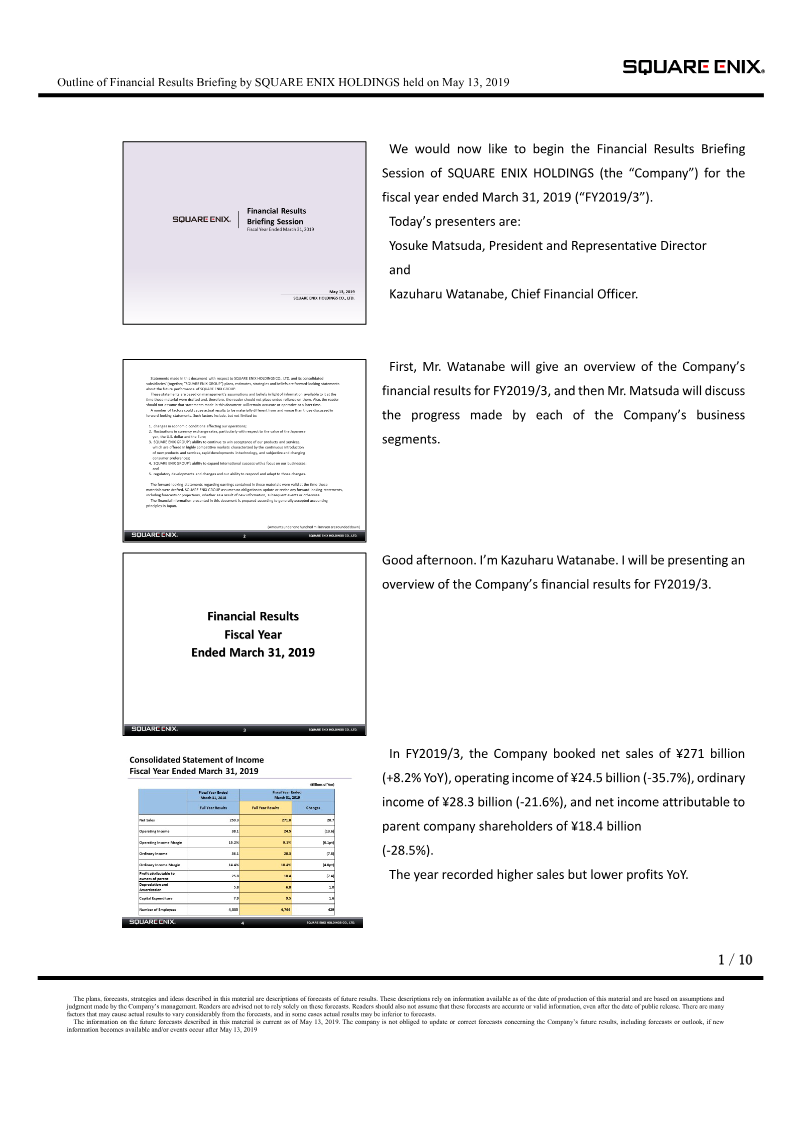
Square Enix Holdings Financial Results Briefing: Fiscal Year Ended March 31, 2019
Square Enix Holdings reported financial results for the fiscal year ended March 31, 2019, characterized by a divergence between top-line growth and bottom-line contraction.
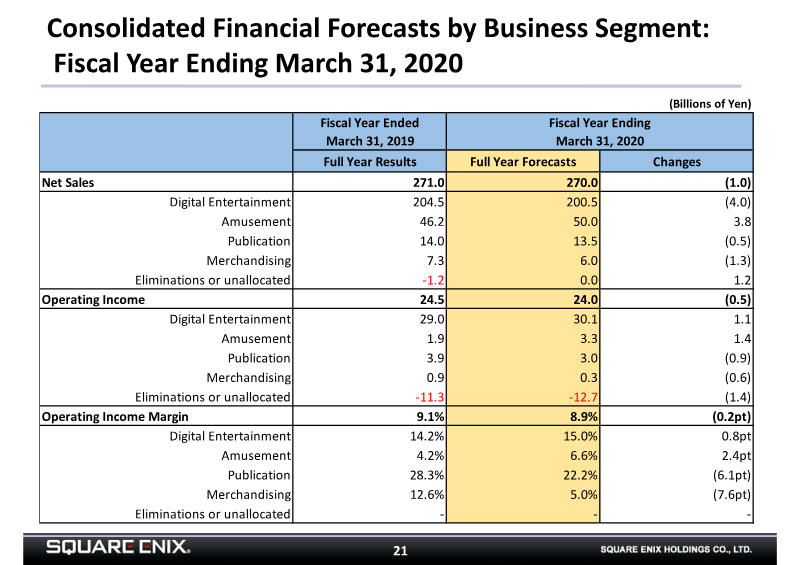

Square Enix Holdings Financial Results: Fiscal Year Ended March 31, 2019
Square Enix Holdings reported financial results for the fiscal year ended March 31, 2019, reflecting a period of revenue growth tempered by declining operating margins.
- Square Enix reported net sales of 271.0 billion yen for the fiscal year ended March 31, 2019, but operating income fell significantly to 24.5 billion yen, down from 38.1 billion yen in the previous year.
- The Digital Entertainment segment, the company's largest revenue driver, saw operating income drop from 43.4 billion yen to 29.0 billion yen, resulting in an operating margin contraction of 8.5 percentage points to 14.2%.
- Digital sales in the HD games segment have grown by an annual average of approximately 40% over the past five years, with digital downloads accounting for 40% of total HD sales in FY2019/3.
Square Enix Holdings 3Q FY2019/3 Financial Results Briefing
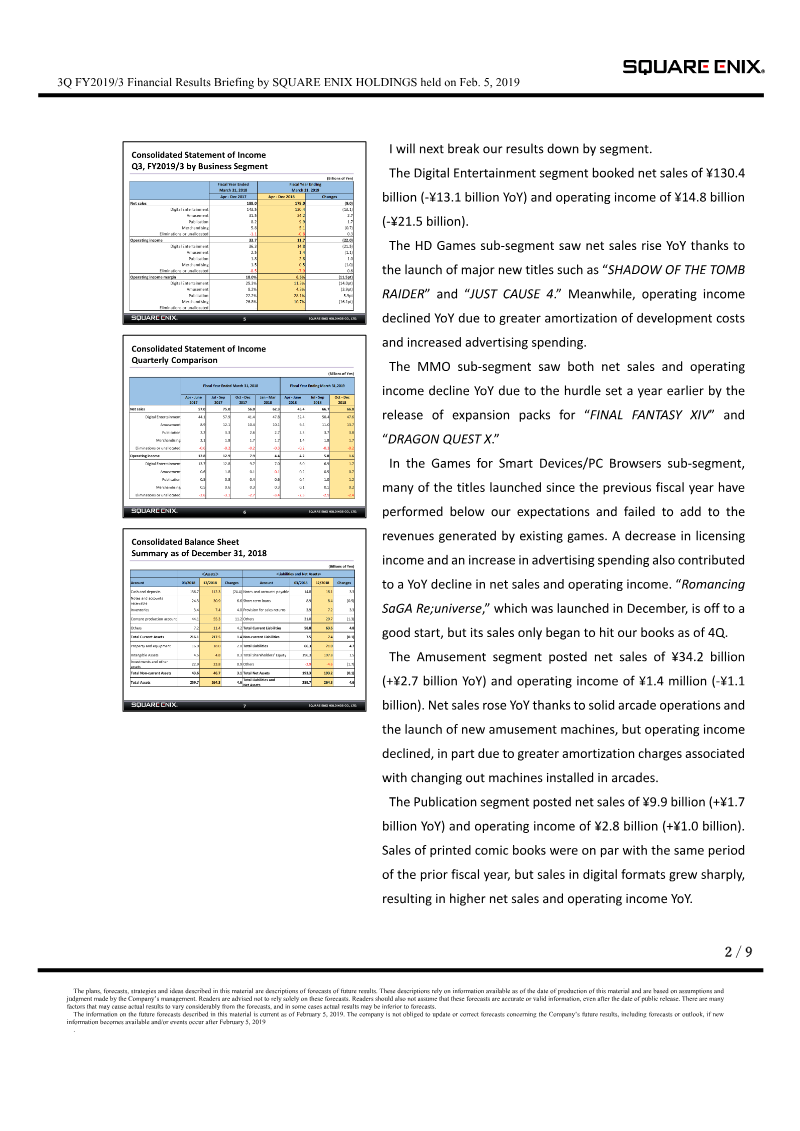
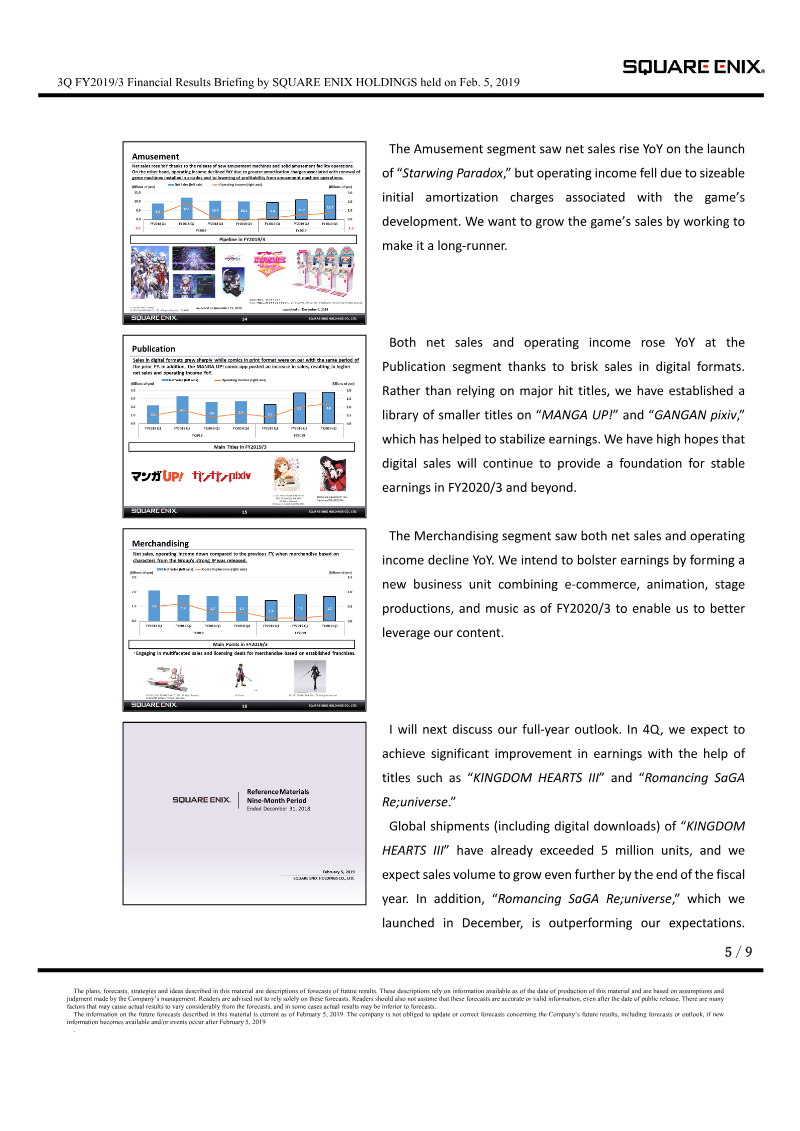
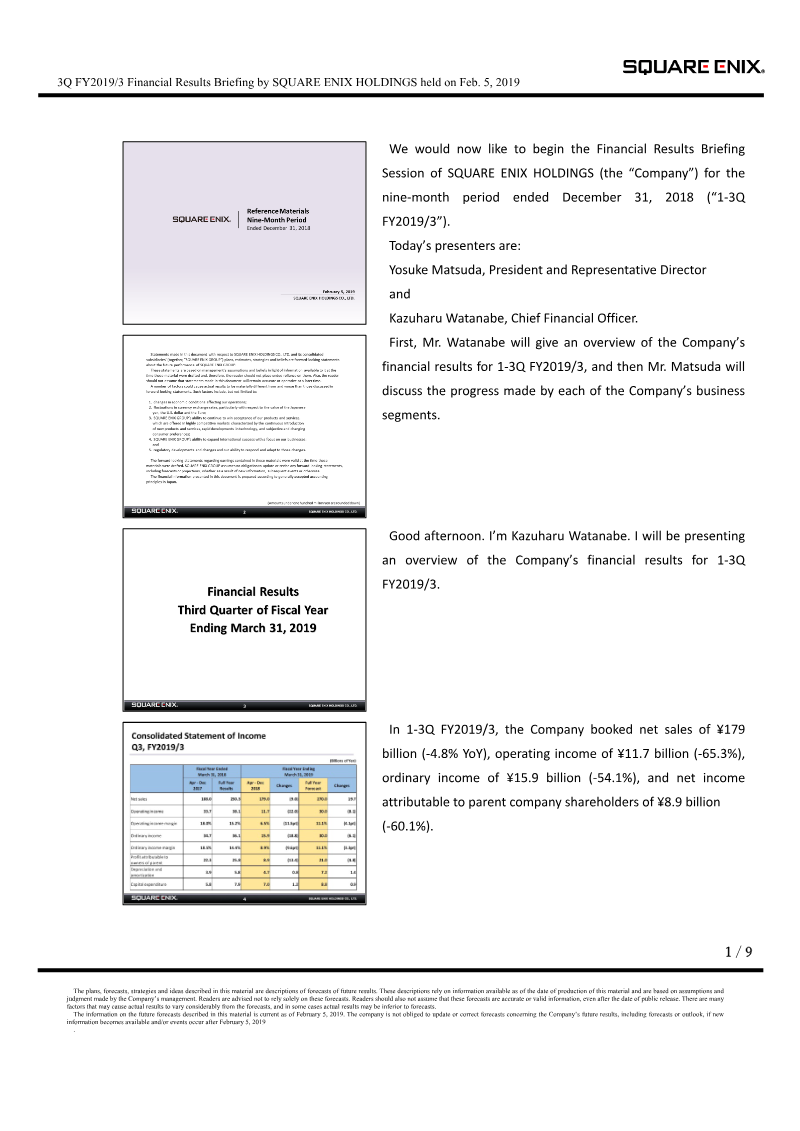
Square Enix Holdings reported a challenging financial performance for the nine-month period ending December 31, 2018.
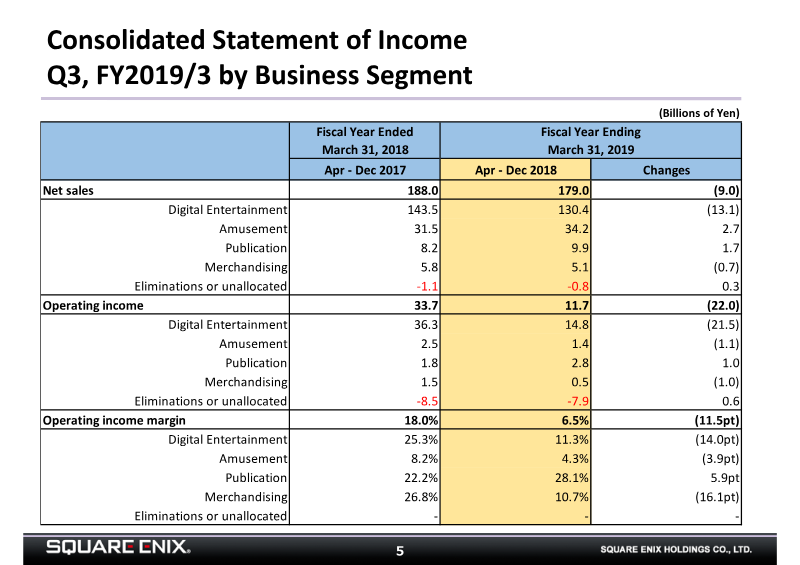
- Square Enix reported a 65.3% year-over-year decline in operating income to ¥11.7 billion for the nine-month period ending December 31, 2018, alongside a 4.8% drop in net sales to ¥179 billion.
- The Digital Entertainment segment, the company's core business, saw net sales fall to ¥130.4 billion due to high development amortization costs, heavy advertising spend, and underperforming titles like Just Cause 4.
- To improve operational efficiency and profitability, Square Enix will consolidate its eleven existing business divisions into four units starting in fiscal year 2020.

Square Enix Holdings Nine-Month Period Financial Results: Ended December 31, 2018
Square Enix Holdings reported a challenging financial performance for the nine-month period ending December 31, 2018, characterized by a significant decline in profitability compared to the same period in the previous fiscal year.
- Square Enix reported a significant decline in financial performance for the nine-month period ending December 31, 2018, with net sales falling to 179.0 billion yen and operating income dropping to 11.7 billion yen, a 22.0 billion yen decrease year-over-year.
- The Digital Entertainment segment, the company's primary revenue driver, saw operating income plummet to 1.6 billion yen in the third quarter of FY2019, down from 7.9 billion yen in the same period the previous year.
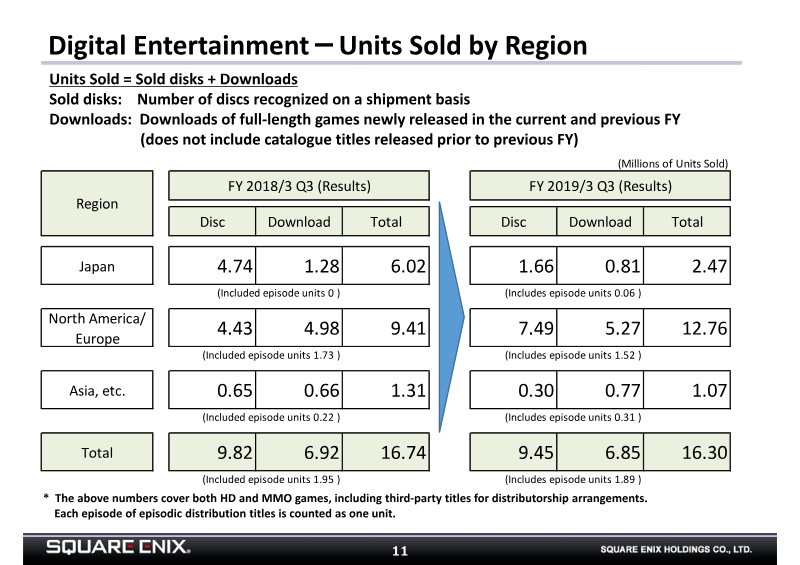
- HD game performance was mixed; while titles like 'Shadow of the Tomb Raider' and 'Just Cause 4' bolstered sales, overall profits were suppressed by increased development amortization and higher advertising expenditures.
Square Enix Holdings 2Q FY2019/3 Financial Results Briefing
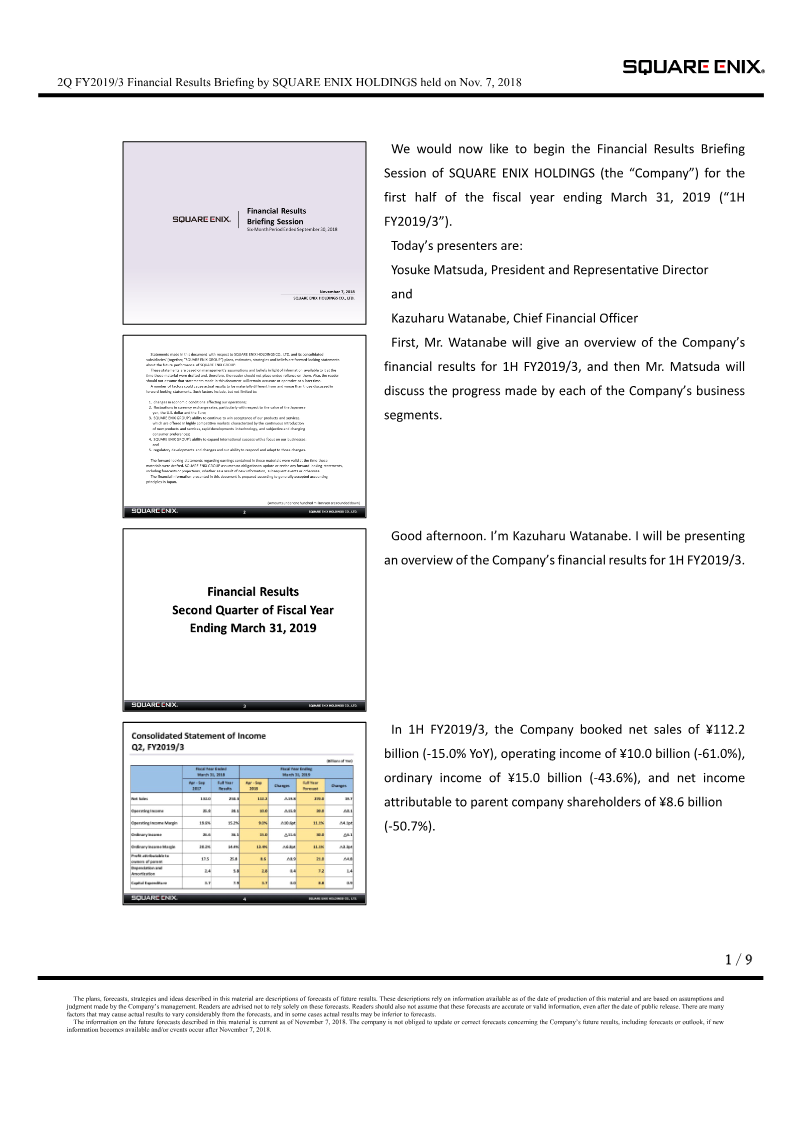
Square Enix Holdings reported a decline in financial performance for the first half of the fiscal year ending March 31, 2019.

Financial Results Briefing Session: Six-Month Period Ended September 30, 2018
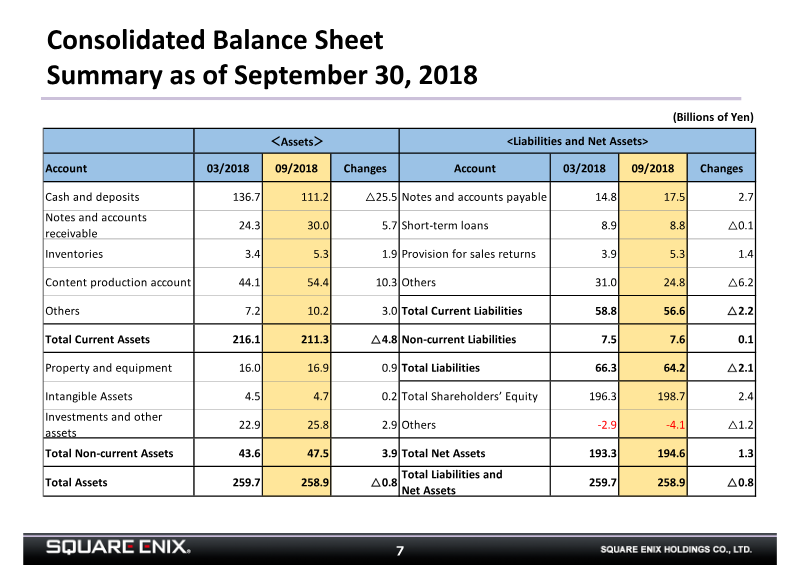
The financial results for the six-month period ending September 30, 2018, reflect a challenging fiscal environment for Square Enix Holdings Co., Ltd. compared to the same period in the previous year.
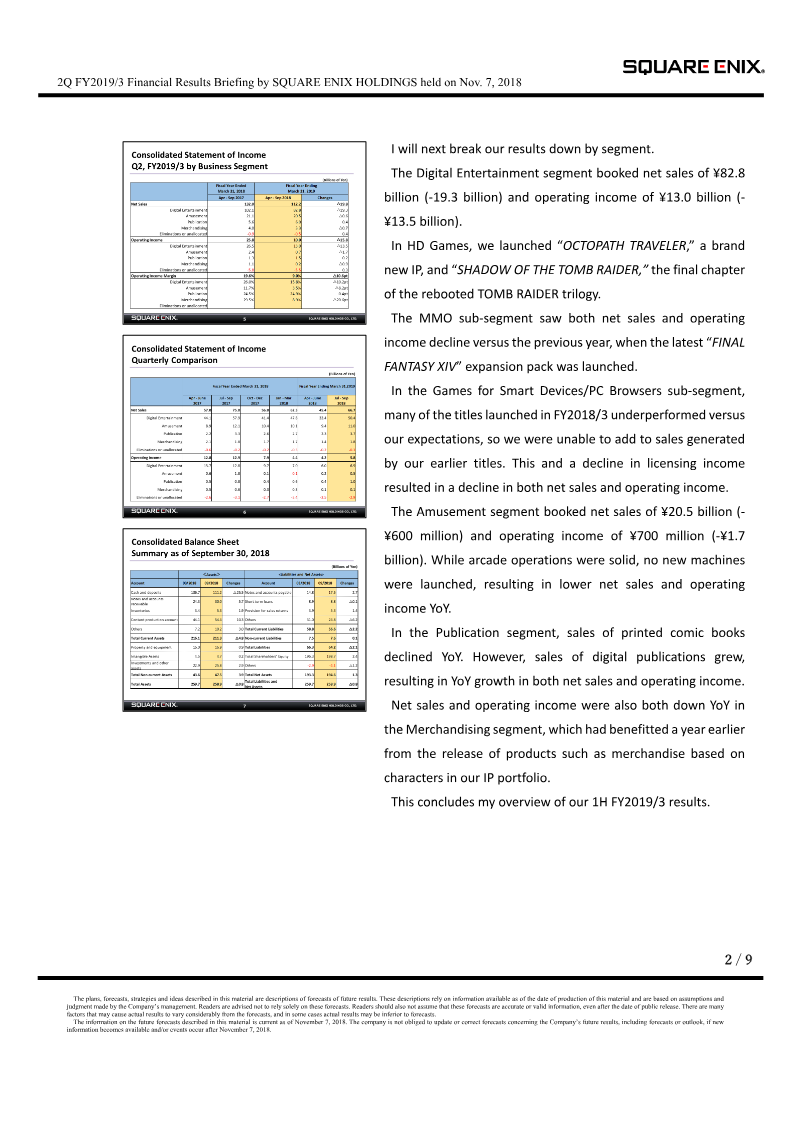
- Square Enix reported a decline in performance for the six-month period ending September 30, 2018, with net sales falling to 112.2 billion yen (down 19.8 billion yen YoY) and operating income dropping to 10.0 billion yen (down 15.8 billion yen YoY).
- Luminous Productions, a wholly-owned subsidiary, recorded an extraordinary loss of 3.733 billion yen due to a strategic shift toward focusing exclusively on large-scale, high-quality AAA titles.
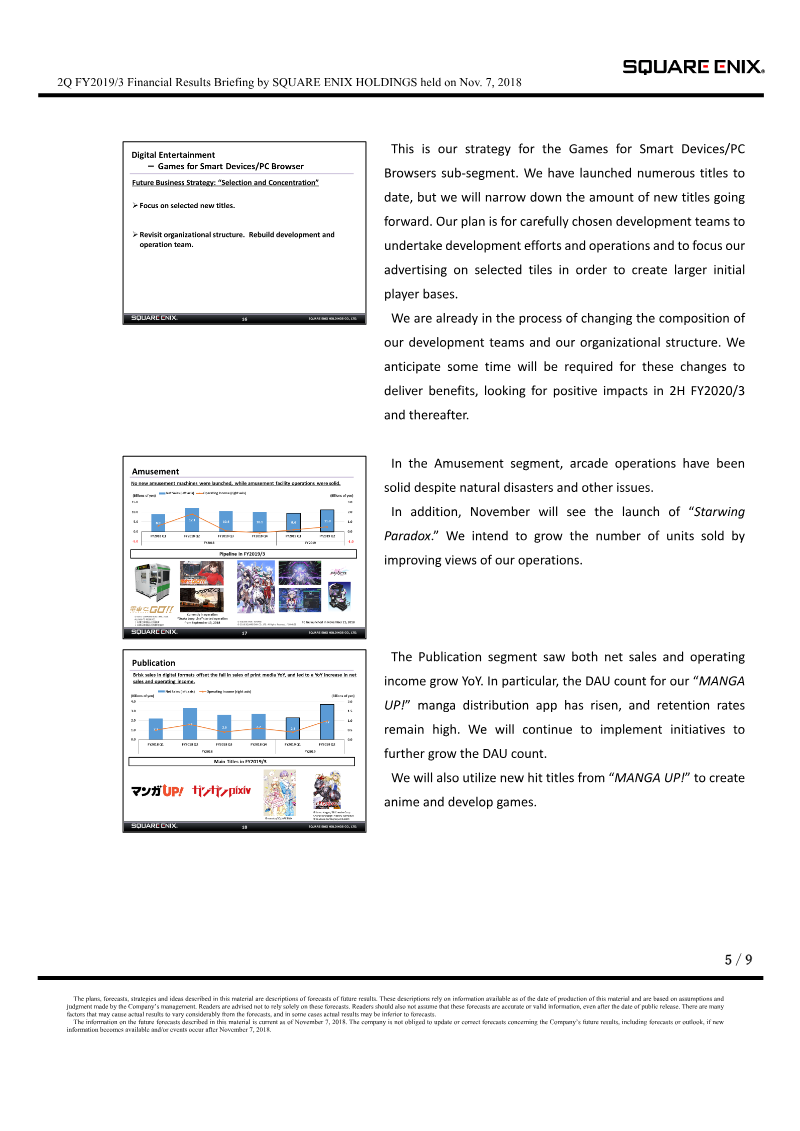
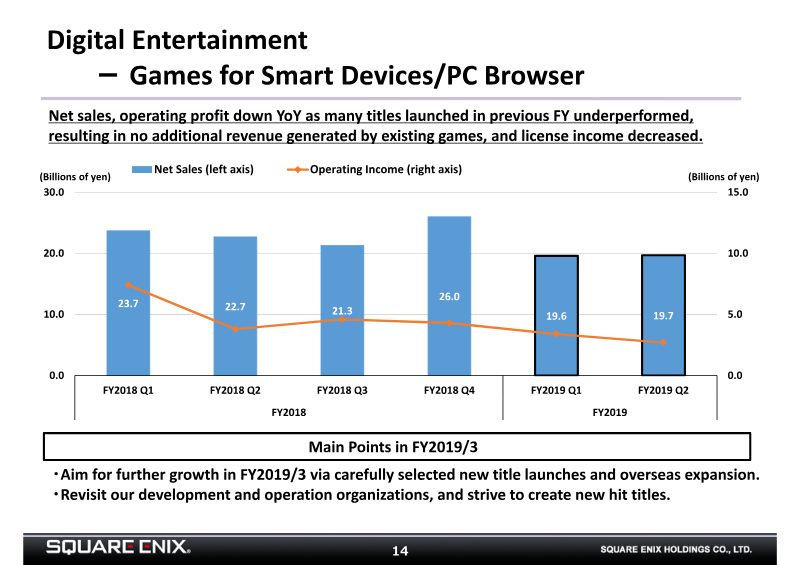
- The Digital Entertainment segment for smart devices and PC browsers saw a decline in both net sales and operating profit, attributed to the underperformance of titles launched in the previous fiscal year and reduced license income.

The Hitman Sniper post-mortem
The Hitman Sniper post-mortem details the transition of a premium mobile title into a sustainable, live-operated service.
- Square Enix Montreal successfully pivoted Hitman Sniper from a declining premium title to a sustainable live-operated service by implementing 36 iterative updates over three years.
- Regional price adjustments in emerging markets proved highly effective, resulting in a 115-fold increase in game downloads.
- The implementation of personalized, mission-specific rifle offers based on behavioral and geographic data increased conversion rates for key items by nearly four times.
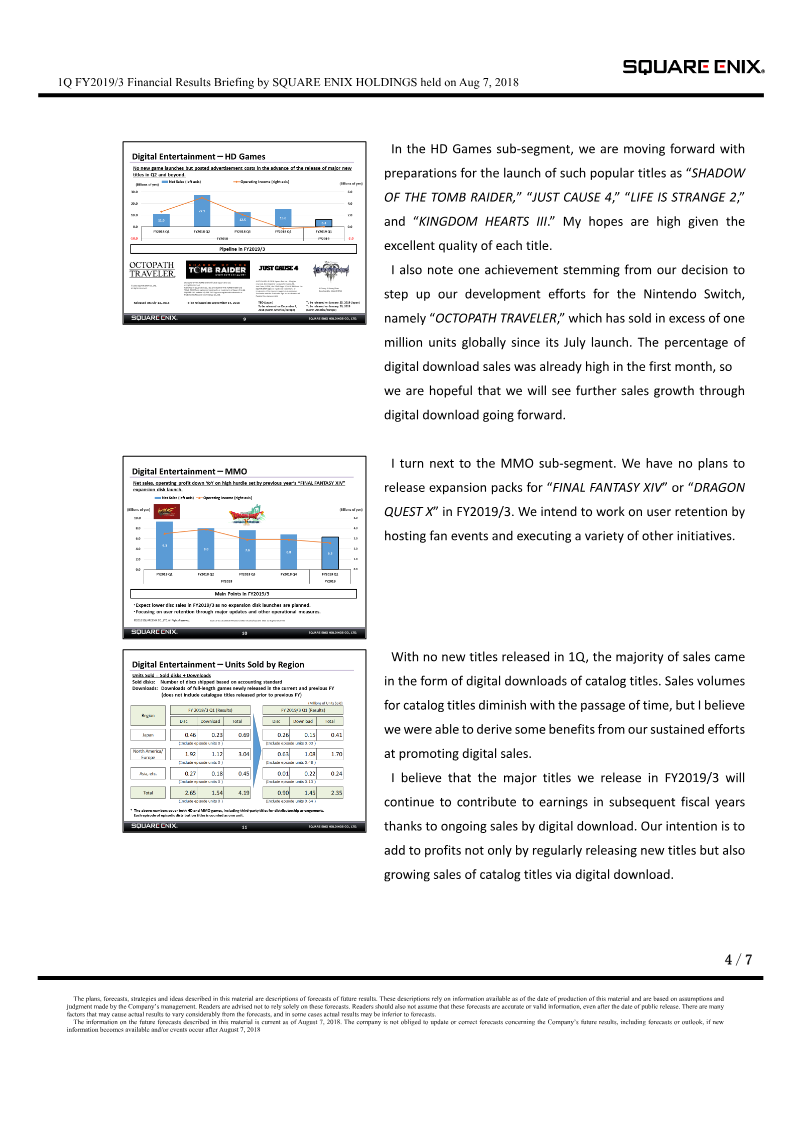
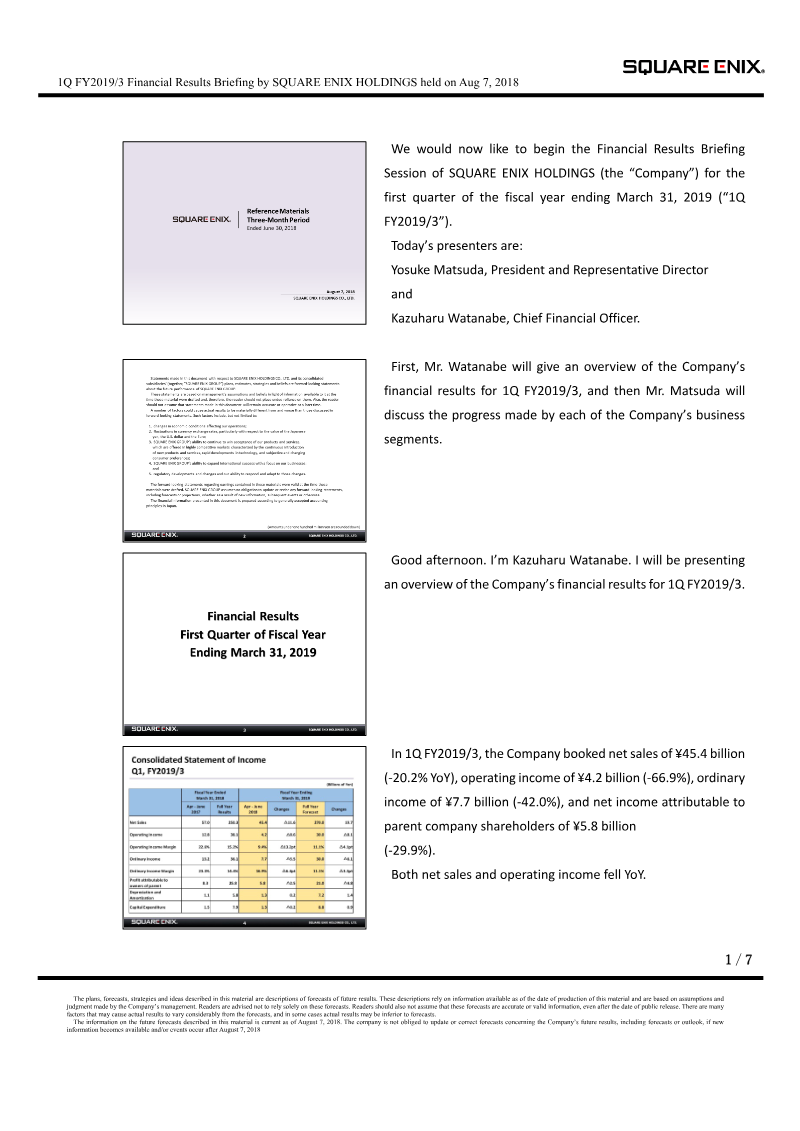
Square Enix Holdings 1Q FY2019/3 Financial Results Briefing
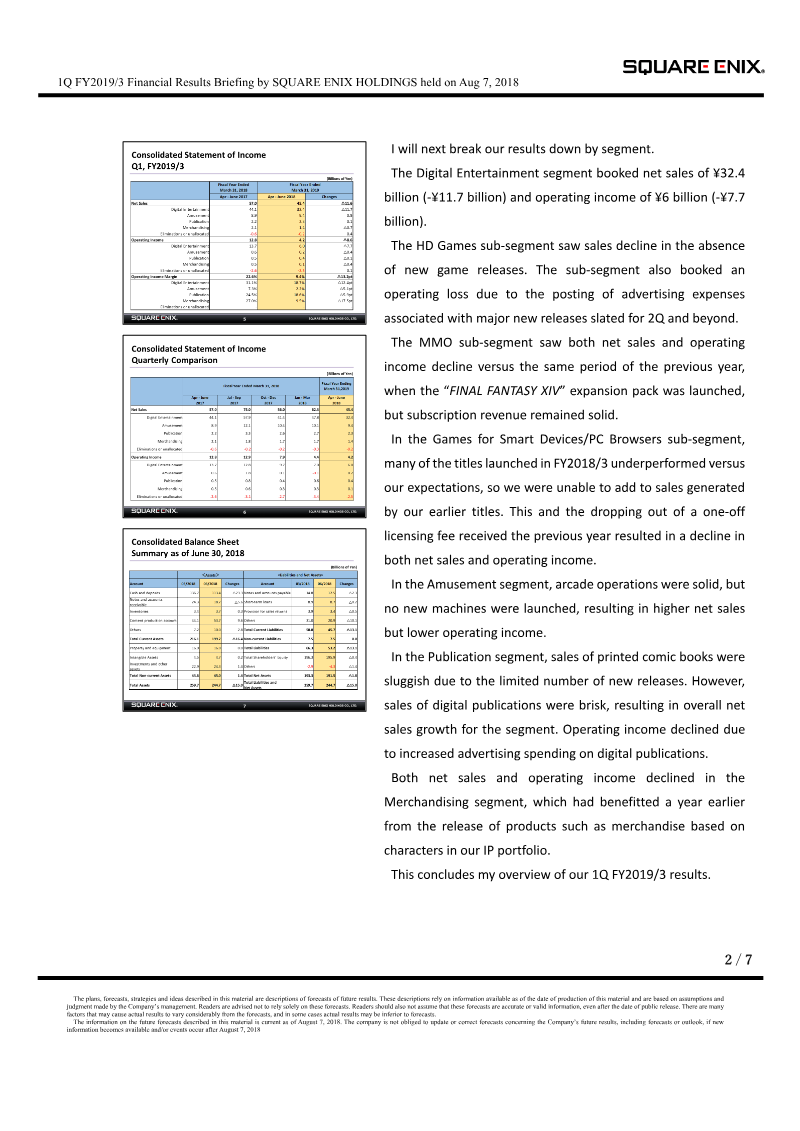
Square Enix Holdings reported a decline in financial performance for the first quarter of the fiscal year ending March 31, 2019.

Square Enix Holdings: Reference Materials for the Three-Month Period Ended June 30, 2018
Square Enix Holdings’ financial results for the first quarter of the fiscal year ending March 31, 2019, reflect a period of year-over-year decline across most business segments.
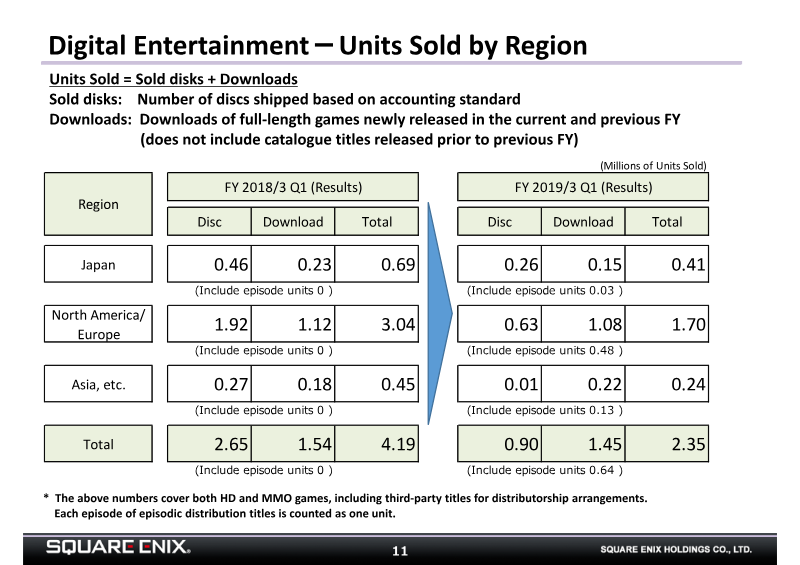
- Square Enix reported a decline in Q1 FY2019/3 performance compared to the same period in 2018, with net sales falling from 57.0 billion yen to 45.4 billion yen and operating income dropping from 12.8 billion yen to 4.2 billion yen.
- The Digital Entertainment segment, the company's primary revenue driver, saw net sales decrease to 32.4 billion yen in Q1 FY2019/3, down from 44.1 billion yen in Q1 FY2018/3.
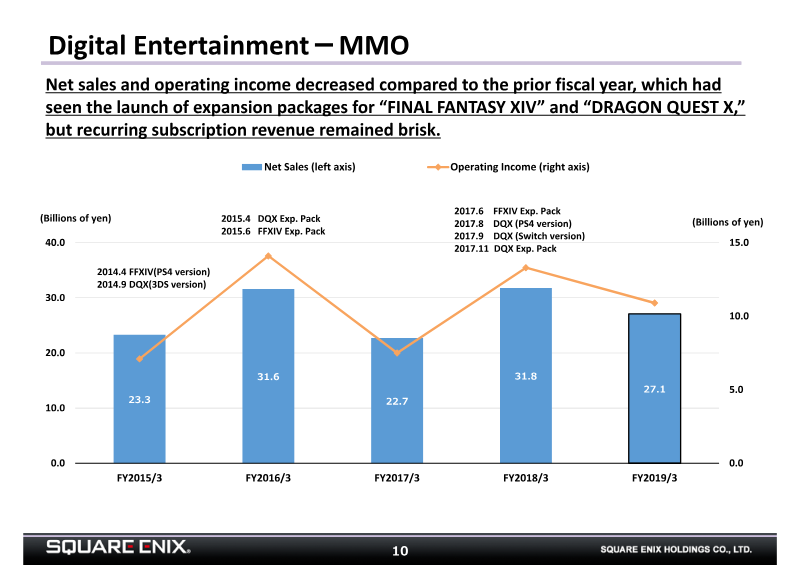
- MMO revenue declined year-over-year due to the absence of a major expansion disk launch for 'Final Fantasy XIV' compared to the previous year's 'Stormblood' release.
Financial Results Briefing: Fiscal Year Ended March 31, 2018
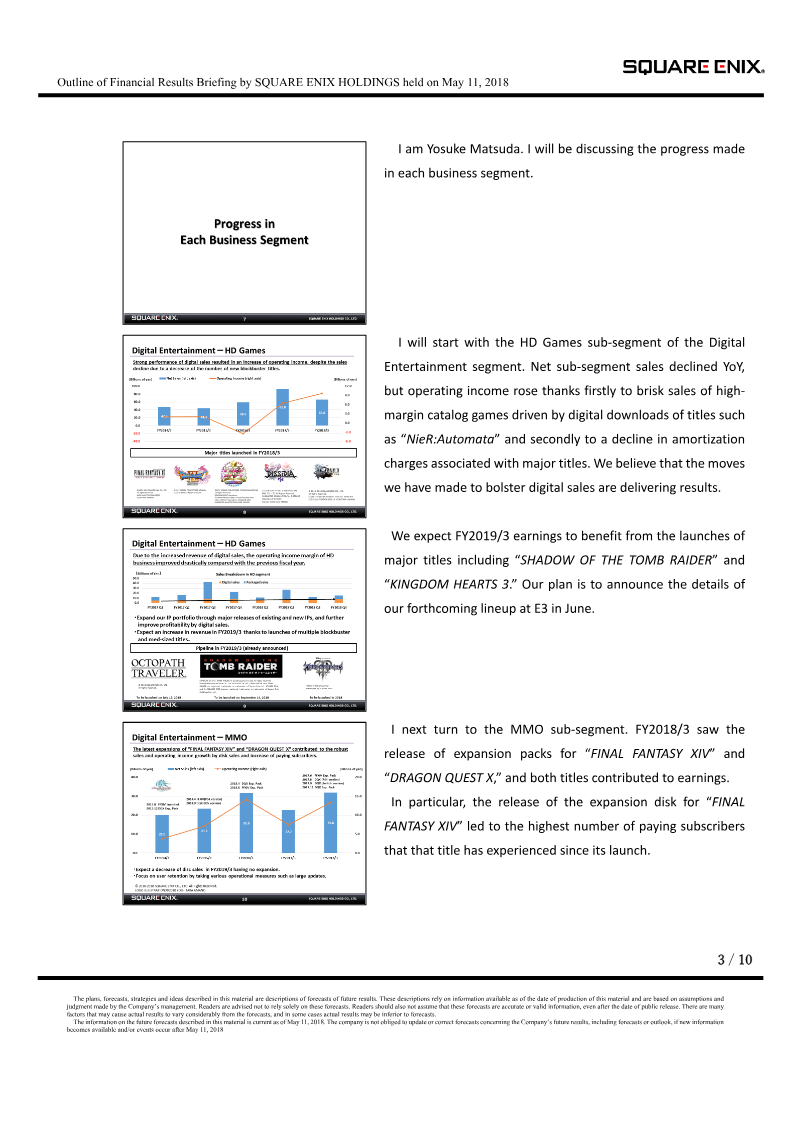
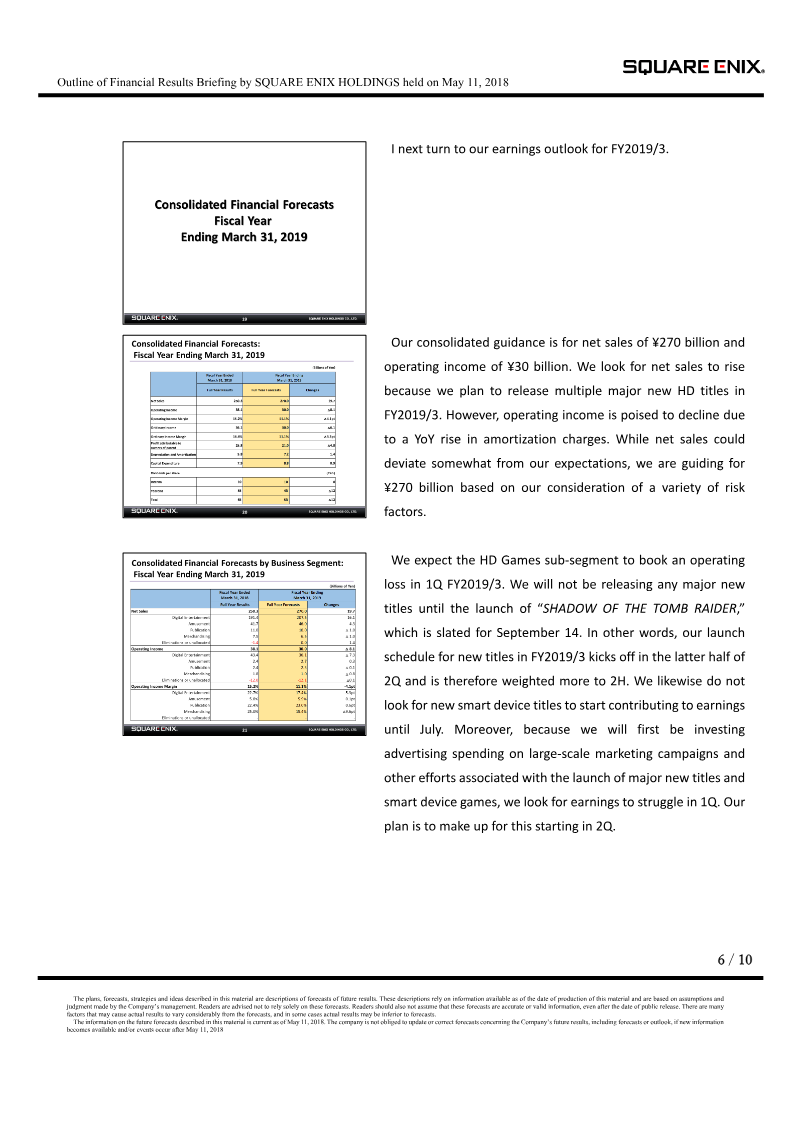
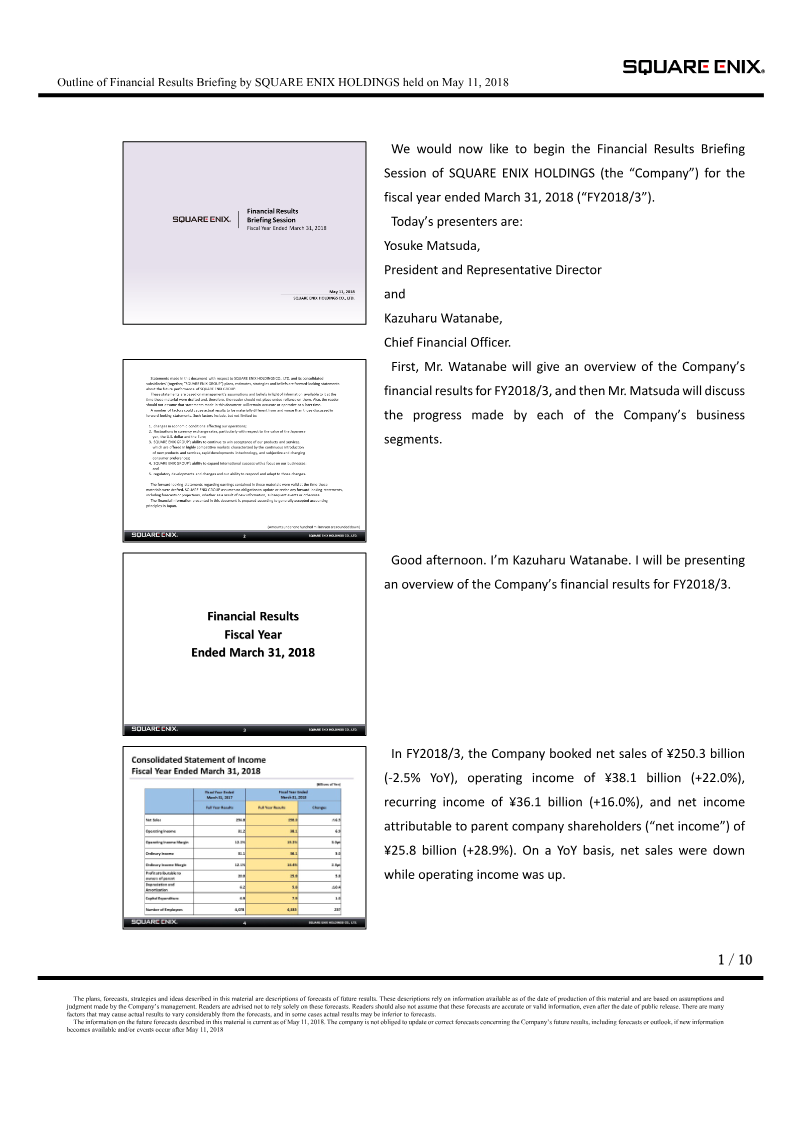
Square Enix Holdings reported its financial results for the fiscal year ended March 31, 2018, highlighting a period of strategic transition toward digital-first revenue streams.
- Square Enix reported FY2018 net sales of ¥250.3 billion, a 2.5% decrease, while operating income grew 22.0% to ¥38.1 billion and net income rose 28.9% to ¥25.8 billion.
- The company set medium-term targets for the fiscal year ending March 31, 2020, aiming for ¥300–400 billion in net sales and ¥40–50 billion in operating income.
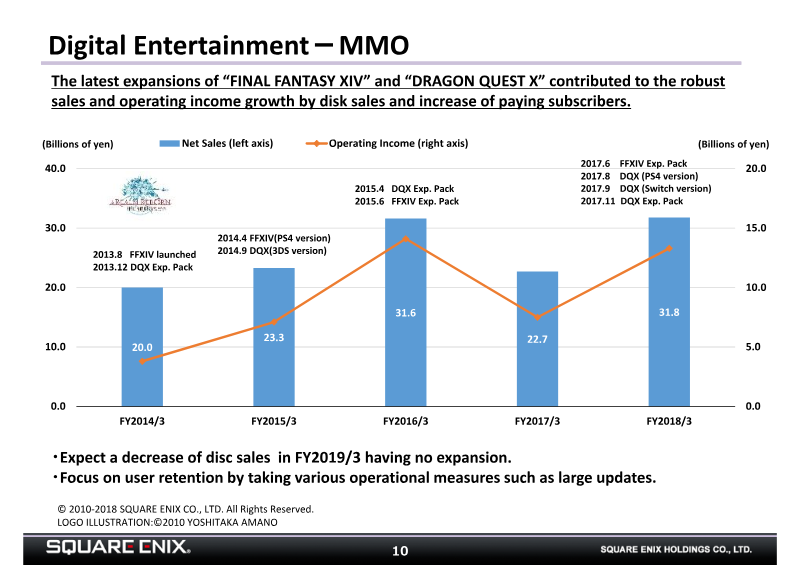
- Growth was driven by high-margin digital catalog sales, specifically NieR:Automata, and expansion packs for MMO titles Final Fantasy XIV and Dragon Quest X.
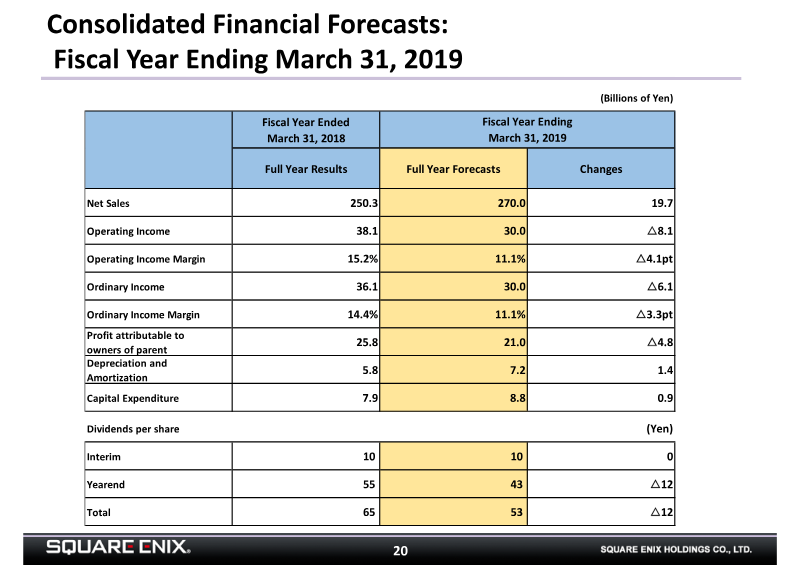

Square Enix Holdings Financial Results: Fiscal Year Ended March 31, 2018
Square Enix Holdings reported its financial results for the fiscal year ended March 31, 2018, demonstrating a period of improved profitability despite a slight decline in overall net sales.
- Square Enix reported a consolidated operating income of 38.1 billion yen for the fiscal year ended March 31, 2018, representing a 6.9 billion yen increase over the previous year despite a slight decline in net sales to 250.3 billion yen.
- The Digital Entertainment segment drove profitability with an operating income of 43.4 billion yen and a margin of 22.7%, bolstered by strong performance in smart device/PC browser games and MMO expansions.
- For the fiscal year ending March 31, 2019, the company forecasts a decline in operating income to 30.0 billion yen, down from 38.1 billion yen, alongside a projected reduction in dividends per share from 65 yen to 53 yen.