Creative
Company
Documents about Creative
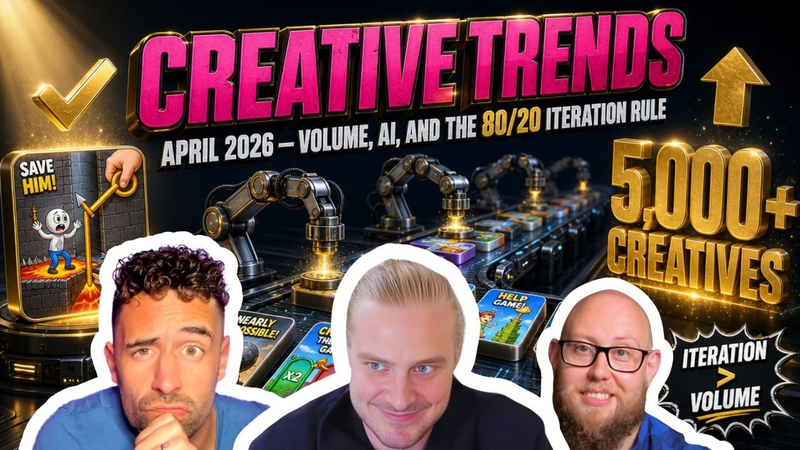
🎯 Creative Trends April 2026: Volume + 80/20 Creative Strategy FTW!
The mobile gaming industry is currently defined by a high-stakes volume race, where market dominance is contingent upon the rapid, consistent deployment of thousands of creative assets each month.
- Leading mobile studios are adopting an 80/20 creative strategy, allocating 80% of resources to iterating on proven concepts and 20% to exploratory innovation to maintain market dominance.
- Aggressive use of divergent hooks, such as mini-games and onboarding mechanics, has enabled 4X strategy games to reduce cost-per-install figures from $80 down to $15–$20.
- Market competitiveness is currently driven by a high-stakes volume race that requires the rapid, consistent deployment of thousands of creative assets every month.

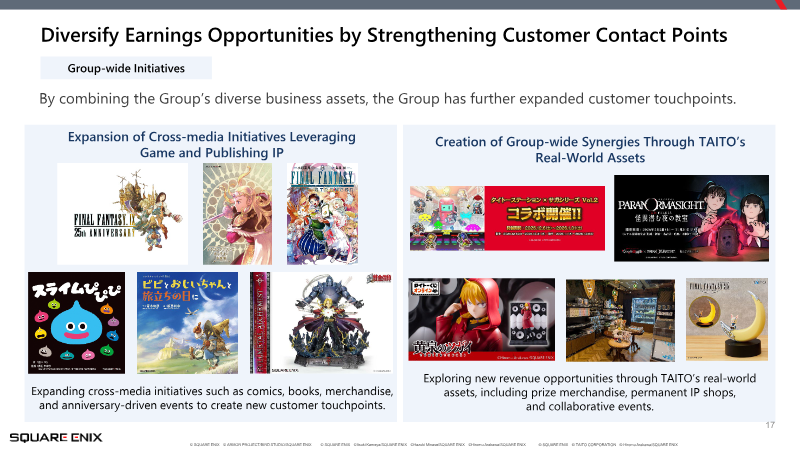
Progress Report on the Medium-Term Business Plan (FY2025/3-FY2027/3)
The Square Enix medium-term business plan for the fiscal years 2025 through 2027 outlines a comprehensive three-year "reboot" strategy designed to maximize corporate value through the cultivation and expansion of intellectual property.
- Square Enix is shifting its Digital Entertainment strategy from quantity to quality by reorganizing into a Creative Studio structure and consolidating overseas development resources into Japan.
- The company is executing a multi-platform strategy for major titles, with upcoming releases including 'Dragon Quest I & II HD-2D Remake' in June 2026 and 'Final Fantasy Tactics - The Ivalice Chronicles' in January 2027.
- Structural reforms of overseas operations are projected to generate annual cost savings of over ¥3.0 billion starting in FY2027/3, supported by a new global marketing and data analytics organization.
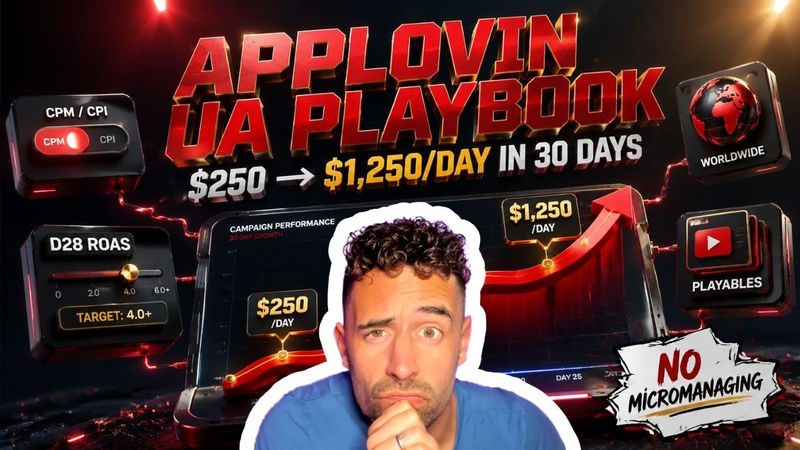
🧠 MVP UA template AXON: How to set up your Applovin for Success by Matej Lancaric
AppLovin’s Axon platform functions as a high-performance, automated user acquisition engine that requires a distinct strategic approach compared to Facebook or Google.
- Creative assets are the primary performance driver on AppLovin, with playables accounting for 80% to 90% of total ad spend.
- Top-performing games maintain high creative velocity by producing and shipping over 60 new playable assets per month.
- Abandon traditional geo-bucket campaign structures in favor of a worldwide approach, using geo-level ROAS targets instead of geo-level budgets to manage traffic.
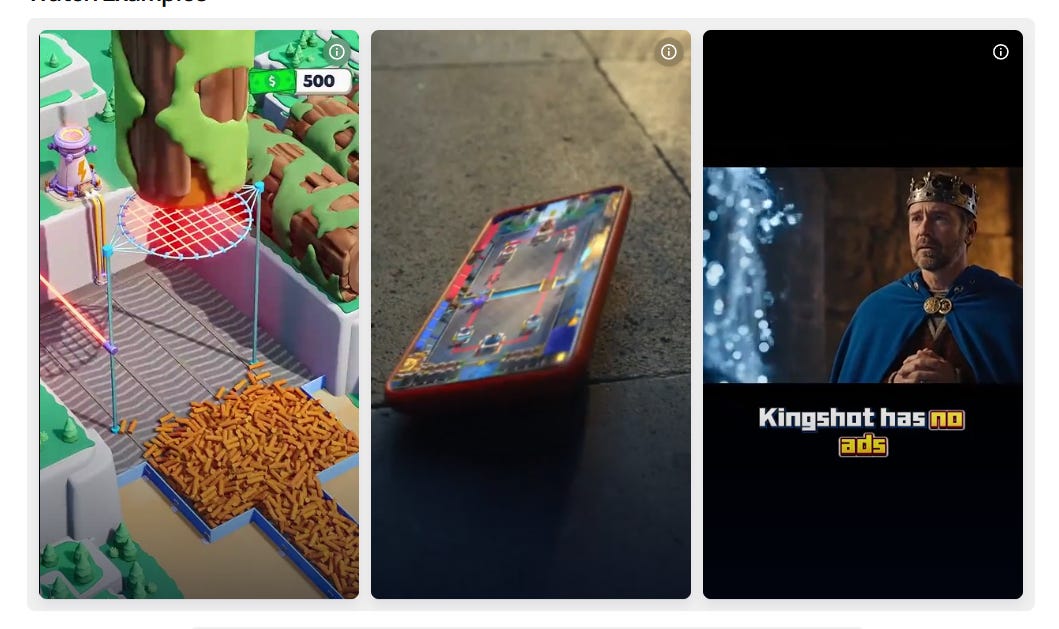
Never Ending Creative Trends #4
The mobile gaming industry experienced a significant shift in user acquisition creative strategies throughout March 2026, moving away from traditional gameplay showcases toward content centered on cognitive engagement and curiosity.
- 84% of top-performing mobile UA creatives now utilize unresolved endings or direct viewer challenges to drive installs by prioritizing curiosity over resolved narratives.
- 92% of top-performing ads feature 'Engaging Challenges with Direct Appeal,' which combine direct viewer interaction with a satisfying triumph moment.
- AppLovin has shifted its dominant creative strategy toward humor and meme-based hooks, specifically utilizing a 'noob protagonist → timed challenge → flashback → unresolved ending' formula.
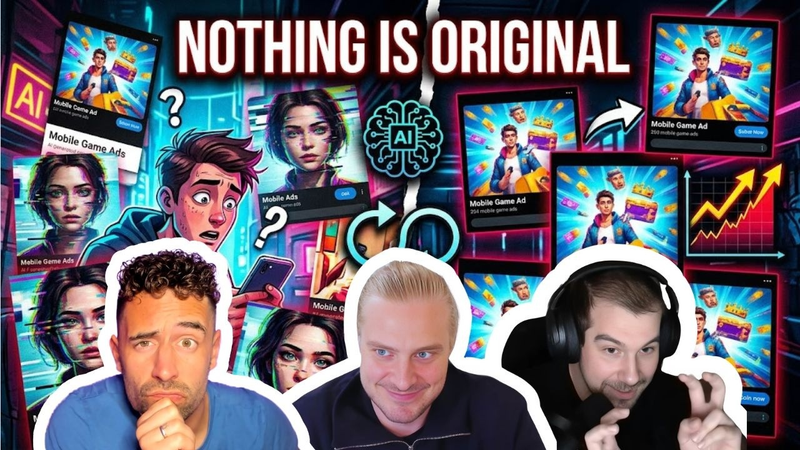
👾 Creative Trends March 2026: AI hooks, fake ads, and the infinite iteration machine
Mobile game marketing in early 2026 is defined by a strategy of infinite iteration, where developers prioritize the rapid, continuous remixing of proven creative concepts over original gameplay representation.
- Mobile game marketing in early 2026 is dominated by 'infinite iteration,' a strategy that prioritizes the rapid remixing of high-performing creative hooks over accurate gameplay representation.
- Top-grossing titles are increasingly utilizing stylized or misleading advertisements that bear little to no resemblance to the actual game experience to drive initial user engagement.
- The industry relies on a cycle of recycling proven tropes, such as wood-chopping mechanics, surreal animations, and failure-based puzzle loops, to maintain ad performance in a saturated market.
2026 Global Mobile Gaming Marketing Trends: How Growth Is Being Won
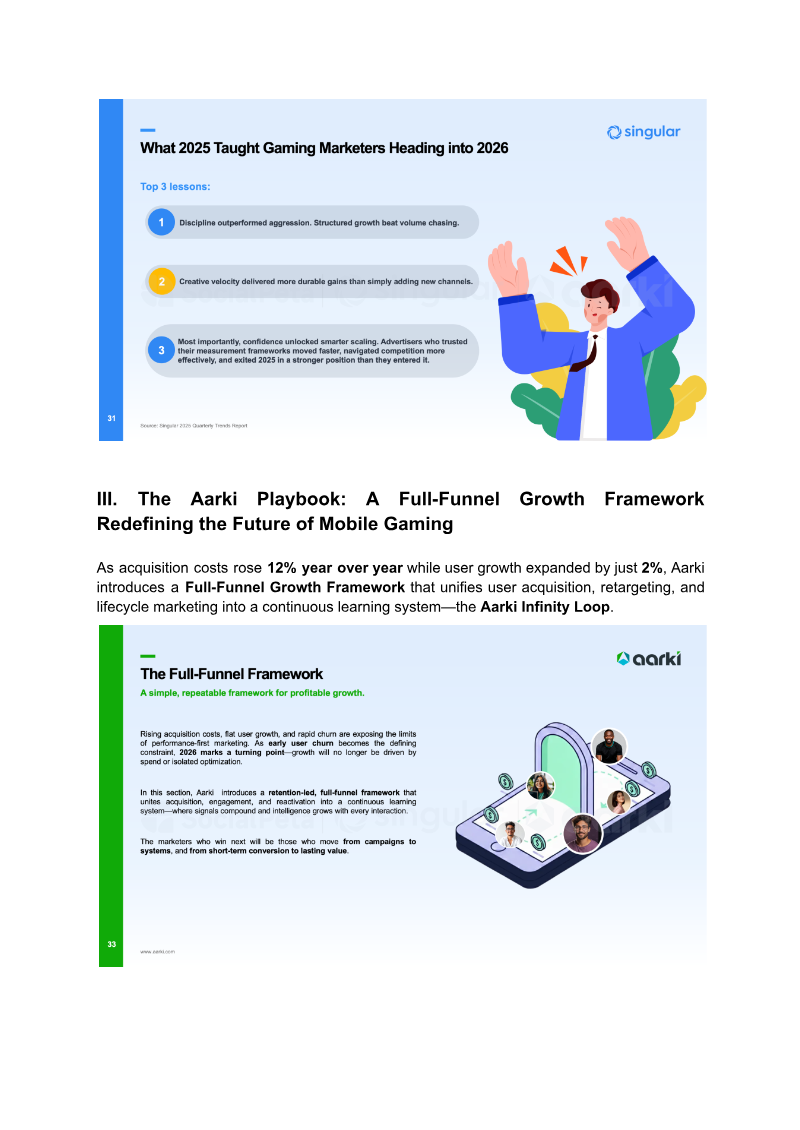
The 2026 Global Mobile Gaming Marketing Trends white paper analyzes the transition of the mobile gaming industry from a phase of rapid, volume-based expansion to a competitive environment defined by disciplined, retention-led growth.
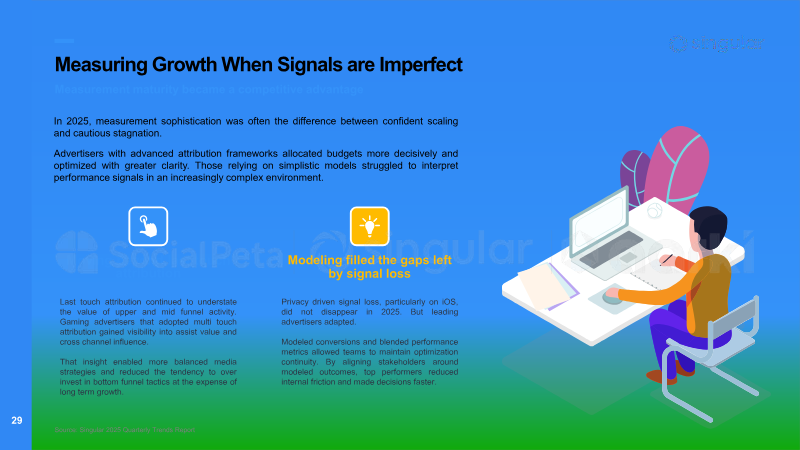
- Mobile gaming marketing has shifted to a retention-led model where full-funnel orchestration between user acquisition and retargeting can increase user lifetime value by up to 20%.
- Creative iteration is the primary competitive lever, with 82.5% of advertisers launching new creatives monthly—a 14.6% year-over-year increase—and short-form videos under 30 seconds accounting for 58% of all creative formats.
- In the 4X strategy genre, achieving a D7 retention rate of 15-18% is critical for scalability, which is heavily dependent on an Alliance join rate of over 60% by Day 3.
2026 Global Mobile Gaming Marketing Trends White Paper
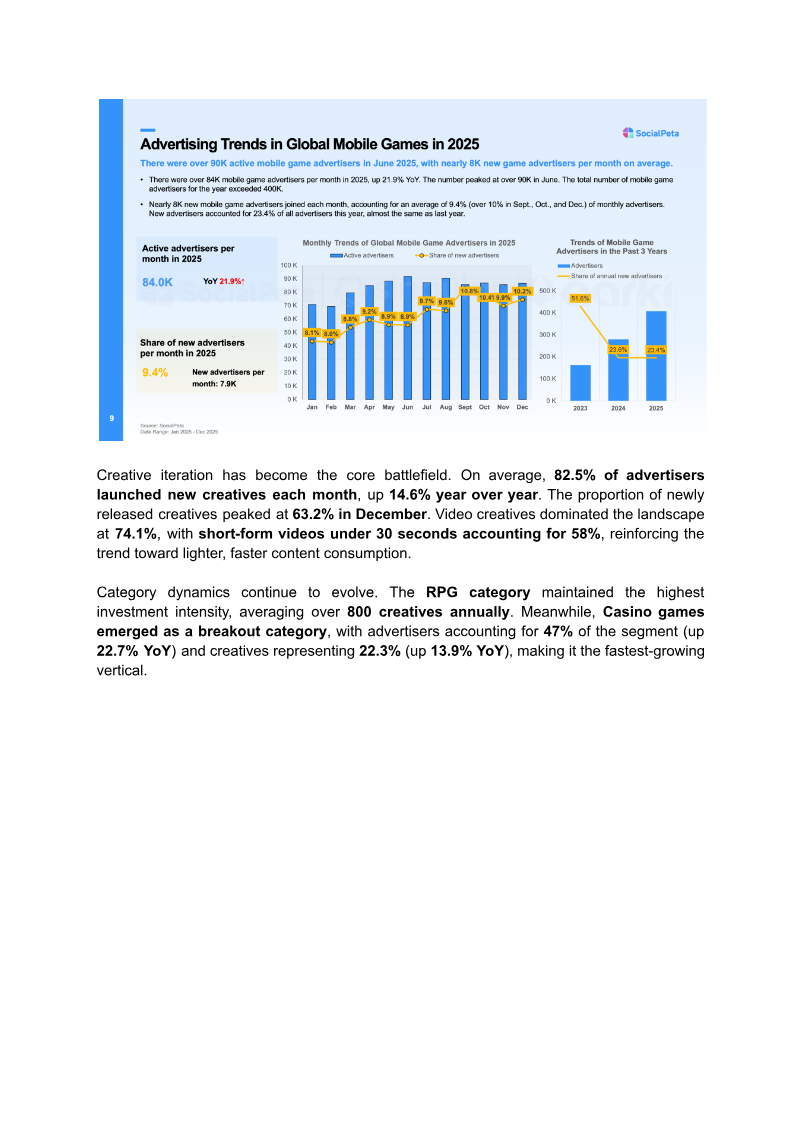
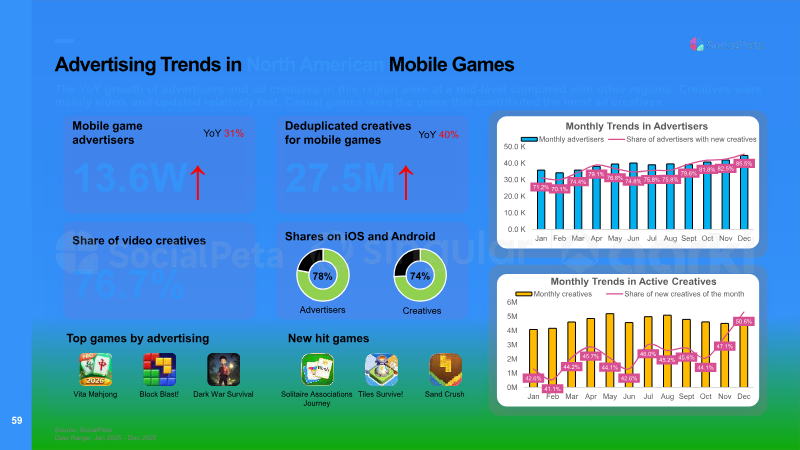
The white paper establishes that the mobile-gaming advertising ecosystem expanded rapidly in 2025, with more than 90 000 active advertisers and an influx of roughly 8 000 new entrants each month, a 22% year-over-year rise.
- The mobile gaming advertising ecosystem grew by 22% year-over-year in 2025, with over 90,000 active advertisers and 8,000 new entrants joining monthly.
- Video content now accounts for 74% of all mobile game ads, representing a 14% year-over-year increase in usage.
- A shift toward an 'Infinity Loop' marketing model, supported by supervised AI, can increase player lifetime value (LTV) by up to 30% by integrating acquisition, retargeting, and lifecycle management.

Watch us chat with British comedian and Taskmaster star Maisie Adam
The comedy and gaming industries share a fundamental structural challenge: the necessity of balancing creative evolution with the preservation of core elements that initially fostered fan loyalty.
- Success in both comedy and gaming requires balancing creative evolution with the preservation of core elements that initially established fan loyalty.
- Iterative development, similar to the software industry's early access model, allows creators to refine material through direct audience feedback before final release.
- Creators must manage the tension between maintaining a unique artistic voice and adapting to the shifting expectations of a diverse, global audience.

The UA System the Platforms Can't Build for You
The mobile gaming industry faces a structural misalignment between ad networks, which optimize for short-term proxy metrics, and publishers, who rely on long-term user value.
- Studios must build an internal translation layer to map long-term business objectives to network-level ROAS targets, as ad networks are structurally limited by 7-to-28-day optimization windows.
- Modern growth teams must transition from media-buying units to cross-functional systems teams as monthly spend scales from $500,000 to over $25 million.
- Competitive advantage in creative strategy now relies on production velocity and rigorous testing systems rather than individual craft, allowing studios to identify breakout formats before they are replicated.
MDM Podcast, Season 7, Episode 7: MDM Mailbag #7 (with Matej Lancaric)
The mobile gaming industry is undergoing a structural shift toward web-based onboarding and direct-to-consumer payment strategies to mitigate the impact of platform-level tracking restrictions and high app store fees.
- Mobile game developers are increasingly using web-based onboarding and shops to bypass the 30% platform fees charged by Apple and Google, though major companies remain hesitant to fully move their monetization stacks due to security concerns and the difficulty of auditing web-based transactions.
- Artificial intelligence and no-code tools have drastically shortened production cycles for high-quality video and playable ads, allowing developers to deploy new creatives in as little as one day using pre-built templates.
- The effectiveness of mobile measurement partners (MMPs) remains debated, with smaller studios often lacking the internal resources to manage complex data attribution, leading to a reliance on internal dashboards built on top of Firebase and Looker.
PlayStation's Logo-Makers: Process Behind Iterative Branding
The PlayStation Studios Creative Arts team employs a strategic approach to franchise branding, focusing on the transition from singular game titles to expansive, multi-entry series.
- PlayStation Studios utilizes flexible, systematic design frameworks rather than static logos to ensure brand consistency across sequels, spin-offs, and expansions.
- The team develops proprietary typefaces, such as 'Machine Nova' created for the Horizon franchise, to serve as scalable foundations that prevent style-guide degradation.
- Centralized creative oversight is used to balance the need for robust, interconnected visual systems with the flexibility to break rules for specific project requirements.
Never Ending Creative Trends #3
The latest analysis of mobile user acquisition creative trends highlights a significant shift in advertising strategy, particularly within the idle-clicker genre.
- Mobile user acquisition strategy is shifting from simple gameplay summaries to emotionally resonant, narrative-driven content to drive higher engagement and install rates.
- Effective creatives now prioritize immersive techniques such as direct address, simultaneous parallel views, and competitive progression scenarios to maintain viewer attention.
- Advertisements must leverage high-stakes environments that evoke specific human emotions like frustration, envy, and triumph to improve conversion performance.