Kinephanos
Bilingual (French/English) open-access journal on media, video games and popular culture, based in Québec.
Documents
Remembering Repton: An Alternative History of Co-creativity in 1980s Britain
The history of user-generated content and co-creativity in gaming is frequently misattributed to the rise of online communities in the 1990s.
- The foundations of modern user-generated content and co-creative gaming were established in 1980s British microcomputing, predating the rise of online communities in the 1990s.
- Early titles like Repton, Lode Runner, and Impact! utilized level editors as foundational tools that transitioned players from passive consumers to active producers.
- The Repton series, specifically Repton Infinity, utilized accessible design interfaces and the proprietary language Reptol to demystify game creation for non-technical users.

Return in Play: The Emergence of Retrogaming in Finnish Computer Hobbyist and Game Magazines
Retrogaming in Finland evolved from a practical necessity for software compatibility into a formalized cultural movement that defines how digital history is preserved and consumed.
- Retrogaming in Finland transitioned from a practical necessity for maintaining software compatibility on aging hardware into a formalized cultural movement focused on the canonization of digital artifacts.
- The late 1990s served as a critical inflection point for the movement, driven by the proliferation of internet communities and the adoption of emulation technologies like MAME.
- Finnish computer hobbyist magazines acted as the primary architects of gaming heritage by publishing nostalgic columns and personal recollections that codified a shared history for the player base.
From Importers to Designers and Publishers: How Distributors and Computer Stores Helped Shape the French Video Game Industry
The French video game industry underwent a pivotal transformation around 1983, evolving from a market dependent on foreign imports into a robust domestic creative sector.
- The French video game industry transitioned from a foreign-import market to a domestic creative sector starting around 1983, driven by the widespread adoption of microcomputers.
- Specialized computer stores acted as essential hubs for hobbyists and early developers, facilitating the knowledge exchange required to professionalize game development.
- Retailers accelerated industry growth by evolving into distributor-publishers, providing the infrastructure to market, localize, and commercialize amateur software projects.
History of Japanese Video Games
The history of Japanese video games remains significantly under-documented in English-language literature, which often relies on sanitized, PR-vetted narratives or focuses exclusively on console giants like Nintendo.
- An estimated 70,000 video games were produced in Japan between the late 1970s and early 2000s, the vast majority of which remain unknown to Western audiences.
- The Japanese gaming industry originated in the late 1970s and early 1980s within a computer hobbyist scene centered on platforms like the PC-88, rather than the console-first narrative often presented by corporate PR.
- Early Japanese computer games experienced a 'Cambrian Explosion' that established foundational mechanics, including recharging health bars and complex RPG tropes, years before they were popularized by consoles.
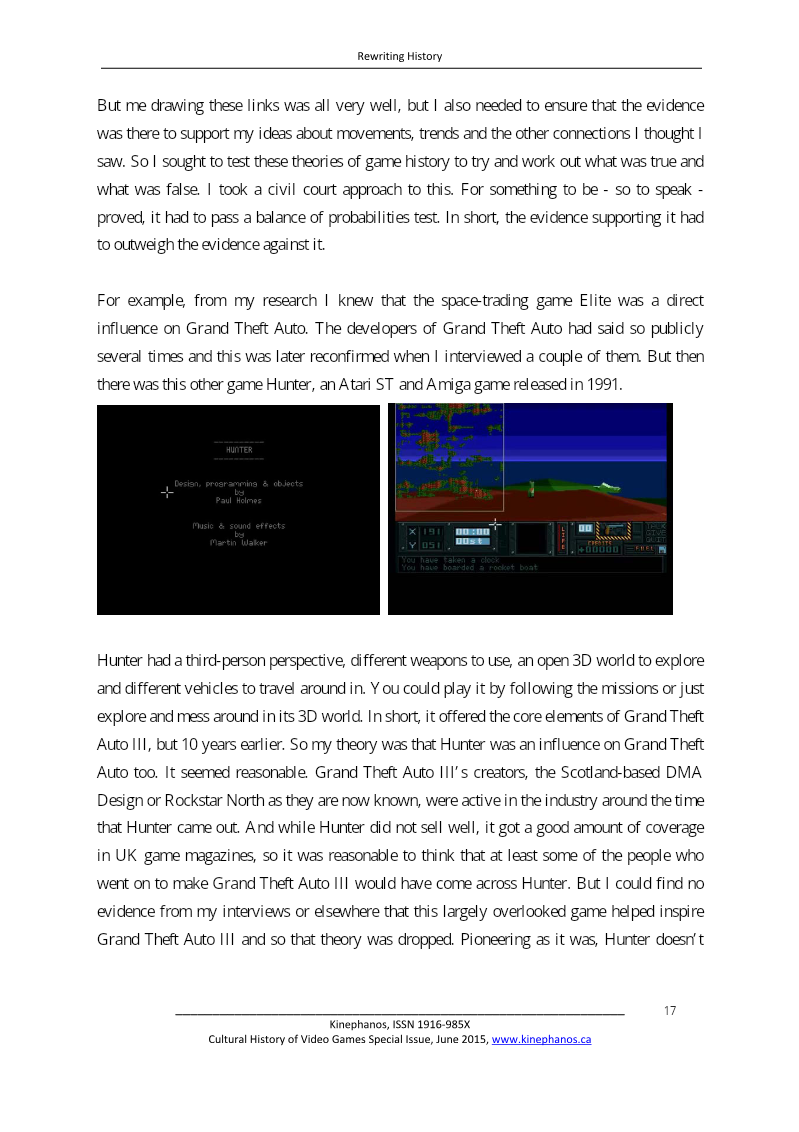

Rewriting History: Keynote Address to the 2014 Game History Annual Symposium
Video game historiography requires a fundamental shift away from the traditional, linear focus on American console hardware and marketing-driven milestones.
- Video game historiography must shift from a narrow, hardware-centric focus on American consoles to a broader, multifaceted cultural narrative that accounts for global design trends and societal influences.
- The industry must prioritize the immediate collection of oral histories from pioneers to preserve firsthand accounts before these primary sources are permanently lost.
- Methodological rigor requires synthesizing thousands of individual game titles with qualitative oral histories to move beyond simple sales figures and technical specifications.

Game Engines and Game History
The history of video games requires a shift from simple chronological accounts toward rigorous, narrative-driven analysis that situates technological development within broader social and intellectual contexts.
- The emergence of the game engine as a distinct technological paradigm in the early 1990s fundamentally transformed the industry by separating core software from creative assets.
- Id Software’s architectural innovations in titles like DOOM and Quake established modularity as a foundational industry standard, enabling professional licensing models and player-driven modding.
- The shift to modular architecture created a new cultural economy that significantly extended the lifespan and influence of software beyond its initial commercial release.

Interview with Warren Spector
This interview with game designer Warren Spector explores the critical necessity of video game preservation, the challenges of institutional archiving, and the current state of game criticism.
- The video game industry requires centralized, institutional preservation efforts to safeguard software, hardware, and production materials, as individual developers and publishers prioritize short-term commercial interests over long-term cultural legacy.
- Effective archiving must extend beyond final products to include internal documentation such as design documents, emails, development schedules, and marketing materials to provide necessary historical context.
- Emulation is a critical technical necessity for maintaining access to software as original hardware inevitably degrades over time.
Preserving Game History at The Strong's International Center for the History of Electronic Games
The International Center for the History of Electronic Games (ICHEG) at The Strong National Museum of Play serves as a primary model for the systematic collection, interpretation, and preservation of video game history.
- The International Center for the History of Electronic Games (ICHEG) maintains a collection of approximately 50,000 items, including hardware, arcade cabinets, and personal archives from industry figures like Ralph Baer and Will Wright.
- ICHEG addresses the threat of digital obsolescence by employing a multifaceted preservation strategy that includes physical hardware acquisition, data migration, and video documentation of gameplay.
- Video documentation is utilized as a critical preservation tool for Massively Multiplayer Online games, which face permanent loss when their external servers are decommissioned.
Unrepresented and Under-represented Video Game History
The study of video game history is fundamentally shaped by narrative structures that connect events, innovations, and genealogies.
- The historical record of video games is currently skewed toward North American home console gaming due to the loss of extinct technologies and inaccessible corporate records.
- Video game historiography is shifting from subjective, interview-based journalistic accounts toward comprehensive academic inquiry that incorporates global perspectives beyond the United States.
- Early industry documentation relied heavily on limited secondary sources and subjective databases like the Killer List of Videogames (KLOV).

The Casual Revolution of 1987: Making Adventure Games Accessible to the Masses
The evolution of computer adventure games during the 1980s represents a pivotal shift toward mass-market accessibility, challenging the misconception that the industry’s move toward casual play was merely a regression to arcade-style simplicity.
- The 1987 shift in adventure games prioritized narrative immersion over exclusionary, high-barrier design to transition the genre from a niche hobbyist pursuit to a mainstream market.
- The adoption of the Macintosh graphical user interface acted as the primary technological catalyst, enabling the replacement of text-based parsers with intuitive point-and-click mechanics.
- Developers like Ron Gilbert successfully dismantled 'hacker' difficulty by refining puzzle logic to be more equitable and accessible to non-technical players.

Looking at the History of Video Games Through the Prism of Ludicisation Processes
The concept of ludicisation provides a transformative framework for analyzing video games, shifting the focus from rigid, static definitions toward an understanding of games as dynamic, socio-cultural assemblages.
- Ludicisation defines games as dynamic socio-cultural assemblages rather than static objects, where play emerges from the interaction between a player's attitude, the environment, and the situation.
- Games function as historical 'ludic strata' that evolve and transform as they migrate across different cultural landscapes and territories.
- The boundaries between traditional gaming and everyday reality are becoming increasingly porous as ludic structures are applied to non-traditional domains.
The Construction of Civilization
The study provides a methodological framework for analyzing the history of the Civilization game series, arguing that popular journalistic accounts often oversimplify the development process by focusing exclusively on lead designer Sid Meier.
- The Civilization series evolved from closed systems into open architectures that intentionally integrated modding capabilities under designers like Brian Reynolds and Soren Johnson.
- A cyclical development pipeline emerged where players who learned to program by modifying early titles eventually transitioned into lead architects for later installments in the series.
- Core gameplay mechanics, such as tile-based resource management, are not isolated inventions but are transmedial developments rooted in board game designs dating back to the 1930s.