Kinephanos
Bilingual (French/English) open-access journal on media, video games and popular culture, based in Québec.
Documents
Welcome to the Dollhouse: Constructing Bodies in Crytek’s Crysis and Mattel’s Kiddle Dolls
Video games and traditional toys share a fundamental lineage as constructed, prosthetic bodies that shape human subjectivity.
- Digital avatars in games like Crytek’s Crysis and physical toys like Mattel’s Liddle Kiddles function as prosthetic bodies that actively shape human subjectivity and identity.
- Both video games and traditional toys act as affective ecosystems that use hypernormal models of interaction to structure user agency and narrative immersion.
- Crysis reinforces a masculine power fantasy by mapping player agency onto a hyper-militarized, technologically augmented avatar within an economy of fear.

Football Manager: Mutual Shaping between Game, Sport, and Community
Football Manager functions as a sophisticated performative model that bridges the gap between digital simulation and the professional football industry.
- Football Manager has evolved from a simulation game into a professional scouting tool, with real-world football clubs now utilizing its proprietary database for player recruitment.
- The game’s realism is sustained by a hierarchical network of volunteer researchers who function as a global, crowdsourced scouting apparatus.
- The software operates through a process of mutual shaping, where the game, its community, and the professional football industry continuously influence and redefine one another.

Century of Play: 18th Century Precursors of Gamification
Gamification is not a modern digital innovation but rather a historical practice with deep roots in the eighteenth century, an era frequently characterized as the Century of Play or Spielsaeculum.
- Gamification is not a modern digital innovation but a historical practice rooted in the 18th century, an era known as the 'Century of Play' or 'Spielsaeculum'.
- 18th-century society integrated rule-based mechanics and aleatoric systems into non-game sectors—including luxury furniture, religion, and science—to influence human behavior and social habits.
- The historical use of play as a tool for managing power and knowledge mirrors contemporary digital strategies that use ludic elements to increase engagement with repetitive or functional tasks.
The Game Freaks Who Play With Bugs: In Praise of the Video Game Xevious
The arcade game Xevious represents a foundational shift in digital entertainment, marking the transition from the repetitive, score-driven competition of early electromechanical machines to a more immersive, mythopoetic experience.
- The arcade game Xevious marked a foundational shift in the early 1980s Japanese gaming industry by transitioning from score-driven competition to immersive, narrative-based exploration.
- Technological advancements in microprocessors enabled the move from simple, electromechanical-style mechanics to complex, scrolling sci-fi environments.
- Player engagement shifted from seeking high scores to investigating software for hidden elements and technical anomalies, treating the game as an interactive landscape.
Pachinko: A Game Studies Perspective
Pachinko represents a significant ludic and transmedia phenomenon that extends far beyond its common classification as a mere gambling activity.
- Pachinko functions as a massive economic force and a primary site for neighborhood leisure in Japan, extending beyond simple gambling into a pervasive form of social escape.
- The industry operates within a complex legal gray area in Japan, necessitating a nuanced analysis that balances police regulation, economic influence, and player psychology.
- Pachinko’s design utilizes intense visual and auditory stimulation to maintain player attention, sharing mechanical parallels with global electronic gambling machines.
Formation et développement des cultures autour de la « Geemu ongaku » (1980-1990)
The emergence of geemu ongaku, or Japanese video game music, between 1980 and 1990 represents a foundational era that established the medium as a distinct and respected cultural phenomenon.
- Between 1980 and 1990, the Japanese video game industry successfully transitioned game music from functional background noise into an independent, respected art form.
- The Dragon Quest series acted as a primary catalyst for this shift by commissioning professional composer Koichi Sugiyama to integrate classical musical traditions into game scores.
- The industry elevated sound designers from anonymous corporate employees to celebrated artists through the creation of specialized record labels and live orchestral performances.
Playing (with) the Trace: Localized Culture in Phoenix Wright
The localization of the Phoenix Wright series serves as a critical case study for challenging the industry-standard practice of total cultural erasure.
- The Phoenix Wright localization series demonstrates that preserving residual Japanese cultural elements, rather than pursuing total cultural erasure, creates a more nuanced and ethically responsible model for global media.
- Moments of cultural incongruity, known as iwakan, should be reclassified from technical flaws or translational oversights into productive sites of player engagement.
- By avoiding the full assimilation of foreign content into a target-culture framework, developers allow players to navigate the frictional realities of international borders.
Fold, Flip, Stick: Paper Mario, 2.5-Dimensionality and the Media Mix
The Paper Mario franchise serves as a definitive case study for the concept of 2.5-dimensionality, an aesthetic and mechanical framework that intentionally collapses the distinction between two-dimensional planes and three-dimensional environments.
- The Paper Mario franchise utilizes '2.5-dimensionality' to integrate flat, 2D character designs into 3D volumetric environments, creating a core mechanical framework.
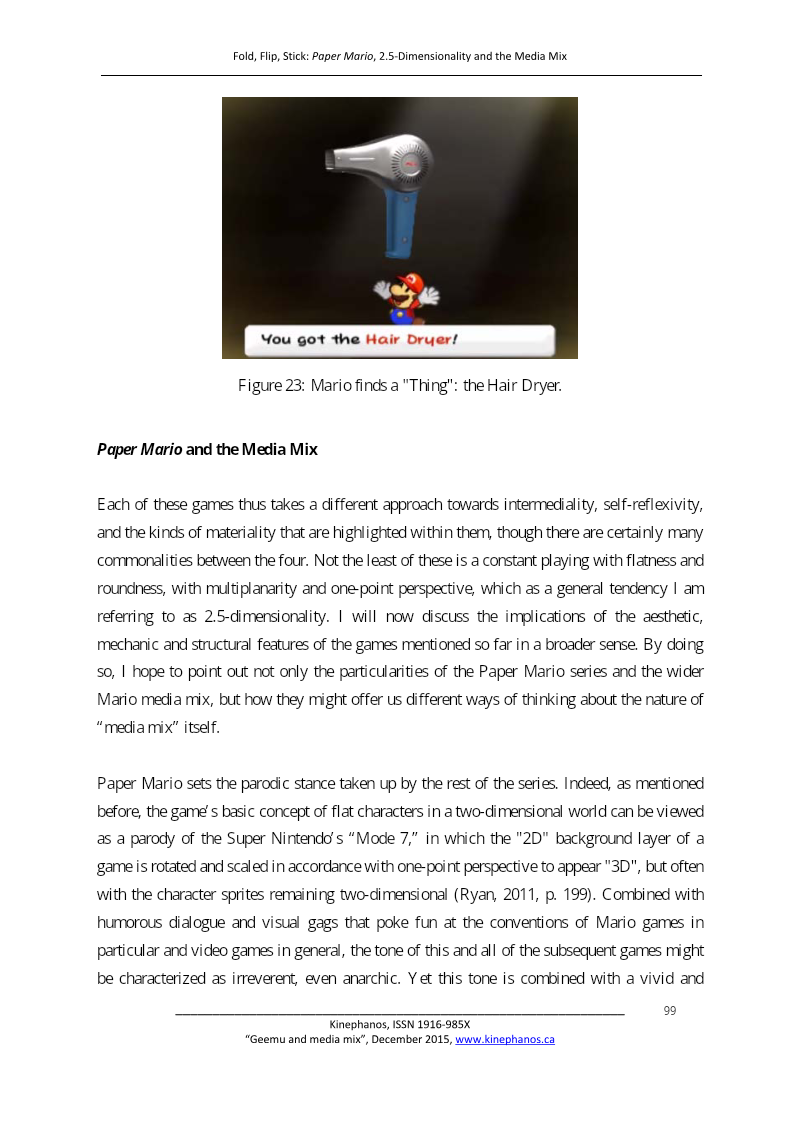
- Gameplay mechanics in later titles, such as folding, flipping, and sticking, require players to actively manipulate spatial depth rather than treating it as a purely visual aesthetic.
- The series draws design inspiration from traditional media forms, specifically Japanese kamishibai theater and pop-up books, to inform its digital spatial construction.
Kawaii Japan: Defining JRPGs through the Cultural Media Mix
Japanese role-playing games function as primary instruments of soft power, operating as essential components of a broader cultural media mix that projects a curated national identity to international audiences.
- JRPGs function as instruments of soft power that project a curated national identity to international audiences as part of a government-backed creative ecology.
- The industry utilizes a media mix model to align game design with national initiatives like the Cool Japan campaign, commodifying cultural tropes into a marketable brand.
- Developers embed visual markers such as kawaii to maintain a distinct Japanese lens, leveraging semiotic connections to other media properties to reinforce cultural branding.
8-Bit Manga: Kadokawa’s Madara, or, The Gameic Media Mix
This analysis examines the evolution of the Japanese media mix during the 1980s, specifically focusing on the transition from the blockbuster film-novel-soundtrack model to a "gameic" media mix centered on world-building and interactive engagement.
- During the 1980s, Kadokawa Corporation transitioned from a film-novel-soundtrack media model to a 'gameic' media mix centered on world-building and interactive engagement.
- The Madara project, launched in the magazine Marukatsu Famikon, served as a foundational case study for creating original intellectual property designed specifically around RPG mechanics.
- The Madara manga integrated 8-bit aesthetic elements, such as pixelated text and character statistics, to simulate the experience of console gameplay within a print medium.
Reconstructing Warrior: Vectorbeams, Natural Magick & Business Intrigue
The 1979 arcade title Warrior represents a pivotal, albeit ephemeral, moment in the evolution of electronic entertainment, serving as a bridge between traditional electromechanical amusements and the burgeoning digital arcade industry.
- The 1979 arcade game Warrior utilized a hybrid design, layering Cinematronics vector-beam digital sprites over a physical Pepper’s Ghost optical illusion to bypass the graphical limitations of oscilloscope-based hardware.
- The game’s commercial failure was driven by its unconventional two-player-only requirement, which alienated audiences accustomed to single-player arcade experiences.
- Industry volatility, specifically the acquisition of the developer Vectorbeam by Exidy and subsequent manufacturing consolidation, severely limited the game's market penetration.

Space Odyssey: The Long Journey of Spacewar! from MIT to Computer Labs Around the World
The historical narrative surrounding the proliferation of Spacewar! during the 1960s often overstates its initial ubiquity.
- Spacewar! did not achieve rapid, widespread adoption in the 1960s, as its distribution was initially limited by the high cost of computing hardware and restricted access to research facilities.
- The game's expansion only gained significant momentum after 1967, driven by the increased availability of cathode-ray tube displays and the growth of interactive computing communities.
- Spacewar! served as a foundational influence for the commercial arcade industry, directly inspiring subsequent titles such as Galaxy Game and Computer Space.