Kinephanos
Bilingual (French/English) open-access journal on media, video games and popular culture, based in Québec.
Documents
Is Game Design for Everybody? Women and Innovation in Video Games
Gender diversity serves as a fundamental catalyst for innovation and collective intelligence within the video game industry.
- The video game industry faces a critical disconnect between a player base that is majority female and a design workforce where women remain significantly underrepresented.
- Gender diversity is a strategic necessity for innovation, as varied team perspectives mitigate groupthink and improve the ability to solve complex creative challenges.
- Systemic barriers to entry, including technical recruitment biases and educational gaps, originated from gendered marketing of home computers in the 1980s and persist today.
FemShep: Féminité sexualisée ou subversive? Analyse du personnage féminin de la série Mass Effect
The character of Commander Shepard, specifically the female iteration known as FemShep within the Mass Effect series, occupies a complex position at the intersection of gender performance and industry-standard design.
- Only 18 percent of the Mass Effect player base opted to play as the female iteration of Commander Shepard, illustrating the niche status of the character within the series.
- BioWare’s marketing strategy frequently relegated FemShep to a secondary status, often utilizing superficial beauty-focused campaigns that prioritized heteronormative standards over genuine representation.
- FemShep was originally designed as a gender-blind copy of the male protagonist, sharing identical narrative arcs and animations rather than being built with a distinct female identity.
The Witcher, or The End of Masculinity (as We Know It)
The Witcher 3: Wild Hunt functions as a critical deconstruction of traditional, paternalistic masculinity, positioning the protagonist, Geralt of Rivia, as a figure whose identity is defined by failure rather than heroic dominance.
- The Witcher 3: Wild Hunt deconstructs traditional masculinity by framing Geralt of Rivia’s identity as a fragile performance of alienation rather than a stable heroic ideal.
- The game’s narrative shifts the player’s role from one of patriarchal control to that of a reflective witness, highlighting the limitations of the hero’s agency.
- Geralt’s attempts to act as a traditional father figure are consistently undermined by female characters who possess superior political agency and insight.

Andromeda on the Rocks: Retreading and Resisting Tropes of Female Sacrifice in Tomb Raider
The Tomb Raider reboot series, specifically the 2013 and 2015 installments, functions as a complex case study in the tension between narrative subversion and the perpetuation of regressive gender tropes.
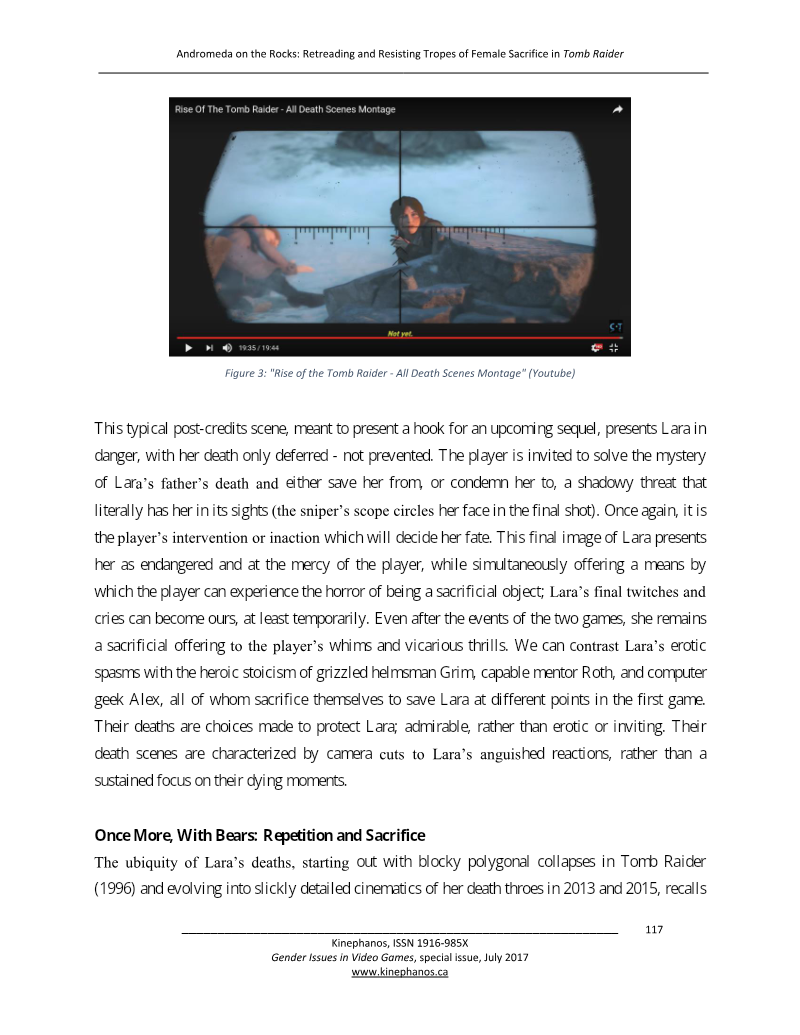
- The 2013 and 2015 Tomb Raider reboots utilize graphic, cinematic death animations that function as a form of ritualized sacrifice, undermining the games' claims of feminist empowerment.
- Gameplay mechanics in these titles commodify female vulnerability, positioning the player as both an observer and perpetrator of eroticized, violent spectacle.
- Despite narrative attempts to modernize character arcs for figures like Sam and Hoshi, the structural reliance on female peril and self-harm remains a persistent feature of the player experience.
The Poetics of Form and the Politics of Identity in Assassin's Creed III: Liberation
Assassin’s Creed III: Liberation serves as a critical case study for examining how video games function as sites of power, identity politics, and social representation.
- The Persona System in Assassin’s Creed III: Liberation integrates identity into gameplay mechanics by requiring players to navigate colonial Louisiana through the distinct roles of Lady, Slave, and Assassin.
- By centering on Aveline de Grandpré, the game challenges industry norms that have historically favored patriarchal and colonial narratives by making race, class, and gender central to the player experience.
- The game’s mechanical design allows for fluid interpretations of the protagonist, facilitating potential queer or transgender readings that move representation beyond simple narrative exposition.
Diversity without Defense: Reframing Arguments for Diversity in Games
The video game industry must transition away from justifying diversity through market-driven metrics or defensive business arguments.
- The industry must stop justifying diversity through market-driven metrics, as treating representation as a strategic concession reinforces the exclusion of marginalized groups.
- Diversity should be reframed as a fundamental design standard and creative norm rather than a response to social pressure or a tool to capture specific demographics.
- Persistent homogeneity in gaming is a result of historical gatekeeping and the deliberate construction of a masculine-coded culture, rather than a natural outcome of market forces.
Bridging Game Studies and Feminist Theories
Feminist theory serves as a critical lens for deconstructing the systemic gender stereotypes embedded within the global video game industry.
- Contemporary game design frequently relies on reductive archetypes—such as the damsel in distress and the hyper-sexualized avatar—that reinforce patriarchal structures and dehumanize female characters.
- The industry’s reliance on serial models of femininity prioritizes unrealistic beauty standards, which alienates female players and restricts the potential for nuanced storytelling.
- Game mechanics often normalize the subordination of women by confining female agency to domestic tasks or framing women as threats to be neutralized for the male gaze.
World of Warcraft Dramaturgical Approach: A Drama That Plays with Its Own Limits
World of Warcraft functions as a sophisticated, evolving dramatic system designed to facilitate infinite expansion through a unique synthesis of rigid structural rules and player agency.
- World of Warcraft maintains long-term engagement by balancing rigid, developer-controlled narrative arcs with player agency, ensuring the game can expand indefinitely without breaking established lore.
- The game utilizes a modular, quest-based system derived from tabletop role-playing traditions to allow players to construct non-linear narrative experiences.
- Specialized instances are used to isolate cooperative and competitive encounters, allowing developers to maintain control over key narrative beats while providing players with localized agency.
Bridging the Gap between Game Designers and Cultural Institutions: A Typology to Analyse and Classify Cultural Pervasive Games
Cultural Pervasive Games (CPGs) represent a transformative approach to visitor engagement within heritage sites, blending digital narratives with physical environments to foster deeper educational and cultural connections.
- A new typology for Cultural Pervasive Games (CPGs) provides a standardized framework to align game design mechanics with the pedagogical and institutional goals of heritage sites.
- The research evaluates 12 distinct case studies within heritage and tourism contexts to identify how digital narratives can effectively overlay physical environments.
- Successful CPG implementation requires balancing technological immersion with an institution's specific mission, using elements like ambiguity and apophenia to encourage novel visitor interactions.
Differentiating Serious, Persuasive, and Expressive Games
Serious, persuasive, and expressive games are defined primarily by developer intent and contextual framing rather than by inherent gameplay mechanics or procedural code.
- Serious, persuasive, and expressive games are defined by developer intent and contextual framing rather than by their underlying mechanics or procedural code.
- The classification of a game is fluid and often shifts based on external factors like distribution context, authorship, and the presence of reflexive elements.
- Players and institutions identify a game's purpose through paratextual clues such as visual aesthetics, dialogue choices, and the level of realism employed.
Defining and Designing Expressive Games: The Case of Keys of a Gamespace
Expressive games represent a distinct category of interactive media designed to facilitate moral and ethical inquiry rather than deliver didactic messages or traditional entertainment.
- Expressive games distinguish themselves from serious or persuasive games by avoiding didactic messaging, instead utilizing interactive mechanics to facilitate open-ended inquiry into moral and ethical dilemmas.
- The design philosophy of expressive games prioritizes a 'ludic ethos,' which centers on the exploration of complex themes like free will and determinism rather than goal-oriented progression.
- Qualitative analysis of the title 'Keys of a Gamespace' reveals a significant divide in player reception, where users accustomed to traditional reward systems often struggle to engage with non-prescriptive, experience-driven narratives.
Replaying the Lost Battles: The Experience of Failure in Polish History-Themed Board Games
Polish history-themed board games serve as sophisticated instruments of procedural rhetoric, designed to align mechanical gameplay with state-sanctioned narratives of national identity.
- Polish history-themed board games, such as 'Little Insurgents' and '7 Days of Westerplatte', utilize procedural rhetoric to frame military defeats as moral triumphs rather than strategic failures.
- These titles prioritize state-sanctioned narratives of national identity and martyrology over objective historical simulation or counterfactual exploration.
- Designers frequently employ cooperative mechanics and sanitized depictions of conflict to emphasize emotional resonance and national heroism.