Kinephanos
Bilingual (French/English) open-access journal on media, video games and popular culture, based in Québec.
Documents
Exhibiting The Hobbit: A Tale of Memories and Microcomputers
Museums face significant challenges when attempting to collect and exhibit videogames, as these works are often defined by their technical variability and the subjective experiences of their players.
- Museums must shift from preserving a single 'idealized' version of a game to embracing the 'multiplicity' of digital works, including various platform ports and hardware-specific constraints.
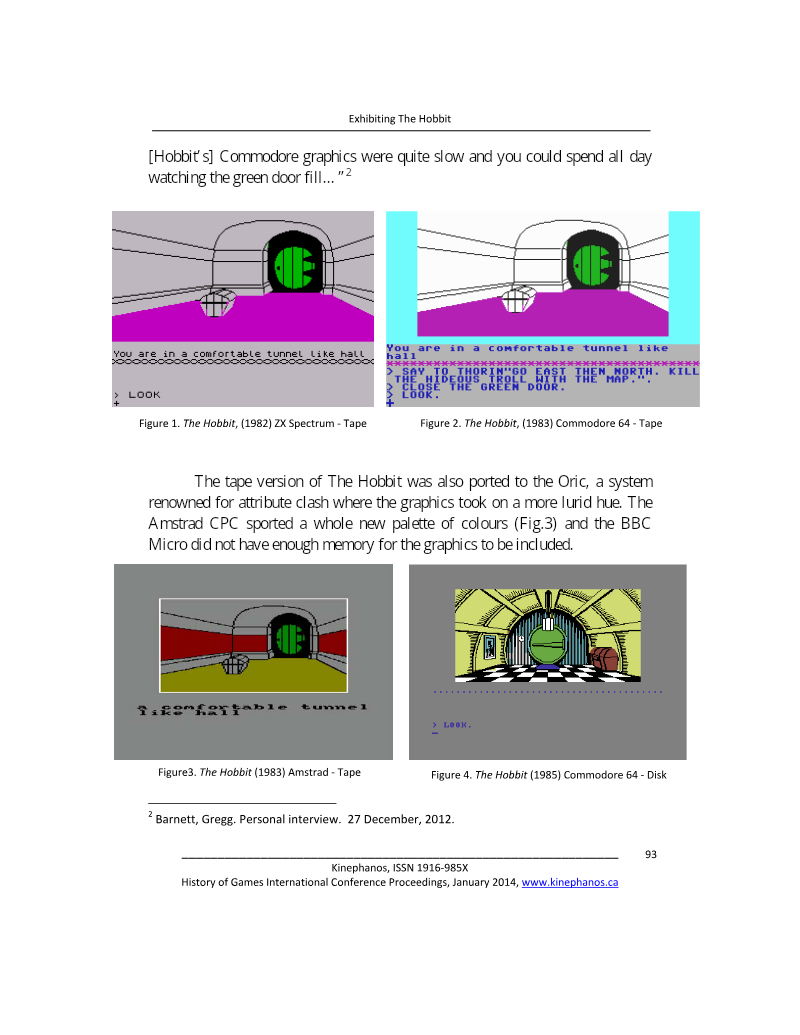
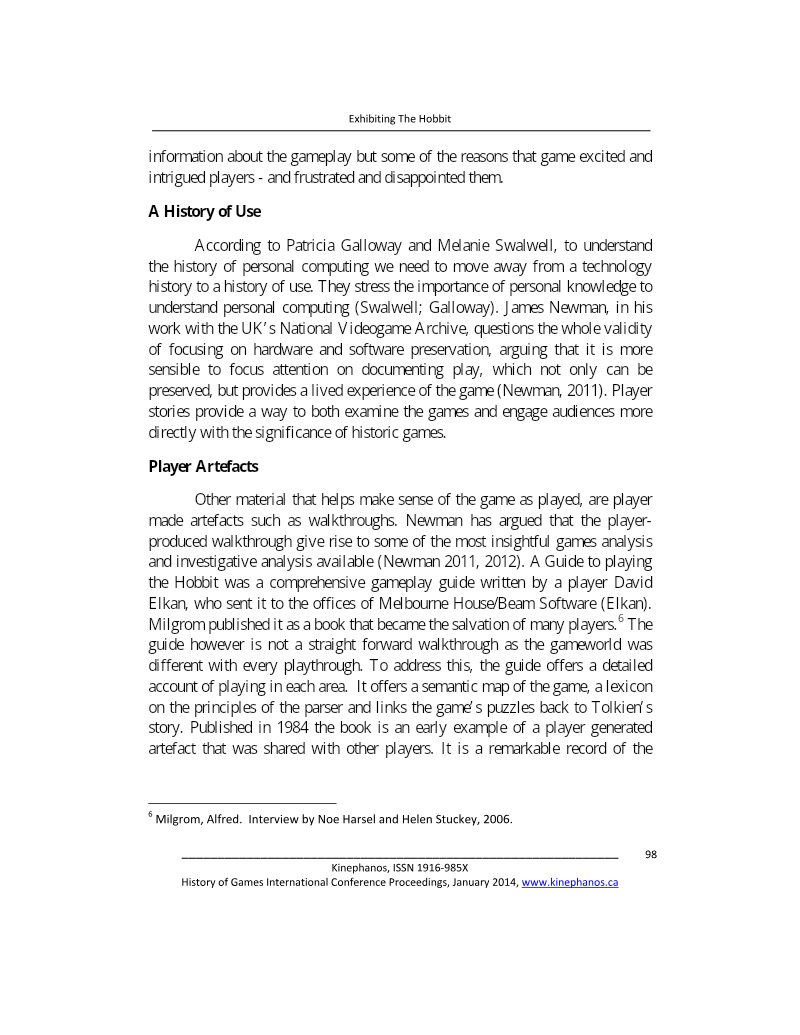
- Beam Software’s 1982 text adventure, The Hobbit, serves as a primary case study, having been released across more than nine distinct platforms with unique graphics, speed, and sound capabilities.
- Relying exclusively on emulation or a single version of a game risks homogenizing the history of 1980s microcomputing by erasing the technical ingenuity required to adapt software to diverse hardware.
Conserving Portal: Defining and Documenting the Object
Video games represent complex cultural artifacts that challenge traditional museum conservation practices due to their ephemeral and interactive nature.
- Video game preservation requires a shift from treating games as static objects to managing their technical, aesthetic, and interactive components to ensure long-term accessibility.
- The Mechanics, Dynamics, and Aesthetics (MDA) model provides a structured framework for curators to systematically document the core elements that define a game's identity.
- Effective preservation must combine technical solutions like migration and emulation with comprehensive documentation to maintain the functional and artistic intent of the work.
A History of Real-Time Strategy Gameplay: From Decryption to Prediction
The evolution of the real-time strategy genre is defined by a fundamental transition from a paradigm of decryption to one of prediction.
- The evolution of the real-time strategy genre is defined by a fundamental shift from 'decryption'—mastering fixed systems and AI patterns—to 'prediction,' which requires anticipating the maneuvers of human opponents.
- Genre development is driven by the institutionalization of player habits and the iterative accumulation of shared tactical knowledge rather than the impact of singular foundational titles like 1992’s Dune II.
- The transition to a prediction-based paradigm was necessitated by the rise of competitive multiplayer environments, which demand active scouting and real-time strategic adaptation.
Arcade-Style Game Design: Pinball’s Connections to Coin-Op Videogames
Early coin-operated videogames represent a direct evolution of electromechanical pinball rather than a departure from traditional gaming frameworks.
- Early coin-operated videogames evolved directly from electromechanical pinball, sharing core design philosophies like high-score objectives, rapid reaction gameplay, and near-miss mechanics.
- The 1947 introduction of flippers in pinball was the critical innovation that shifted the medium toward the real-time, skill-based control systems that define early digital arcade titles.
- The transition from pinball to digital arcade systems was driven by a continuity of industry personnel, hardware components, and a shared focus on immediate feedback and escalating difficulty.
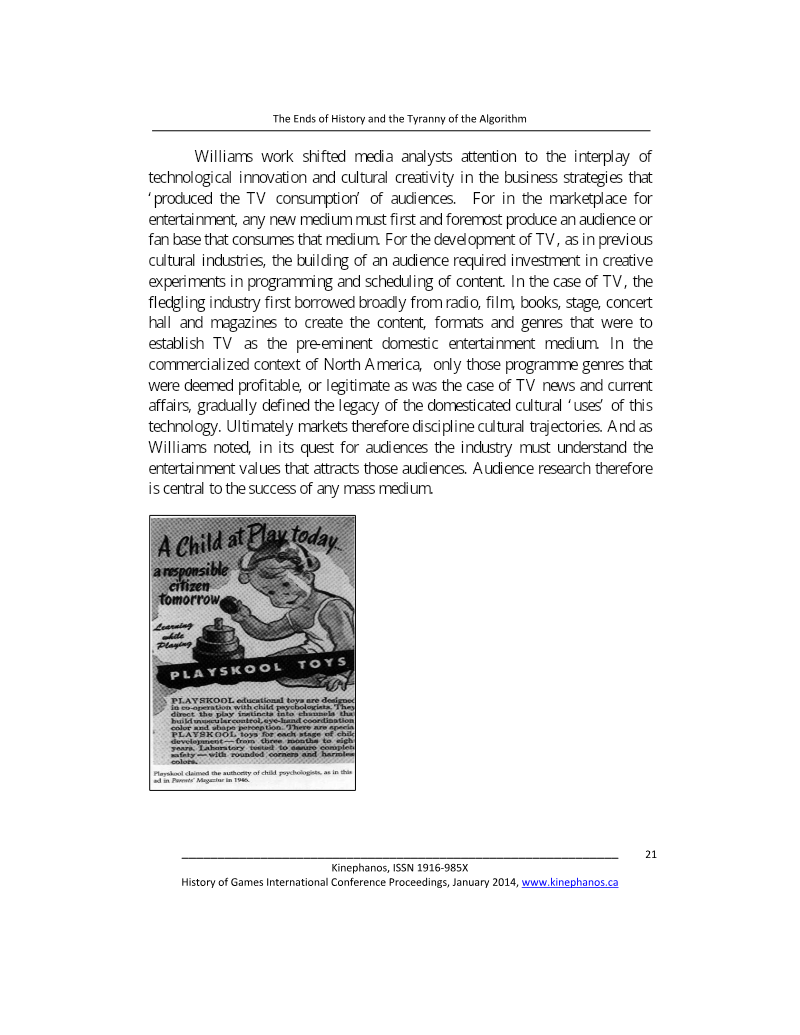
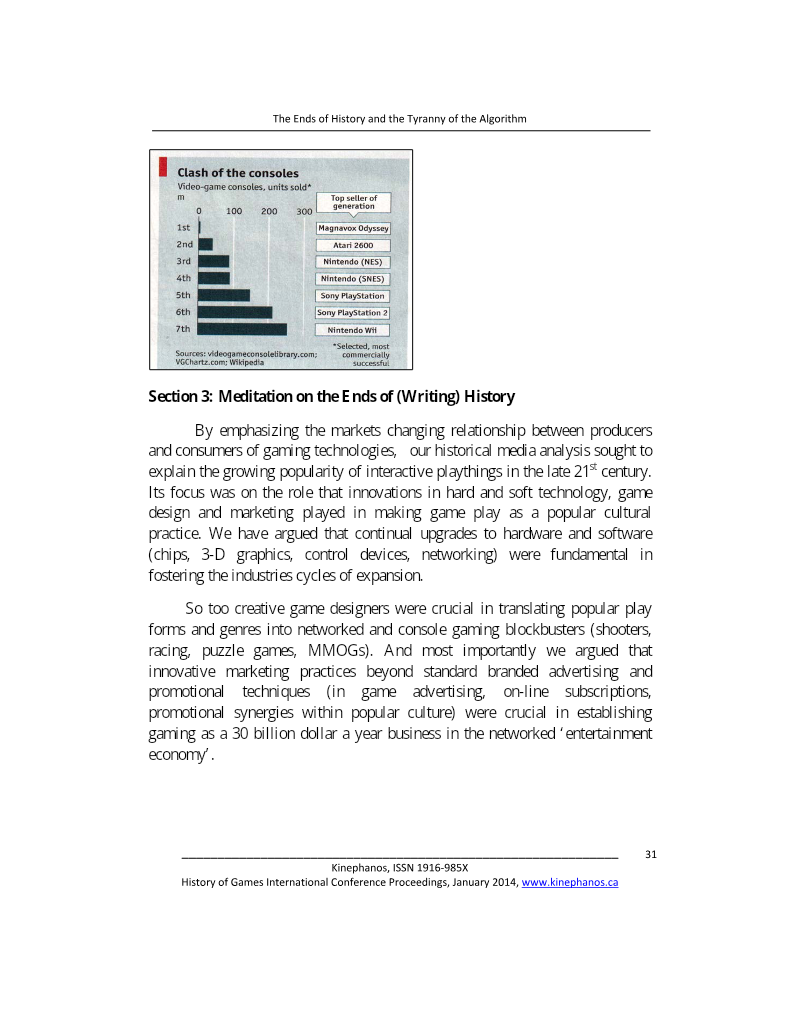
The Ends of History and the Tyranny of the Algorithm
The evolution of the video game industry is defined by a tension between technological potential and the rigid constraints of commercial strategy.
- The video game industry is transitioning from traditional console-based blockbuster models to mobile platforms that prioritize data-driven advertising and user information monetization.
- Commercial imperatives and corporate business models consistently take precedence over digital innovation, leading to a stagnation where predictable design is favored for profit.
- The industry’s current turmoil stems from a conflict between legacy hardware-centric strategies and the adoption of invasive surveillance practices common in the modern digital economy.
L'effet-clip au cinéma
The music video effect, or effet-clip, represents a significant aesthetic shift in cinema that prioritizes sensory immersion, rhythmic editing, and musical integration over traditional linear narrative structures.
- The 'effet-clip' is a cinematic technique that prioritizes rhythmic editing and sensory immersion over traditional linear narrative structures.
- Rather than being a sign of poor quality, the technique functions as a narrative parenthesis that suspends plot to explore character interiority and emotional resonance.
- The aesthetic has roots dating back to the late 1960s, predating the rise of the MTV era.
Demon's Souls: L'esthétique de la répétition au cœur de la pratique hardcore du jeu vidéo
The aesthetic of repetition serves as a foundational pillar in the hardcore gaming experience, functioning as a necessary mechanism for player mastery and progression.
- Repetition in hardcore gaming functions as a critical learning mechanism that facilitates a triple transformation: expanding the perceived game world, enhancing avatar capabilities, and refining player skill sets.
- Demon’s Souls utilizes punitive difficulty and permanent save states to force players to adapt to rigid system requirements rather than relying on modern accessibility conventions.
- The traditional dichotomy between casual and hardcore gaming is becoming obsolete, replaced by a spectrum of player engagement defined by varying levels of dedication and investment.
Cinema as a Sacred Surface: Ritual Rememoration of Transcendence
Cinema functions as a modern ritualistic space that facilitates a profound reconnection between the human observer and the natural world.
- Cinema functions as a modern ritualistic space that transcends the Cartesian divide between spirit and matter by merging the viewer's physical body with the projected image.
- The cinematic experience acts as an evolutionary successor to prehistoric practices like cave painting and shadow theater, utilizing darkened environments to replicate ancient rituals of divine unification.
- The act of filming and the communal viewing process constitute a hierophany, where the technical apparatus itself mediates the unity of immanence and transcendence.
The Gospel of the Winchesters: Neoreligious Fan Practices and Narrative in Supernatural
The television series Supernatural functions as a site of neoreligious practice, where the boundaries between narrative fiction and fan engagement blur to create a hybrid space of devotion.
- Fans of the television series Supernatural treat the show as a neoreligious framework, using its narrative to build communal meaning-making structures that operate independently of traditional religious institutions.
- The fandom actively reclaims agency by subverting the show's internal narrative hierarchy, transforming diegetic objects like the 1967 Chevrolet Impala into symbols that reflect their own values rather than the creators' original intent.
- The series’ producers utilize characters like Becky Rosen to mock or marginalize fan enthusiasm, creating an adversarial dynamic that the audience counters through the creation of fanfiction and alternative interpretations.
Sacralising Fandom: From the 'Loss Hypothesis' to Fans' Media Rituals
This analysis examines the prevailing academic tendency to equate media fandom with religious practice, a framework often referred to as the "loss hypothesis."
- The 'loss hypothesis'—the academic theory that fandom serves as a functionalist substitute for traditional religion in secular society—lacks empirical support and relies on speculative narratives rather than actual audience research.
- Fan communities do not operate through rigid, institutionalized boundaries between the sacred and the profane as suggested by neo-Durkheimian sociology.
- Fan rituals are characterized as mobile, fractal, and pluralistic, constantly contesting the border between media-constructed worlds and ordinary reality.
It's All About Love: Félix Guattari's Minor Cinema
Thomas Vinterberg’s film It’s All About Love serves as a primary case study for re-evaluating cinematic subjectivity through the theoretical framework of Félix Guattari’s minor cinema.
- Thomas Vinterberg’s film 'It’s All About Love' serves as a case study for applying Félix Guattari’s 'minor cinema' theory to subvert capitalist control and traditional identity politics.
- The film utilizes a-signifying elements, including specific color palettes, sonic intensities, and global cutaway shots, to disrupt linear narrative structures.
- By prioritizing sensory intensities over realist conventions, the film replaces individualistic subjectivity with a molecular and affective model.
La langue comme marqueur générique: Réaffectation de la langue japonaise dans la traduction amateur du visual novel
Amateur localization communities play a transformative role in the global circulation of Japanese visual novels, moving beyond traditional translation to engage in a process of transfiguration.
- Amateur localization groups are shifting industry standards by forcing commercial publishers to adopt previously niche linguistic markers, such as honorifics, to meet established fan expectations.
- Fan communities act as active negotiators rather than passive consumers, using 'textual poaching' to reappropriate Japanese linguistic elements as generic markers for North American audiences.
- While commercial localization historically prioritized the removal of foreign linguistic markers for Western market adaptation, amateur groups intentionally preserve these elements to signal genre authenticity.