Key insights
6 slides
Urgent need
The video game industry requires centralized, institutional preservation efforts.
Individual developers and publishers prioritize short-term commercial interests over long-term cultural legacy.




1 / 6
- 01The video game industry requires centralized, institutional preservation efforts to safeguard software, hardware, and production materials, as individual developers and publishers prioritize short-term commercial interests over long-term cultural legacy.See it on page 6
- 02Effective archiving must extend beyond final products to include internal documentation such as design documents, emails, development schedules, and marketing materials to provide necessary historical context.See it on page 7
- 03Emulation is a critical technical necessity for maintaining access to software as original hardware inevitably degrades over time.See it on page 4
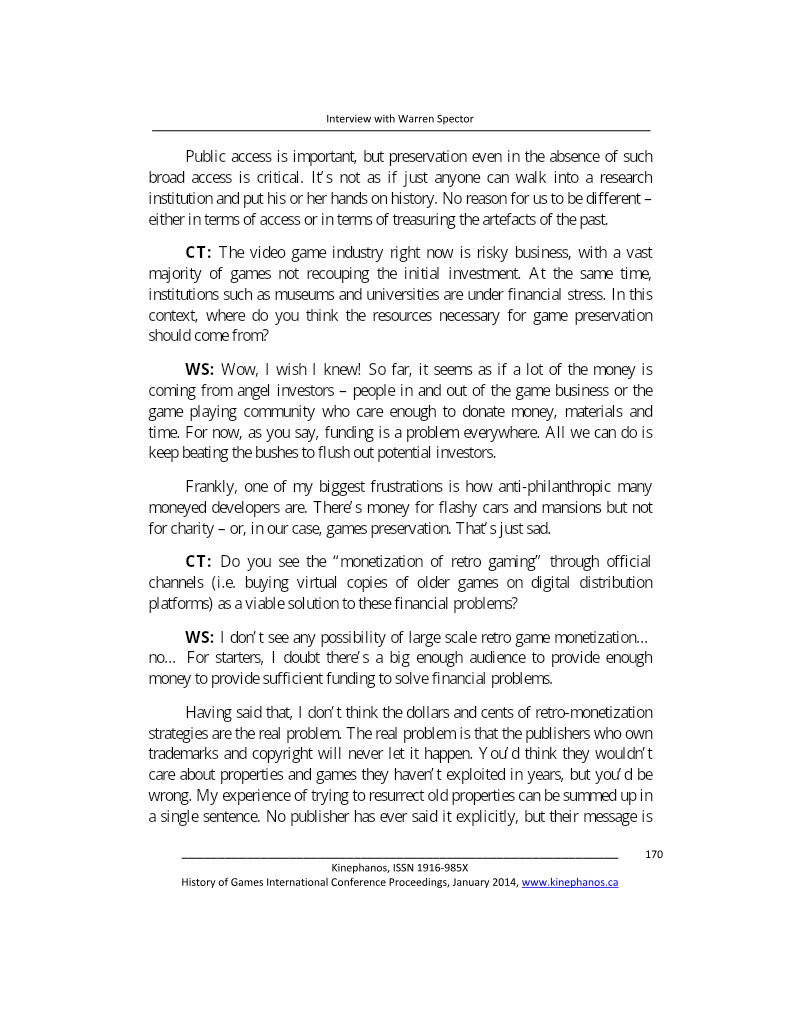
- 04The industry suffers from a lack of historical philanthropy, with many publishers refusing to release rights to older properties even when those assets are no longer being commercially exploited.See it on page 3
- 05Game criticism needs to evolve into a more accessible, mainstream tradition similar to film criticism, as current academic and journalistic writing often fails to reach a broad audience.See it on page 8
- 06Video game genres should be defined by core play patterns rather than surface-level content.See it on page 10
- 07Titles such as Suikoden, Space Rogue, Ico, and Ultima Underworld are identified as foundational works that have significantly shaped the medium.See it on page 11
Ask AI about this article
Summary
This interview with game designer Warren Spector explores the critical necessity of video game preservation, the challenges of institutional archiving, and the current state of game criticism. The discussion emphasizes that while public access to every historical artifact is an ideal goal, the primary responsibility of institutions should be the systematic preservation of games, hardware, and production materials for historians and researchers. Spector argues that because the industry is inherently volatile and prone to losing historical data, there is an urgent need for consistent, centralized preservation efforts rather than relying on individual developers or publishers, who often prioritize short-term commercial interests over cultural legacy.
Spector contends that the industry lacks a robust tradition of philanthropy regarding its own history, noting that many publishers are reluctant to release rights to older properties even when they are no longer being exploited. He advocates for a comprehensive approach to archiving that includes not just final products, but also design documents, emails, schedules, and marketing materials, as these provide essential context for how games evolve during development. Furthermore, he supports the use of emulation as a vital tool for maintaining access to software as original hardware inevitably degrades.
Finally, the discussion addresses the evolution of game criticism and genre classification. Spector suggests that current academic and journalistic writing often fails to reach a mainstream audience, calling for a more accessible, critical tradition similar to film criticism. He posits that game genres should be defined primarily by play patterns rather than content, and he highlights influential titles such as Suikoden, Space Rogue, Ico, and Ultima Underworld as examples of games that have significantly shaped the medium despite varying levels of historical recognition.