
Journal of Games Criticism
Open-access peer-reviewed journal (since 2014) that bridges academic game studies and popular games criticism.
Documents
Play While Paused: Time and Space in Videogame Pause Menus
Pause menus represent a critical, often overlooked interface that reveals the complex computational temporalities governing digital games.
“Together They Are Twofold”: Player-Avatar Relationship Beyond the Fourth Wall
The fourth wall in video games serves as a dynamic site of interaction rather than a static barrier, necessitating a refined typology to distinguish between characters who merely acknowledge their fictionality and those who engage in genuine metareferential dialogue.
Of Actors and Non-Player Characters: How Immersive Theatre Performances Decontextualize Game Mechanics
Immersive theatre productions frequently adopt design mechanics from video games to market themselves as highly agentic, interactive experiences.
“There’s No Point In Saving Anymore”: Diegesis And Interactional Metalepsis In Pony Island And Doki Doki Literature Club
Video games increasingly employ metalepsis—the transgression of boundaries between narrative levels—to dismantle the traditional fourth wall and foster a sense of ontological disorientation.
Local Practices in Digital Gaming Heritage: An Interview With Maurizio Banavage and Andrea Dresseno
Digital gaming heritage preservation currently relies heavily on the labor of small-scale, volunteer-driven initiatives, such as Malta’s Vintage Computer Club and Italy’s Videogame Archive.
"I Never Asked For It, But I Got It And Now I Feel That My Knowledge About History Is Even Greater!": Play, Encounter And Research In Europa Universalis IV
Europa Universalis IV functions as a powerful catalyst for informal historical education, facilitating a dynamic cycle of play, encounter, and research.
Labour and Love: Play-Centrism and Procedurality in Spiritfarer
The tension between procedurality, which posits that meaning is embedded within a game’s formal rules, and play-centrism, which emphasizes the subjective role of the player, serves as a critical framework for understanding modern game design.
The Kid in the Fridge: Sacrificial Children and Vengeful Masculinity in Contemporary Videogames
The sacrificial child trope in contemporary gaming serves as a critical narrative mechanism designed to justify hypermasculine, militarized violence.
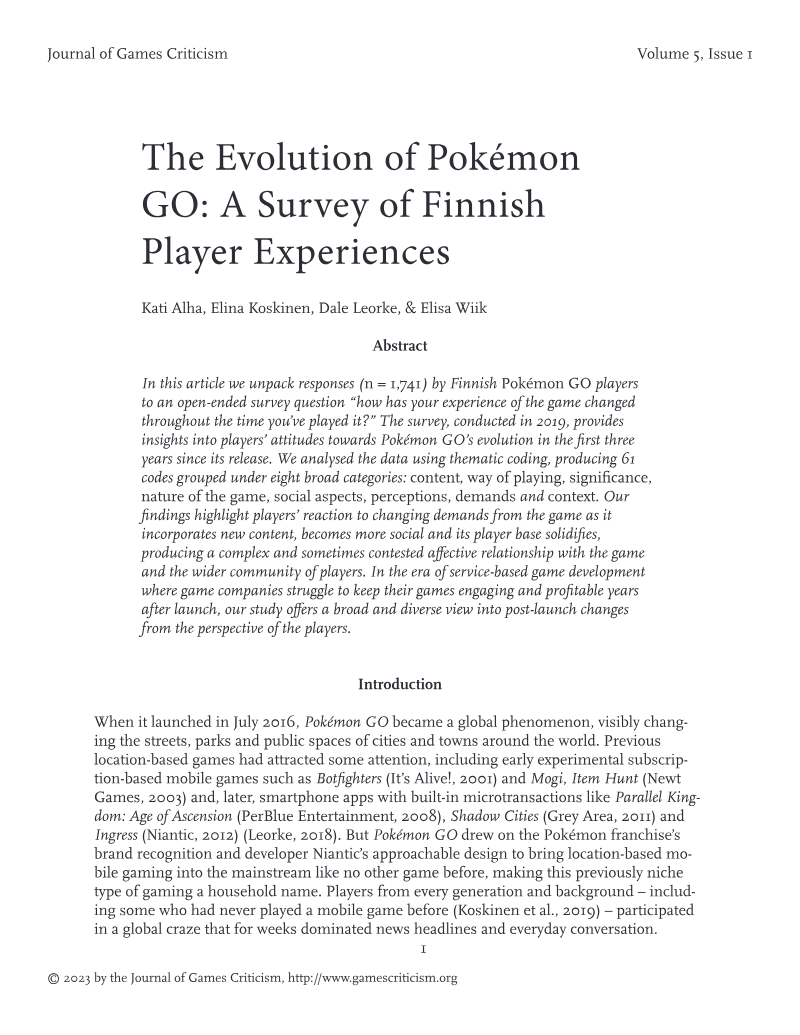
The Evolution of Pokémon GO: A Survey of Finnish Player Experiences
Pokémon GO has undergone a significant transformation since its 2016 launch, evolving from a spontaneous, community-driven phenomenon into a structured, habitual service model.
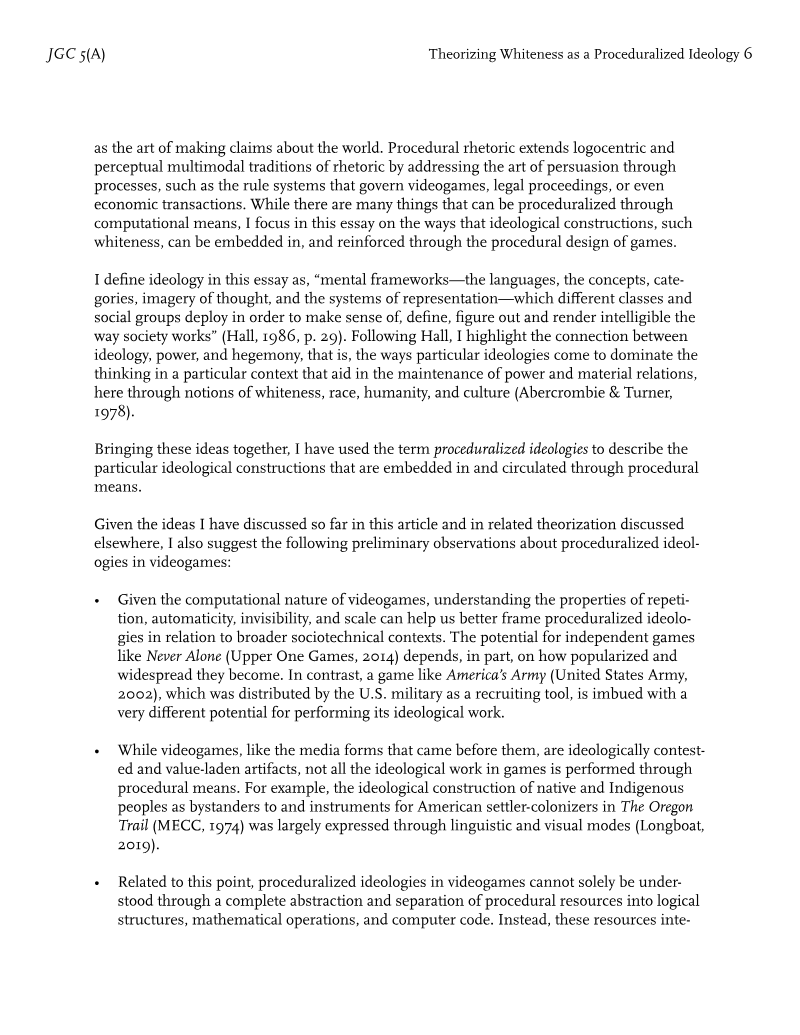
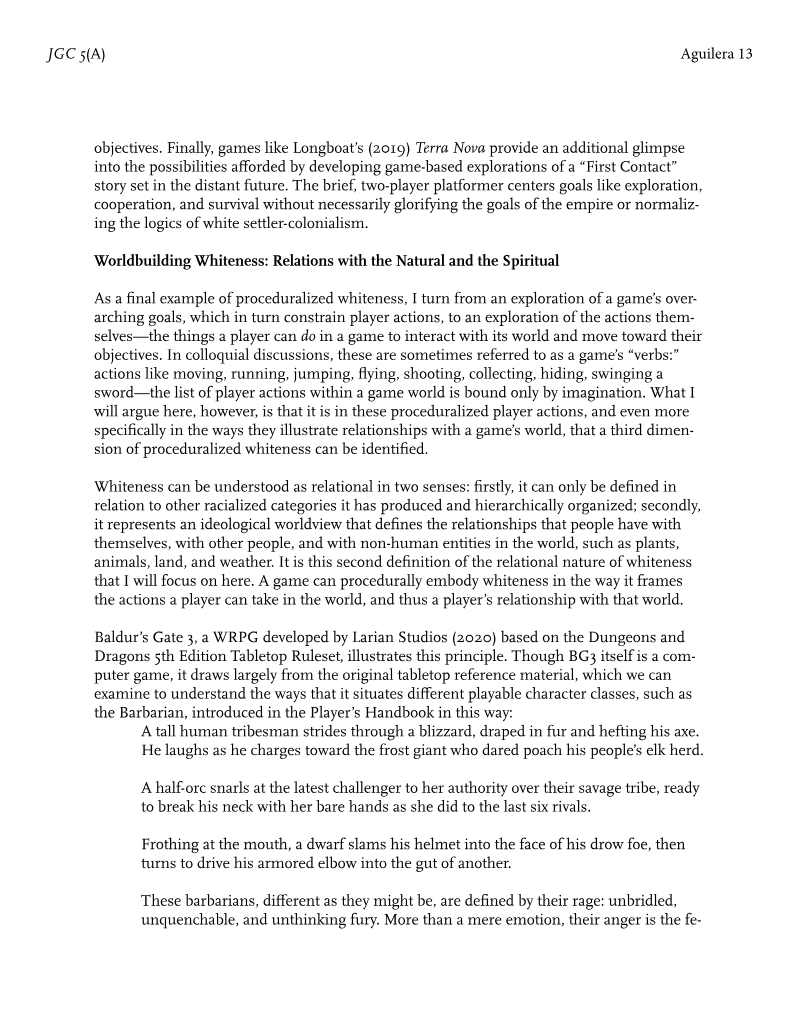
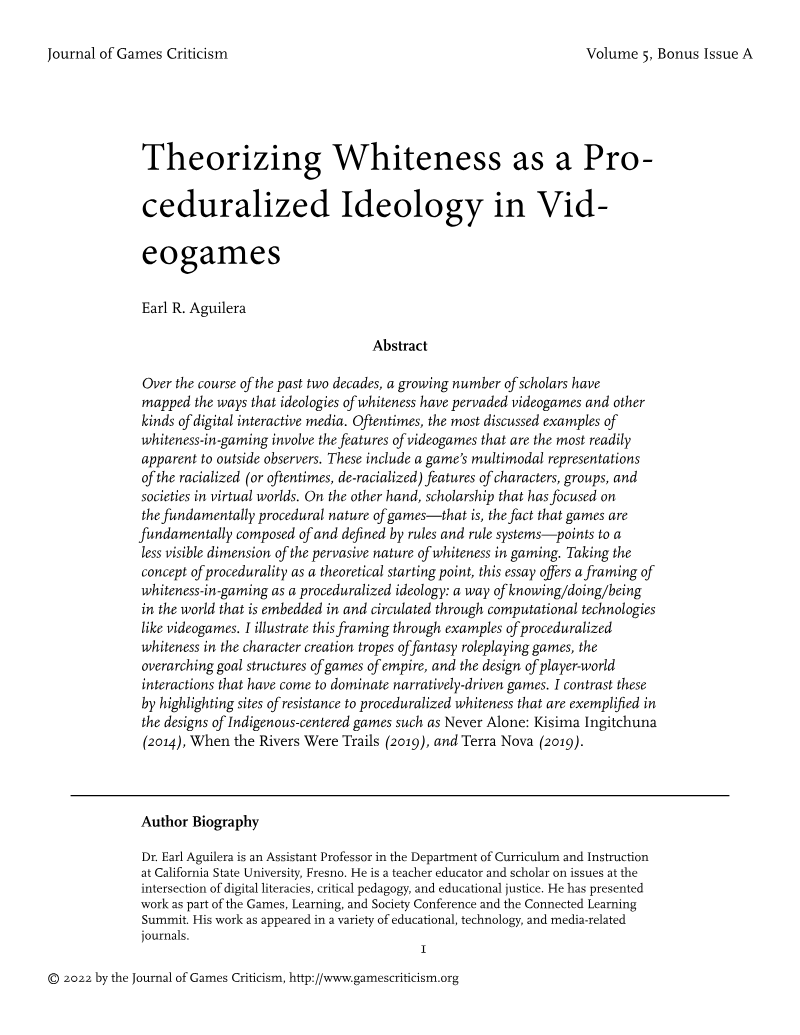
Theorizing Whiteness as a Proceduralized Ideology in Videogames
Proceduralized whiteness functions as a foundational ideology within video games, manifesting not merely through visual representation but through the core rules, mechanics, and goal structures that govern play.
Black Deprivation in Naughty Dog's The Last of Us Remastered and The Last of Us Part II
Naughty Dog’s The Last of Us series functions through a framework of black deprivation, a narrative strategy that systematically relegates Black characters to disposable roles to ensure the existential longevity and emotional development of white protagonists.
Highway to the Golden Zone: PC Bangs and Techno-Orientalism in the StarCraft II Visual Novel
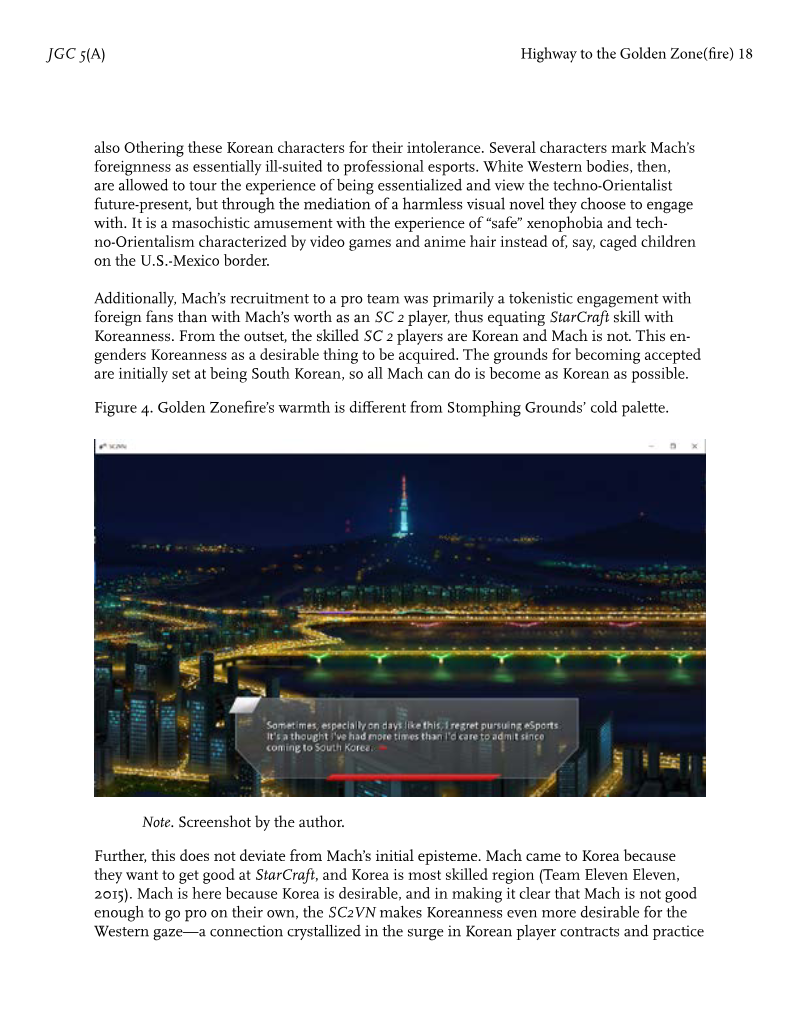
The visual novel SC2VN functions as a site of techno-Orientalist discourse, utilizing the South Korean pc bang as a central trope to navigate Western anxieties surrounding the nation’s dominance in mid-2010s esports.