
Journal of Games Criticism
Open-access peer-reviewed journal (since 2014) that bridges academic game studies and popular games criticism.
Documents
Between a Rock and a Hard Place: Games Coverage and Its Network of Ambivalences
Game criticism currently exists in a state of perpetual crisis, defined by a profound lack of professional consensus and a fractured identity.
Considering the Sequel to Game Studies
This collection of essays, derived from the 2015 Extending Play: The Sequel conference at Rutgers University, examines the theoretical and material implications of sequence, iteration, and repetition within game studies.
Hanging in the Video Arcade
Video arcades in 1980s America functioned as complex, contested social environments defined by a fundamental tension between the commercial mandate of coin-operated play and the informal practice of loitering.
Assessing Mass Effect 2 and Elder Scrolls V: Skyrim: Using Collaborative Criteria for Player Agency in Interactive Narratives
The tension between ludology and narratology remains a central challenge in interactive media, specifically regarding how games balance player freedom with structured storytelling.
Imperialism in the Worlds and Mechanics of First-Person Shooters
First-person shooters function as significant cultural vectors for imperialist ideologies, systematically reinforcing Western geopolitical agendas through the mechanics of territorial conquest and the pacification of foreign environments.
The Replication of Ideology: An Interview with Adrienne Shaw and Marcus Boon
This discussion explores the replication of ideology within digital culture, gaming systems, and academic research.
Ludic Spolia in Sid Meier's Civilization: Beyond Earth
Ludic spolia serves as a critical framework for understanding the development and reception of Sid Meier’s Civilization: Beyond Earth.
A Proceduralist View on Diversity in Games
A proceduralist perspective on game design offers a critical framework for analyzing how software architecture, algorithms, and data representation influence the portrayal of gender, race, and sexuality.
Liberating Play: An Interview with Anna Anthropy and Miguel Sicart
This discussion between Anna Anthropy and Miguel Sicart advocates for the liberation of play from the restrictive, formalist, and technology-centric definitions currently dominating the video game industry and academic scholarship.
Swipe Left to Detain: A Procedural Comparison Between Tinder and Papers, Please
Tinder and the border-control simulation Papers, Please function as persuasive machines that utilize identical procedural mechanics to shape user behavior and reinforce specific ideologies.
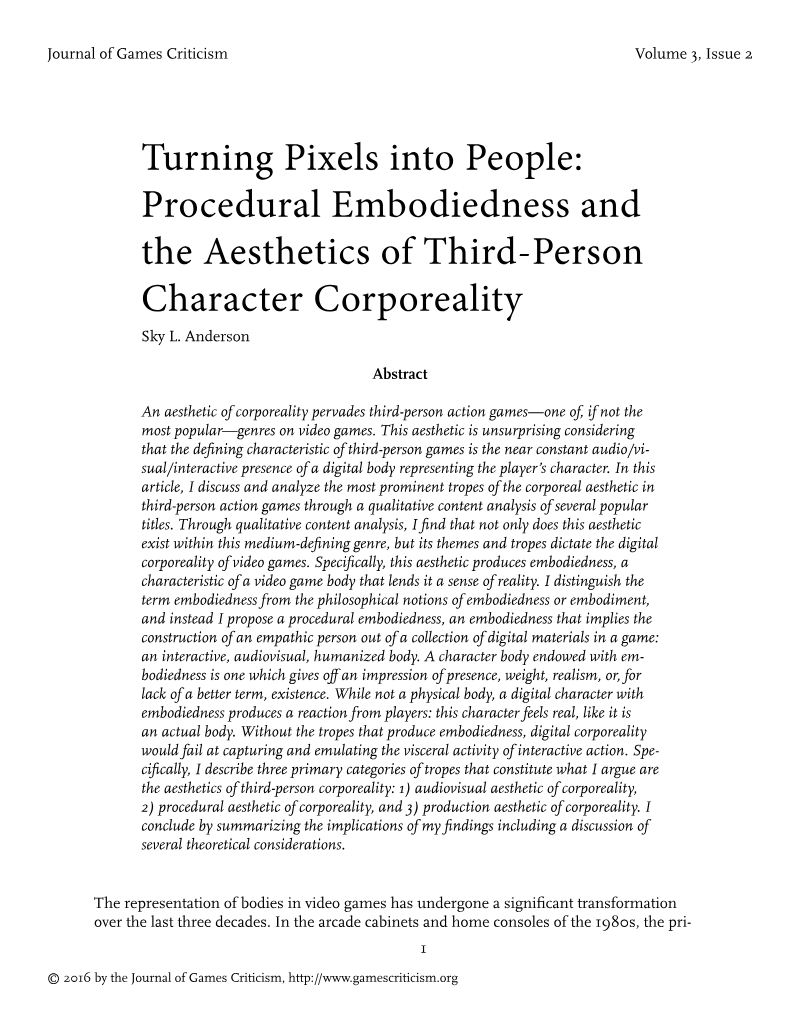
Turning Pixels into People: Procedural Embodiedness and the Aesthetics of Third-Person Character Corporeality
Procedural embodiedness serves as the primary framework for understanding how third-person action games transform digital avatars into entities that possess weight, presence, and vulnerability.
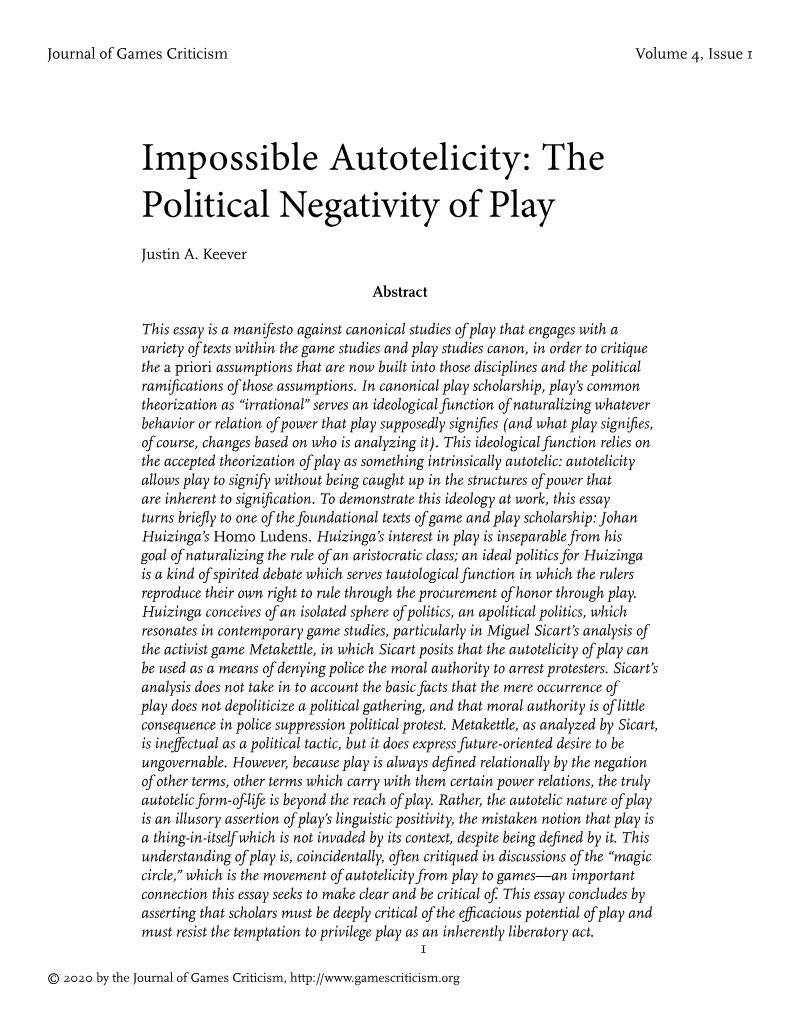
Impossible Autotelicity: The Political Negativity of Play
The conceptualization of play as an autotelic, self-contained activity serves as a pervasive ideological construct that obscures the material and political realities of human interaction.