
International Journal of Games and Social Impact
Open-access journal from Lusófona University on games, game design and their social impact.
Documents
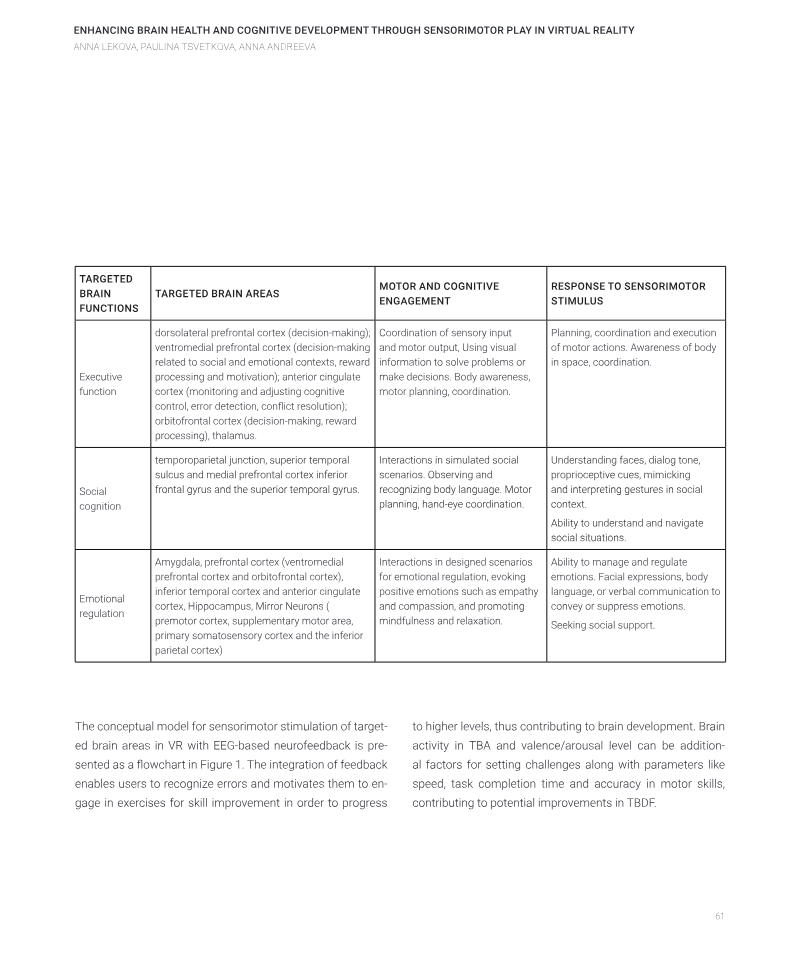
Enhancing Brain Health and Cognitive Development Through Sensorimotor Play in Virtual Reality: Uncovering the Neural Correlates
This paper, authored by researchers at the Bulgarian Academy of Sciences' Institute of Robotics, examines whether sensorimotor play in virtual reality can support brain health and cognitive development.
- The paper proposes that sensorimotor play in virtual reality can support brain health by linking VR activity to brain-derived neurotrophic factor activity, executive function, and neuroplasticity, though these are framed as hypotheses rather than established outcomes.
- The reviewed EEG studies associate VR-based sensorimotor and motor-imagery training with increased beta and mu-rhythm activity, while neurofeedback research links frontal alpha and sensorimotor rhythm power to better attentional control and memory.
- Imaging studies cited in the review report VR-related increases in cortical gray matter volume and activation of prefrontal, premotor, and mirror-system regions during emotion regulation and action observation.
Learning Engagement in a Pre-Alpha Version of an Educational Game: Evaluation and Proposed Solutions
The study evaluates learning engagement in a pre-alpha version of "Planeta em Perigo," an educational math game designed for both deaf and hearing students, with the aim of demonstrating that engagement-focused playtesting conducted early in development can meaningfully improve an educational game before release.
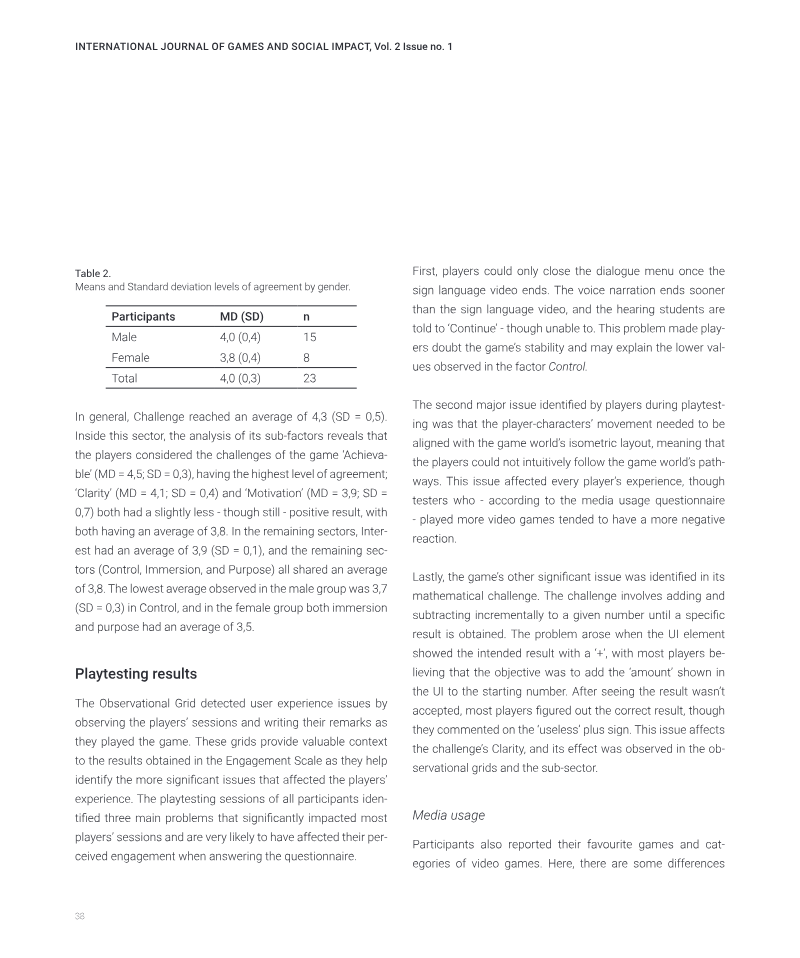
- Overall engagement with the pre-alpha educational math game "Planeta em Perigo" was moderate (MD = 4.0, SD = 0.3) across 23 hearing students aged 7 to 18, evaluated with Whitton's five-factor engagement model.
- Challenge was the highest-rated engagement factor (MD = 4.3), with Achievability as its strongest sub-factor (MD = 4.5), while Control was the principal weakness.
- Control problems stemmed from misaligned movement axes in the isometric view, the inability to skip sign-language narration, and unfamiliarity with keyboard controls.

Playful by Design: A Third Space Community of Practice for Game Studies & Design
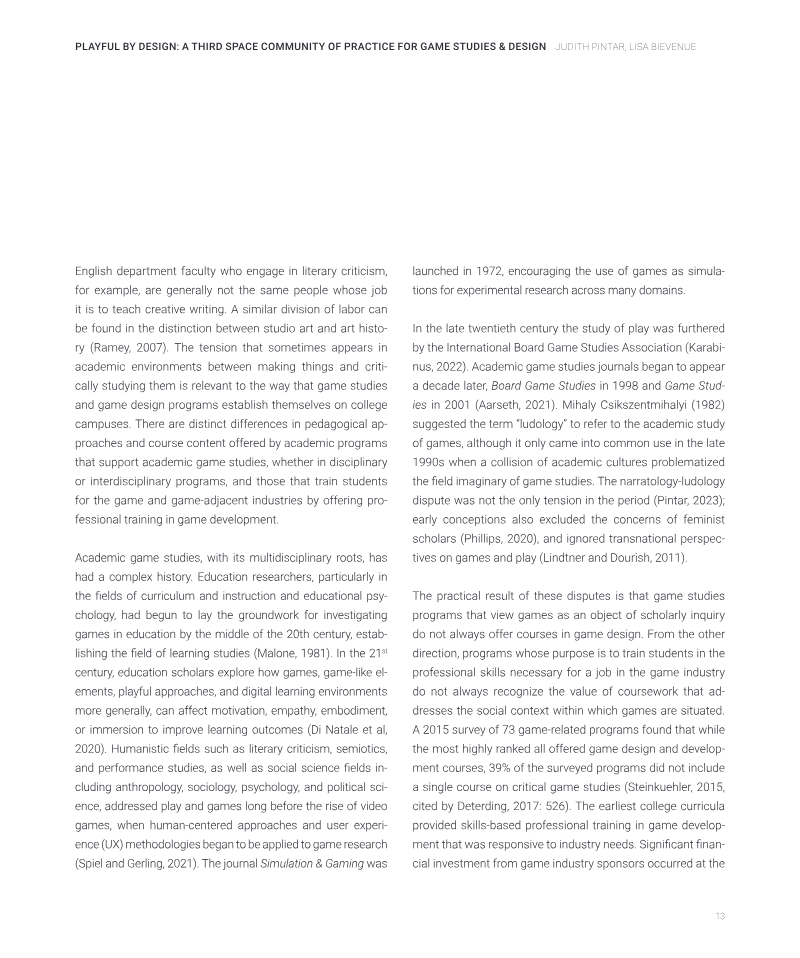
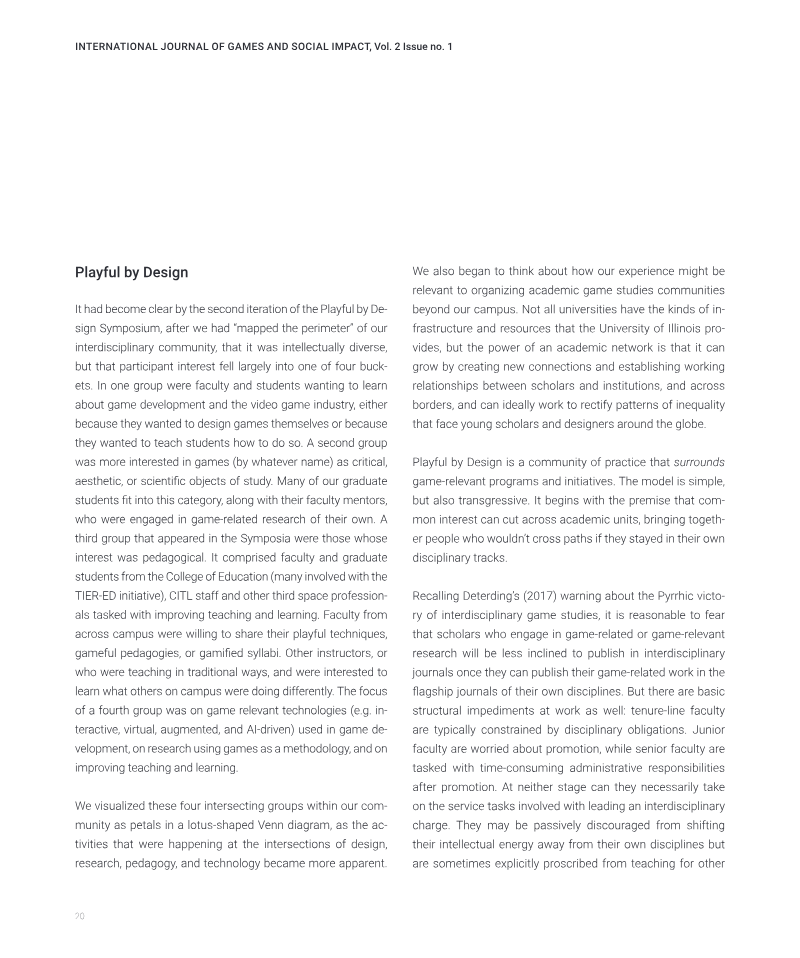
"Playful by Design" presents the development of an interdisciplinary Game Studies & Design program at the University of Illinois Urbana-Champaign as a case study in building a "third space" community of practice.
- The authors argue that games now permeate many academic disciplines, yet tensions persist between critical game studies and professional design training, and between qualitative humanities and quantitative STEM methods, so the field is better served by re-centering on design practice and cultivating interdisciplinary third spaces.
- The University of Illinois Urbana-Champaign program began with a 2015–2016 campus census that found game-related teaching and research scattered across colleges without any unifying structure.
- A 2017 Provost's Office grant established a Game Studies & Design unit offering undergraduate and graduate minors, later followed by an online professional Master's program, while the 'Playful by Design' research cluster's first symposium drew more than 300 attendees.

Analogue Co-Design: Opportunities, Challenges and Other Nuances
This article brings together a roundtable discussion among analogue board game designers, namely the sibling-style partnerships of Inka and Markus Brand and Isra and Shei of Llama Dice, to examine co-design as a creative practice.
- Co-design is presented as producing stronger analogue games than solitary authorship, because negotiation, debate, and fresh perspectives sharpen ideas, and both featured teams (Inka and Markus Brand, and Isra and Shei of Llama Dice) have worked exclusively in this mode.
- Publishers seek one strong core idea, and co-designers add value by providing testing capacity and iteration capability, which the article frames as a sustainable professional strategy for independent designers.
- Development timelines are long: Markus and Inka recount roughly seven years before their first publication, so the designers advise persevering through extended development periods.

Why Have There Been No Great Women or Non-Binary Board Game Designers?
The analysis argues that the underrepresentation of women and non-binary designers in board gaming is best understood as a question of who feels welcome to play and study games in depth.
- Women make up roughly 25 percent of board game players, yet only about 2.4 to 4.1 percent of designers of top-rated 2018 games were women.
- Among the top 400 games in 2023, only 2.7 percent of designers were white women and 0.5 percent were white non-binary people.
- Men account for 76.8 percent of characters among the top 200 games on BoardGameGeek in 2023, reflecting male dominance in game covers and characters.

Current and Future Opportunities for 3D Printing in Modern Board Games
3D printing, or additive manufacturing, is examined here as an emerging force in modern board games, where its current use is driven largely by hobbyists rather than publishers.
- Hobbyists, not publishers, currently drive 3D printing in board games: community members create and share models mainly for customization and organization, while designers and publishers are only beginning to use the technology for prototyping.
- Quality, durability, material range, copyright concerns, and high per-part costs are identified as the main barriers to mass production of 3D-printed board game components.
- Of roughly 3,013 available 3D board game models on BoardGameGeek, only about 377 (around 12.5 percent) are non-insert upgrade components, with storage and organization inserts making up the large majority.

Guidelines for Ludonarrative Conversion: A Case Study for a Children's Book Converted to a Game
Katryna Starks' 2023 paper, published in the International Journal of Games and Social Impact, proposes a set of guidelines for ludonarrative conversion, the process of adapting a children's book into an interactive game.
- The paper argues that books and games differ fundamentally: books are static narratives, while games are driven by player agency and dynamic interaction, so adaptation requires translating narrative elements into mechanics rather than copying them.
- The guidelines follow a three-stage framework: regulatory and screen-time considerations, mechanic selection matched to developmental phases, and faithful preservation of book elements such as characters, locations, objects, and story beats.
- Supporting data cited includes 71% of American children playing video games, 77% of parents playing with them weekly, and 84% of US parents aware of ESRB ratings (75% using them).

Current Accessibility Challenges and Perspectives for People with Visual Impairments in Tabletop Games
This paper examines the accessibility barriers that blind and visually impaired people face in tabletop games, with a particular focus on Brazil.
- Most tabletop games rely on visual information, so visually impaired players usually depend on sighted companions to adapt games for them, which is the paper's central problem.
- Adapted editions such as braille versions are scarce and considerably more expensive than standard games, and this cost burden falls on people with disabilities in Brazil, who face high poverty rates.
- The paper critiques historically ableist language and medicalist views of disability, proposing a social-model alternative called "Design in Partnership" in which disabled people act as co-designers and play-testers.

"Public Interest" and the (Potential) Social Impact of Board Games: The Role of the "Strategic Twist", Definition and Scope
Paulo Antunes's paper examines the "strategic twist" in modern board game design and asks whether this shift carries significance for the public interest.
- The paper defines the 'strategic twist' along two dimensions: the orientation of games toward strategic play, and the strategic transformation of the surrounding games milieu.
- The author's central thesis is that board games can have social impact, but only if that impact is realized through community participation, production conditions, and fostering critical, participatory culture.
- The analog games industry shifted after the post-Catan renaissance from pure randomness and player elimination toward strategy, control, and meaningful player choice, which the author frames as dialectical evolution rather than rupture.


An Analog Game-Based Intervention and a Playability Analysis in the Elderly: A Pilot Study
This pilot study investigates whether a four-week analog game-based intervention can produce favorable emotional and perceptual outcomes among institutionalized older adults.
- A four-week pilot with 13 institutionalized older adults (mean age 80) tested the Ta!Ti! Hand Game, a tabletop serious game for memory and upper-limb movement, to assess its playability in a therapeutic setting.
- Roughly 44% of participants reported increased excitement and a similar share reported increased joy, while about two-thirds reported reduced anxiety after sessions.
- Participants rated enjoyment moderately to highly and boredom low, with mean scores of roughly 3.5 to 4.6 on a five-point scale.

Cognitive Teleintervention With Board Games During the Pandemic Lockdown in School-Age Children
A pilot randomized controlled trial examined whether a remotely delivered board game program could support executive functions in school-age children during the COVID-19 lockdown in Spain.
- A pilot randomized controlled trial with only 25 Spanish children aged 5 to 12 (15 in the 12-session remote board game program, 10 wait-list controls) tested remote board game play during the COVID-19 lockdown.
- The most consistent finding was improved cognitive flexibility and verbal fluency (phonological and semantic) across the full sample, with the play group showing larger gains than controls in flexibility and phonological fluency.
- Gains among play-group children were concentrated in those who reported high satisfaction with the sessions and games, suggesting engagement may matter for benefit.

Mastering Modern Board Game Design to Build New Learning Experiences: The MBGTOTEACH Framework
The paper presents MBGTOTEACH, a step-by-step framework designed to help teachers adopt, adapt, and create modern board games (MBG) for classroom learning.
- The MBGTOTEACH framework helps teachers adopt, adapt, or create modern board games for classrooms, with the choice depending on their level of commitment and skill: using an existing game, modifying one, or designing a new one.
- Two teacher workshops (15 face-to-face primary and secondary teachers, and 11 online teachers and researchers) raised teachers' perceptions of board games as teaching tools by +1.07 face-to-face and +0.69 online.
- The author cautions that these gains come from small samples, teachers' low prior game habits, and effects that depended heavily on debriefing, so the results should not be broadly generalized.