1 free read left. Create a free account for unlimited reading + AI research.
Create free accountWhitepaper International Journal of Games and Social Impact
1 free read left. Create a free account for unlimited reading + AI research.
Create free accountWhitepaperInternational Journal of Games and Social Impact
The games were made during the third Óbidos Cultural Game Jam, part of the Horizon Europe EPIC-WE project. Their theme was "That's Not Fair."
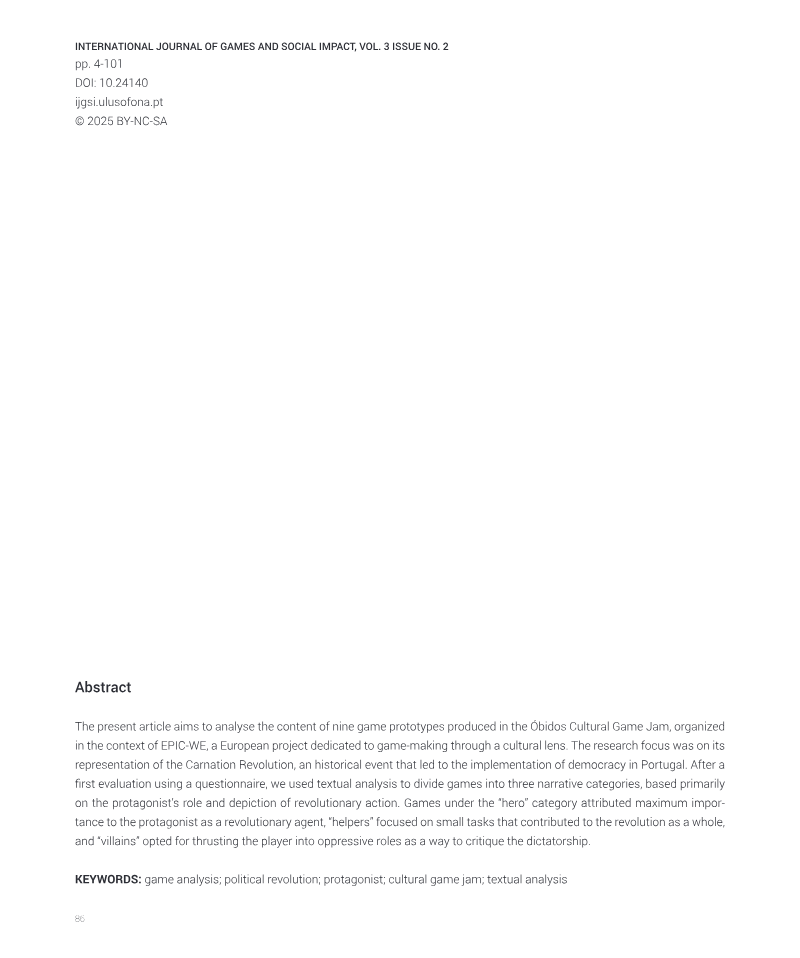
Nine game prototypes created during the third Óbidos Cultural Game Jam in February 2025 form the basis of this study, which examines how participants represented Portugal's 1974 Carnation Revolution and the 1973 Captains' Meeting that preceded it. The jam, held under the theme "That's Not Fair" as part of the Horizon Europe EPIC-WE project, combined surveys, interviews, observation grids, seven-dimension Likert evaluations, and textual analysis of gameplay and narrative. The central aim is to understand how the games engage cultural heritage and European values, and how historical memory is translated into interactive form.
The analysis sorts the games into three categories according to protagonist perspective. "Heroes" follow individual agency in a conventional monomyth structure, while "Helpers" cast the player as minor figures whose small acts contribute to collective change, such as Bufo Catcher. "Villains" invert the perspective entirely, placing players in the role of secret police or regime enforcers, with titles such as Blue Brigade and Message of the Red Cloves using gameplay to expose the mechanics of repression. This typology reveals a clear progression from celebratory narratives toward more critical and morally ambiguous forms of engagement.
A notable finding concerns the influence of participant background. Games produced by high school students using Twine tended toward conventional storytelling with explicit moral messaging, whereas university-produced games favored experimental narratives and serious-game characteristics, with several drawing on established models such as Papers, Please. The authors acknowledge a methodological limitation: researchers attended the event and heard developers' pitches, so interpretations were not fully blind, though the analysis prioritized gameplay and story over stated intent.
The study concludes that cultural game jams generate a plurality of interpretations shaped by participants' experience and training, and that narrative design is central to how such games mediate cultural heritage and historical meaning.
Each row is a game or company this document names, each column a document, oldest first. A mark means that document names it. Select a row to see those documents.
International Journal of Games and Social Impact · 2026
International Journal of Games and Social Impact · 2026
International Journal of Games and Social Impact · 2026
International Journal of Games and Social Impact · 2026
International Journal of Games and Social Impact · 2026
International Journal of Games and Social Impact · 2026
International Journal of Games and Social Impact · 2026
International Journal of Games and Social Impact · 2026
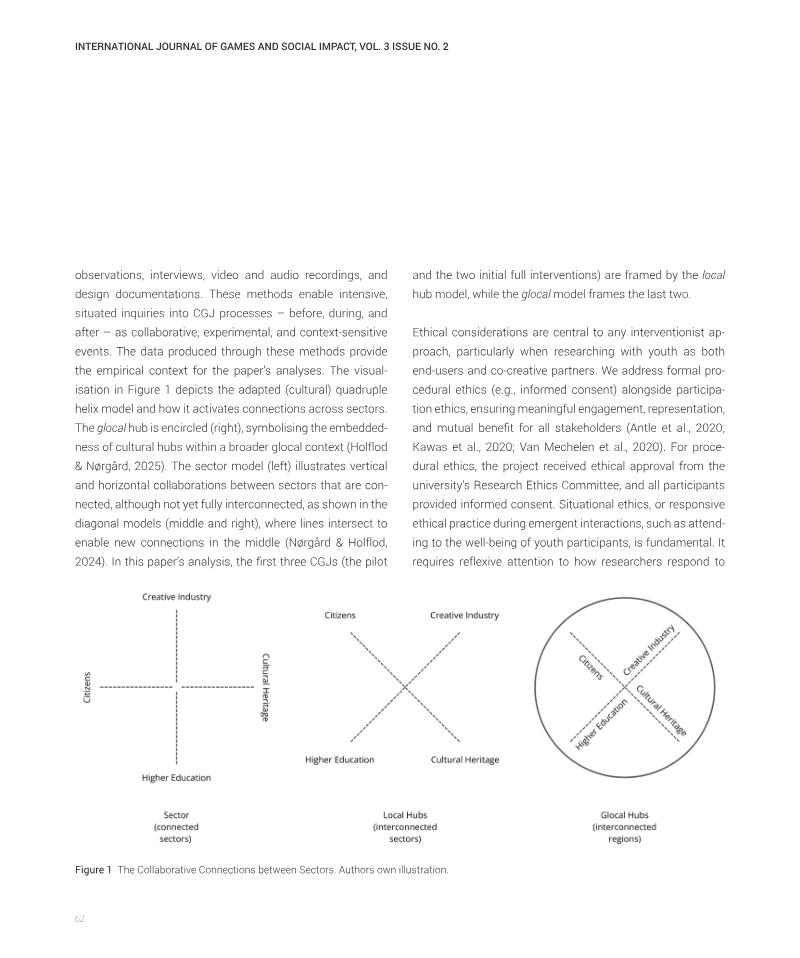
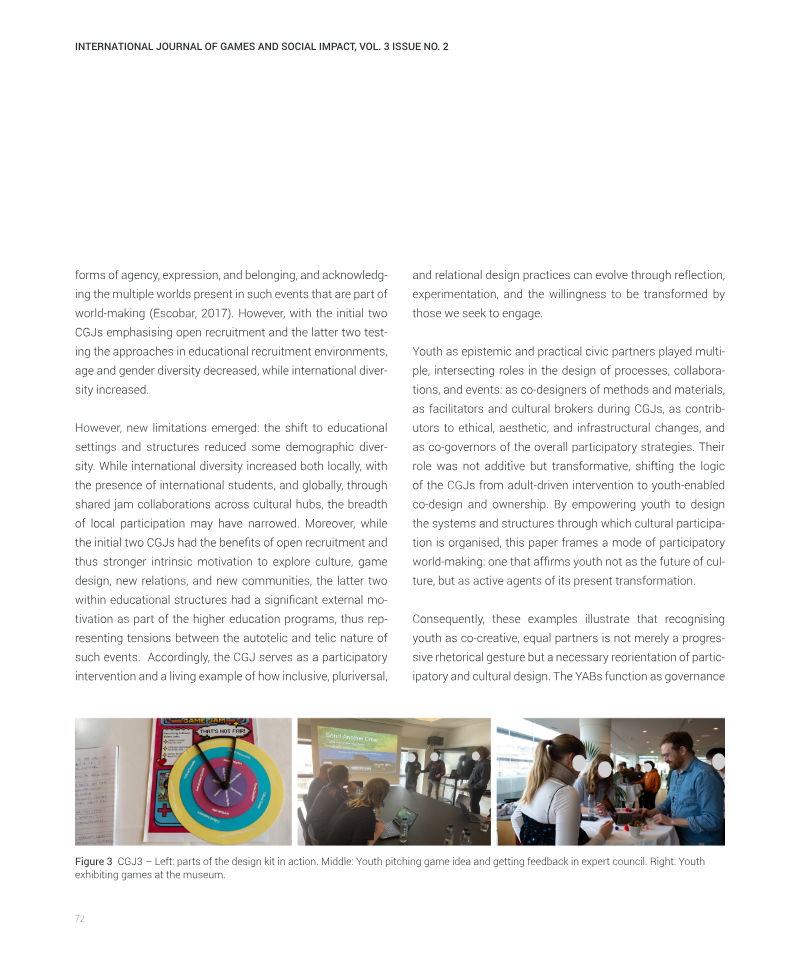
International Journal of Games and Social Impact · 2025
International Journal of Games and Social Impact · 2025
International Journal of Games and Social Impact · 2025

International Journal of Games and Social Impact · 2025



European Conference on Games Based Learning (ECGBL) · 2026



European Conference on Games Based Learning (ECGBL) · 2026



DiGRA · 2026