
International Journal of Games and Social Impact
Open-access journal from Lusófona University on games, game design and their social impact.
Documents

Cultural Heritage in Yakuza 0: Representing Japan's Bubble Economy
Yakuza 0, released in 2015 and set in Japan in 1988, is examined as a repository of cultural heritage from the country's bubble economy.
- The study argues that Yakuza 0 (2015, set in Japan in 1988) functions as cultural heritage of the bubble economy, and that its representation merits recognition in the spirit of UNESCO-style heritage frameworks applied to digital media.
- Historical context cited includes bank lending rising from roughly 135 to 376 trillion yen during Japan's bubble economy, alongside dramatic asset price inflation.
- Tangible heritage is assessed through ludoformed landmarks such as Kamurochō and Sotenbori, plus in-game objects like expensive dining and telephone cards.
Gaming for Social Change: Sharmila and the Representation of Otherness
Ferreira and Lietti's study examines whether serious games can shift public perceptions of global inequality rather than reinforce "othering" narratives, using the World Food Programme's 2021 humanitarian training game Sharmila as its case study.
- The study uses a qualitative thematic analysis of five playthroughs of the World Food Programme's 2021 game Sharmila, totaling roughly 12 hours and supported by 39 screenshots, and finds it departs from stereotypical portrayals of marginalised groups.
- Sharmila's conclusions are theoretical and qualitative; the authors do not measure player outcomes quantitatively, so claims about learning effects remain unverified.
- The game still risks a 'saviour' dynamic in which players must fix vulnerable communities, even though its characters are diverse and mostly active.
Enhancing the Learning of Students with Specific Learning Disabilities in Resource Rooms: An Educational Game to Teach the Concepts of Expansion and Contraction
A carpet-based educational game was designed to help fifth-grade students with specific learning disabilities in Turkish resource rooms grasp the concepts of expansion and contraction while building life skills.
- A carpet-based educational game was designed for fifth-grade students with specific learning disabilities in Turkish resource rooms to teach the concepts of expansion and contraction while building life skills.
- The design was grounded in semi-structured interviews with 40 educators and academics, who most valued learning by doing, material variety, educational games, teamwork, frequent repetition, and daily-life association.
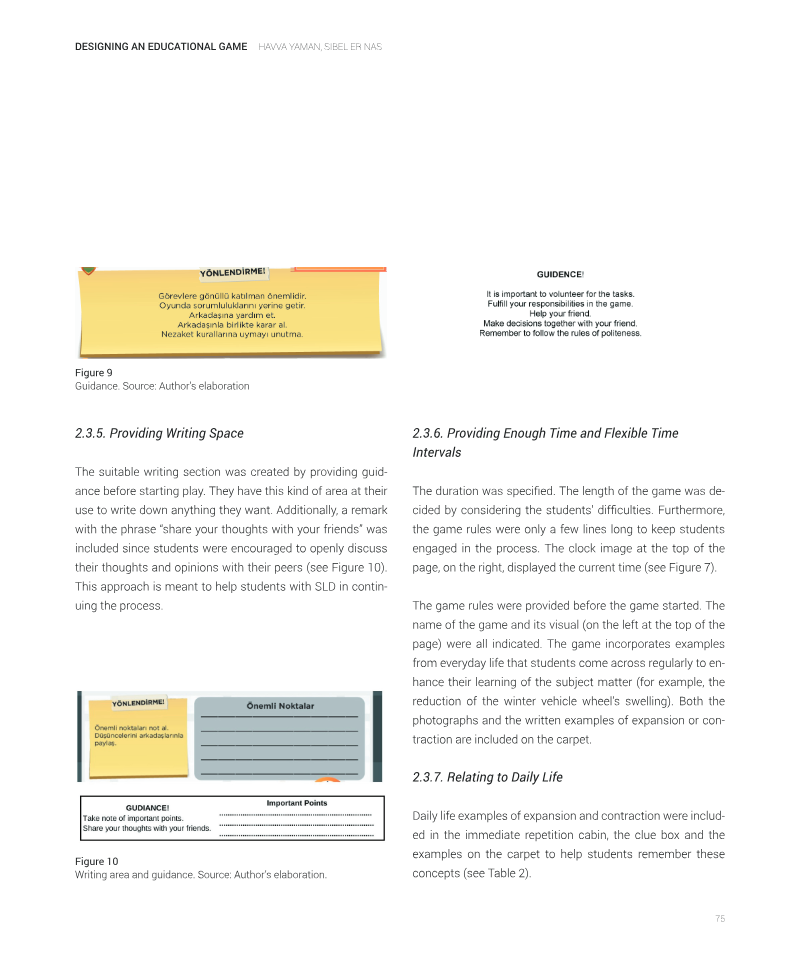
- Concrete features translated from these findings include an immediate repetition cabin, QR-coded audio and video rules, a clue box, writing space, flexible timing, and everyday examples of expansion and contraction.
Board Games on the Path to Environmental Education for Sustainability
Antunes, Moreira, and Schreck Reis of the University of Coimbra present a framework for designing board games that integrate STEAM education, education for sustainability (EfS), and gamification.
- The authors argue that conventional STEM curricula are siloed and human-capital oriented, neglecting the social and economic pillars of sustainability in favour of environmental education, and propose interdisciplinary STEAM/EfS gamification to address this gap.
- Their framework rests on the evidence that gamified interventions rarely produce behavioural change unless they include reward mechanisms and structured debriefing, and that board games are particularly effective at illustrating complex systems and encouraging social interaction.
- The framework's design structure has three core elements (defining the problem, building co-creation communities, and prototyping solutions), with debriefing and clear learning goals running throughout.
Romance in Single-Player RPGs
Anand and Kumar's study examines romance in single-player role-playing games, arguing that romantic options in these titles can function as existential projects in which players channel their agency through avatars and experience authentic, consequential choice.
- Romance in single-player RPGs can function as an existential project, letting players channel their agency through avatars and make authentic, consequential choices, drawing on philosophers such as Sartre, Heidegger, and Gualeni.
- The study's central finding is that romance systems have grown markedly more complex across successive game iterations, with choices, consequences, and player agency increasingly shaping relationship outcomes and immersion.
- The analysis surveys romance mechanics across major franchises including BioWare's Mass Effect and Dragon Age, CD Projekt's The Witcher series and Cyberpunk 2077, Bethesda's Skyrim and Fallout 4, and Persona 5 and Fire Emblem: Three Houses.

Sketch First, Play Later: Allowing Illustration to Influence Game Design in Board Games
Anni Paz's paper examines a practice that is uncommon in board game development: beginning the design process with illustration rather than mechanics, with art treated as a foundational influence instead of a late-stage addition.
- Illustration-first design treats art as a foundational influence on theme, narrative, and mechanics, rather than a late-stage addition to finished mechanics, a practice the paper describes as uncommon in board game development.
- The study's primary evidence is interviews with four board game designers, drawn from ten contacted, who work from illustration; they cite Scythe as an example of illustration acting as a thematic anchor.
- Designers reported that starting from illustration unifies a game's theme, narrative, mechanics, and visual identity, producing greater cohesion and immersion for players.
Gameful Pedagogy: Towards a Students' Bill of Rights
Pintar et al.'s "Gameful Pedagogy: Towards a Students' Bill of Rights" argues that student emotional well-being should be an explicit goal of instructional design, not a byproduct of learning.
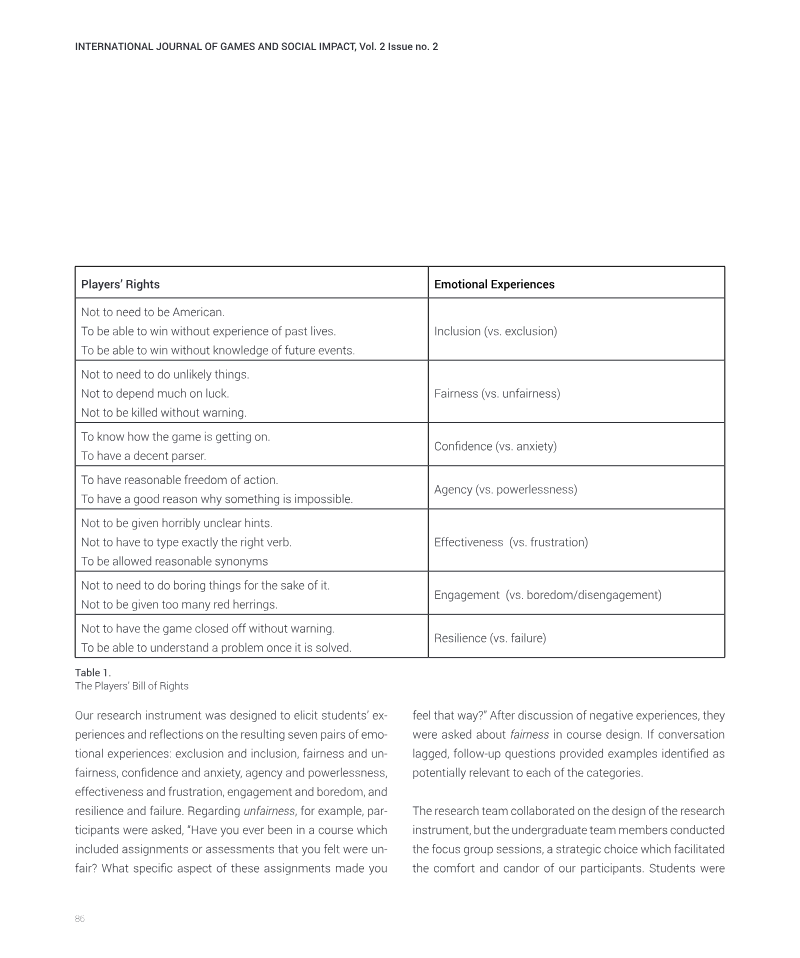
- Student emotional well-being is argued to be an explicit goal of instructional design rather than a byproduct of learning, and the paper proposes a 14-point Students' Bill of Rights adapted from video game player rights (such as fairness, agency, and resilience) across categories including inclusion, confidence, effectiveness, and engagement.
- Findings from nine focus groups with 22 undergraduates at the University of Illinois (April to July 2021) show that exclusion and powerlessness are linked to heightened anxiety and disengagement, which make failure more likely, while fairness, agency, and skillful teaching are associated with confidence and persistence.
- Students reported feeling excluded when instruction catered only to already-prepared learners, when syllabi and policies were vague, or when assessments rewarded memorization and speed over mastery.
Designing Romance and the Playersexuality Debate: Love, Romance, Identity, and Player Perceptions of Baldur's Gate 3 and the Dragon Age Series
Christine Tomlinson's study examines how players perceive romance design in the Dragon Age series and Baldur's Gate 3, with the central claim that player attitudes toward in-game love are internally contradictory.
- Players hold contradictory attitudes toward in-game romance: they value agency through 'playersexual' systems, where any character can be romanced regardless of orientation, yet also want realistic characters with fixed sexualities, which partly undercuts that promised control.
- Perceived realism depends less on a character's sexuality than on personality, character growth, and narrative development, with fixed, emotionally developed characters receiving praise from players.
- The study's qualitative grounded-theory approach drew on roughly 657 hours of Dragon Age gameplay and 217 hours of Baldur's Gate 3, combined with online forum observation over periods of eight to 24 months.
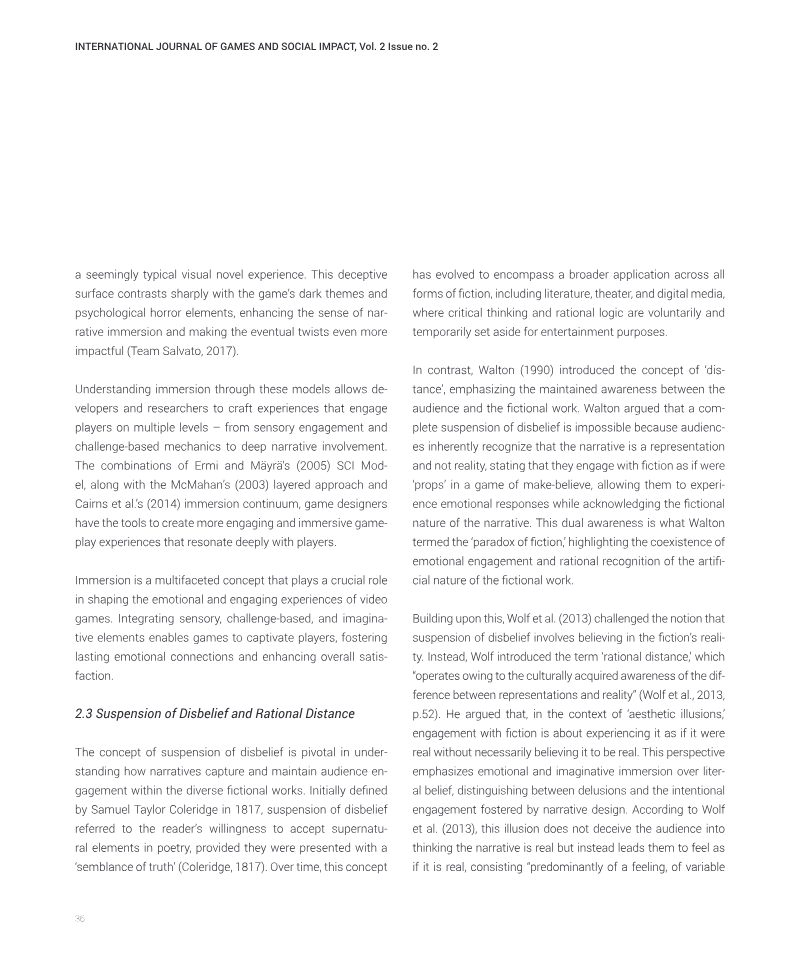
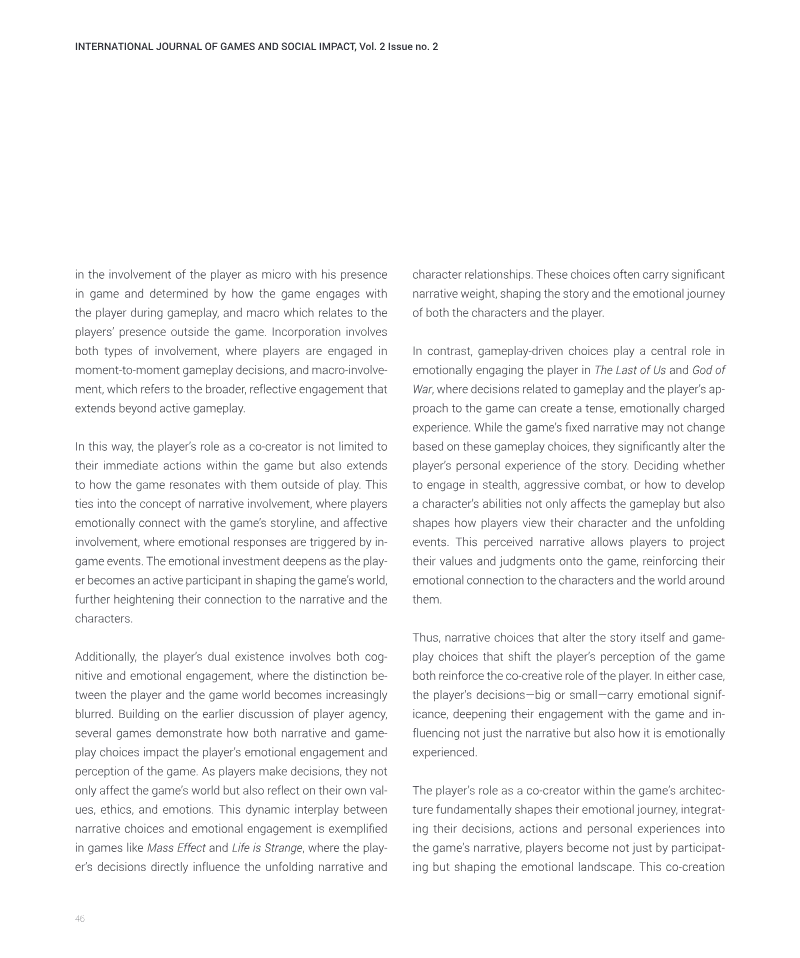
Beyond the Screen: Exploring the Player's Role and Its Impact on Emotional Experiences in Video Games
This article argues that players function as co-creators of their own emotional experiences in video games, operating under an implicit "contract" that invites them to accept game rules and engage emotionally with narratives, characters, and virtual worlds.
- Players act as co-creators of their emotional experiences, operating under an implicit contract that invites them to accept game rules and engage emotionally with narratives, characters, and virtual worlds.
- The article argues that interactivity deepens emotional connection in ways passive media cannot, drawing on Salen and Zimmerman's magic circle, Juul's 'half-real' games, and Murray's active creation of belief.
- The framework centres on agency, immersion, suspension of disbelief, rational distance, involvement, and incorporation, with incorporation describing how game experiences persist in players' cognitive and emotional lives beyond play, which the article presents as an evolution of traditional immersion theory.

I'd Rather Have Cake: Asexual Representation and Queer Designing of Games
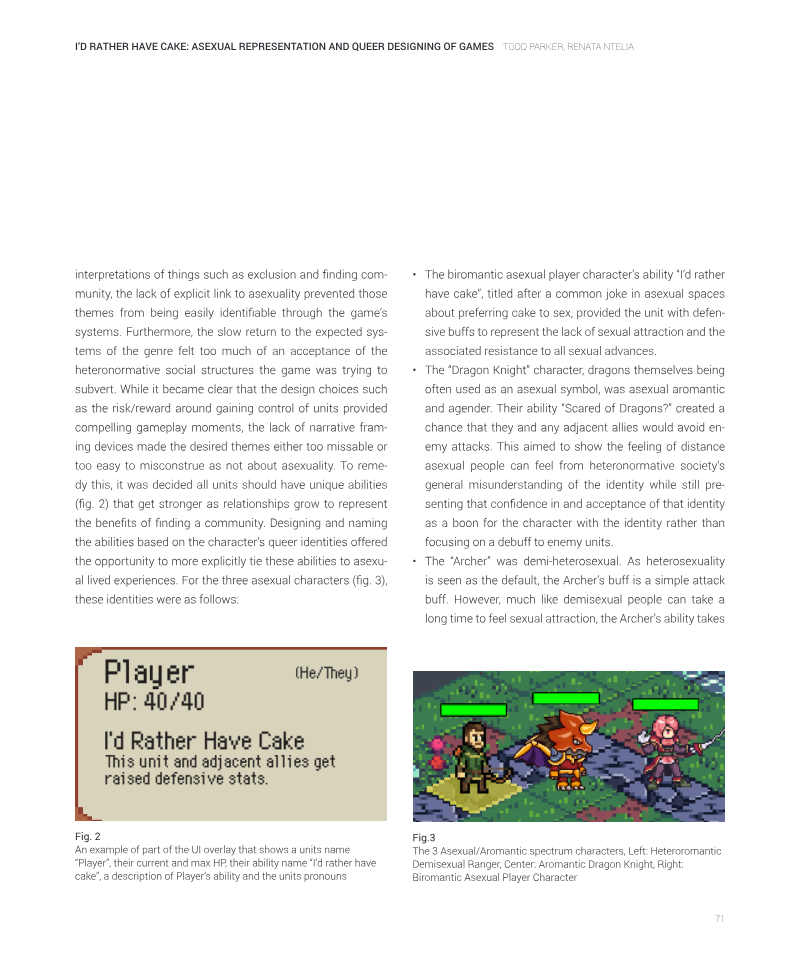
Parker and Ntelia's paper argues that asexual identities are markedly underrepresented in queer game design, and that this shortfall stems from a structural habit of separating formal gameplay elements (rules and mechanics) from dramatic ones (narrative, art, and aesthetics).
- Asexual representation in games is severely underserved: only about 1% of the 4,303 'LGBT'-tagged games on Itch.io carry an asexual tag, against survey estimates of roughly 1% to 5% of the population.
- Only 2.5% of Steam games are tagged LGBTQIA+, and console storefronts fall below 2% while lacking asexuality-specific search filters.
- The authors attribute the gap to a structural habit of separating formal gameplay elements (rules and mechanics) from dramatic ones (narrative, art, aesthetics), which pushes queer representation into ancillary, often skippable content.
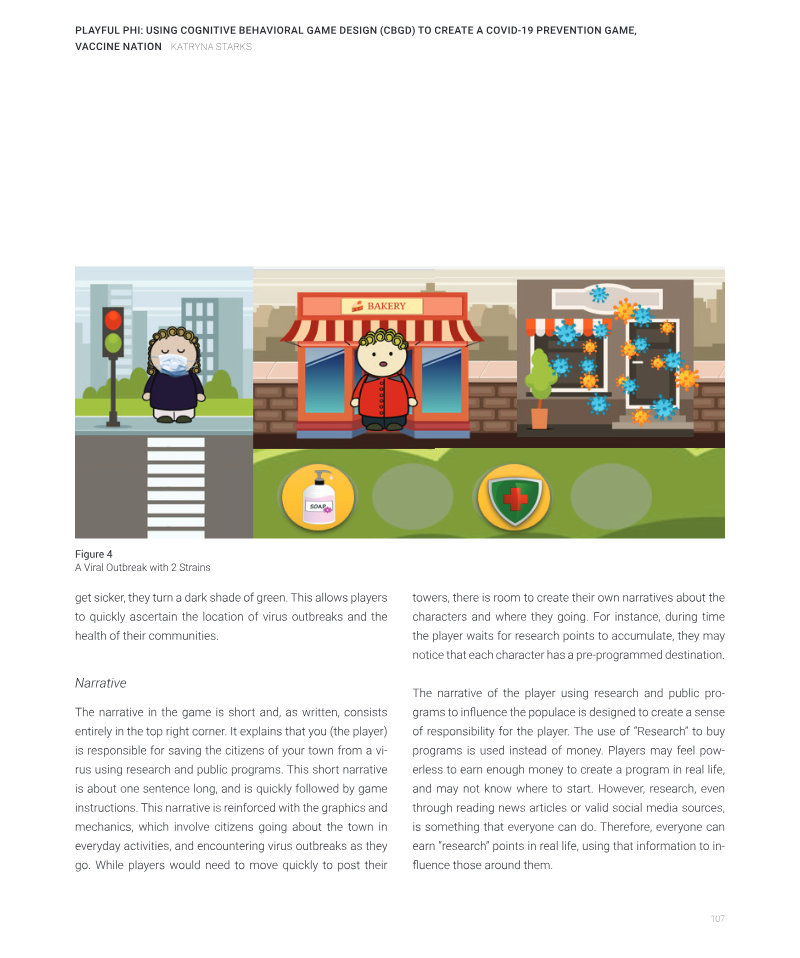
Playful PHI: Using Cognitive Behavioral Game Design (CBGD) to Create a COVID-19 Prevention Game, Vaccine Nation
"Playful PHI" presents Vaccine Nation, a tower-defense game designed to promote COVID-19 prevention behaviors including hand hygiene, masking, social distancing, isolation, and vaccination.
- Vaccine Nation is a tower-defense game built on Cognitive Behavioral Game Design (CBGD), which pairs social cognitive goals such as behavior change, awareness, and self-efficacy, drawn from Social Cognitive Theory, with mechanics that engage multiple forms of intelligence.
- The game aims to promote COVID-19 prevention behaviors including hand hygiene, masking, social distancing, isolation, and vaccination, with vaccination yielding the highest survival rates among interventions.
- The authors cite a study finding that up to 40 percent of COVID-19 social media posts originated from unreliable sources, motivating the use of play to counter misinformation.
"Meeple-Centred Design" to Assess Collaborative Play: The Case of Team3
Team3 is a cooperative board game available in green and pink versions, and this study evaluates its accessibility using Heron et al.'s (2018) "Meeple Centred Design" heuristics.
- The paper applies Heron et al.'s (2018) "Meeple Centred Design" heuristics to assess the accessibility of Team3, a cooperative board game available in green and pink versions, across visual, cognitive, emotional, physical, communicative, socioeconomic, and intersectional dimensions.
- Team3 is judged broadly accessible overall, with its distinct color-shape pairings supporting players with color blindness, though its mean contrast ratio of about 4.17:1 falls below the recommended 4.5:1.
- The pink mini-expansion presents greater accessibility challenges because of its perspective and three-dimensional demands, while the base game's low reading demands, moderate game-state complexity, and structured turn system support cognitive accessibility.