1 free read left. Create a free account for unlimited reading + AI research.
Create free accountWhitepaper International Journal of Esports
1 free read left. Create a free account for unlimited reading + AI research.
Create free accountWhitepaperInternational Journal of Esports
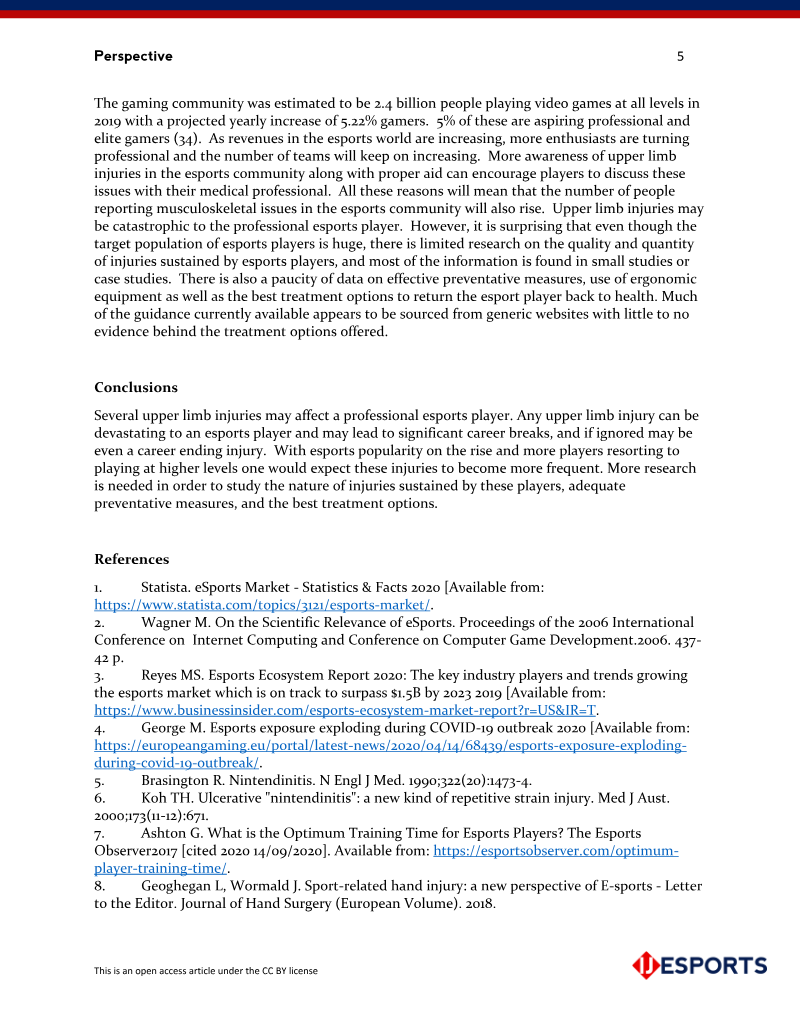
The authors argue this growth is likely to bring a corresponding rise in upper limb overuse injuries, which they frame as a possible emerging epidemic.
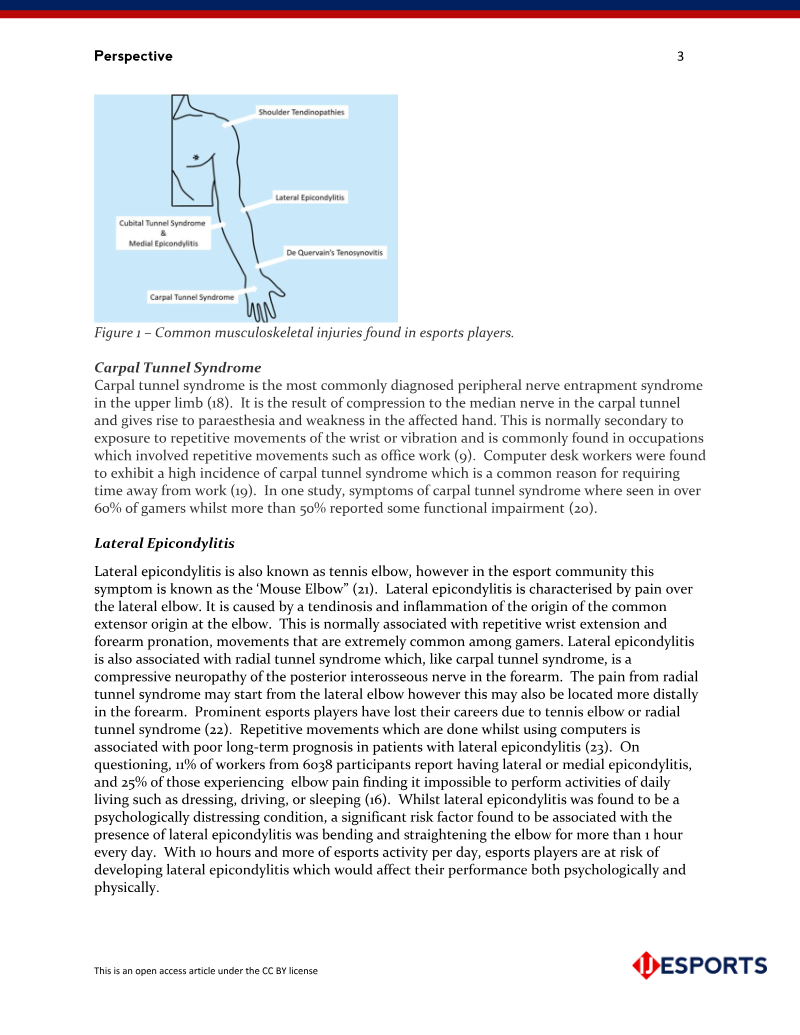
Esports has grown rapidly in viewership, revenue, and professional participation, and this perspective argues that the rise in competitive play is likely to bring a corresponding increase in upper limb overuse injuries. Professional players reportedly perform more than 400 fine motor movements per minute and may train over 10 hours daily, loading the hand, wrist, elbow, and shoulder repetitively. The authors identify carpal tunnel syndrome, lateral epicondylitis, and tendinopathies as the most common conditions, with additional concern for De Quervain's tenosynovitis, cubital tunnel syndrome, and medial epicondylitis, though prevalence data for these remain limited.
The evidence cited to support this concern includes reports that neck and back pain affect 42% of players, wrist pain 36%, and hand pain 30%, with some sources claiming hand or wrist pain in over 60% of players. One study found carpal tunnel symptoms in over 60% of gamers, and more than half of those reported functional impairment. The authors draw parallels with office and factory workers, whose occupational data show elevated rates of similar disorders associated with repetitive wrist and finger activity. Notably, fewer than 2% of gamers seek early medical attention, which the authors suggest contributes to late diagnosis and potentially career-ending outcomes, with several high-profile players having retired or been sidelined.
The scope of the discussion is global and focused on competitive and aspiring players, with the projected gaming population estimated at 2.4 billion people in 2019 and roughly 5% considered aspiring or elite. The article is a perspective piece rather than a systematic study, relying largely on small studies, case reports, occupational research, and industry or online sources. The authors conclude that the field lacks rigorous evidence on injury incidence, preventive strategies, ergonomic equipment, and treatment pathways, and they call for dedicated research to address these gaps.

International Journal of Esports · 2026
International Journal of Esports · 2026
International Journal of Esports · 2026
International Journal of Esports · 2026

International Journal of Esports · 2026
International Journal of Esports · 2026
International Journal of Esports · 2025
International Journal of Esports · 2025

International Journal of Esports · 2025

International Journal of Esports · 2025

International Journal of Esports · 2025
International Journal of Esports · 2025
Niko Partners · 2026