
G|A|M|E – The Italian Journal of Game Studies
Open-access peer-reviewed game studies journal published by the Italian cultural association Ludica since 2012, mostly in English.
Documents
Interactive Digital Narratives and Counter-Narratives: Systematising Knowledge to Derive Clusters as Lenses of Observation
This special-issue study examines how interactive digital narratives (IDNs) can function as counter-narratives, asking whether these works can challenge dominant discourses and give voice to marginalised groups.
- IDNs are not inherently counter-hegemonic by medium; their capacity to challenge dominant narratives depends largely on curation, design choices, and the author's personal investment.
- The field's fragmented terminology was consolidated into the umbrella concept 'Interactive Digital Narrative' by Koenitz in 2015, with eight dominant IDN definitions reorganised into three clusters (dramatic experience, fusion of artistic vision and technology, expressive narrative form), with procedural rhetoric as a cross-cutting concern.
- Counter-narrative scholarship was mapped across 13 definitions into clusters centred on narrative inquiry, resistance to hegemonic narratives, and empowerment and agency, and counter-narratives remain shaped by existing power structures.
Cardboard Genocide: Board Game Design as a Tool in Holocaust Education
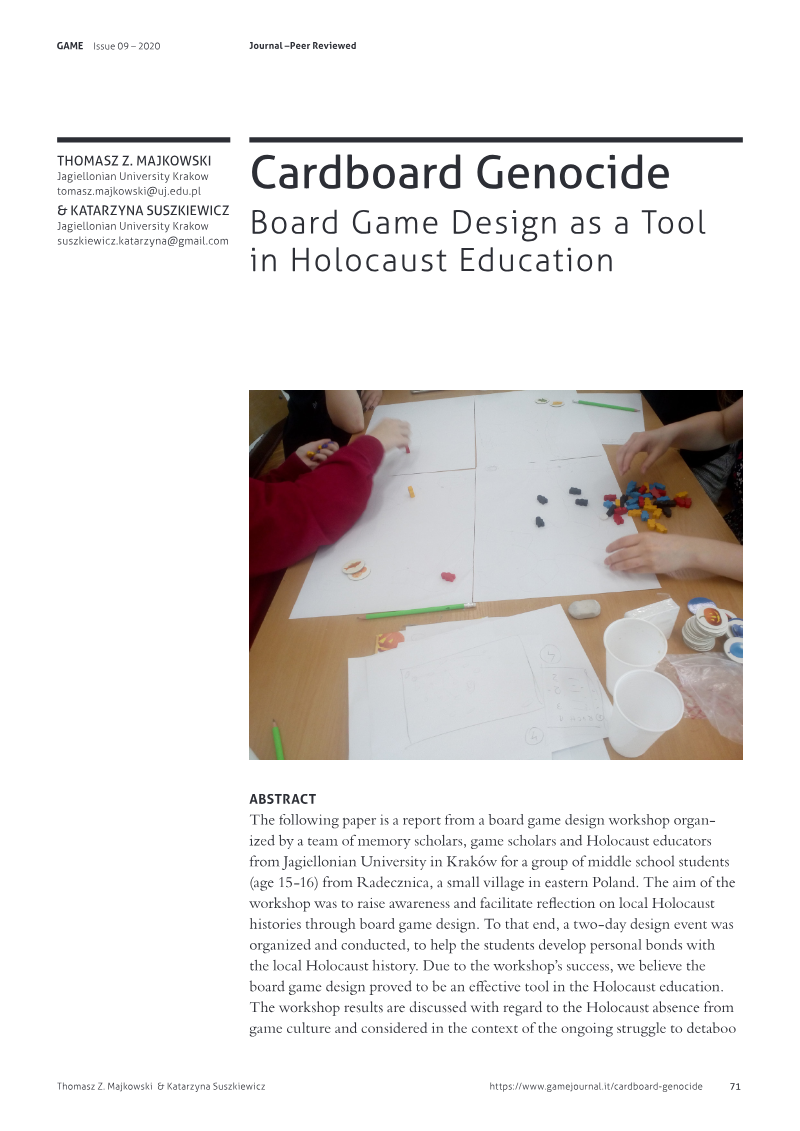
In "Cardboard Genocide: Board Game Design as a Tool in Holocaust Education," the authors make the case that designing board games, rather than playing them, offers an effective pedagogical route into local Holocaust history.
- The Holocaust has been largely absent from game culture, with only two board games identified as directly addressing the genocide, a gap the authors attribute to games being seen as trivial, restrictions on Nazi imagery, and pressure from memory custodians.
- The central obstacle to Holocaust games is ethical rather than technical: player agency risks implying victims were responsible for their fates, while assigning players perpetrator or heroic-rescuer roles invites distortion.
- The heroic-rescuer framing is especially fraught in Poland, where it aligns with official memory that downplays local participation in murders.
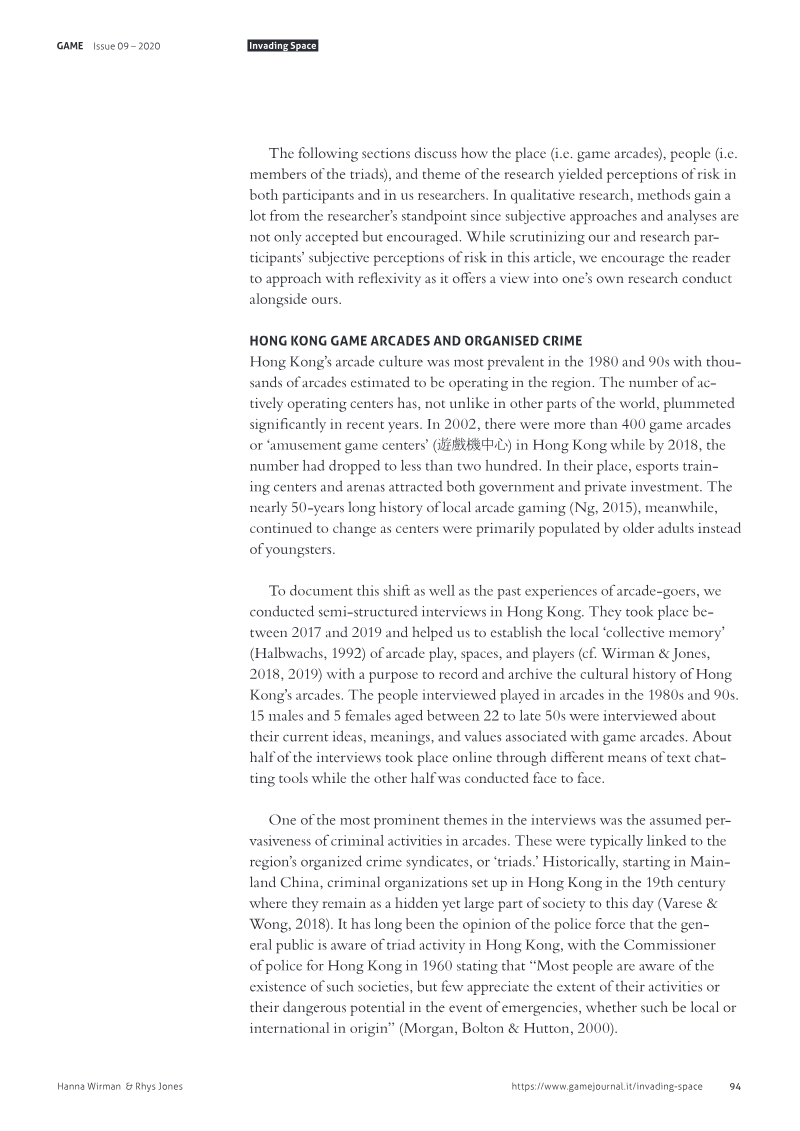
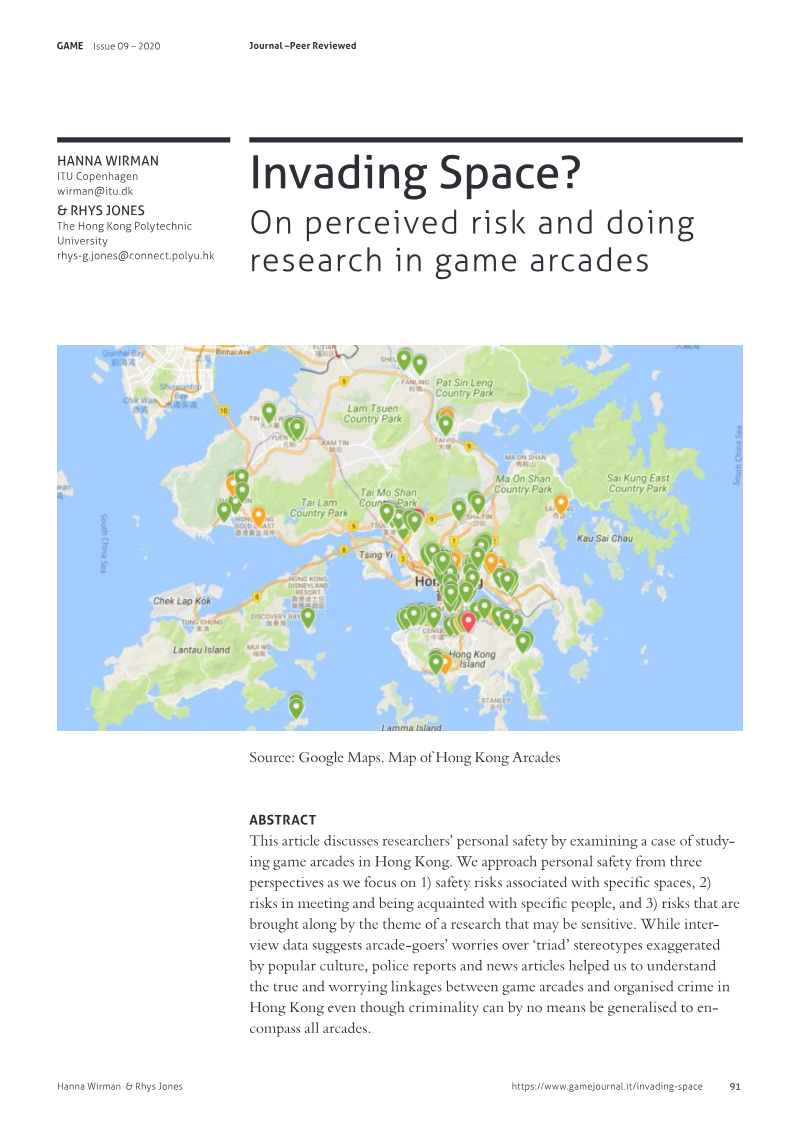
Invading Space? On Perceived Risk and Doing Research in Game Arcades
This study examines the safety, ethics, and methodological challenges of researching Hong Kong game arcades, a setting where perceived risks and documented realities are closely intertwined.
- The study argues that researcher risk in Hong Kong game arcades must be assessed as both perceived and real, and that these two dimensions shape research conduct inseparably, while small, carefully designed studies remain valuable when precautions are taken.
- Popular perceptions of arcades as triad-dominated are partly exaggerated, yet documented links between arcades and organized crime are real, with 1,353 triad-related crime cases reported in 2019 and a June 2020 operation raiding 527 locations and arresting 380 people.
- Those triad links do not generalize to every arcade, so researchers should avoid treating all arcades as equally dangerous.
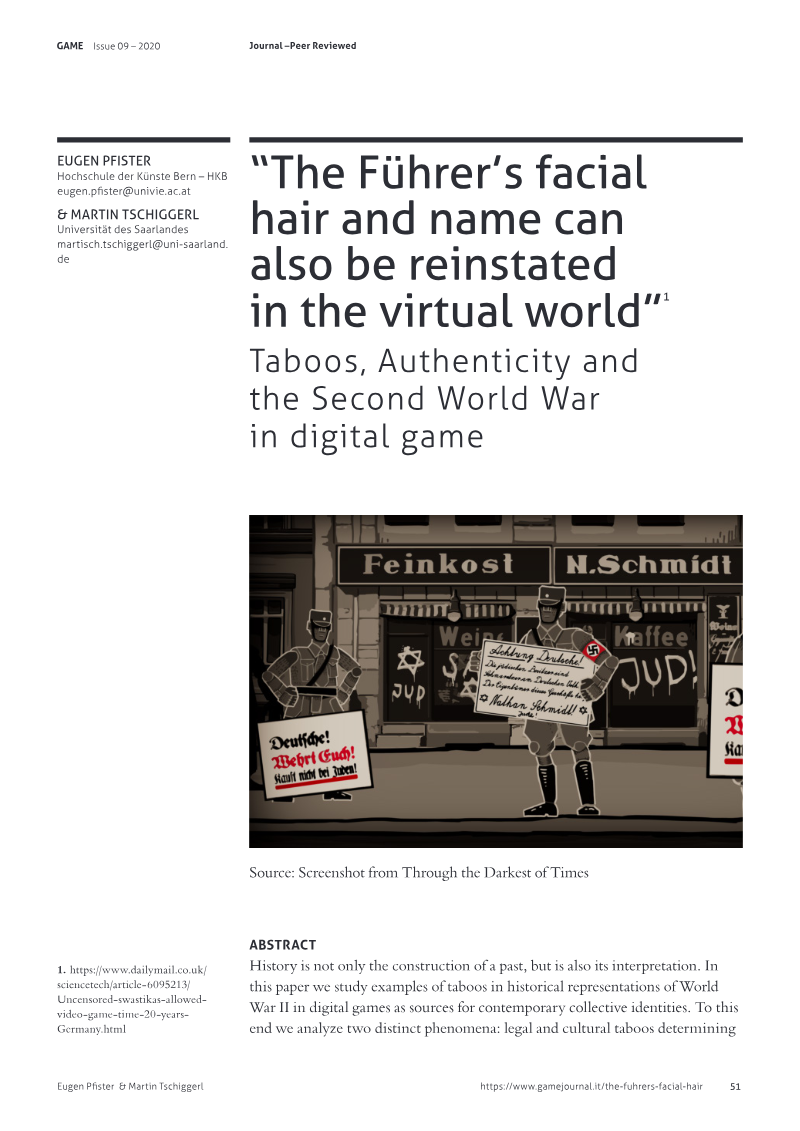
The Führer's Facial Hair and Name Can Also Be Reinstated in the Virtual World: Taboos, Authenticity and the Second World War in Digital Games
This study examines how legal taboos, cultural norms, and player-enforced standards of "authenticity" shape the depiction of Nazi symbols, the Holocaust, and the Second World War in digital games.
- German and Austrian bans on Nazi symbols, extended to games by a 1998 court ruling, led publishers to pre-emptively censor content through cosmetic changes such as covered swastikas and renamed characters, which the authors argue can depoliticize Nazi material rather than prompt critical engagement.
- Earlier controversies such as the 1980s KZ-Manager and the 2010 Sonderkommando Revolt mod drew sharp backlash and withdrawal, while a clear paradigm shift became visible in the late 2010s, partly attributed to the pulp, fantasy, or explicitly historical framing of titles like Wolfenstein: The New Order and Through the Darkest of Times.
- Players have internalized official taboos and generate additional taboos of their own around 'authentic' historical representation, so enforcement of standards comes substantially from the player community rather than only from regulators or publishers.
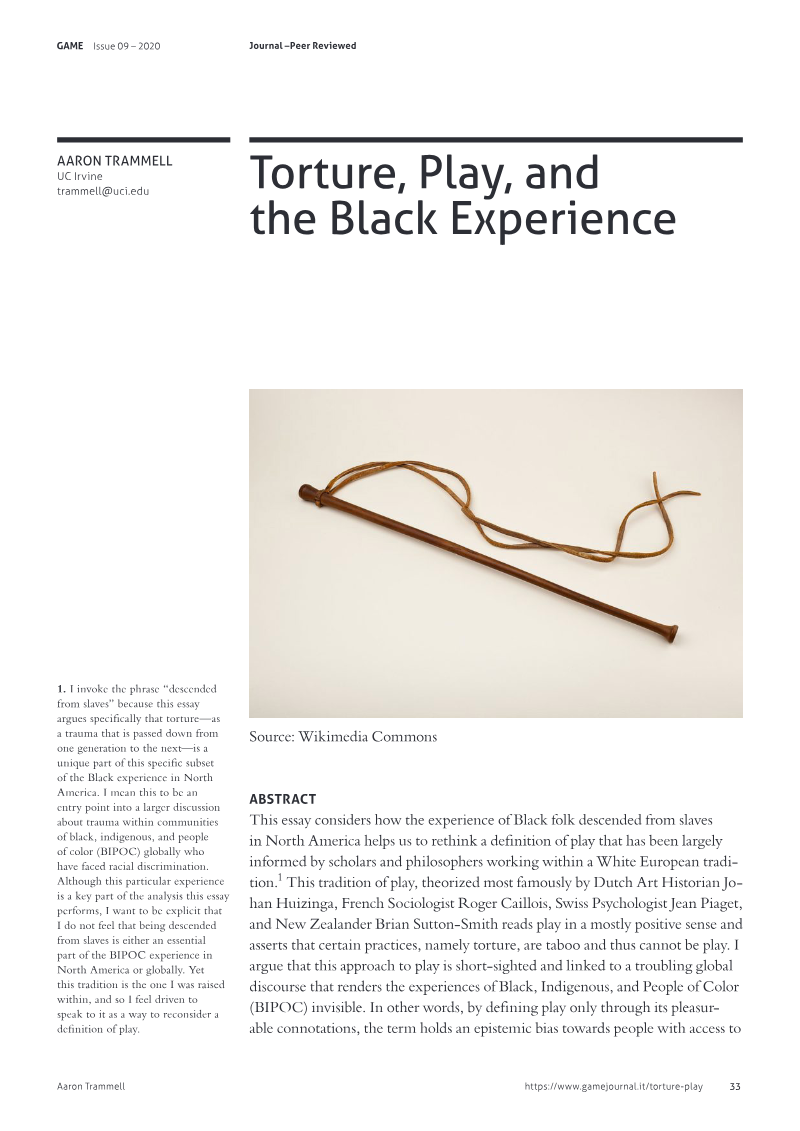
Torture, Play, and the Black Experience
Aaron Trammell's essay challenges the dominant theorization of play in Western scholarship, arguing that foundational thinkers such as Huizinga, Caillois, Piaget, and Sutton-Smith have framed play as overwhelmingly positive while excluding torture and violence as taboo.
- Aaron Trammell argues that foundational Western play theorists (Huizinga, Caillois, Piaget, Sutton-Smith) frame play as overwhelmingly positive and exclude torture and violence as taboo, rendering the experiences of Black, Indigenous, and People of Color invisible in games discourse.
- The central claim is that torture should be understood as a form of play that disciplines and subjugates, and that acknowledging this is essential to a more inclusive and reparative definition of play.
- The analysis holds that play is voluntary only for the player and not necessarily for the one being played, making it a subject-object rather than subject-subject relationship, and that play can reduce a participant to an object, as illustrated by the children's game "tag."
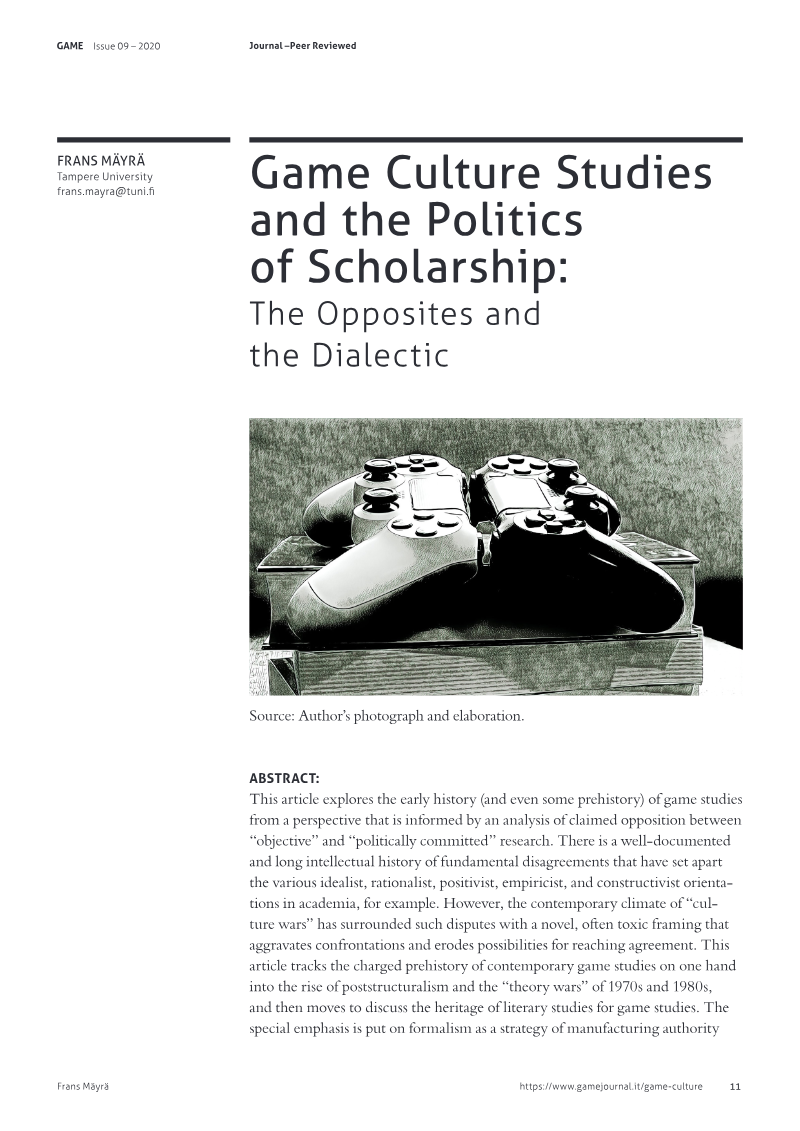
Game Culture Studies and the Politics of Scholarship: The Opposites and the Dialectic
Frans Mäyrä's article argues that game studies has long been shaped by epistemological disputes, from idealism versus empiricism to positivism versus social constructionism, and that these conflicts have been intensified by today's politically charged culture wars.
- Frans Mäyrä argues that game studies has been shaped by recurring epistemological disputes (idealism vs. empiricism, positivism vs. social constructionism) that are intensified by today's politically charged culture wars, and that this hostility should be openly acknowledged rather than concealed.
- Mäyrä contends that a dialectical tradition has quietly become the mainstream of cultural game studies, and that the supposed opposition between formal and cultural or political dimensions of games is a limited and ultimately detrimental framing.
- The ludology vs. narratology dispute reflected deeper questions about authority, definition, and legitimate knowledge; early ludology drew on New Criticism formalism, with Aarseth dismissing representation (including gender and the body) as irrelevant to play.
Unhuman Agency: Reading Subjectivities in Playdead's Inside
"Unhuman Agency" offers an analysis of Playdead's 2016 game Inside, arguing that the game disperses agency among the player, the game's systems, and nonhuman or abject actors, producing a sense of compromised control.
- The report argues that Playdead's 2016 game Inside disperses agency among the player, the game's systems, and nonhuman or abject actors, producing a sense of compromised control that compels players to unlearn conventional assumptions about gaming agency.
- The analysis distinguishes the 'unhuman' from both the posthuman and the nonhuman, drawing on Karen Barad's agential realism, Dylan Trigg's phenomenology of horror, and Daniel Cottom's concept of the unhuman.
- The final entity, the 'huddle,' a fleshy aggregate that exceeds both player control and the notion of the human subject as an absolute agent, is read as the energy source of a corporate mind-control network.
The Player as a Hybrid: Agency in Digital Game Cultures
The Player as a Hybrid: Agency in Digital Game Cultures argues that the player is a hybrid subject whose agency emerges from the interplay of games, technologies, and cultural context.
- Players are hybrid subjects whose agency arises from the interplay of games, technologies, and cultural context, combining active agency with subordination to a game's programmed structure.
- The author argues that technology succeeds only when it becomes organic to its setting, citing the Indian hand pumps, which failed until local social practices were addressed, and Spacewar!, whose playful appropriation of a computer spurred dedicated controllers and new user cultures.
- Immersion and flow are presented as a deep merging of mind, body, and game, grounded in an avatar-like relationship between self and observer that games deliberately exploit.
Epistemology of the Closet and the Queer Agency of One Night Ultimate Werewolf
The document offers a queer theory reading of the party game One Night Ultimate Werewolf, arguing that its hidden-identity mechanics and secrecy-driven play mirror the lived experience of the closet and queer strategies of passing.
- The report is an interpretive queer-theory reading of One Night Ultimate Werewolf, framing its hidden-identity and secrecy mechanics as a structure of concealment that mirrors the closet and strategies of passing.
- Werewolf players are read as performing a false identity under surveillance, with agency located in successfully concealing their role and subverting the game's deductive scrutiny, paralleling queer navigation of heterosexist scrutiny.
- The analysis draws on Sedgwick's linkage of sex and knowledge, mapping it onto the game's social deduction mechanics, and cites theorists including Sedgwick, Muñoz, Butler, Babuscio, Ruberg, and Benshoff.
Playing with the Player: Agency Manipulation in Shadow of the Colossus and Japanese Computer Games
This analysis examines how Shadow of the Colossus (Team Ico, 2005) manipulates player agency and uses that manipulation as a vehicle for social critique.
- The analysis argues that Shadow of the Colossus (Team Ico, 2005) uses manipulated player agency as a vehicle for social critique, framing its protagonist Wander's quest to resurrect Mono as a corrupting process that reframes the act of play itself.
- The game is situated within Japan's "Lost Decades" following the 1990s, a period of economic collapse and social disruption including the rise of hikikomori, and its narrative is read as engaging anxieties about individualism, community, and agency arising from that context.
- The report characterizes the game's design as a closed ethical system and "futile interactivity": players enjoy considerable freedom of movement, yet outcomes such as the tendril attacks following each colossus defeat are predetermined.
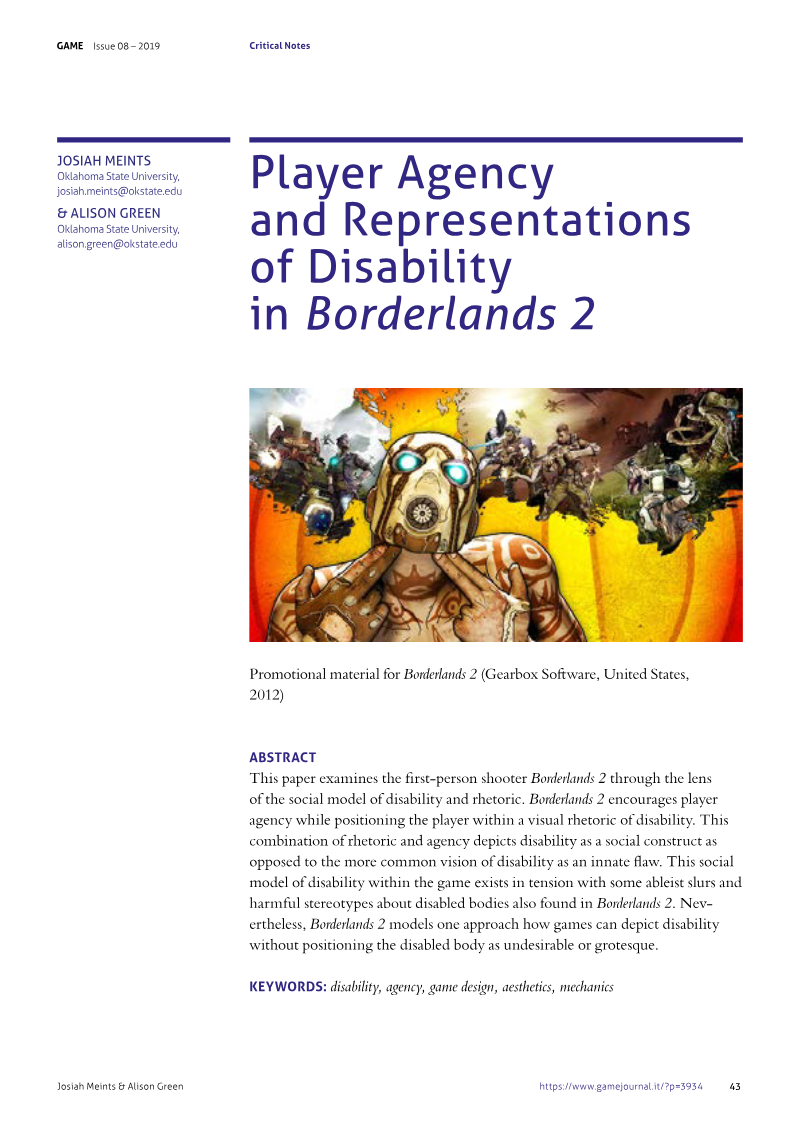
Player Agency and Representations of Disability in Borderlands 2
This analysis examines Borderlands 2 through the social model of disability and visual rhetoric, arguing that the game frames disability as a social construct rather than an individual deficiency.
- The report argues Borderlands 2 frames disability as a social construct rather than an individual deficiency, presenting cybernetic limbs, mental trauma, and scarring as ordinary across Pandora's playable characters, NPCs, and antagonists.
- Unlike AAA titles such as Dead Space and Left 4 Dead 2, which portray disabled bodies as grotesque, Borderlands 2 humanizes them and keeps its playable avatars at full mechanical agency regardless of backstory.
- The game's weapons and shields carry built-in trade-offs, pairing strengths with weaknesses so no item is optimal in every scenario, which the authors say locates disability in objects rather than avatars while preserving player agency.
Digital Games for Special Needs; Special Needs for Digital Games
This special issue examines the relationship between digital games and individuals with special needs, framing the field as contested: on one hand, the games industry is becoming more inclusive through assistive hardware such as the Microsoft Adaptive Controller, accessibility interest groups, customizable input systems, and…
- The games industry is becoming more inclusive through assistive hardware such as the Microsoft Adaptive Controller, accessibility interest groups, customizable input systems, and funding initiatives, yet players with disabilities remain underserved and scholarly literature on the topic is scarce.
- The authors justify further research on video games and disability on four grounds: games sit at the forefront of technological adoption, they shape cultural attitudes toward disability, they allow the social model and cultural lens on disability to be combined, and they show potential for supporting special education.
- Contributions from educational technology, computer science, games studies, design, and biology converge on inclusion and universal access, with asymmetrical roles and diverse input letting impaired and unimpaired players share the same play space rather than being segregated into simplified sub-sections.