1 free read left. Create a free account for unlimited reading + AI research.
Create free accountArticle G|A|M|E – The Italian Journal of Game Studies
1 free read left. Create a free account for unlimited reading + AI research.
Create free accountArticleG|A|M|E – The Italian Journal of Game Studies
Overlapping terms for the field were traced into the standardised umbrella concept 'Interactive Digital Narrative', introduced by Koenitz in 2015.
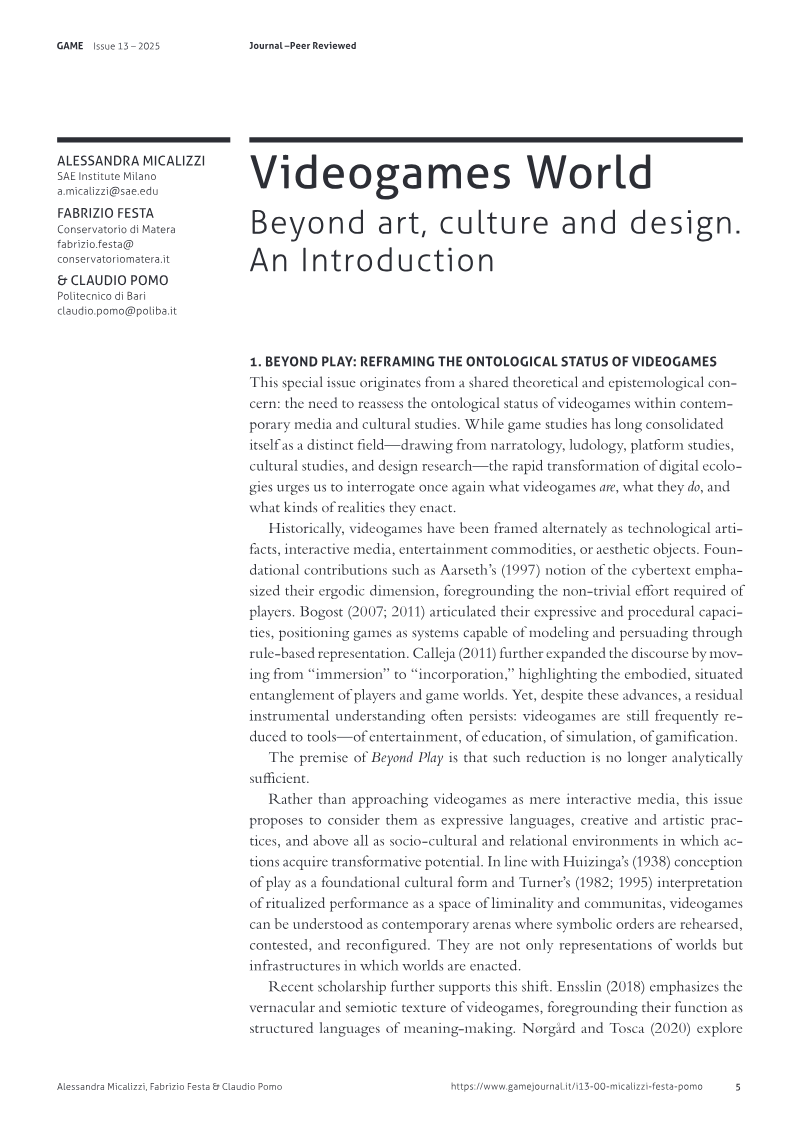
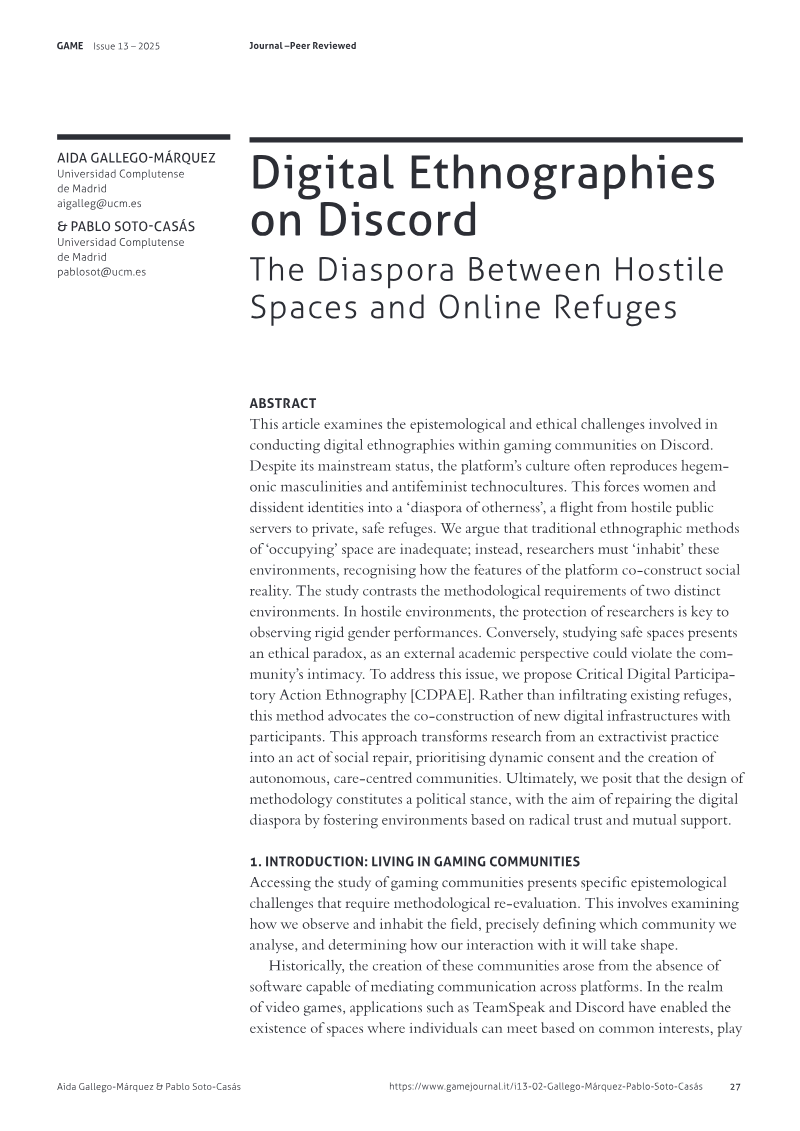
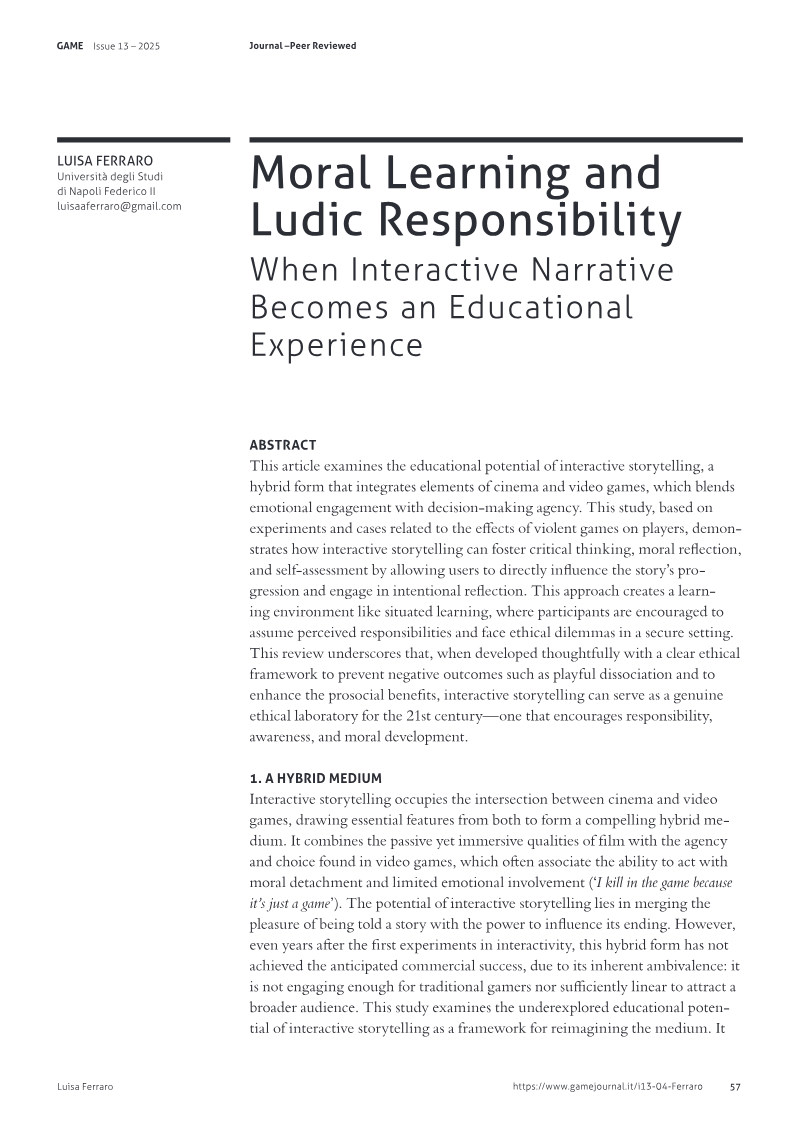
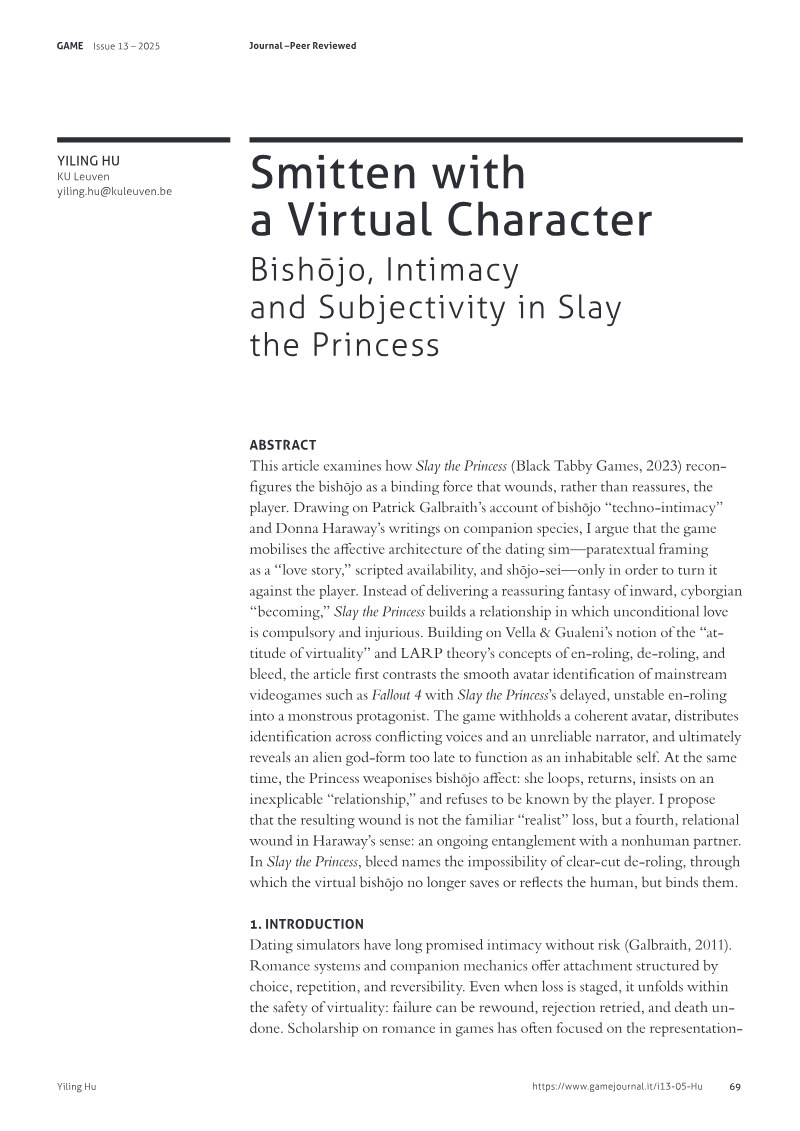
This special-issue study examines how interactive digital narratives (IDNs) can function as counter-narratives, asking whether these works can challenge dominant discourses and give voice to marginalised groups. Its central thesis is that IDNs are not inherently counter-hegemonic by virtue of their medium; rather, their capacity to challenge dominant narratives depends largely on the curation, design choices, and personal investment of their authors. The authors ground this argument in a long lineage of narrative theory and in foundational scholarship by Aarseth, Murray, Ryan, Crawford, and Koenitz, noting a persistent split between humanities research on user experience and computer science research on generative systems and authoring tools.
The study systematises the vocabulary of its field, tracing "Interactive Digital Narrative" from a fragmented set of overlapping terms into a standardised umbrella concept introduced by Koenitz in 2015. Eight dominant IDN definitions are reorganised into three clusters: IDN as dramatic experience, as a fusion of artistic vision and technology, and as an expressive narrative form, with procedural rhetoric as a cross-cutting concern. A parallel review of 13 counter-narrative definitions yields clusters centred on narrative inquiry, resistance to hegemonic narratives, and empowerment and agency, with the observation that counter-narratives remain shaped by existing power structures.
Applying these lenses to six contributions in the special issue, the authors find that queerness and gender identity dominate the themes explored. IDNs can foster trust, intimacy, and empathy through techniques such as breaking the fourth wall, cultivating co-desire between player and character, and enabling safe identity exploration, though these outcomes are not automatic and depend heavily on the creator's personal connection to the subject. The articles cluster most strongly around IDN as expressive form and as dramatic experience, with empowerment and audience-centred agency emerging as the most prominent counter-narrative features, while resistance plays a smaller role.
The authors conclude that marginalised communities remain underrepresented in IDN production, making the sharing of design knowledge with these groups an important priority. Their closing theoretical argument, drawing on Bruner, positions user participation as an active process of interpreting meaning, and frames IDNs as spaces for questioning social topics. The conclusions are theoretical rather than empirical, offering a conceptual framework for future research and practice.
Each row is a game or company this document names, each column a document, oldest first. A mark means that document names it. Select a row to see those documents.
G|A|M|E – The Italian Journal of Game Studies · 2026
G|A|M|E – The Italian Journal of Game Studies · 2026
G|A|M|E – The Italian Journal of Game Studies · 2026
G|A|M|E – The Italian Journal of Game Studies · 2026
G|A|M|E – The Italian Journal of Game Studies · 2026
G|A|M|E – The Italian Journal of Game Studies · 2026
G|A|M|E – The Italian Journal of Game Studies · 2026
G|A|M|E – The Italian Journal of Game Studies · 2026
G|A|M|E – The Italian Journal of Game Studies · 2026
G|A|M|E – The Italian Journal of Game Studies · 2026
G|A|M|E – The Italian Journal of Game Studies · 2026
G|A|M|E – The Italian Journal of Game Studies · 2026
DiGRA · 2026